It all started with fish balls in Times Square
Back in 2017 I was standing at a food stall in Times Square (the one in Hong Kong, not New York) about to order curry fish balls in Cantonese. A woman beside me turned and asked if I needed help, since the whole menu was in Chinese. I told her “Thanks, but I’ve got this.” I’d watched someone order curry fish balls from that exact stall in a YouTube video, and I’d practiced the phrase, word for word.
Earlier that day, I had landed in Hong Kong. Stepping off the bus into the city, I felt something I can only describe as a sense of home — like I belonged there. And during that trip I felt the Lord leading me very clearly to learn Cantonese.
It didn't feel like an assignment. It felt like a fire lighting up — a pull I couldn't have ignored if I'd tried. I just had to learn this language.

Times Square, Hong Kong, 2017 — ordering curry fish balls in Cantonese for the first time. Where it all began.
The pattern I didn't know I had
I grew up in a small town in northern Sweden, so Swedish is my mother tongue. Even though I grew up monolingual, English was always there in the background. We'd get cartoons in English, and I'd watch them without understanding much. Me and my friends watched Ghostbusters on repeat when we were six or seven — my mom couldn't figure out why we loved it so much, because we couldn’t understand the English or read the subtitles.
At age 15, I remember buying Buffy the Vampire Slayer on VHS. It was an import version with no subtitles, so I looked up every word I didn’t know and built a little handmade dictionary that I tucked inside the box. When I let a friend borrow the tape, I left the word list in there for him. He said it helped.
In high school I watched tons of American movies without subtitles, which really developed my listening comprehension — it worked far better than three years of French in junior high ever did. I wasn’t even trying to “get good at English.” I just loved the culture and wanted to watch these movies to relax. Even today, I tell people to “just keep watching and listening, even when you don’t understand everything.” I was doing it intuitively already back then.
Years later, I lived in the US for a few years — a dream come true, and a chance to fully immerse in the culture I loved. Every word I didn’t know, I’d ask about or look up, until there wasn’t much left to look up. I was often mistaken for an American. Some of my classmates were shocked to hear I was from Sweden. “Where’s your accent?” one asked. “I thought you were this surfer dude from southern California,” another one said — even though I don’t surf. Maybe it was the relaxed vibe. Or the long hair.
After the US, I worked in Norway here and there, and I figured, why not learn some Norwegian? As a Swede, Norwegian is already about 80% comprehensible out of the gate, so I picked it up by talking with my coworkers — speaking Swedish at first, then mixing in more and more Norwegian, jotting down words and expressions in the notes app on my iPhone 3G.
Both English and Norwegian showed me the same thing: when a language is already mostly comprehensible to you, you can absorb it with enough exposure and curiosity. The real test came with two languages I understood nothing of to begin with — Cantonese and Finnish. That's when I really learned how to learn a language from scratch, which is a very different thing.
Already fluent
Actively learning
Plus a bit of Japanese and Mandarin on the side — just for the fun of it.
It was never really about the languages
Here's the thing that might surprise you: languages were never quite the point for me. The cultures were. The people were. And I don't think you can ever truly know a culture and its people without learning the language.
I felt the first hint of that young. When I was twelve I had a pen-pal in Manchester, England — our families had met on a summer vacation in Greece — and I still remember that thrill of realizing I could actually communicate with someone from another country and be understood. We wrote letters back and forth, and it cracked something open for me. So did ordering food in broken Greek on family holidays, and learning to order a glass of water in English at age nine.
That's what's really underneath it all. It’s not that I don’t love languages themselves — I do. I love how they sound, and I love trying to mimic the way natives say things. But it was never about an interest in grammar and linguistics. It was about the moment you're standing around a grill with a group of friends, talking about life and just hanging out together — and it's all happening in a language that wasn't yours, in a country that isn't yours, and somehow none of that matters. You're just in it. Part of it. There's no feeling quite like it, and learning the language is the only door I've found that opens it.
With every new language, it feels less like adding a skill and more like adding a part of myself — a side of my personality that only comes out in that language. I usually don't even realize it's there until after I've learned it. Like a part of me that was just waiting to have a home.
Music came first — and taught me how to learn
Long before I started intentionally learning languages, I was obsessed with music. I started playing drums at nine and practiced every single day from my early teens well into my twenties — for hours and hours. I played in bands, studied music at university, toured with professional artists in Sweden, and played gigs in Italy, South Africa, and the US. For most of my life, music was the thing.
Some say being a musician gives you better pronunciation. I'm honestly not sure that's true — I've seen it go both ways in people I know. But for me, I believe all those hours transcribing parts and listening for the smallest details sharpened my ear and my attention to the nuances of how people speak. Those nuances have always fascinated me, in music and in languages.
Those tens of thousands of hours of music also established a few things that turned out to be central to my language learning: pouring years into something purely because I loved it, the power of daily practice, and that long-term consistency beats short-term intensity. And maybe most importantly — while a lot of people chase fluency like a finish line, music taught me early to enjoy getting better at something with no finish line in sight. That carried straight over. These languages are part of my life and who I am, not a goal I'm trying to cross off. My only real aim is to feel comfortable in them — understanding comfortably, speaking comfortably — for myself, not for anyone else.
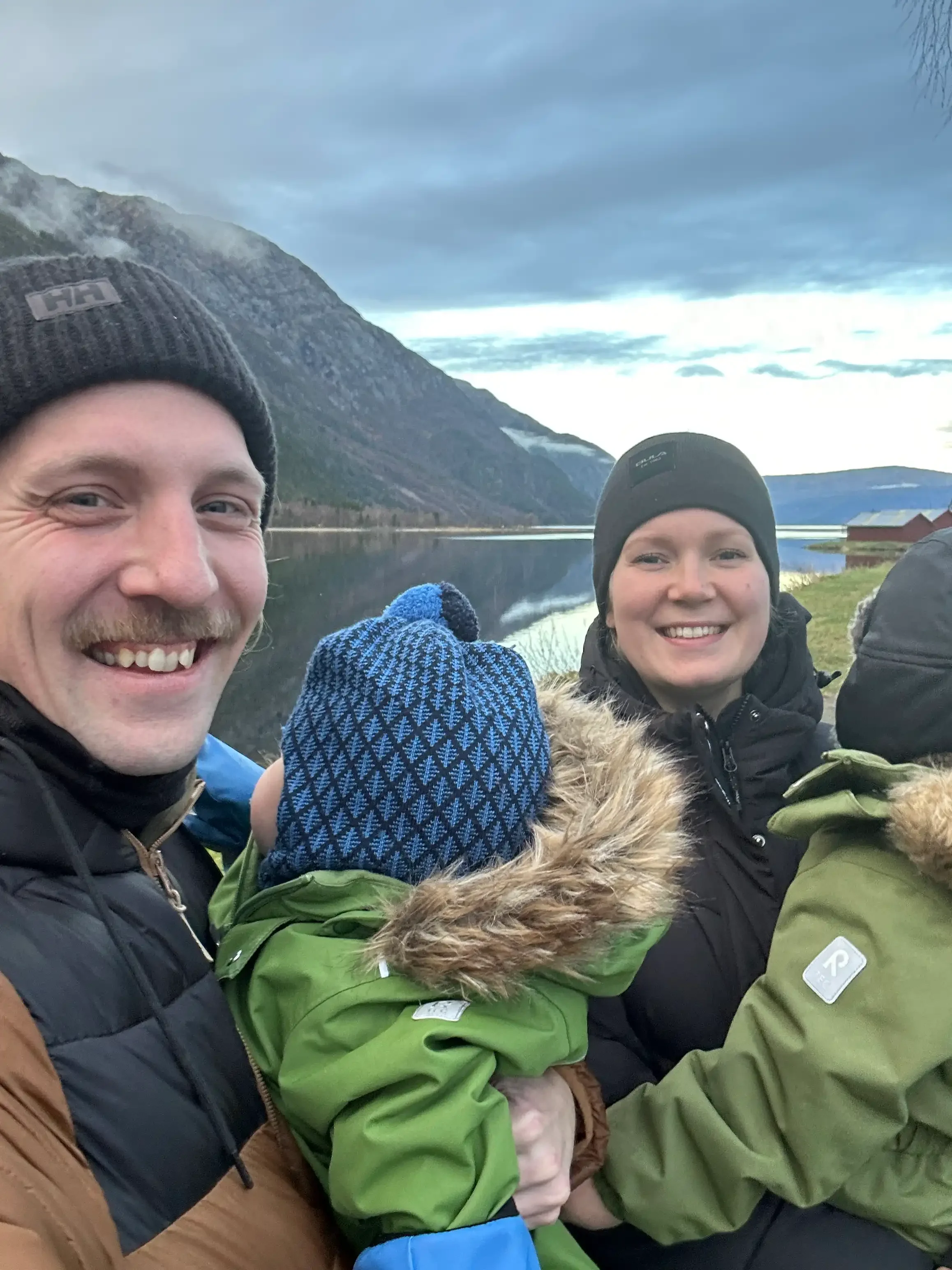
In the fjords of Norway with my wife and two boys — a country that's become deeply meaningful to us.
Hong Kong made it intentional
When I came home from Hong Kong, I spent every spare hour devouring videos and blogs on how to learn a language. Cantonese is often called one of the hardest languages in the world. I didn't care — I deliberately skipped the “why Cantonese is hard” videos and just went on the journey. I just really wanted to learn it, and I enjoyed every step. Within a year I could improvise a two-minute video speaking Cantonese.
Around that time I met my wife, who's from Finland — so naturally I wanted to learn her native language: Finnish, another famously tricky one. I learned both at the same time. Now, living in Finland, Finnish is part of my daily life and a language I can use in any situation. I’m still working on improving it, though — it's not quite as effortless as English feels.
Then came Spanish, which was a redemption. Years earlier I’d tried to learn it with Duolingo, every day for six months, and still couldn't string a sentence together. I quit and moved on. When I came back to it later with the right approach, I learned more in two weeks than I had in all six months of my first attempt. These days I'm comfortably conversational — upper intermediate, maybe edging into advanced (these labels were always a bit meaningless to me, but you get the idea). My latest is Korean, a language that I’ve wanted to learn since I fell in love with StarCraft and the Korean e-sports scene as a teenager. And I'm picking up a little Japanese and Mandarin on the side, purely for fun.
I know learning this many languages is unusual. Most people just want to learn one. The funny thing is that I never set out to. They just seem to pile up. They have entered my life one at a time, for different reasons, but the core is always the same: I'm curious about the culture and the people behind each one. It also means that when I write, I'm not speaking from one narrow corner. I've been in the beginner's seat and the advanced one, in easy languages and brutally hard ones — which helps me meet people wherever they are.
Where the name “Lingtuitive” comes from
For a while I was just helping friends learn languages, sharing what had worked for me. One of them said something that stuck: she liked what I was doing because it sounded more intuitive than what she'd heard before. So I blended “lingo” with “intuitive” and that's where Lingtuitive came from.
The idea is simple. The most effective way to learn a language isn't wrestling with grammar, or grinding through gamified apps that don't translate into real skill — it's spending time with the language in ways you actually enjoy. Reading, watching, listening, speaking. Letting it come to you through exposure. Naturally, intuitively. It feels a lot to me like getting to know a dear friend: you just spend time together.
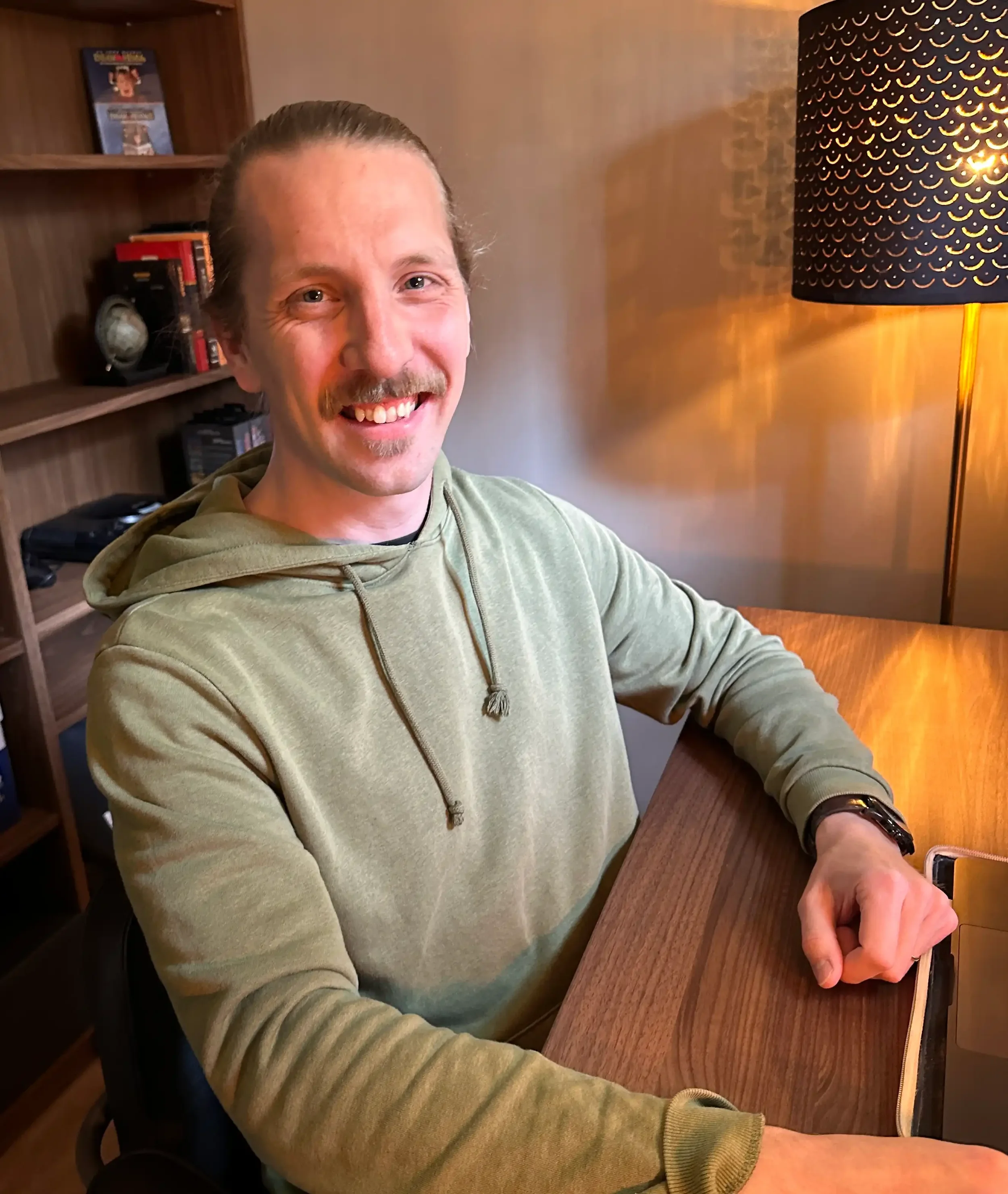
My home office — where I do most of my writing, and a fair bit of language learning.
Why I do this
I created Lingtuitive in 2021 because the content I was looking for as a learner didn’t really exist. I was always left wanting more. I wanted to know the concrete details: How much time did you spend each day? What exactly did you do? How? That's how I try to write — practical and concrete, not getting lost in theory.
For a long time this blog was just a hobby. I was coaching, teaching, doing a bit of everything, and one day I asked my wife what she thought I should focus on. Without hesitation, she said I’d be happiest doing the blog full-time. It surprised me — because back then it was nowhere near big enough to live on, and I didn’t think it was possible. But she was right. And I kept writing because I felt the Lord leading me to, and years later it became something I never imagined. It started as a passion project, and it still is one. I look forward to writing every day, because I just love it.
That's the whole idea: my own journey, laid out honestly, for you to learn from and hopefully be inspired by. Learner first, blogger second. Nearly everything I recommend has been part of my own learning. The rare exception is when I round up the best apps for a particular language and include one I haven't personally learned with — but have genuinely tried and tested enough to recommend. When I do, I make sure to let you know. I’m always upfront about how this blog makes money — you can read exactly how on my affiliate disclaimer.
My passion for languages hasn't dimmed since 2017. Give me a free moment and you'll find me watching something in Cantonese, using a Korean app, reading a book or listening to a podcast in Finnish or Spanish. It’s become as natural as breathing, and keeping that kid-like curiosity has always been a priority.
Lingtuitive exists for one reason: to make your language learning easier, more enjoyable, and more concrete — the stuff I wish I’d had when I started.
If there’s something you’re stuck on, or a tool or topic you’d like me to dig into, I’d love to hear it. Head over to Connect and send me a message — knowing what you’re actually wrestling with is what makes this blog better.
If you'd like to see exactly what apps I use every day:
If you'd like to hear from me and get the latest, you can sign up for my email list below.