I Spent a Week Learning Korean with Rocket Languages (From Absolute Zero)
This post contains affiliate links. If you buy through one of them, I may earn a commission at no extra cost to you. Some of the products I write about are also provided to me for free. See Full Affiliate Disclaimer.
Table of Contents
- 1. How Much Korean I Knew Before Starting
- 2. How Rocket Korean Actually Works
- 3. My First Week in Detail — What Actually Happened
- Day 1 - First Impressions & Discovering the Features
- Day 2: Pronunciation, Hangul, and the Cantonese Connection
- Day 3: Romanization Actually Makes it HARDER
- Day 4: Settling Into a Rhythm
- Day 5: Things Are Starting to Click
- Day 6: Stepping Up the Challenge
- Day 7: Finding a New Workflow That Clicked
- Week 1 Stats & Patterns
Since I was a teenager, I've been a huge fan of StarCraft, a computer game that became a cultural phenomenon in South Korea. Every Korean I've met knows about it and even the names of famous players. It gave me an early interest in Korean culture that has stayed with me for years.
Having learned several languages these past 8 years, there's still been one at the back of my mind this whole time: Korean.
I've always known I'd learn it eventually. I’d love to watch Korean dramas without subtitles, understand those crazy StarCraft commentators, and speak with natives when I visit Korea someday (high up on my dream list). And I just love the sound of the language—it just has this smooth flow to it.
Why use Rocket Languages? My wife uses Rocket Spanish right now and loves it. I’ve tried the Spanish course before, but since I’m already a solid intermediate in the language I can’t really get that authentic beginner experience that you only get when you go through it raw. So I decided to test it with Korean, where I'm starting from absolute zero, so that I can share my authentic experience with you.
The only thing: Now is not a great time to start a new language. I'm juggling Spanish, Cantonese, and Finnish daily. Plus I’m starting a week before Christmas. But, you know what—I'm doing it anyway and I’m documenting everything. Why? Because I want to. I treat it just as a thing I’m doing for my own fun and enjoyment, with no big goals or plans (though if I finish it I’ll write a complete Rocket Korean review).
What I want to find out is: Is Rocket Korean a good course to learn Korean online for beginners?
1. How Much Korean I Knew Before Starting
Almost nothing. Maybe 3-4 phrases that I learned from Korean tourists: "thank you," "hello," "have a good day," and "congratulations" (learned that one from StarCraft). Oh and I happen to know the word for “reindeer” (oddly enough) as it’s nearly identical in Cantonese.
I know Korean has different politeness levels depending on who you're talking to, and the verb comes at the end of sentences (SOV word order, like Japanese). I’m familiar with how the language sounds, but when I hear Korean—it’s just a bunch of gibberish to me.
Because even though I speak 6 languages, I'm starting Korean from scratch like a baby. Just like everyone else.
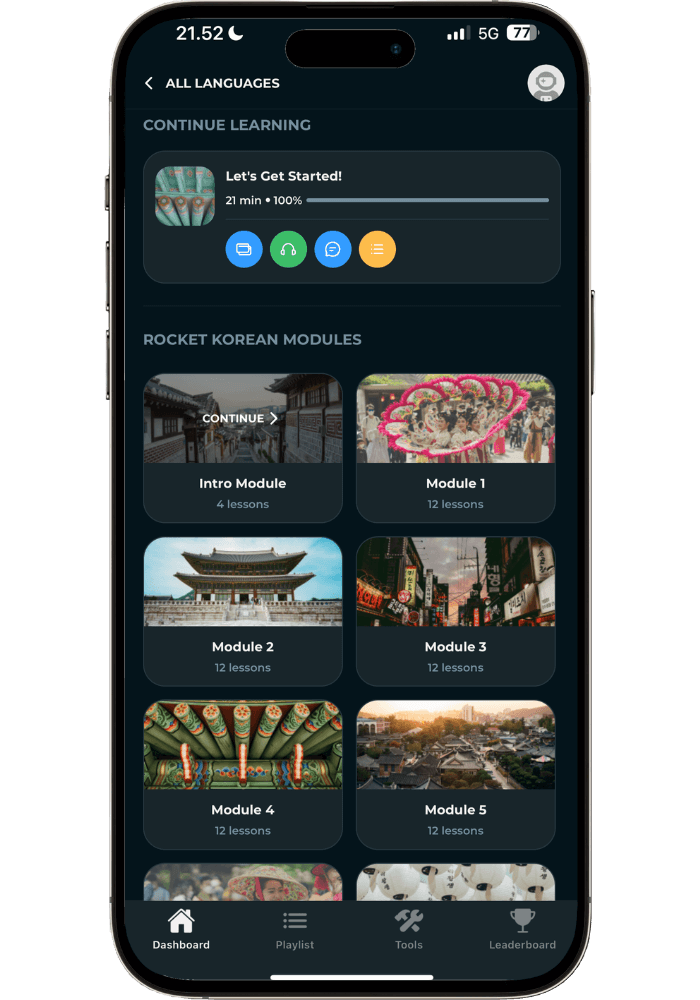
Overview of the ‘Rocket Korean’ Level 1 course
2. How Rocket Korean Actually Works
Rocket Languages Korean is an audio-based Korean language course that is designed for you to start using and speaking the language right away. Some languages have 3 levels but Korean currently has 1, which is still plenty of content to get started.
The basic structure:
Audio lessons (15-45 min) that break down conversations phrase by phrase, along with some cultural insights about Korea and the language
Interactive video role-plays where you practice speaking
Reading & writing lessons
Voice recognition that gives you feedback
4 practice activities to reinforce what you learned
Everything downloadable for offline use
The rest you'll discover through my week...
3. My First Week in Detail — What Actually Happened
Here’s a day-to-day breakdown of how my first week of learning Korean with Rocket Languages went. Along with how much time I spent each day.
Day 1: First Impressions & Discovering the Features
Learning time: 60 minutes
For my first day, I just put on my headphones and I pressed ‘start’ on the first lesson. The dialogue was completely incomprehensible to me (other than “Hello”) and sounded like a bunch of random syllables strung together. But that’s also exciting, because I know my brain will eventually connect these sounds with meaning
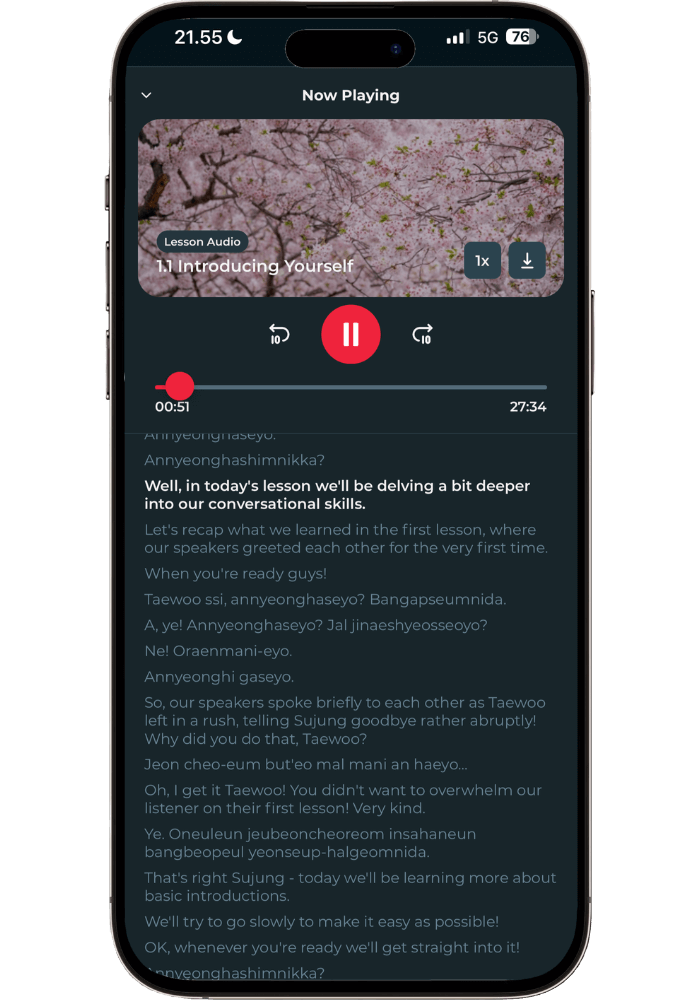
The rolling transcript was useful: The lessons can be done hands-free, but there's a transcript showing everything. When I needed visual confirmation or wanted to replay something, I just clicked it, which was helpful.
Role-play was surprisingly engaging: After the lesson, you can practice the conversation in an interactive video format. You choose which character to play, say your lines, and voice recognition tells you if you got it right. When you mess up, there's a "review hard phrases" button to drill those specifically (this was handy). Way more engaging than just repeating by yourself.
The 4 practice activities: Listening activity was most helpful (hear Korean, repeat, see meaning—in that order). ‘Flashcards’ and ‘Speaking’ felt too hard at this stage and just didn’t connect with me. Quiz was fine but I’m not a quiz kind of person.
Went above my original “plan”: I had thought I’d do 5-20 minutes, but I ended up doing a full hour because I was hooked. Probably won't maintain that every day though, but a good sign still.
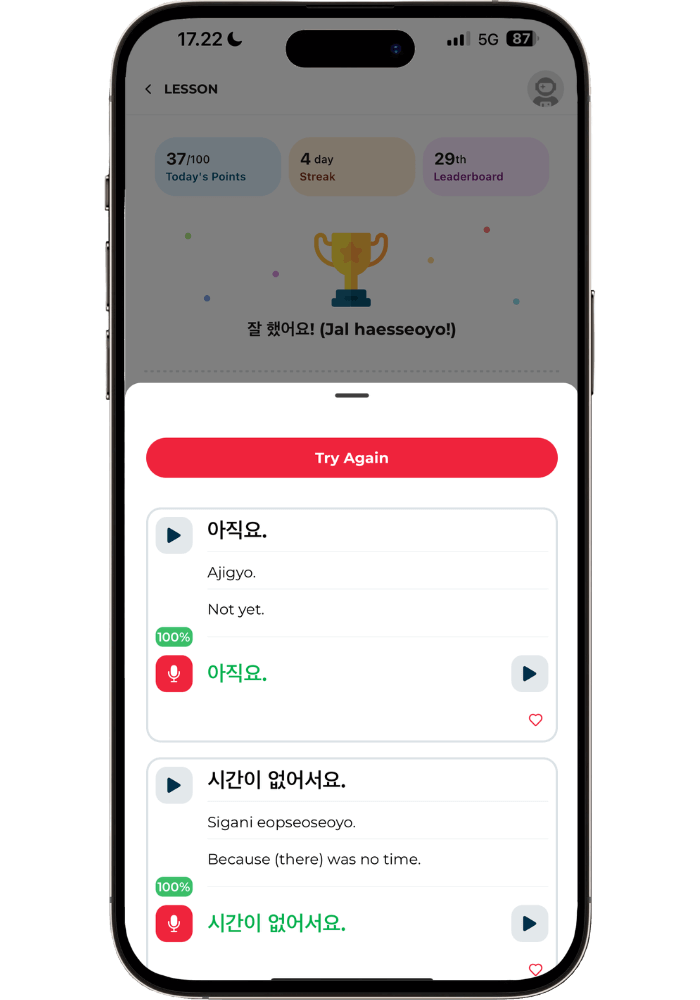
The option to ‘review hard phrases’ after the ‘role-play’ was helpful to target my weak points.
Day 2: Pronunciation, Hangul, and the Cantonese Connection
Learning time: 19 minutes
Didn’t maintain the 1-hour pace from yesterday, and I didn’t even try to (it wasn't my goal anyway).
Korean Pronunciation: Today I did the lesson on Korean sounds which introduced the Korean alphabet Hangul. It said the lesson would take 38 minutes, but it took me about 20. I didn’t feel like I was speeding through it but I wasn’t trying to drill any of it into my mind either.
Hangul is actually genius: The letters are shaped based on how your mouth forms to produce them. Learning probably won't be as intimidating as it seems. Plus, I can see how reading Hangul would be more natural than the romanization (which crams too many letters together to form words).
Cantonese Connection: Some of the example words in the pronunciation lesson reminded of Cantonese. Only a few—such as “tea”, “bank” and “Korea”—but those words obviously stand out more to me.
My approach: I’m not trying to memorize anything. I just want to get an overview and then let repetition through the course handle learning it.
Day 3: Romanization Actually Makes it HARDER
Learning time: 35 minutes
Having now gone through the intro module, I dived into the first official lesson from Module 1, Lesson 1.1 - “Introducing Yourself”. It expanded on the intro module’s lesson on different greetings.
What am I even saying? While Rocket Languages break down sentences word by word, the focus is on learning whole phrases (I’m a big believer in this). This makes things more challenging initially, because I’m most often repeating phrases without knowing what they mean (I forget 2 seconds after I’ve heard it). And even if I do know what the meaning of the sentence is, I still can't tell which word means what in that sentence.
A Key Insight:At the end of each lessons there’s something called “Rocket Review”—you’ll hear the English sentence, be prompted to say it in Korean, and then hear it said by the native speaker. Most of the time, I can’t remember these even though we’ve gone through them multiple times in the lesson. However, here’s the thing: I found that simply trying to find the correct answer helps me remember it better when I do hear the answer—just because I at least tried.
Romanization makes it HARDER I’m realizing that if I’m reading the romanization it actually makes it harder to pronounce Korean. Compared to if I’m just listening and repeating the phrases from memory based on the sounds. That’s because the romanization has so many letters stuck together. It makes it hard to read, and it’s not even that consistent. So I’m just using the romanization for the video role-play feature to give myself a ‘memory cue’. But I don’t read every letter since I find that just confuses my pronunciation and makes it sound off, stiff, and just… lacking flow.
That makes me look forward to learning to read Hangul! (It’s such a beautiful script too.)
Want to experience it for yourself? Start with Rocket Korean's free lessons here.
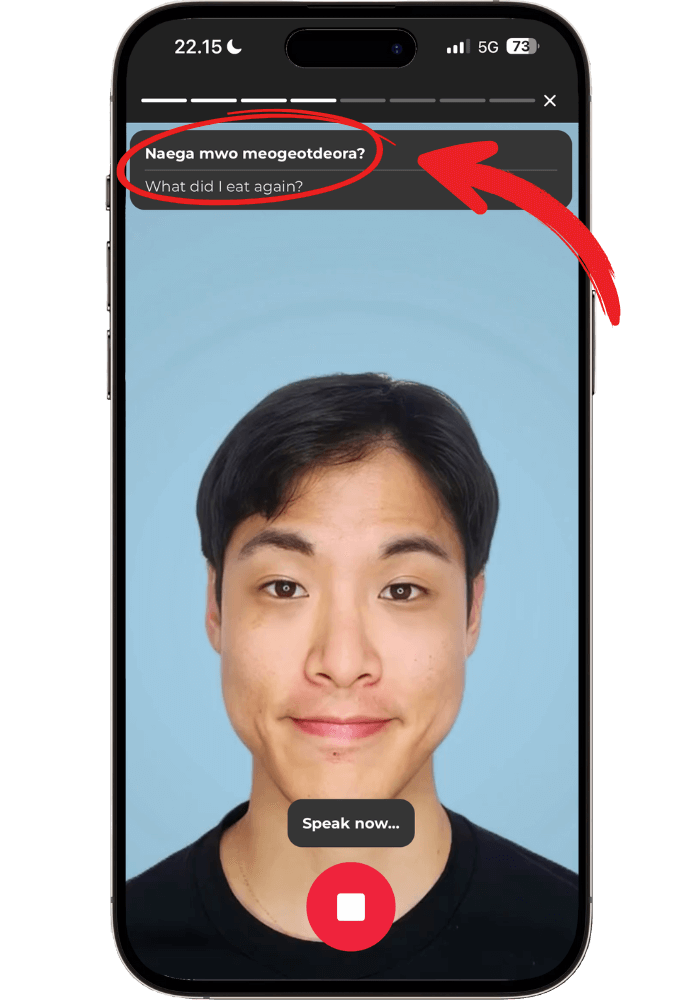
Reading the Korean romanization makes speaking choppier compared to repeating based on pure sounds
Day 4: Settling Into a Rhythm
Learning time: 54 minutes
Quick morning practice: I did a couple role-plays from yesterday's lesson while having coffee. One Role-play session is literally 1 minute, so it’s easy to do. A great way to start the day.
I'm at that awkward "repeat but don't understand" phase: I can mimic the sounds pretty well, but I have no clue what I just said most of the time. But, here’s why I’m fine with that: Right now I'm just trying to absorb the sound of Korean—the flow, the rhythm, how syllables connect. The actual meaning will come.
Feature I wish was there: I often forget the meaning of words, so I wish I could click on them in the rolling transcript and in the role-plays to see their meaning.
They speak fast, which I think is great: I like how the dialogues feel natural and not dumbed-down for beginners. It’s still clear but you get real, natural sounding language. Which is more useful and better practice.
Word order throws me off a bit: Because the verb comes at the end it’s easy to get lost halfway through a sentence. But I'm not fighting it. At first, Cantonese had parts that felt impossible to get used to at first but are totally normal now. I know I will get there with Korean too. I just need more time.
The importance of mindset: I keep imagining myself actually using these phrases in Korea. Like I’m saying them to a person and putting some emotion/acting Korean into it. It honestly helps. A lot of language learning is about believing you can actually do it. If you don't believe it's possible, your brain won't bother trying to remember anything.
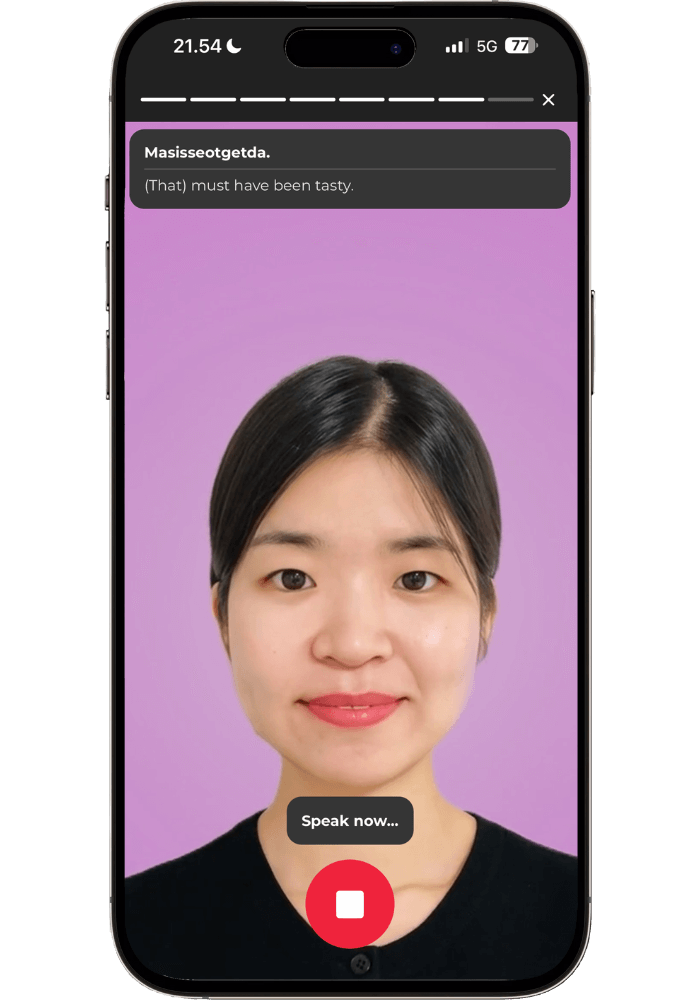
Role-play feature: speaking your lines and hearing the response from a native speaker is a low-pressure but fun way to improve your speaking, even as a beginner
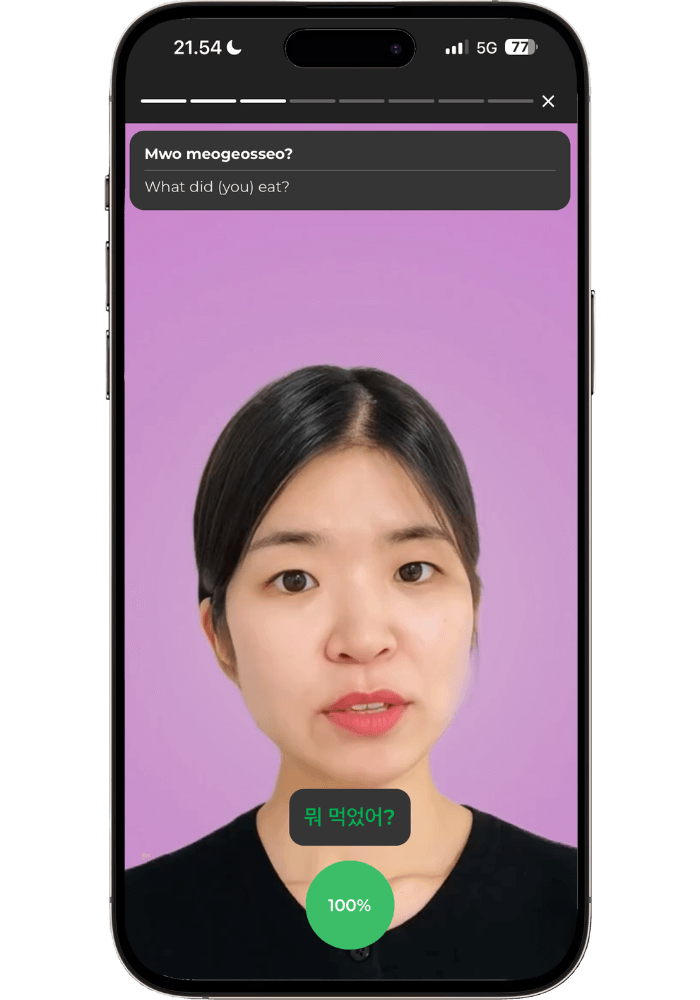
The voice recognition in role-plays gives you feedback on how correct you were. You can target practice the ones you forgot or didn’t say correctly afterwards.
Day 5: Things Are Starting to Click
Learning time: 28 min
Today I repeated lesson 1.04. Which was a good idea since way more stuck this time. Repetition really does pay off.
Word order breakthrough: Verb at the end is starting to feel natural. It somehow just feels… normal. And, well, Korean. I thought this would be a bigger hurdle, but because I'm learning whole phrases and not analyzing every word, my brain just accepts "that's how you say it.”
Reconsidering my earlier complaint: Yesterday, I wished I could click individual words to see their meaning. BUT I'm starting to see there might be some wisdom in not having that feature—it forces me to learn everything in chunks which helps speaking and might be better in the long run (time will tell… but still, it would be nice to have the option to click them!)
Learning reminder: When everything is new, it takes forever for things to stick. But once you know 50% or even 25% of the words in a phrase, the rest comes quicker. I can already feel it getting a bit easier even as just a few words are becoming more familiar.
Doing the audio lessons while working out: Did the lesson while doing a kettlebell workout. Worked well actually. Since it's audio-based, multitasking is actually doable, even though I can’t listen with as much focus. However, getting it done beats waiting to do it when I have perfect focus.
Planning a Korea trip? Rocket Languages is perfect for learning practical phrases fast.
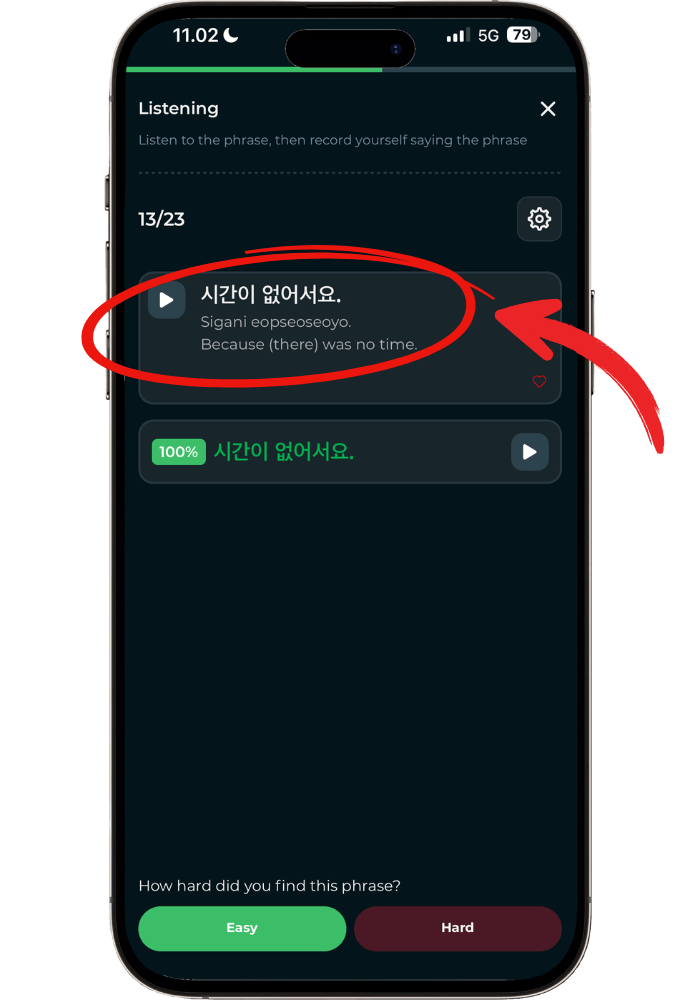
The Korean “Sigani” (시간이) sounds very similar to the Cantonese “si4 gaan3” (時間) — both mean “time”
Day 6: Stepping Up the Challenge
Learning time: 40 minutes
Today I tried the role-play on medium difficulty, which removes the romanization. You just get English prompts and then have to say it in Korean from memory. Harder in a way but good practice and I thought it would be a good way to get me away from relying on romanization and just process the words based on sounds instead (which is easier as long as I just remember the words).
Something I noticed about the immersion: The two native Korean speakers in the lessons only speak Korean. They never use English. The English host guides you and explains things, but when the Koreans talk, there's no translation. However, I found that you can sometimes still figure out what they say. Just from context, tone, and how the English host responds to them. It adds a bit of subtle immersion, which I like. But it’s also no big deal if you have no idea what they’re saying.
Review old lessons was revealing: I went back to lesson 1.01 today and I was surprised how much I had actually missed the first time. The more you learn, the more you absorb when you re-listen. It’s simply too much to learn all of it the first time. And I feel with a language like Korean, reviewing lessons multiple times becomes more of a necessity because how different it is.
The Rocket app's Korean listening activity is still my go-to..., though some phrases from a third speaker are spoken really fast and I can't reproduce them even after 5 tries. Wish there was a slow-down button or a way to skip specific phrases. For now I just mark them as "easy" to get them out of my ‘review hard words’ queue.

In the “Listening” activity you first listen to the pure Korean audio, then try speaking it yourself.

If you say it correctly, it will reveal what it meant + the Korean script (you can also click ‘Reveal’ if you find it too hard to say)
Get My Free Language Learning Guide Intuitive Language Secrets!
Learn the foundations of how to learn any language intuitively in my free guide—download now by clicking below!
Download Free GuideDay 7: Finding a New Workflow That Clicked
Learning time: 31 minutes
Today was the last day of week one. Even though I’ve definitely made progress, I’m still just at the beginning. I realized that a lot of the phrases just aren’t sticking, so I decided to try to be more intentional with my practice.
New workflow I discovered:
First, I’ll do the listening activity—practicing the phrases individually by mimicking them (based on audio only)
Then, I do the role-play from BOTH perspectives (so I get to hear both sides of the conversation)
After that, I go back and listen to the audio lesson again
Why this worked way better: Instead of hearing the lesson first and being overwhelmed, I first built familiarity with the phrases first, then heard and spoken them in context. It actually made a big difference. Because you can't speak what you haven't properly heard and processed first. So doing a “listening first-approach” before practicing it in the role-play makes sense.
A sign this worked: After this workflow, after I had re-listened to the audio lesson, I noticed phrases started repeating in my mind. That is a good sign that the phrases are starting to stick and you even get “automatic review” in your head.
One feature I wish existed: A button to play just the dialogue portion of the lesson (the conversation between the two Koreans) without having to click each sentence individually. Would be perfect for review (note: I noticed later this was available on desktop at least).
Week 1 complete. Time to see where I actually stand...
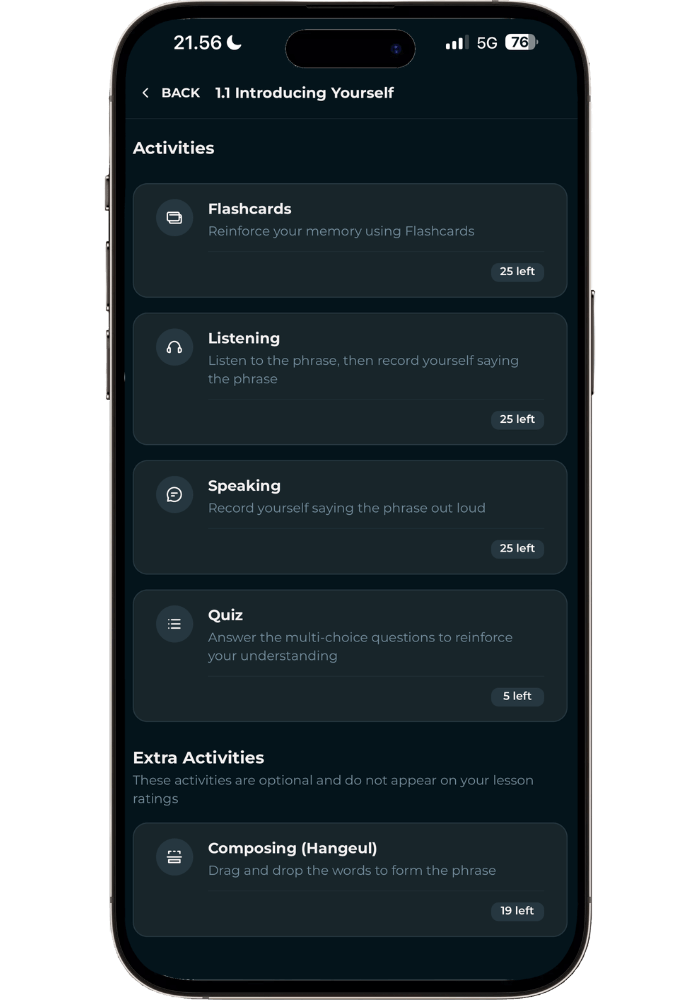
The 4 Practice Activities at the end of each lesson, including Extra Activities.
Week 1 Stats & Patterns
Day-by-day breakdown:
Day 1: 60 min
Day 2: 19 min
Day 3: 35 min
Day 4: 54 min
Day 5: 28 min
Day 6: 40 min
Day 7: 31 min
Total: 4 hours, 27 minutes
Daily Average: 38 min per day
Reality vs. goal: I thought I’d do 5-20 minutes daily. But I averaged more than that because I was enjoying it. Even when busy, I kept coming back to the different features. The role-plays feel like trying to beat a mini-game at different levels and get a perfect score. But instead of doing just it for entertainment, I’m actually learning to speak Korean.
Quick note on pricing: Rocket Korean Level 1 is $149.95 (one-time payment, lifetime access). They also offer a 60-day money-back guarantee.
4. What Actually Worked (and What I'd Skip)
Features I used the most:
Audio lessons — the core of the program
Listening activity — hear it, recording saying it, mark hard/easy
Role-play video feature — 1-minute speaking practice, both perspectives
Rolling transcript — visual backup when needed
Voice recording playback — compare pronunciation to the native speaker
What I'd skip at this stage:
Flashcards (too hard when everything is new)
Speaking activity (too many phrases remember based on just seeing the English translation)
Quizzes (not a quiz person, but they're quick ‘comprehension checks’ if you like them)
What I wish it had:
Clickable words for individual meanings
Time-tracking in the app (I used Refold’s language learning time-tracking app instead - it’s free)
"Play full dialogue" button (though this is available on desktop! Just wish it was available on the phone app)
Slow-down option for long, fast phrases
Skip button for phrases you want to exclude
Three key things I was reminded of about language learning:
Volume beats perfection — I multitasked during most lessons (dishes, workouts, whatever). Wasn't 100% focused, but listening multiple times at 70% focus beats once at 100%. Exposure and repetition is key.
Order matters — Day 7 breakthrough: practice individual phrases first (listening activity), then role-play, then listen to full lesson. Builds familiarity without overwhelming. This stuck way better since I was reviewing the same vocab but in different ways.
Whole sentences > individual words — Learning phrases from day one is harder initially, but you learn to actually speak faster. Because we don't speak in isolated words but in chunks. Grammar gets baked in naturally without analyzing it to death.
5. My Week 1 Rocket Korean Review: Should You Try It?
My first week flew by! I've learned a lot, but there's a long journey ahead. I just love that my Korean journey has finally started and will be fun to see where the journey will take me.
I didn’t expect I was going to spend as much time on Korean as I did. I thought to myself: “I’ll just do 5-10 minutes a day at least and we’ll see” but once I got started I enjoyed myself so much that I just continued.
Even though I was hesitating starting Korean, I’m so glad I started (there’s never a perfect time to start a language). It’s been a long time coming and it feels wonderful to learn as a beginner again. It’s a special, kind of like falling in love-phase in language learning.
Am I continuing? Yes! My plan is to finish the entire Rocket Korean course. I’m curious as to where that gets me. I’ll go at whatever pace feels natural but when I finish, I'll write a complete Rocket Korean review.
What did this Korean language course actually teach me? A week ago I could only say 2-3 phrases that I had learned from tourists. Now, I can at least stumble through basic greetings, conversation phrases, and I have more of a foundation for how the Korean language works. Definitely progress.
So, is Rocket Korean worth it? For a self-paced Korean course that focuses on speaking from day one, Rocket Korean is probably one of the best Korean learning apps available for beginners. If you're preparing for a trip, exploring the language, or (like me) finally starting to learn that language you’ve been thinking about for a long time, it's definitely worth checking out. It has a clear structure but still enough variety in practice activities to keep things interesting. You just have to navigate which ones to focus on and which ones to skip for best results.
As for me, I’m excited to continue—improving my Korean listening comprehension and learning how to order “Bibimbap” at the local Korean restaurant. Stay tuned for more updates on my Korean journey!
Ready to start your Korean journey?
Rocket Korean Level 1 includes 96 interactive lessons, role-play conversations, voice recognition, and lifetime access for $149.95. 60-day money-back guarantee.
You can try free lessons first or get started with the full course.
I'm an affiliate, so I may earn a commission if you purchase through my links. This helps support the blog at no extra cost to you.
Not the right fit? If you prefer immersion-based learning that saves speaking for later, check out StoryLearning's Uncovered or Refold's Teach Yourself a Language.
