The Language I Spoke Wrong for 5 Years (and How I Finally Fixed it)
Published
This post contains affiliate links. If you buy through one of them, I may earn a commission at no extra cost to you. Some of the products I write about are also provided to me for free. See Full Affiliate Disclaimer.
After 5.5 years of learning Finnish, I had reached a level where I could use it quite fluently — in any situation, whether personal or professional. My Finnish wasn’t perfect, and there was still plenty of room for improvement, but I was fairly proficient.
Then one day, while I was having a conversation with an AI tutor in Finnish, it corrected a pronunciation mistake — I was mixing up the letters E and Ä. It wasn’t the first time this had happened so I asked my wife about it. She confirmed straight away that — yes, I actually do that. Regularly.
As it turns out, I had been pronouncing the letters “E” as “Ä” interchangeably for years without even noticing. It had become what is often referred to as a ‘fossilized pronunciation mistake’. And Finnish pronunciation is exact and consistent in a way most languages aren’t. If you mix up the wrong vowel you might end up saying a completely different word than you intended. At best you get a confused look, at worst you’ll be misunderstood.
So I decided to fix this. And what I’m about to show in this post is how to fix pronunciation mistakes like this one — using a simple, targeted method that reprogrammed my muscle memory. The specific mistake I’m using here is for Finnish, but the method works for any pronunciation error in any language.
The Mistake I Didn't Know I Was Making
The app that caught my mistake was Langua — an AI language learning app I’ve been using for over 1.5 years now for both Spanish and Finnish. And it's gotten increasingly good at catching pronunciation errors during conversation.
Since this was a consistent mistake for me, it showed up in more than one of my AI chats. One was when I said something like ‘veletä’ instead of ‘välitä’ — Langua flagged it immediately and gave me the correct form. Another instance was pronouncing käyttättään instead of käytettään — using Ä when it should be E and vice versa. Once I started paying attention, I realized these weren't just random slips, it was a consistent pattern.
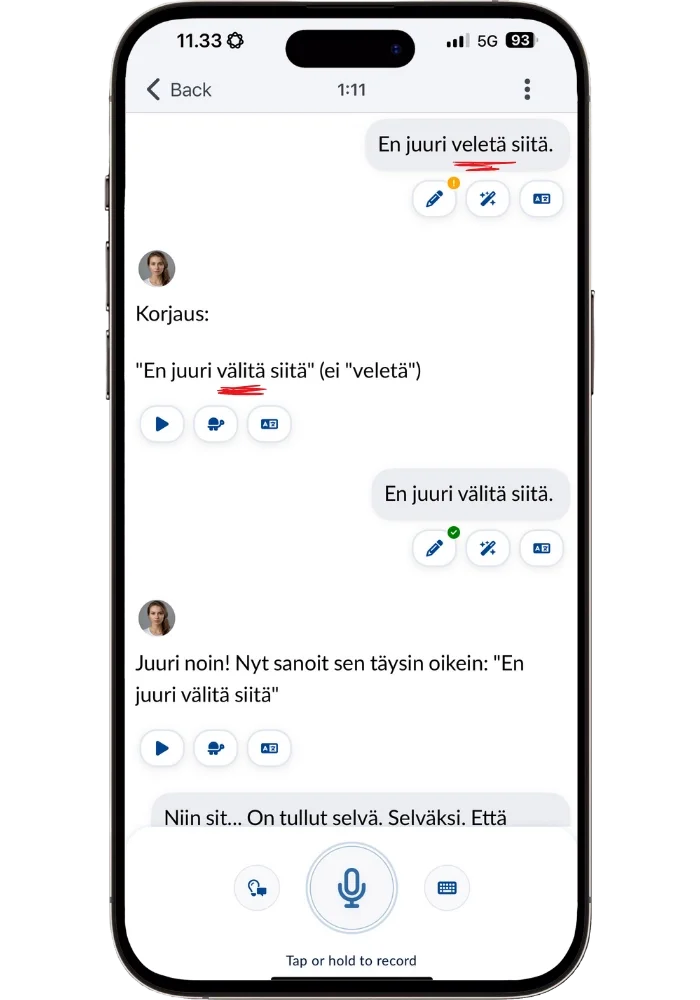
Langua catching my Finnish veletä / välitä pronunciation mistake.
This doesn't mean that Langua catches all pronunciation errors. There are a lot of native-level nuances and subtleties that AI doesn’t catch.
Which is why the most powerful tool in fixing pronunciation is your own ears. AI can sometimes flag the mistake and make you aware of it, but you can only fix it once you can truly hear it yourself.
Why My Native Swedish Set This Trap
The reason for this mistake comes down to my native language. Swedish also has both E and Ä, but they're pronounced fairly loosely and quite interchangeably (some dialects even pronounce E as Ä consistently).
Finnish is the opposite. They pronounce these two vowels very distinctly and never interchangeably. The Ä is an open front vowel, like the 'a' in 'cat', while E is more closed, a bit like the 'e' in 'bed' (though even more in the front of your mouth) — and Finnish speakers always pronounce these two sounds with a clear difference.
And honestly, I've always considered myself quite good at pronunciation. It's something I'm very interested in, and I have a lot of ear training from years as a musician and transcribing music note for note. So finding out I'd been making this mistake for years was a bit of a shock — how had something so glaring slipped past me for so long?
I didn't let it discourage me though. Because becoming aware of it is already halfway there to fixing it.
Why I Never Caught it — The Listening Gap
As I wrote in my post I Spoke 5 Languages From Day One, one significant mistake I made with Finnish was putting too much of an emphasis on reading. Not that reading is wrong, I’ve read daily for years in several languages where my pronunciation is fine. But the difference was that in those languages I was still primarily listening-focused. Reading was just to support the listening, but in Finnish it was the opposite.
Because of this, I could often recall a Finnish word and use it in speaking, but I wasn’t always fully sure of exactly how it was pronounced and sounded. I was processing Finnish more through text than through sound — being a word-processor rather than a sound-processor (this video by Idahosa Ness from the Mimic Method goes deeper into what the difference is if you’re curious). And being a sound processor is crucial if you want your pronunciation to sound natural. When you’re a word processor, subtle sound distinctions can slip right past you without you even realizing it.
Reading gives you a large vocabulary, but acquiring those words through listening is needed to be able to produce them accurately. More extensive listening to natural Finnish speech would have made me more attuned to these distinctions earlier. It’s totally possible I would have still made this mistake, though less likely.
What’s important to keep in mind is that language learning is not a perfectly smooth path. There are things we mishear, misunderstand, and simply aren’t aware of that sometimes form bad habits.
The Fix — A Simple, Focused Drill
To fix this, I didn’t completely change my entire approach to learning Finnish. I just did one specific, targeted drill.
I simply told the AI tutor to feed me two-word phrases that had E and Ä in different combinations. That's it. I also told it not to say anything else, because I didn't want a conversation — I just wanted a clean listen-and-repeat drill.
The reason two-word phrases work well is that they're short enough to hold in your head and repeat immediately, which is partly because Finnish tends to have longer words. You might find that 3-4 words work better for your target language. It just needs to be easy enough that you don’t get lost midway through.
The main thing is that you’re training your mouth to move between these sounds in different combinations. Because these two sounds have different mouth shapes: Ä requires your mouth to be more open, like when a doctor asks you to say "aah” (or is this just in the movies they do that?) E is more closed.
They're formed differently, and once you're aware of it, you can feel when you're getting it wrong. What it comes down to is just navigating between these two different shapes and you’ll be able to pronounce it accurately.
Here's the pronunciation drilling method I used:
Listen to how the AI pronounces it
Speak the phrase
Listen back to your own recording (press the ▶️ button under your message)
Listen to the AI’s version again and compare
Say it once without recording
Move on to the next sentence
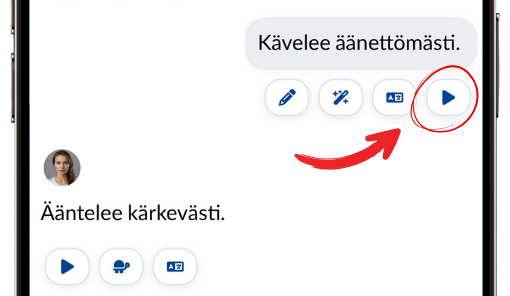
The reason this works so well in Langua specifically is the voice quality — it has the most lifelike AI voices I've heard in any AI speaking app, which is key when you're trying to mimic correct pronunciation.
The main thing was that I wasn’t relying on Langua to catch my mistakes, but my own ears. The playback feature is really helpful for this because often what we sound like when listening back to ourselves is different from what it sounds like in our heads. It might feel a little bit uncomfortable at first to listen to yourself but you’ll quickly get used to it. It narrows that gap between what you think you sound like and what you actually sound like.
Langua still flagged some mispronunciations though, which was helpful (as you can see in the screenshot below). But what actually fixed it was the listen-repeat-adjust loop.
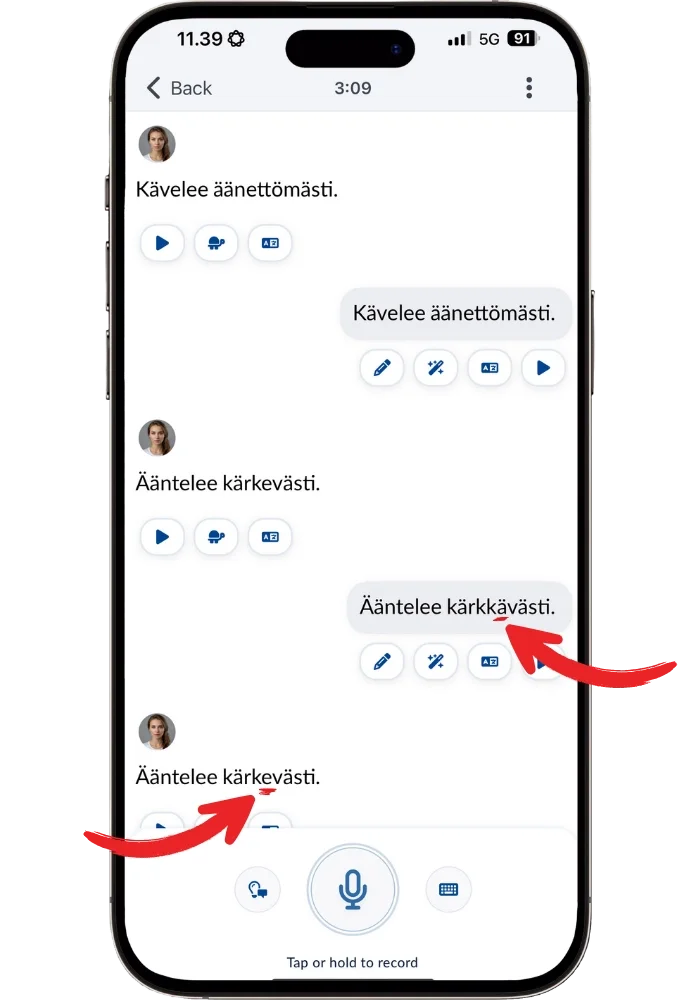
I just did this for 5 minutes 4-5 times a week. That’s all it took. Within a few weeks I saw a noticeable difference. The drill not only became easier, but my everyday Finnish sounded better (which my wife confirmed).
When you zoom in on one sound like this, you start hearing it everywhere and notice how native speakers differentiate between the E and Ä sounds — which only reinforces solid pronunciation.
Now, when I'm reading a book to our sons that happens to be in Finnish, I make a point of pronouncing everything as clearly as possible — especially these two sounds. It’s become natural in a way it wasn’t before.
The Practical Part — How to Do This in Langua
Here’s exactly how to set this up in Langua, though the same principles still apply if you’re using a different tool.
Open Langua, and go to Design my own → Create new
Then paste in this Finnish pronunciation practice prompt — or adapt it for your own language and sounds:
Then just follow the listen-speak-compare loop described above. Even five minutes a day goes a long way if done consistently.
Note: When I did this, you couldn’t create custom prompts in Langua yet. So I simply started a conversation and gave the AI instructions in English at the beginning — telling it what I wanted to drill and how I wanted it to respond. That works well too. The prompt just makes it easier as you can then just re-use the same prompt whenever you want to practice this (under Design my own → My prompts).
Tip: Try to speak slowly and really enunciate each sound, almost exaggerating — then it will stick in your muscle memory faster. Also, these exercises can be a bit intensive so short sessions are ideal. And don't worry about being 100% perfect — the point is just to wake up the right muscles. When it really comes together is when you’re speaking in context, whether that’s with AI or real conversations. That's when this awareness and muscle memory will kick in naturally.
2-minute Demo Video
To see what this looks like in practice, here’s a short video of me running through the drill — including the prompt setup (copy-pasting the prompt above) and the playback workflow:
Final Words — One Thing at a Time
Improving your pronunciation and accent can feel overwhelming, especially when you're trying to figure out how to fix pronunciation mistakes you didn't even know you were making.
The approach is simple: focus on one thing at a time. You can’t overhaul your entire accent overnight, and trying to fix everything at once just means fixing nothing. Plus, it’s just too overwhelming. Pick one thing, drill it until it's automatic, then move on. When your brain isn't juggling ten things simultaneously it can actually go deep enough on one thing to change it.
And once one sound clicks into place — it frees up your attention. Since you no longer have to think about it, your mental space is now able to notice other aspects of pronunciation.
Just let it happen naturally. Stay relaxed and try to be aware, and when something surfaces — whether through AI, a native speaker, or your own ear — treat it as useful information rather than a setback. Then work on it until it stops needing conscious effort.
This applies to any language with sound contrasts your native language doesn't have. The key is short, regular repetition — five minutes spread over days and weeks beats one long session every time. That's how muscle memory actually forms.
As for what's next on my pronunciation list, I'm not entirely sure yet. It might be double consonant vs. single consonant distinction in Finnish or something else. But I know I'll find out, probably the same way I found this one.
If you want to try this method yourself, Langua is the tool I'd recommend. The voice quality is the best I've heard in any AI language app, which matters when you're training your ear to hear subtle distinctions — and the ability to replay your own messages is what makes self-corrections actually work.
You can try a conversation for free to get a feel for it. If you decide to go further, use code LINGTUITIVE20 for 20% off an annual Unlimited plan — bringing it from $199.99 down to $159.99 (which is already 55% cheaper than paying monthly). A free 7-day trial is included so you can explore all the features risk-free:
