Published

This post contains affiliate links. If you buy through one of them, I may earn a commission at no extra cost to you. Some of the products I write about are also provided to me for free. See Full Affiliate Disclaimer.
Table of Contents
- The Turning Point — Refold's 'Level Up Your Listening' Course
- Finding the Right Show — Why Gargoyles?
- My Tools — asbplayer + Anki
- The Method — My Episode Workflow, Step by Step
- Phase 1 — Freeflow
- Phase 2 — Intensive Listening (+ Sentence Mining)
- Phase 3 — Freeflow Rewatch
- Setup & Tips
- See the Workflow in Action (Walkthrough Video)
- The Flashcard Review Habit
- Tracking and Staying Motivated
- The Results After One Year
- How You Can Do This (For Any Language)
- What's Next
I had been learning Cantonese for more than 7 years. My speaking was solid and I always got compliments on my pronunciation. I had started feeling comfortable with reading, even to the point of reading my Chinese Bible comfortably without external tools. But my listening had plateaued. It just wasn't improving at the rate where I would be able to understand TV shows and movies in the near future.
Even though I didn’t really want to admit it (call it pride, or misplaced optimism) — it was just true. It's not that I didn't know things like sentence mining existed. I did. But I didn't have a structure — a clear sense of moving from A to B — that would make me actually show up every day and do it. Working with random materials here and there, which I knew would help eventually, wasn’t motivating enough for me. What I needed wasn't just a method — but a framework.
I was listening every day, but it often felt like pure discipline — the excitement just wasn't there. Which was confusing, since I didn’t lack passion for Cantonese. The problem was simply that my progress was too slow to feel it.
The problem with Cantonese is that, as far as listening comprehension goes, it's by far the hardest language I've learned — short one-syllable words, slang, idioms, homophones, 6 tones, and spoken at a blistering speed. And unlike Spanish or Japanese, there's a serious lack of resources to work with.
So I needed something that was:
A) Effective
B) Engaging and fun so I could stick with it for long enough to see results
Now, a year later, I'm able to follow political podcasts in Cantonese. Still challenging at times, but a year ago I wouldn't even have attempted it. And best of all, Cantonese listening has gone from something I had to force myself to do — to the part I enjoy the most.
So in this post, I'll walk you through my exact Cantonese listening practice process — how I set it up, what tools I use, and how I work through each episode — so you can apply it to your own language learning, whether you're learning Cantonese or any other language where your listening comprehension feels stuck.
One note before we dive in: this intensive listening method works best if you’re at least at an intermediate level and can understand 50% or more of the TV show you’re working with.
The Turning Point — Refold's 'Level Up Your Listening' Course
For years, I had neglected listening in favor of reading. I thought enough Cantonese reading would eventually unlock listening, like it had in Finnish. But the difference was that I lived in Finland, which gave me a lot more immersion in the language. Cantonese was different, and listening comprehension much more challenging than in Finnish.
I had been following Refold — a language learning community and resource hub focused on immersion-based methods — for quite some time. So when they released Level Up Your Listening — a course purely focused on improving listening comprehension for intermediate learners — I was very intrigued. I took the course expecting to get a few new ideas. What I didn’t expect was for it to revolutionize my entire approach to listening across four languages. Though it made the biggest impact on Cantonese, since that's where listening was the biggest struggle.
I took this 28-day course and it gave me: a deeper understanding of how listening works, concrete strategies, a way to track my progress, and a framework that made listening improvement measurable and seriously addicting.
I then took what I learned from that course and developed my own workflow. Part of the homework involved watching two TV shows — one familiar, one new. The new one sent me on a hunt for something interesting to watch in Cantonese.
“It’s hard to improve something if you don’t really understand how it works.”
Finding the Right Show — Why Gargoyles?
I looked through the Disney+ since that’s the biggest library of Cantonese dubbed content of any platform I know of. All the classic Disney shows feature Cantonese dubs. As I was searching, I stumbled upon an old 90s Disney show called Gargoyles.
I'd actually first heard of it a bit earlier while playing with my oldest son — we were listening to a playlist of classic Disney theme songs on YouTube, and the Gargoyles one came on. I was like, 'what is this?' since it was one of the few I wasn’t familiar with. I looked it up and it turns out it's been hailed as one of the best Disney shows ever made. As a Disney fan who grew up in Sweden with DuckTales, TaleSpin, Gummy Bears, and Darkwing Duck, I couldn't believe I'd never heard of it (but it had never been broadcast on Swedish TV so made sense.)
I don't typically watch Disney shows in my spare time, but this one seemed interesting. So I gave it a shot, figuring it could at least be material to use for the 28-day course.
It didn’t take long before I was hooked. The show was at the perfect level for me — comprehensible enough that I could follow, but packed with new vocab and expressions. And the storytelling was deep: morally complex villains, medieval/modern flashback structure, mythology references, and real consequences for characters' actions. Unlike a lot of Disney shows with standalone episodes, Gargoyles builds its story across dozens of episodes. Plus, it featured this unique blend of medieval vocabulary with modern tech vocabulary (90s at least — but eerily relevant for today, even touching on topics like AI).
I started watching it using two different watching strategies, both of which I learned from the Refold course:
Freeflow — watching without subtitles, not looking up any words
Intensive listening — auto-pause between sentences, re-listening to clear up ambiguity
For the latter, I also added sentence mining, which gave me a way to remember vocab and also get targeted listening practice to tricky-to-hear sentences. I’ll explain exactly how I do this.
My Tools — asbplayer + Anki
While no tools are needed for watching in ‘Freeflow’ (just turn off subtitles and press play), for intensive listening you need tools to make the process smooth. There are several Chrome extensions nowadays that let you interact with subtitles — look up words, toggle subtitles on/off, auto-pause, and create one-click flashcards directly from TV shows.
I started with asbplayer (free), and then switched to a paid alternative for a while — which had extra features that asbplayer didn’t have and worked right out of the box. However, I found myself going back to asbplayer. I just preferred its simplicity and reliability — it just always works. You do have to spend some time setting it up, but you only need to do it once and there are good tutorials to help you.
asbplayer
What makes asbplayer great for Cantonese intensive listening is that you can enable modes like ‘auto-pause’ — so that it pauses automatically at the end of each sentence. Through Yomitan integration you can hover over words to see their definition, and by connecting it to Anki you can create one-click flashcards that include: screenshot, audio, sentence, and target word.
The Cantonese-specific wrinkle: subtitles are usually standard written Chinese (SWC), not colloquial Cantonese, so you have to do a bit of manual dictionary work to make it work (I’ll show you exactly how I do this.)
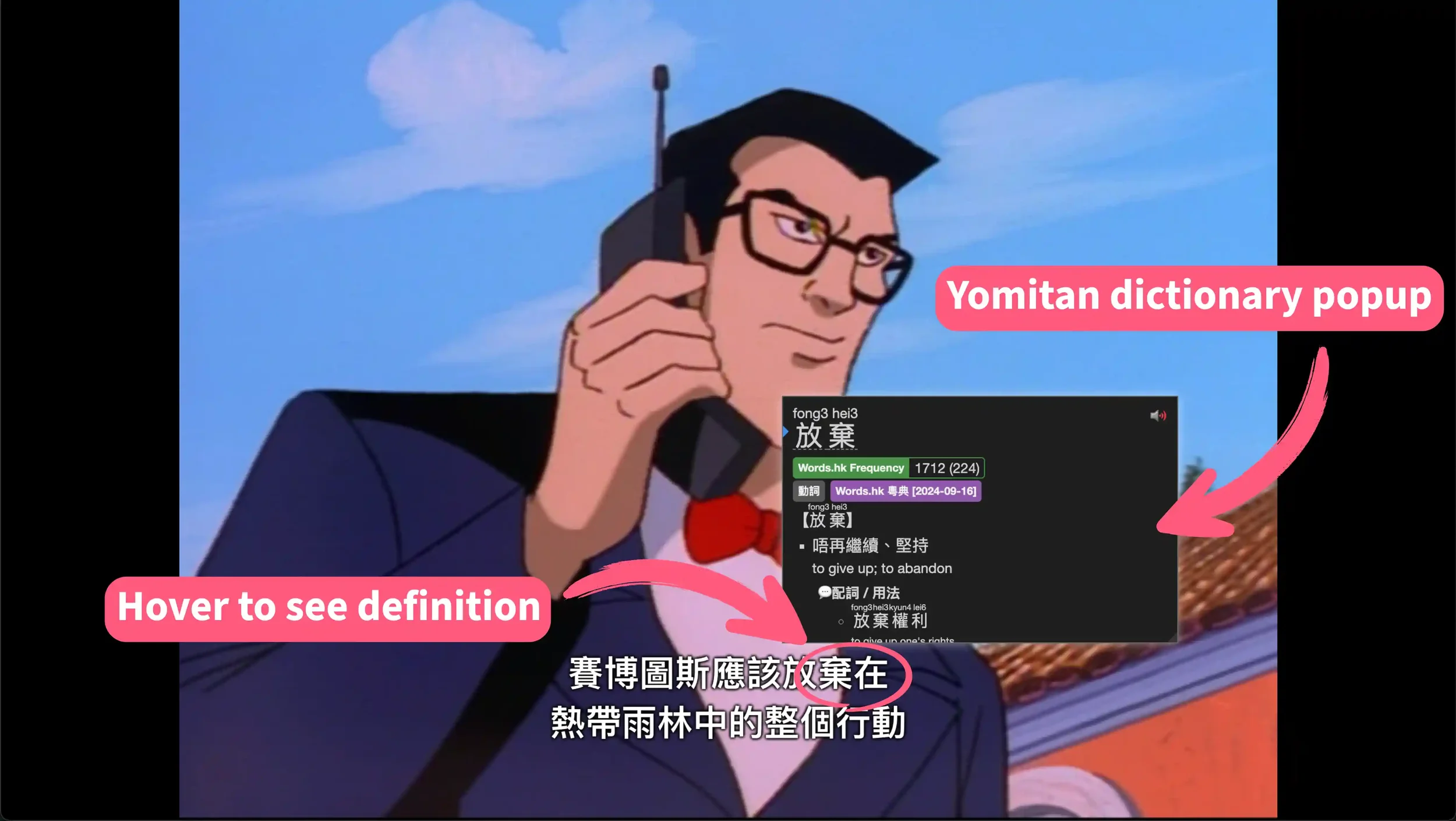
Gargoyles © Disney. Screenshots used for educational purposes to illustrate the language learning method described in this post.
Anki
I used Anki extensively for my first few years of learning Cantonese, making over 6,700+ flashcards. Eventually I burned out on it because the reviews just took too long and manually creating cards took too much time and effort.
But this new workflow brought me back. Now I only save selective words, and the flashcards are way more engaging with the original audio and Refold's card layout. With the updated algorithm and being pickier about what I save, reviews take maybe 5–12 minutes a day right now. It’s fast to do, but it’s been a key ingredient in improving both my listening and my vocabulary.
Anki is free on desktop and Android. The iOS app is a one-time $24.99, which is well worth it if you want to review on the go.
To get set up with both, check out these tutorials:
asbplayer:
The BEST video player for language learning? - ASBplayer Tutorial (7 min)
The ULTIMATE Sentence Mining Tutorial - How to make your own Anki cards (26 min — though you’ll only need to watch part of the first 18 mins. For Asian languages — watch the Yomitan part. For other languages — watch the vocab sieve part)
Anki:
The ONLY Anki tutorial you'll EVER need - How to set up Anki (6 min)
The EASIEST way to create Anki cards with ASB Player (17 min — watch from 7:26. The rest is covered in the above asbplayer sentence mining tutorial)
The Method — My Episode Workflow, Step by Step
The difficult part is setting up the tools. Once that's done, the workflow — while intensive — is actually quite simple and enjoyable once you get the hang of it. Here's how I do it.
Phase 1 — Freeflow
This is a good way to start off. It gives you a sort of “benchmark” to where your comprehension is at. What is ‘freeflow’? Freeflow is simply watching an episode — with no subtitles and without looking up words. You simply press play and watch from beginning to end and try your best to understand.
It’s not a ‘try really hard until your mind explodes’ type of a state. It’s a relaxed focus — you try to pay attention as well as you can, but when you miss something, you just keep watching. This trains your ears to naturally process the language. It can be uncomfortable at first, especially when you don't understand large chunks, but you get used to it.
You might understand 70%, or maybe just 40%. That's okay. Ideally your content is at 50% comprehension and above for freeflow, but with a language like Cantonese it's not always possible to find something at the perfect level.

When you watch the episode the first time in freeflow, note how much you understand. Was it 50%? 70%? This will be helpful for after you finish phase 2.
On looking up words: If you can’t help it and want to look something up, that’s okay. I do that from time to time too. But just know that it breaks up the flow, so keep it to a minimum. All those question marks (or most of them at least) will be cleared up in the next phase anyways.
Phase 2 — Intensive Listening (+ Sentence Mining)
Now it’s time for the juicy part — ‘Intensive Listening’ — which means you watch going sentence by sentence, clearing up everything you can.
This pushes your ears to hear things you miss in freeflow — whether it's unknown words or fast phrases that blur together. The multiple listens give your brain more time to process the language, and the sentence mining builds your vocabulary alongside it.
Here’s how Intensive Listening works:
Auto-pause turned on — this means asbplayer will auto-stop at the end of each sentence.
Subtitles toggled off (initially) — if you leave subtitles on the whole time, your brain will read instead of listen, and you'll think you understand more than you actually do. That's why we start with subtitles off and only toggle them on when you need them.
Then you simply go sentence by sentence, working your way through the entire episode:
Understood? → Move on to the next sentence
Not sure? → Replay 2–3 times
Still unclear? → Toggle subtitles on
Unknown word? → Look it up, create flashcard
Still can’t figure it out after multiple listens? → Ignore and move on
Time it takes: ~2–3 hours for a 20-minute episode
Adding Sentence Mining: Since I was already working through each sentence, I figured — why not sentence mine the unknown words while I'm at it? That way I expand my vocabulary and have a systematic way to review them.
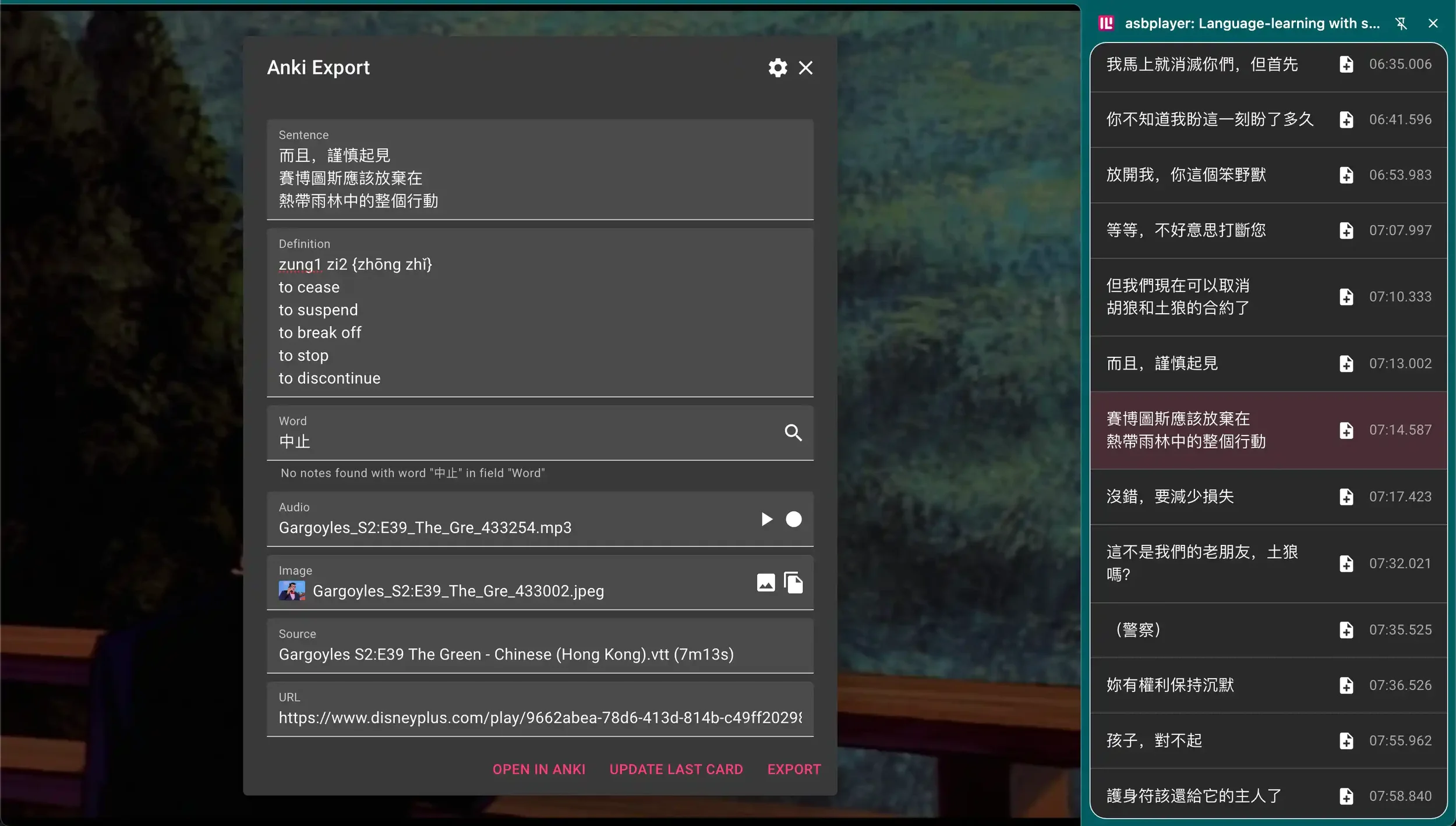
Gargoyles © Disney. Screenshots used for educational purposes to illustrate the language learning method described in this post.
Looking up words: Since Cantonese subtitles are often in standard written Chinese, hovering over a word won't always give you the right spoken Cantonese meaning. So I keep a CC-Canto dictionary open in a separate window. If I can't find the word there, I use Pleco on my phone — the richest Cantonese dictionary I've found. And if even Pleco doesn't have it, I'll ask AI. You can type it in Jyutping with a bit of context and it'll usually give you an accurate definition.
Making the flashcards: The key rule: only one target word per card. If a sentence has two or three unknown words, make two or three separate cards from the same sentence. And if you need to include more than one subtitle line to capture a complete phrase — open the sidebar and drag across multiple lines of dialogue in asbplayer.
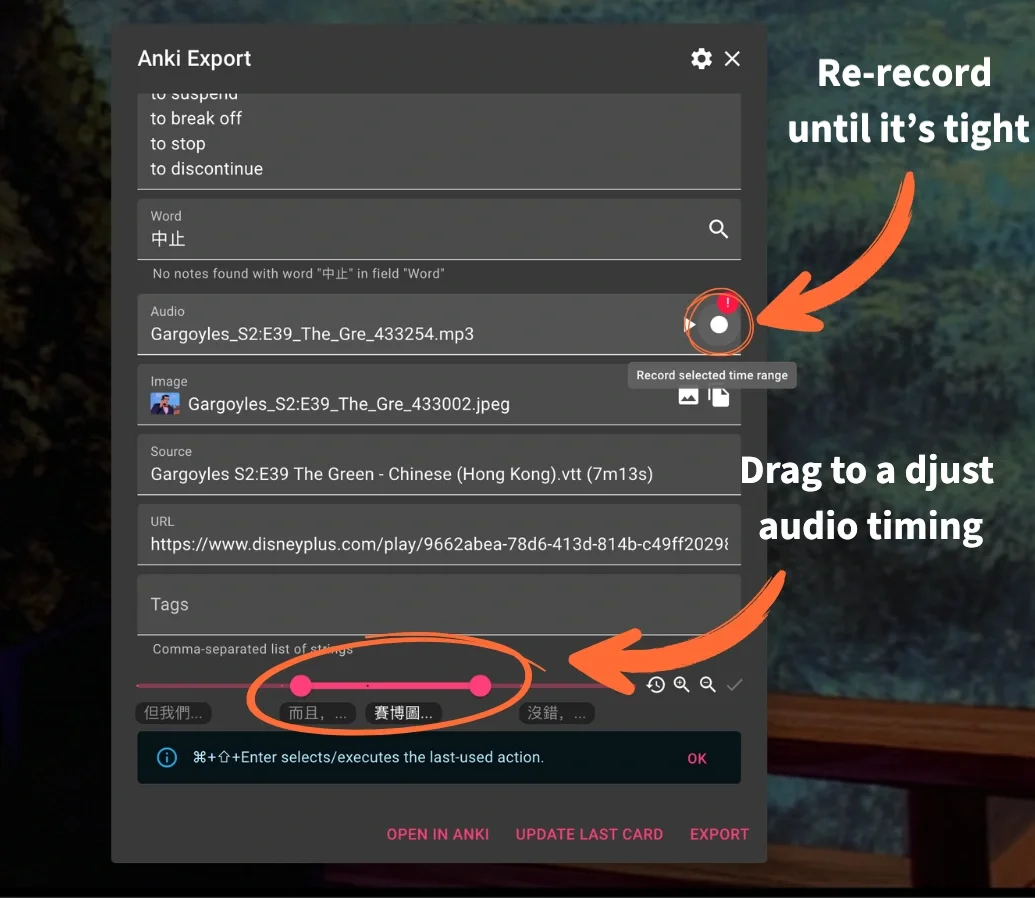
“Make ‘em tight”— why audio timing matters: One of my favorite features of asbplayer is that you can adjust the timing of the audio that ends up in the flashcard. If the sentence is cut off or too long you can adjust the audio length of it — and then re-record the audio. I didn’t really do this in the beginning so the audio sometimes drags on for too long or gets cut off in the middle of a word.
Recently I’ve been making them as tight as possible. It takes some extra time as you might have to record 2-4 times to get the right length. But totally worth it — it saves you time in the long run. You’re going to see these flashcards a lot over the course of days, weeks, and months — so having tight flashcards makes for a quicker and smoother review flow.
How long should this take? For me, intensive listening takes around 2–3 hours per episode, depending on how much new vocabulary there is. If it's taking longer than that, you're probably spending too much time on parts that are too difficult (someone maybe speaks in a way that’s hard to understand — chances are this vocab will return later in a more comprehensible form). Skip them and focus on the lower-hanging fruit.
Session length: I never did this in one sitting. Intensive Listening is intensive, so you do get more tired than when watching in freeflow. I find that a good session length is generally 30-45 minutes. It lets you get into the flow without burning out. But you can also do shorter sessions spread out if you prefer.
Phase 3 — Freeflow Rewatch
The ideal workflow is freeflow → intensive → freeflow again. I did this during the Level Up Your Listening course and the comprehension jump was incredible (60-70% → 90-95%). The first freeflow gives you an overview, intensive listening clears up the gaps, and the final freeflow is where you reap the rewards and acquire the language.
Though to be honest, I often skipped the first freeflow and just did intensive listening followed by a freeflow. Lately though, I’ve been getting back to the original flow and it really is the best way to do it. And it gives you the biggest motivational boost because you can clearly feel the improvement between the first and second freeflows.
If you only have time for one freeflow, I'd recommend watching it after intensive listening rather than before — that way you get to hear all the words you just mined in their natural context. That said, I did freeflow-then-intensive for a long time and it works fine too, since vocabulary keeps reappearing across episodes regardless of the order.
Now let me show you the practical setup that makes all of this run smoothly.
Setup & Tips
I often do the Freeflow watching on my TV, but for Intensive Listening with Sentence Mining I obviously need my laptop. I have a particular setup to make this as smooth as possible. Especially since I need to have a couple of things open beside Disney Plus with asbplayer.
I use two separate desktops on my Mac (using Spaces) and toggle between them with Control + left/right arrow keys — one with Disney+ and asbplayer, the other with Google translate + Cantonese dictionary + Anki. I made the Cantonese dictionary into a desktop app in chrome for easy access (to do this: click the three vertical dots in top right → ‘Cast, Save and Share’ → ‘Install Page as App’)
Here’s what my setup looks like:
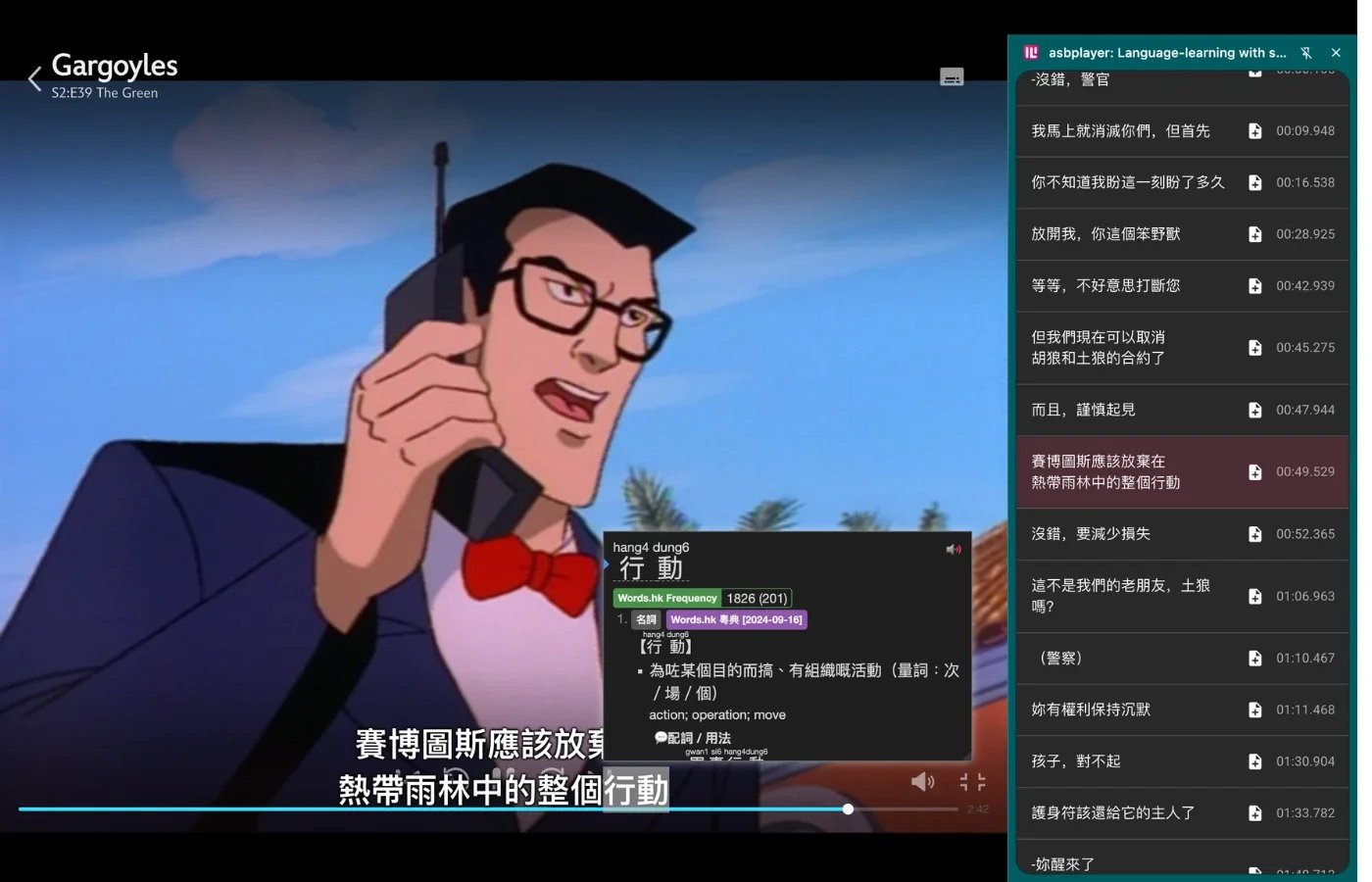
My main screen — a Gargoyles episode with asbplayer
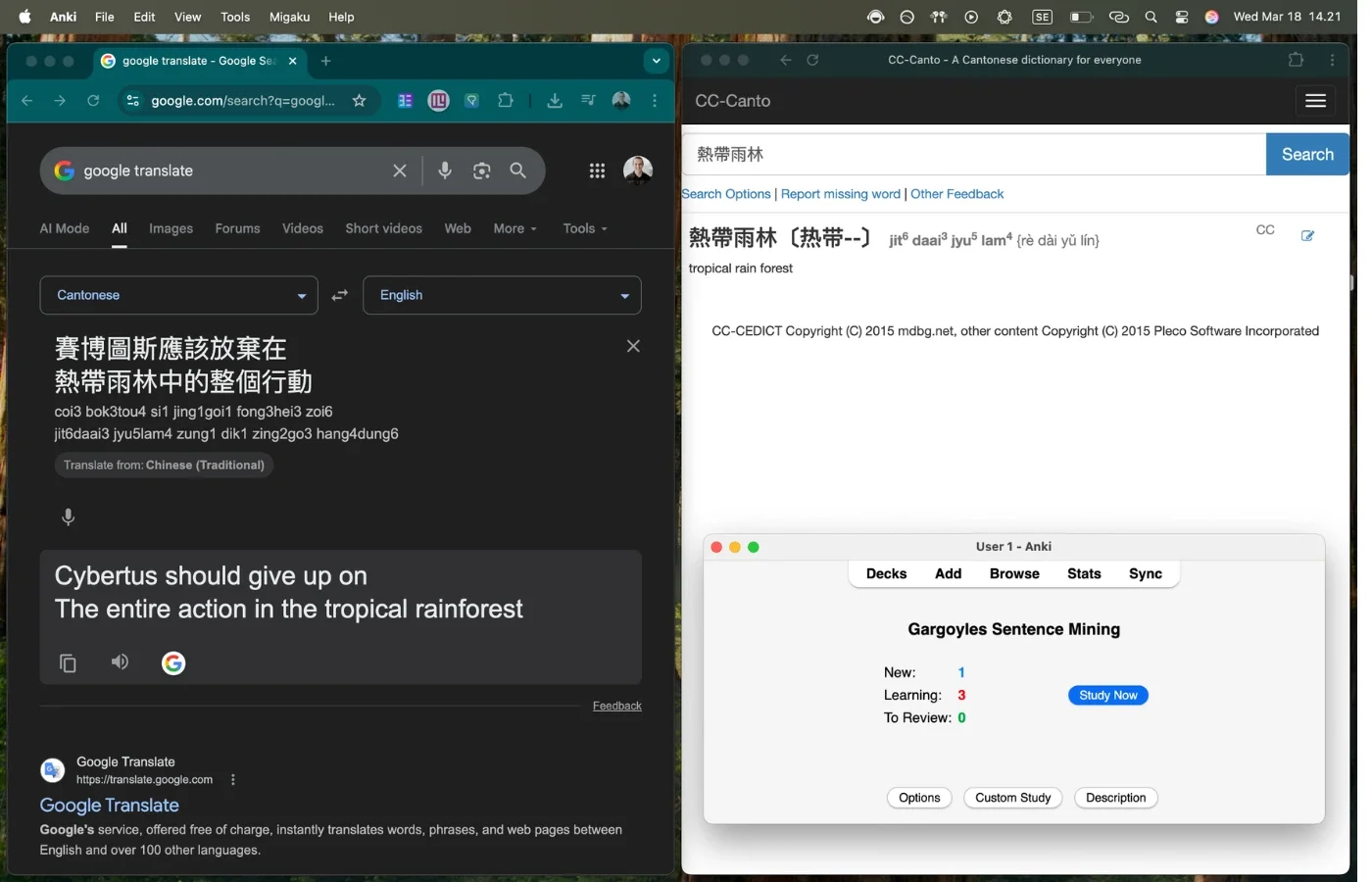
My secondary screen — Google translate, Cantonese dictionary, and Anki.
A few quirks to be aware of with Disney+: Subtitles don't sync automatically — when you start an episode, asbplayer might load subtitles from the middle or end of the episode instead of the beginning. Just toggle through the subtitles until you find the first line of dialogue and sync from there. An easy way to do this is to turn on Disney+’s native subtitles temporarily and match them with asbplayer’s interactive subtitles — then turn them off. You’ll also need to fine-tune the subtitle timings so they start at the beginning of the line of dialogue and don’t chop off the first word. Doing slight adjustments to the subtitle timings will be part of your workflow — but short command buttons make this easy to do in asbplayer.
Also: I usually have to open an episode, quit, and re-open before the subs sync properly. You can also only go back 1-2 subtitle lines, so if you need to go further back, you'll need to re-sync. And when making your first flashcard of a session, the show sometimes starts playing in the background — just re-sync and redo the card. After that first one, everything runs smoothly. I haven't tried this on Netflix but there may be fewer issues there. One last tip: I screenshot where I'm at between episodes, since Disney+ sometimes loses my place.
See the Workflow in Action (Walkthrough Video)
Here's what the full sentence mining workflow looks like in practice. I'm using a Gargoyles episode on Disney+ to walk you through the entire process — from hearing a sentence to creating and reviewing the flashcard.
If this feels overwhelming, I get it — there are a lot of moving parts. For me, everything clicked and became crystal clear when I went through Refold's Level Up Your Listening course. It's where I learned all of this in an organized, step-by-step way. If you want a guided path rather than piecing it together yourself, I highly recommend it — here's my full course review.
The Flashcard Review Habit
Now that you've created your flashcards, it's time to review them. I prefer the Anki mobile app since I can review wherever I am, but desktop works just as well.
With the Refold card template (linked in the tutorials in the tools section), the target word appears in Chinese characters on the front. I decide if I know it or not, then flip — which automatically plays the sentence audio.
If you know it, hit green for ‘good’ (or yellow for ‘hard‘ if you want to see it a little bit sooner). If you didn’t remember it, press red for ‘again’— this is not a failure but a completely normal part of the process. As Ben at Refold says: “You’re just telling Anki what you need to practice a little bit more” — which is exactly it.
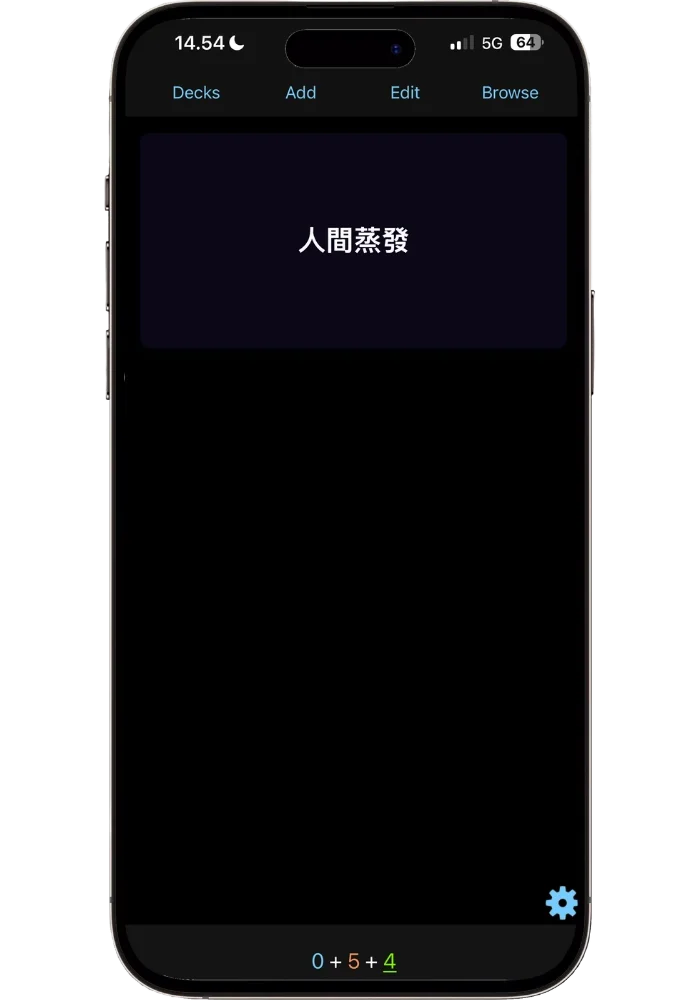
Front — Do I know this word?

Back — sentence, jyutping, definition, screenshot, and audio (with replay button).
You'll notice the sentence on the above card uses 消失 while the target word is 人間蒸發 — both mean 'disappear.' This is the SWC vs spoken Cantonese difference I mentioned earlier. The written sentence won't always match what's spoken, but it still provides helpful context (at least most of the time).
Key things to remember:
Use headphones when reviewing — hearing the audio clearly is key to getting the most out of each card
Finish all reviews every day — they pile up fast otherwise. You don't have to do them all at once though. Do 20 here, 20 there — just make sure your deck says 0 by end of day.
Bonus targeted listening practice: What's great about having the full sentence audio is that every review doubles as targeted listening practice. Whenever a card comes up, try to really process all the words and really listen — not just the target word. If a sentence is tricky to hear and understand — replay it until you can. Sometimes I'll even save a sentence not because it has an unknown word, but just because it's challenging — maybe fast or just difficult to process.
What happens over time: After reviewing a card 10–15 times, you'll often start hearing the sentence audio in your head the moment you see the target word. That's the power of having audio tied to a specific context — it creates a strong memory connection.
How many new cards per day? I do 10 — enough to make steady progress without becoming overwhelming. I don't add new cards every day either (since I don’t do the Intensive Listening workflow every single day), so my daily review pile stays manageable — usually 50–70 cards, which takes me about 5–12 minutes.
Card variation if you don’t read Chinese characters very well: My cards show the target word in Chinese characters on the front, which works well since my reading level is quite high. If yours isn't there yet, you could customize the card template to play the target word with TTS audio instead.
Tracking and Staying Motivated
Tracking is super underrated but it's been crucial to sticking with this for over a year. Few people track their learning, but few people also stick with language learning long-term. For listening especially, which can feel very elusive, having concrete goals makes a huge difference.
I use Refold’s Time Tracker app — the best language learning goal tracker I've seen, and it's completely free. It's very customizable, but instead of turning this into a tutorial (link to that below), I'll just show you how I use it.
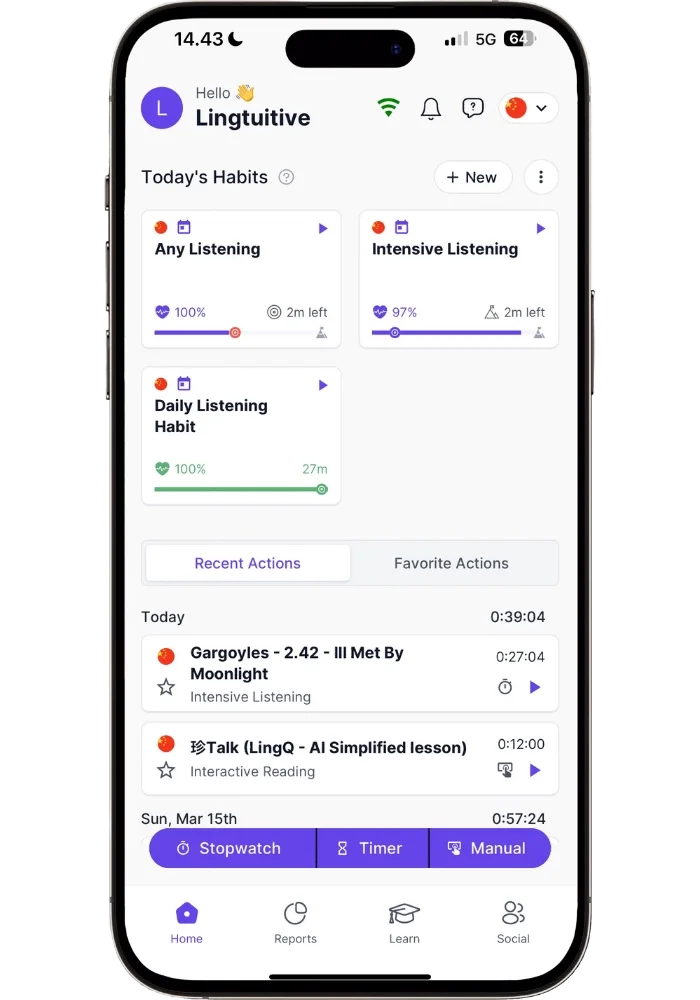
What my Refold Time Tracker app might look like halfway through the day.
As you can see on my daily habits, I have three goals:
Daily Listening Habit — 1 min (making sure I show up every day)
Any Listening — 30 min daily goal, 60 min stretch goal
Intensive Listening — 5 min daily goal, 30 min stretch goal
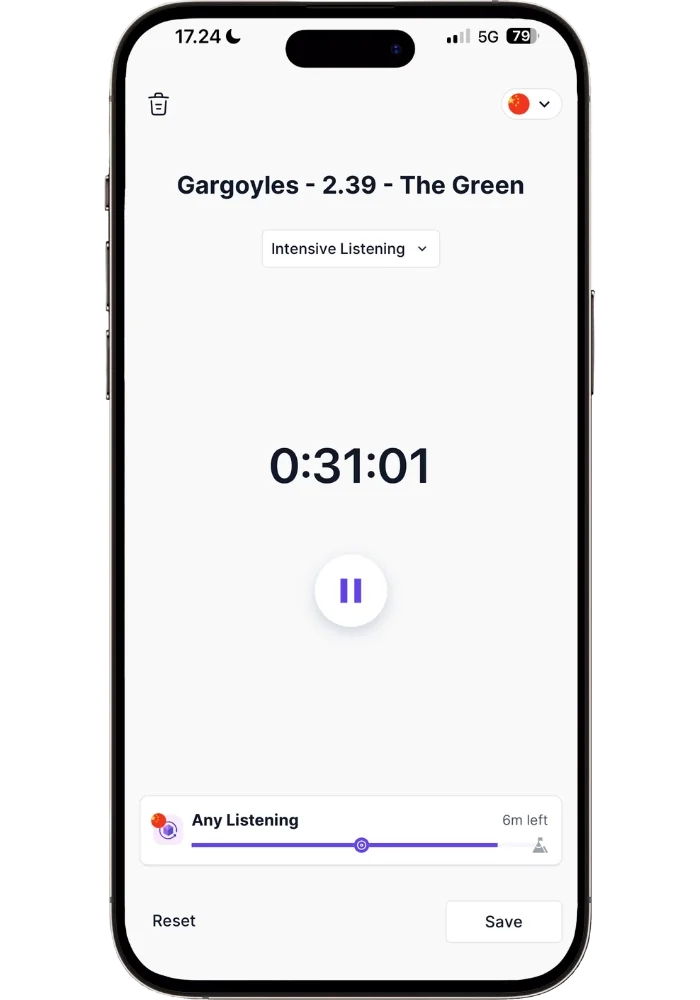
‘Any Listening' covers everything — Gargoyles in freeflow, podcasts, even half-attention listening while doing dishes. 'Intensive Listening' is a separate category that includes the asbplayer workflow plus the Anki reviews — I count flashcard reviews as intensive listening since I'm very focused on hearing and processing the audio when I go through them. This means I can hit the intensive listening goal every day, even when I don't do the intensive listening workflow, since I always do my Anki reviews.
The app is super easy to use — I press the stopwatch on my phone when I start an activity and stop it when I'm done. No mental math, the app tracks everything automatically.
For more on how to use it and set it up:
My Daily 5 AM Morning Coffee Routine
My ideal morning is: waking up at 5 AM, making a cup of coffee, and doing 30–45 minutes of intensive listening before anyone else wakes up. It's become one of my favorite parts of the day, which makes getting up that early easy. My mind is fresh, and there are no other distractions — perfect for some intensive Cantonese learning. What better way to start the day?
The Results After One Year
Over the past year, I've worked through 50+ episodes of Gargoyles using this method — each one involving 2–3 hours of intensive listening and sentence mining, plus the freeflow watch-throughs.
And I've seen massive results in a year. I felt the difference as clear as day just last week. I was watching a new episode of Gargoyles, and a year ago I would have understood maybe 60–70%. Now I could understand 90% — without subtitles, without looking up any words. That might not sound like a huge jump, but it's the difference between 'I can kinda follow the plot but have no idea why they're doing this' and 'I'm understanding pretty much everything that’s going on, just missing some details and nuances.'
Not only do I notice it when watching Gargoyles specifically, but in other content too. Recently, I’ve been listening to this Cantonese podcast about current events and politics — a topic that used to be very difficult to follow a year ago. And while it’s still challenging at times, I can follow it so much better than before and my comprehension just keeps growing.
After watching 10, 20, 30 episodes of the same show, vocabulary naturally reappears — you get built-in spaced repetition just by staying in the same world. Understanding then just compounds the deeper you go.
For example, the expression 我唔係眼花 (ngo5 m4 hai6 ngaan5 faa1) — basically meaning 'I'm not seeing things' or 'my eyes aren't deceiving me' — wasn't in any dictionary I checked. But it showed up enough times across episodes that I eventually understood it purely through context. That's how acquisition works.
How You Can Do This (For Any Language)
This workflow works for any language — not just Cantonese. Here's what you need: a streaming service with target language subtitles, asbplayer (free), Anki (free), and a TV show you genuinely enjoy. You might need specific dictionary add-ons for your language, but the core process is the same.
Pick something where you understand at least 50% — ideally 60-70%+ when in freeflow. But you also don't necessarily want to sacrifice interest for comprehensibility. You might not find something as gripping as your favorite English-language show, but it needs to be interesting enough to sustain you through dozens of episodes. That's what will keep you coming back.
I didn't need a VPN for Gargoyles — it was available in my region. But if you're struggling to find the right show in your target language, a VPN can unlock streaming libraries from other countries and dramatically expand your options. Disney+ for example has a ton of Cantonese content available in Hong Kong that isn't accessible elsewhere. I recommend NordVPN for its speed and large server selection (so you don’t hit any dead ends).
What's Next
Understanding Cantonese TV shows comfortably was a real pain point for me after 7 years of learning — and I finally found a workflow that not only works but is super fun.
I'm right now on episode 2.43 of Gargoyles — just a few left of season 2. After that, I’ll circle back to some season 1 episodes I skipped, which are only a handful.
What about after that? It’s honestly a bit bittersweet that this is coming to an end. It's been a wonderful season of learning and I've enjoyed every bit of it — that’s always a good sign! When you miss even the learning process, you know you’re onto something that’s working.
I might find a new show to work through the same way, or shift to doing more freeflow now that my comprehension has grown so much. I'm also listening to a lot of podcasts, so I might start applying a version of this workflow to that type of content. Time will tell. Right now, I’m just focused on finishing Gargoyles and then I’ll decide.
What I do know is that I'm committed to reaching an advanced level in Cantonese — in listening & reading comprehension and speaking. It's a language and culture that's very dear to my heart, and I'm not stopping until I get there.
