Langua Review: 2+ Years of Use, From Beginner to Advanced
Updated

This post contains affiliate links. I may earn a commission on purchases made through links in this post. Read my full affiliate disclaimer.
Table of Contents
- What Is Langua?
- My Experience at Three Levels: Korean, Spanish and Finnish
- How Langua Works
- My Path and the Beginner Course
- Feedback and Corrections
- Saving and Reviewing Vocabulary
- Human Lessons with LanguaTalk
- Langua Pricing and Free Plan
- Langua vs. Alternatives
- Pros and Cons
- Who Langua Is For (and Who It Isn't)
- Langua FAQ
- Is Langua Worth It? My Verdict
With so many AI language apps out there, it's hard to tell which ones are actually worth paying for and which ones are just ChatGPT with a nicer interface. I've tested the five best AI speaking apps side by side, and Langua came out first. I've now used it for more than two years.
I’ve used Langua in three languages at three very different levels: Korean as a beginner, Spanish as an intermediate learner, and Finnish as an advanced one. So instead of just describing features, this review shows real, unscripted sessions from all three, including the brand-new call mode where it actually hears you in real time and can search the internet while you talk.
You'll also find what I'd still change, who it's for (and who it isn't), and how to get yearly Unlimited for $159.99 a year, every year, with my code.
What Is Langua?
Langua is an AI speaking app that lets you practice conversations with AI tutors whose voices are the most natural I've heard in any app. It increasingly remembers facts about you (optional), lets you create engaging and useful scenarios for practice, or you can just have casual chats about your day.
Everything is integrated into an ecosystem, letting you save any word or sentence in chats, and then review them through integrated flashcards, create AI short stories using the vocab, or weave them into chats. You can also generate feedback reports — audio and written — from your chats.
Out of all the AI apps I’ve tried, Langua is by far the most flexible, and with the deepest, most useful features. It truly lets me adapt to the language, my preferences and specific challenges, and my current level for each language.
Langua currently officially supports 23 languages, though Thai is also available as beta (no transliteration).
Japanese and Chinese have romaji/furigana and pinyin in chats, but not yet in call mode, flashcards or podcasts. Korean has romanization only in the beginner lessons, and Hindi, Arabic and Thai don't have any yet.
No Cantonese support as of yet, which is the one language I’d love to see the most as a longtime Cantonese learner.
What Langua does
An AI tutor you talk to, plus everything around it
What I actually use after 2+ years, in Korean, Spanish and Finnish
The basics
What sets it apart
Also: five correction modes, AI stories built from your saved words, videos and podcasts with clickable transcripts, it works on both your phone and your computer, and every chat is saved so you can continue it any time.
See all the languages Langua supports
Good to know: Japanese (romaji/furigana) and Chinese (pinyin) have reading aids in chat, but not yet in call mode, flashcards or podcasts. Korean has romanization only in the beginner lessons, and Hindi, Arabic and Thai don't have any yet, so you'll need to read the script. No Cantonese yet.
My Experience at Three Levels: Korean, Spanish and Finnish
Right now, I’m using Langua in three languages: Korean as a beginner, Spanish as an intermediate, and Finnish as an advanced learner.
That has let me experience Langua at not only three completely different levels, but in three languages that couldn’t be more different from each other.
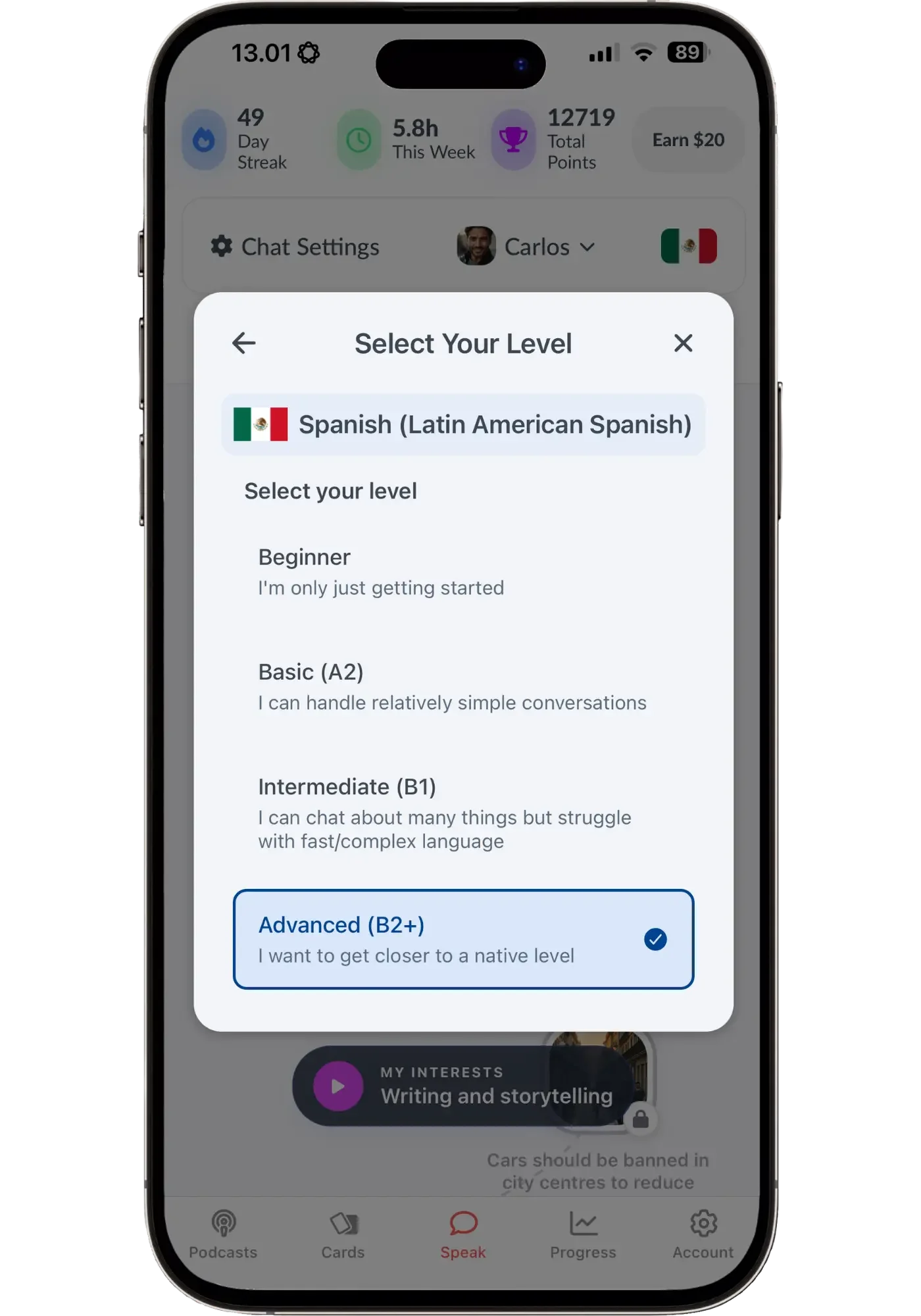
You set your level separately for each language. I keep Spanish on Advanced (B2+) to push myself, though I don't always turn on the extra-slang option.
In Korean, I’m going through the structured beginner course, learning sentences relevant to my life, and practice these sentence structures in Langua’s flashcards.
In Spanish, I have free conversations or practice topics between my LanguaTalk lessons. For the second, I either practice a specific topic or upload audio or text. It’s the language I’ve so far used the most in Langua and it’s really made a huge difference in my speaking to where I now have friendships completely in Spanish.
And in Finnish, I have a high level of comprehension and a large vocabulary, so I’m working on sharpening my correct use of grammar since it’s the most challenging aspect of the language, as well as natural word order, using a very specific prompt.
Each language shows a different side of Langua, so you'll see them throughout this post: Spanish in Call Mode, Korean in My Path, and Finnish in Feedback. If you're wondering where to start at your level, that's roughly it: the beginner course and My Path if you're new, free conversations and call mode once you can hold a simple conversation, and custom prompts when you want to practice something specific.
What Langua Has Done for My Speaking
One of the clearest examples came a little over a month after I started using Langua for Spanish. I ran into an Argentinian man in my town in Finland, and we started talking in Spanish. For the first time, the words just came: I wasn't translating in my head, and I was using expressions I'd picked up in my chats. The funny part is that we were talking about his struggles with learning Finnish, and at the end he asked me which app I'd been using.
A Mexican friend I hadn’t spoken to for nine months other than over text noted that my Spanish was much more fluent now, and a teacher said recently that my Spanish sounds very natural and that I use a lot of native expressions. I really attribute a lot of these to the use of Langua for the past 2+ years.
It hasn't made my Spanish perfect. But I'm far more fluent and less choppy than I was, and much more confident when I speak.
You can try a Langua conversation for free — no credit card needed.
How Langua Works
In Langua, you pick a language, a tutor and a voice, then talk about anything, by voice or by text. Like most AI apps, it works as a back-and-forth of messages, and you can tap any of your messages to see corrections and a more natural way to say it.
You can chat freely about your day or your interests, pick a role-play, debate or game, or set up your own scenario.
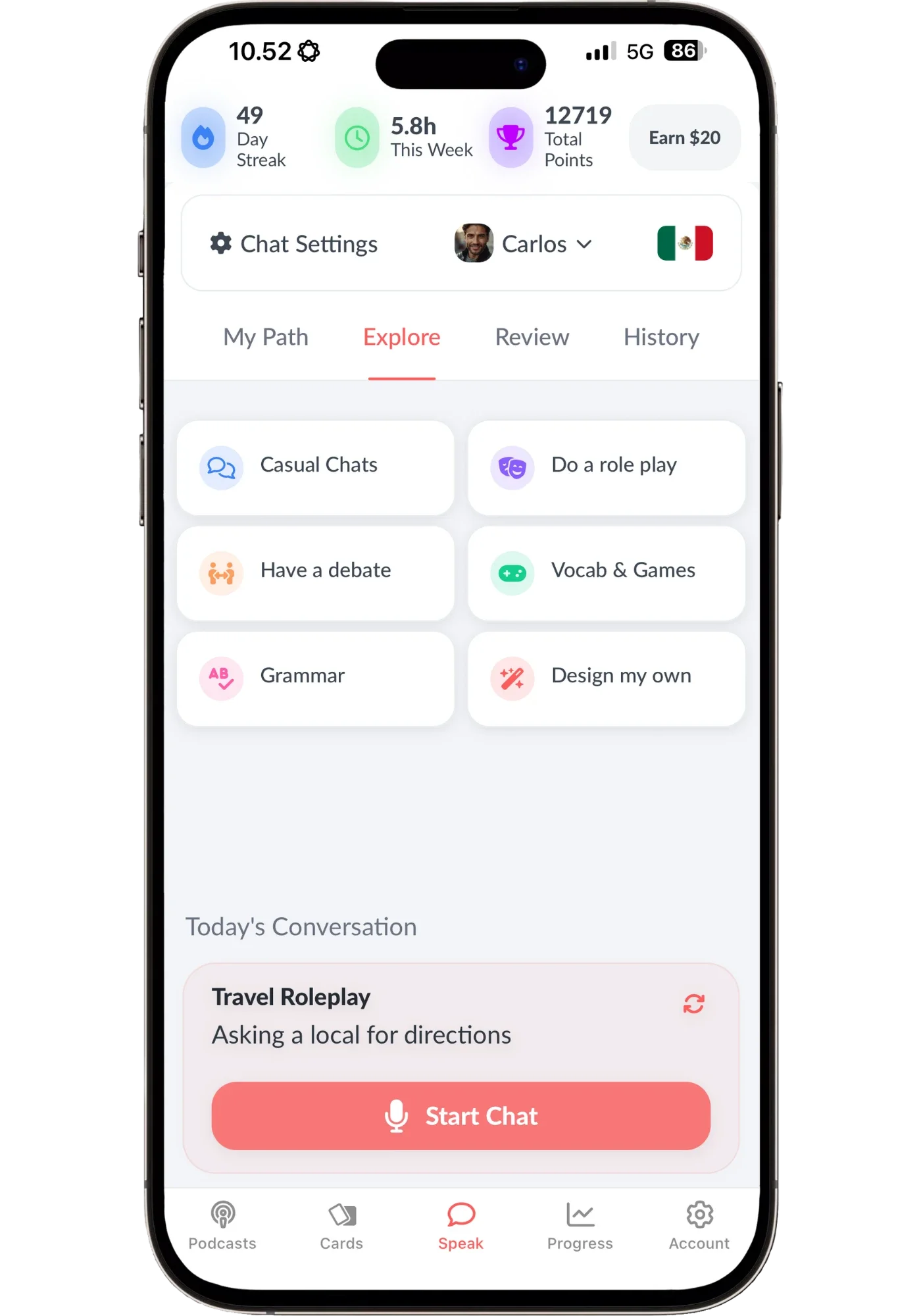
The Explore tab: pick a type of conversation, or design your own.
Roleplay: My Friend Joe at a Café
To give you an idea of these conversations, let me take you to a local café in Spain with my AI tutor.
In the beginning of our chat, I told the AI tutor Alberto (who speaks with a Castilian Spanish accent) to:
“I’d like you to pretend you’re my friend Joe and that we’re having coffee at a coffeeshop on a Friday after work.”
The AI tutor immediately switched to a much more relaxed way of talking. He started calling me tío (the Spanish version of “dude”) and used more local Spanish slang — just like someone would when having a relaxed chat with a friend. I did tell him to give me feedback if I made a mistake, which he did just in passing while continuing the conversation. This helped me clean up some of my mistakes, while still keeping the flow of the conversation going:
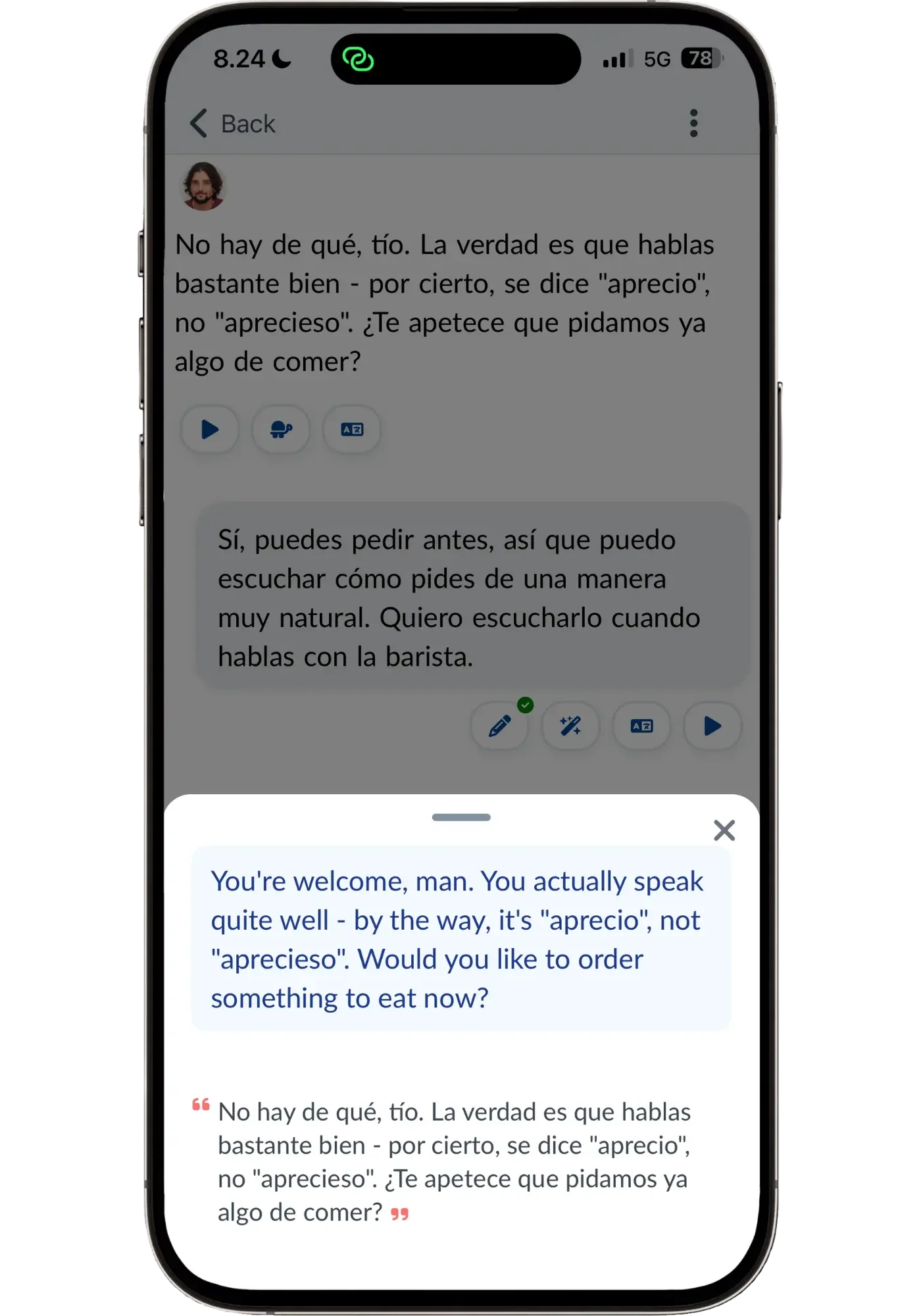
Correction for ‘aprecieso’ to ‘aprecio’ in the flow of conversation
I also picked up some new local Spanish slang phrases, like: ‘fijo’ (literally means “fixed”, but is slang for ‘I agree’), ‘dale’ (‘let’s do it’) or the phrase ‘no hay de qué, tío’ (‘you’re welcome, dude’).
I sometimes clicked the pen icon on a message I just sent to see if there were any corrections. One example of these was: “cuando hablas”(“when you speak”) should have been → “cuando hables” (“when you will speak”) since it needed the subjunctive for that particular structure.
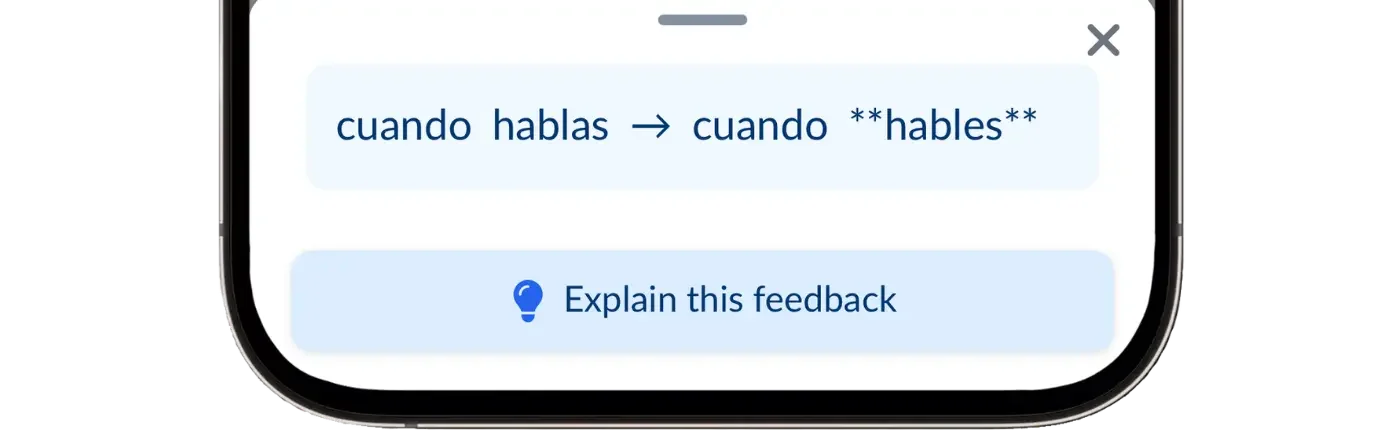
What it looked like when I clicked the pen icon and got a grammar correction for ‘cuando hablas’ to ‘cuando hables’.
Langua’s real-time corrections are exactly what I need to sharpen speaking and listening naturally. It also helps me gain confidence that I’m using the correct grammar, which reduces hesitating when speaking.
Just for fun, I asked Joe to order coffee for us so I could hear how natives do it. This ended up being quite funny, since the AI was talking to someone else (the barista) and not me. It cracked me up when he said “guapa!” (“beautiful!”) to address the barista in the coffeeshop. I didn’t expect him to say that. To me it came off as flirty even, but turns out that’s not necessarily the case (more on that below in the feedback section).
The relaxed way he said it with his comment — “that’s how we usually order here” — further added to the feeling of actually being there in that coffeeshop.
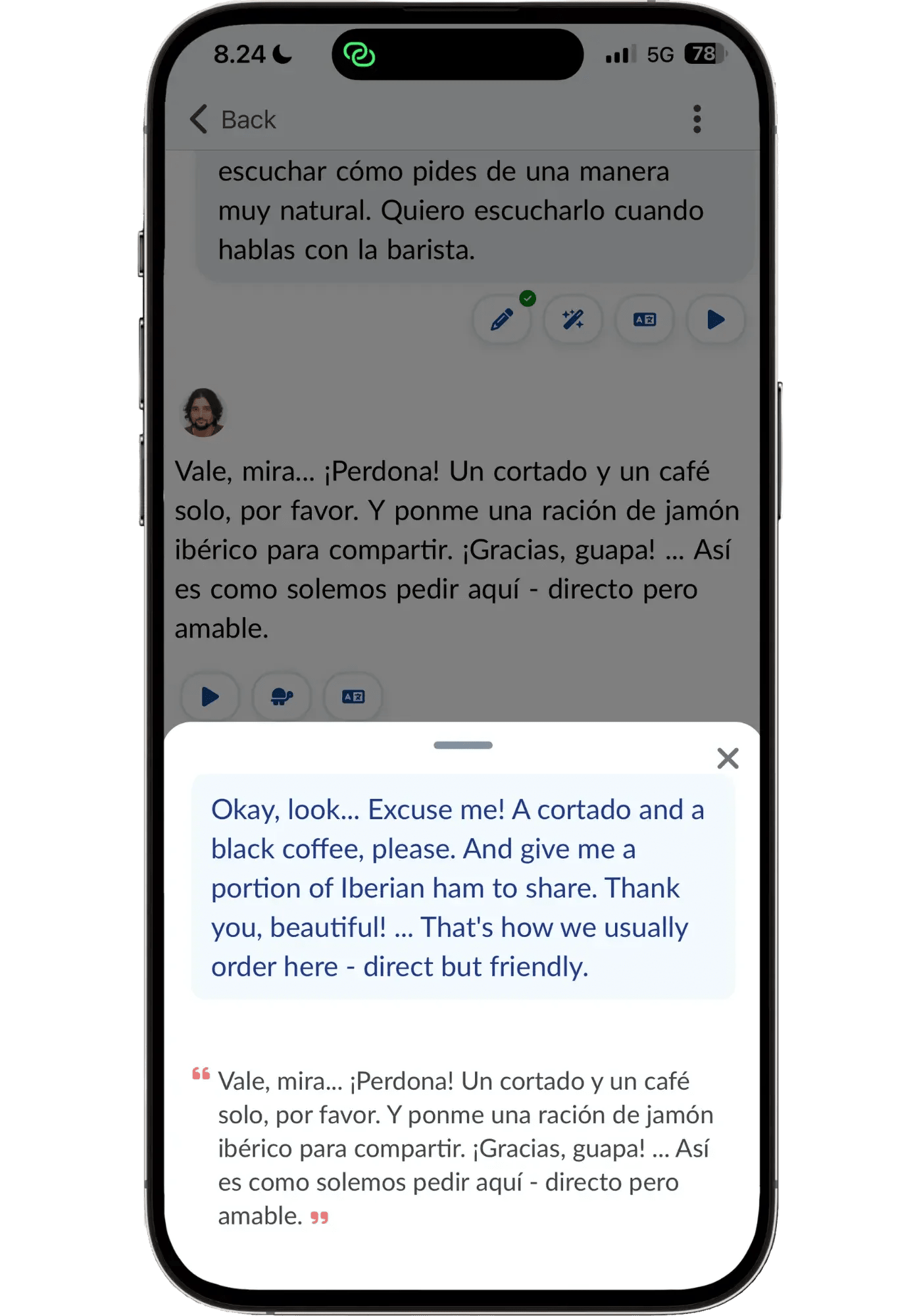
We covered topics like: Mac computers, his new dating relationship, and the ambience of the coffee shop — which stretched my vocab in new ways.
I could literally imagine sitting with someone in a local café in Spain and imagine what it looked like there. How real these situations feel is one of the reasons Langua stands out. I haven’t really felt that with any other AI speaking app that I’ve used. And the language learning features are seamlessly integrated for whenever I need them.
Our café chat is an example of how to practice speaking with AI in a way that is not only helpful but actually engaging.
What the AI Tutors Actually Sound Like
By now you’re probably wondering what the AI tutor actually sounds like. Here are some examples in different languages to give you an idea.
‘Alberto’ in Castilian Spanish:
‘Maria’ in Finnish:
‘Lucy’ in British English:
Their natural way of speaking is exactly why Langua's conversations feel so engaging to me.
I even know someone who lent their voice to Langua — and it sounds exactly like them! Some languages even feature voices from famous language YouTubers.
Want to hear how these voices compare with other AI apps? I put them side by side in a 46-second video in my test of the five best AI speaking apps.
Some languages, like Spanish, include regional dialects from multiple countries. And the tutor you choose will even use local slang and expressions from that particular area:
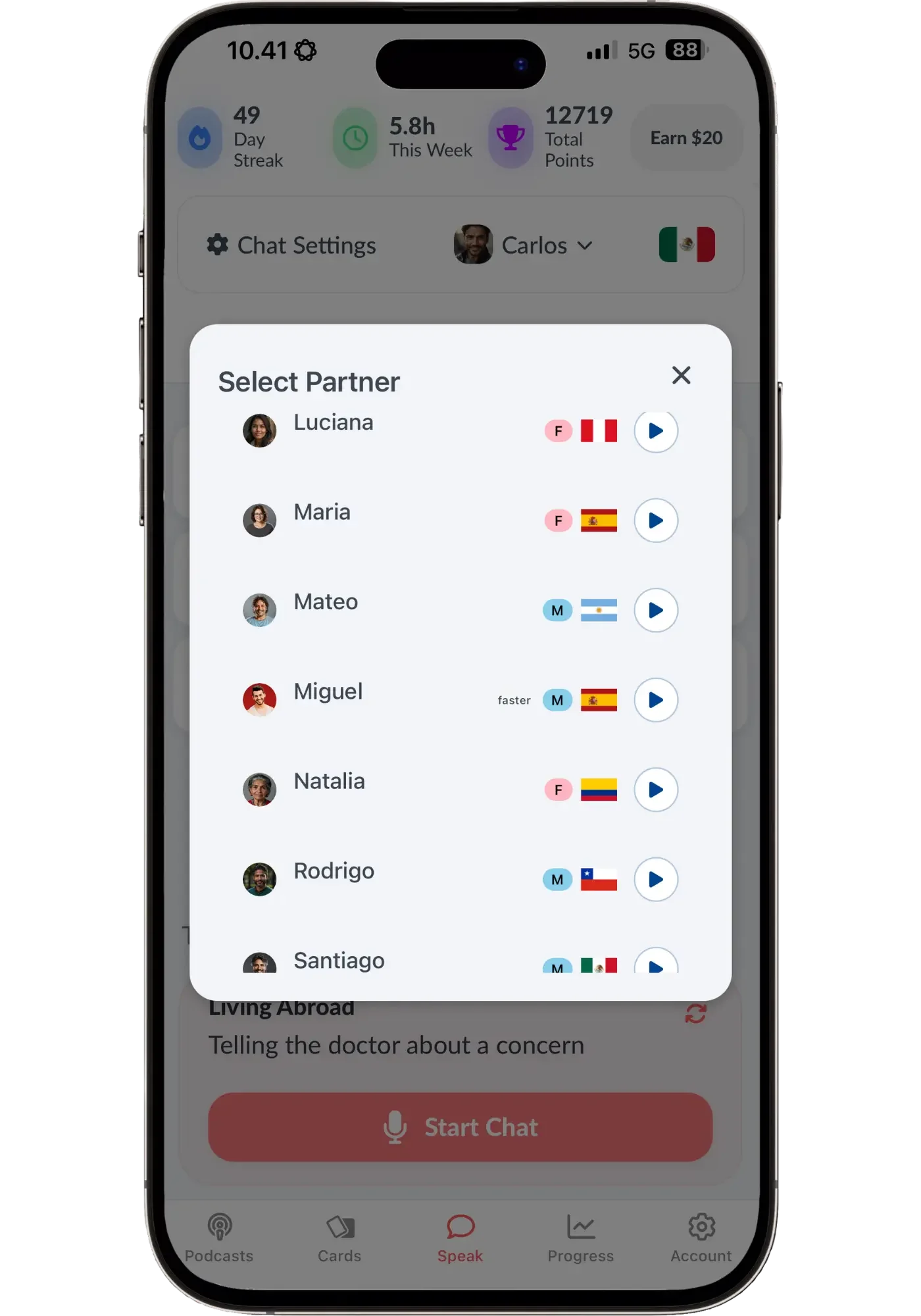
The free plan lets you try a short conversation and hear the voices yourself.
Call Mode
Call mode is the closest Langua gets to a real phone call with a native speaker, and it's one of the standout features for me. There are no buttons to press: you talk, the tutor answers, and you can interrupt each other like in a real conversation. If you hear something you want to remember, just say "save that for me," and it goes straight to your flashcards. And if you say “translate” it will repeat what it just said in your chosen base language (English, for example).
The New Call Mode (Beta)
In October 2026, Langua released a new version of call mode. According to Langua, it hears your voice directly instead of waiting for your speech to be transcribed, so it responds more naturally and ignores background noise. It can also search the internet while you talk.
Here's a real call I recorded the day it came out, about a StarCraft tournament in Korea. Watch for the live searches, how it explains a word I didn't know, and how it saves phrases when I ask out loud, without me having to touch the screen:
In the video, the tutor looks up the day's news, then the results of the StarCraft series I asked about. It also explains a word I didn't know, contundente ("decisive, convincing"), saves the phrase to my flashcards when I ask out loud, and helps me fix a grammar slip: estaba, not estuvo, plus a more natural way to say my sentence with the subjunctive.
My first call with it went the same way: I asked what was in the news, then steered the conversation to the StarCraft tournament. When I asked what its opinion was based on, it said "Déjame revisar eso para no inventar" ("let me check that so I don't make things up"), admitted its first opinion was "más una corazonada que otra cosa" ("more of a hunch than anything else"), checked the results and changed its pick. I liked that phrase so much that I asked it to save it to my flashcards — it did it for me, without me even touching the screen.
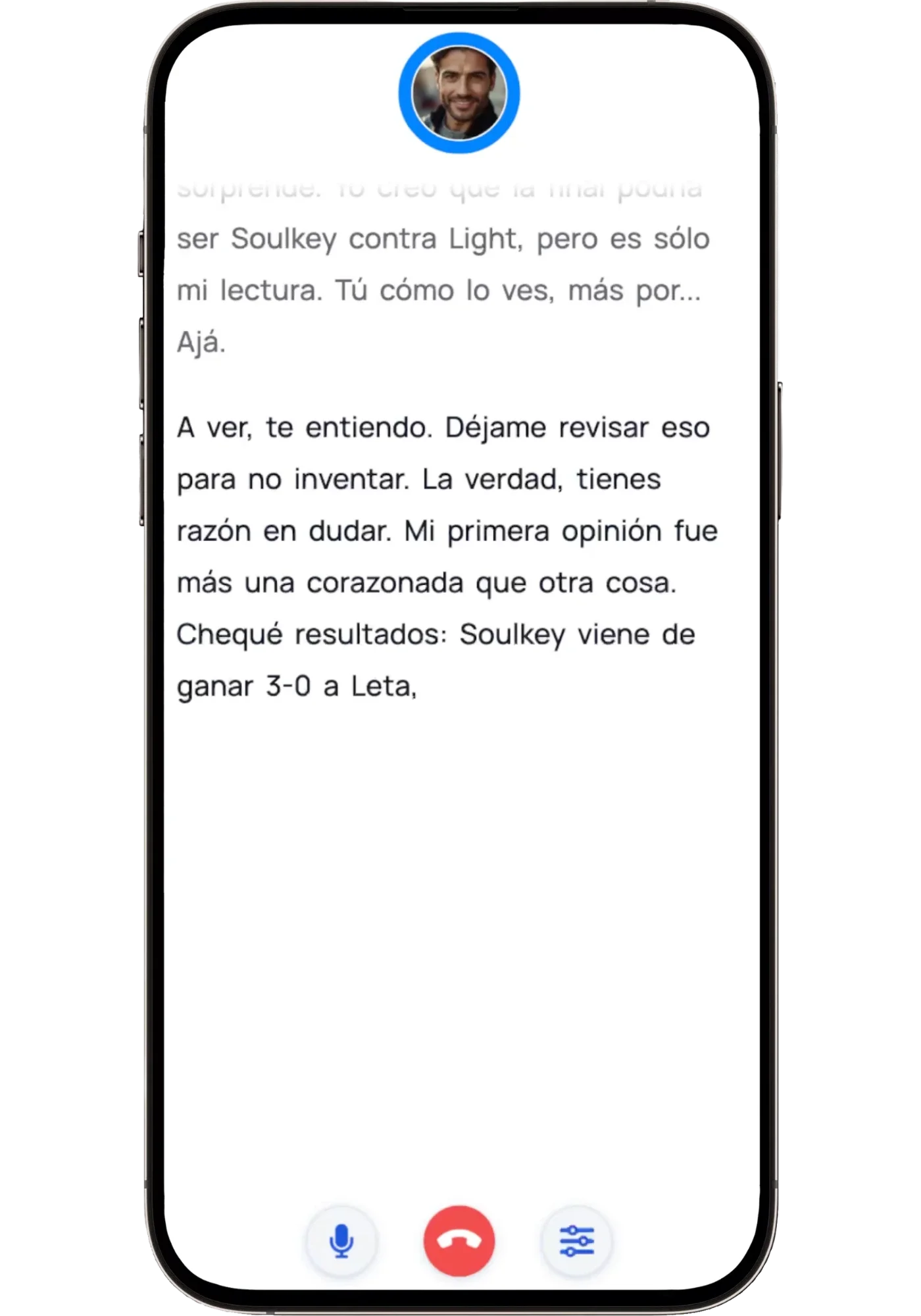
"Let me check that so I don't make things up." The tutor admits its first pick was a gut feeling, then looks up the results.
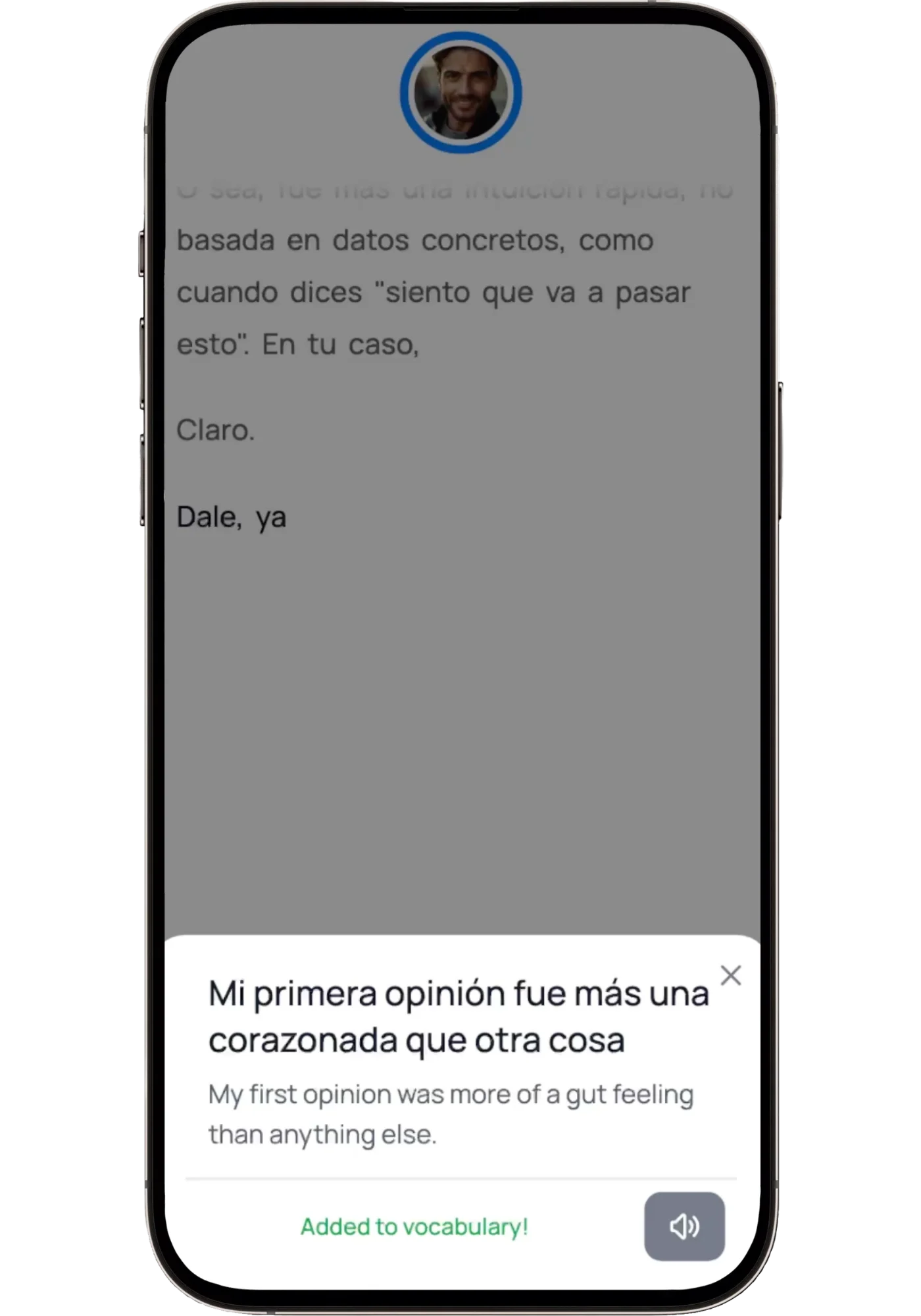
I asked it out loud to save the phrase. It went straight to my vocabulary, without me touching the screen.
New or Older Call Mode?
The older call modes are still there (and their speech recognition has been improved too), and I use both:
The new call mode is better for free conversation. It feels more like a real call: when I say "sí" or "ajá" while the tutor is talking, it keeps going instead of stopping. And being able to ask about the news, or anything else that's happening right now, makes conversations much more interesting.
The older call mode is still what I use for structured practice. The turn-taking is cleaner: you say something, then you get your correction. That's why my Finnish Check-Mark Chat uses the older mode (watch it in the feedback section below). Plus, the old call mode currently has a larger selection of voices available.
A few things to know about the new one. It's in beta, so it shows up as V1 (beta) in your chat settings. It doesn't work in the beginner course yet, and there are fewer voices to choose from for now. Replies still take a second or two, a bit longer when it's searching (funnily enough, it will at times even sort of mumble to itself as it's searching like a real person would). The voice can also sound a bit off at times, like when it read out the news headlines in the video above. And live search isn't always right: in one call it mixed up which season of the tournament we were talking about, so I had to correct it. But as far as conversation flow in an AI app, it's unlike anything I've tried.
Custom Prompts
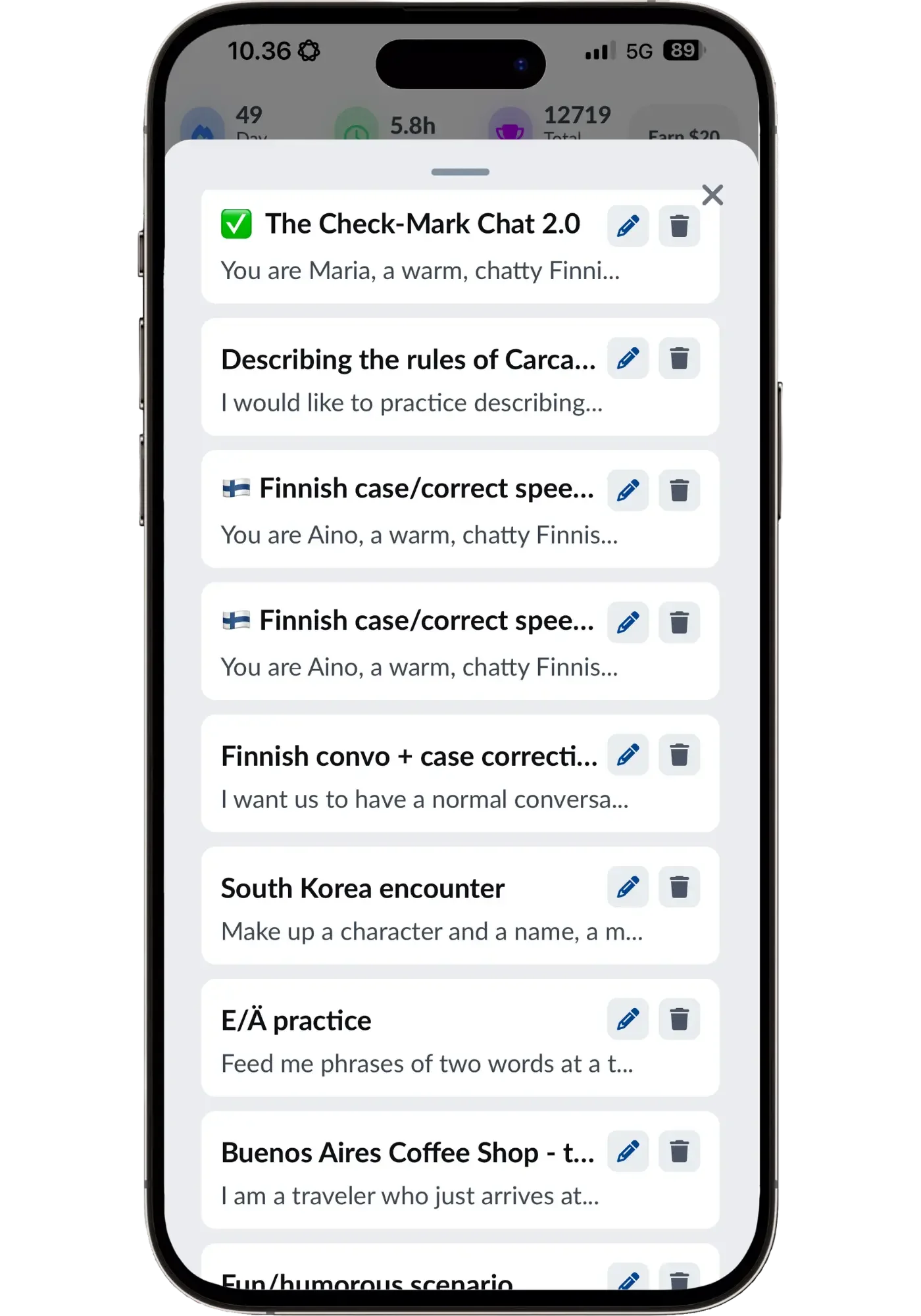
Custom prompts let you set up any scenario or change how the tutor behaves: a job interview, a café roleplay, or a strict grammar drill. You can save them and reuse them whenever you want to practice that way.
My favorite is one I wrote for Finnish, to clean up my grammar and save my corrected sentences while I just talk. Watch me use it in a real Finnish session, plus the full prompt to copy.
What Langua Remembers About You
The more you use Langua, the more it learns specific facts about you — where you live, your favorite movie, what you're currently learning. So you don't start every conversation from zero. It weaves in questions about your life and the things you're actually interested in.
For example, the other day it opened the conversation with “¿cómo va el blog?" since Langua already knows I run a blog called Lingtuitive, as well as other facts, even quite detailed things about my interests.
You can see exactly what it remembers, edit any of it, or delete it under “Memory” in chat settings (scroll down and pick ‘Show advanced settings’ to find it). It won't always use every fact, and in some chats, like role-plays, it doesn't use them at all. And if you'd rather it didn't remember anything, you can switch it off.
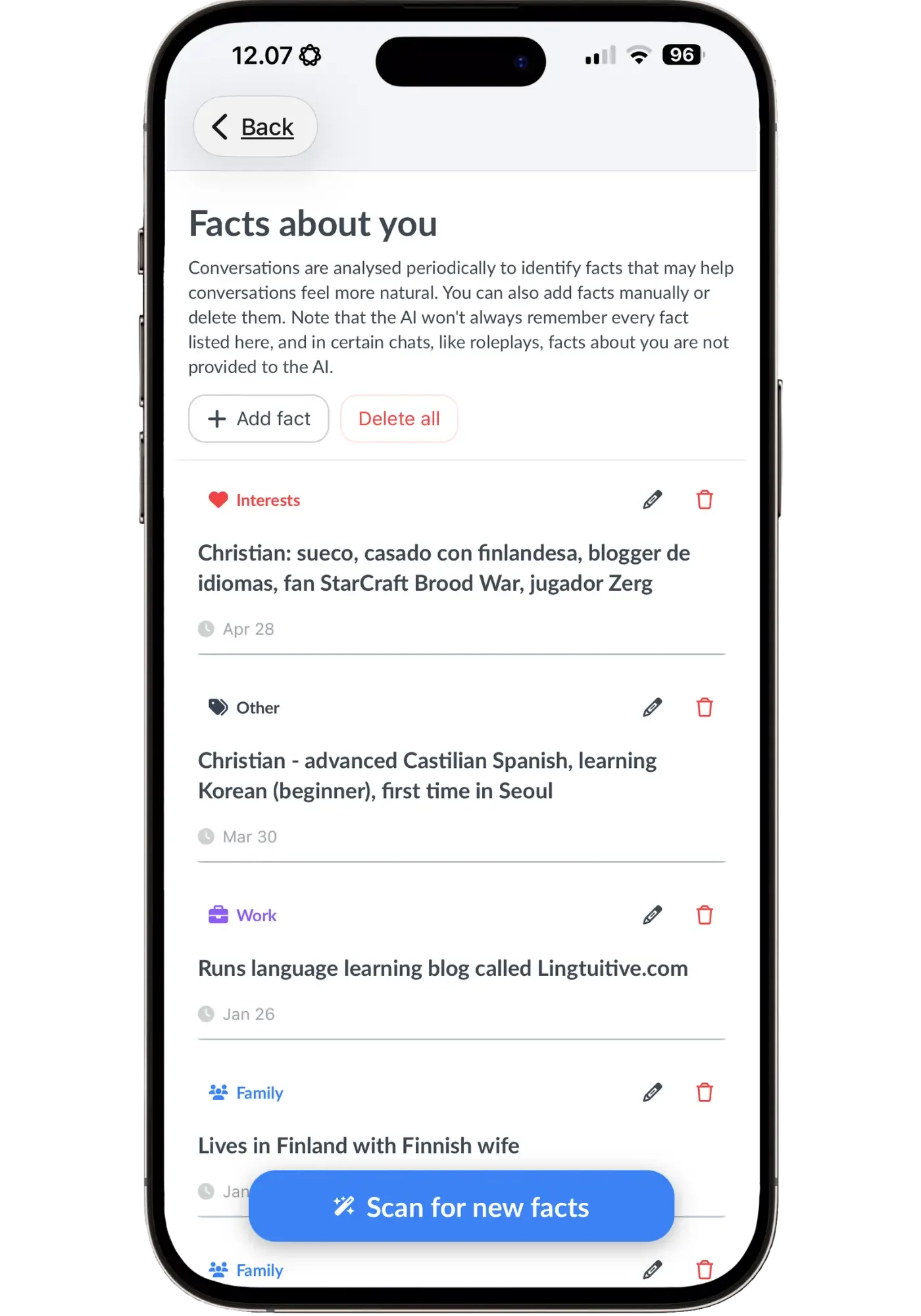
Some of what Langua remembers about me, sorted and dated. I can add facts, edit, or delete any of it with one tap.
Import Your Own Content
Langua also lets you drop your own material straight into a conversation — paste text, upload a .txt file, or upload an audio file — and then discuss it, or have the AI ask you comprehension questions about it. You can switch between chatting about it and listening to the original file right there in Langua, which is convenient.
The text limit is 500,000 characters — which is a lot, since that’s a full-length novel. Audio works the same way (45 minute cap per file), so a podcast episode or a recorded lesson becomes something you can actually discuss rather than just listen to. Anything you import can be saved to "My Imports" to come back to later.
So when you read or listen to something interesting, you can have a conversation about it and start activating that vocabulary in your own speaking, check how well you understood it, or however you’d like to use it.
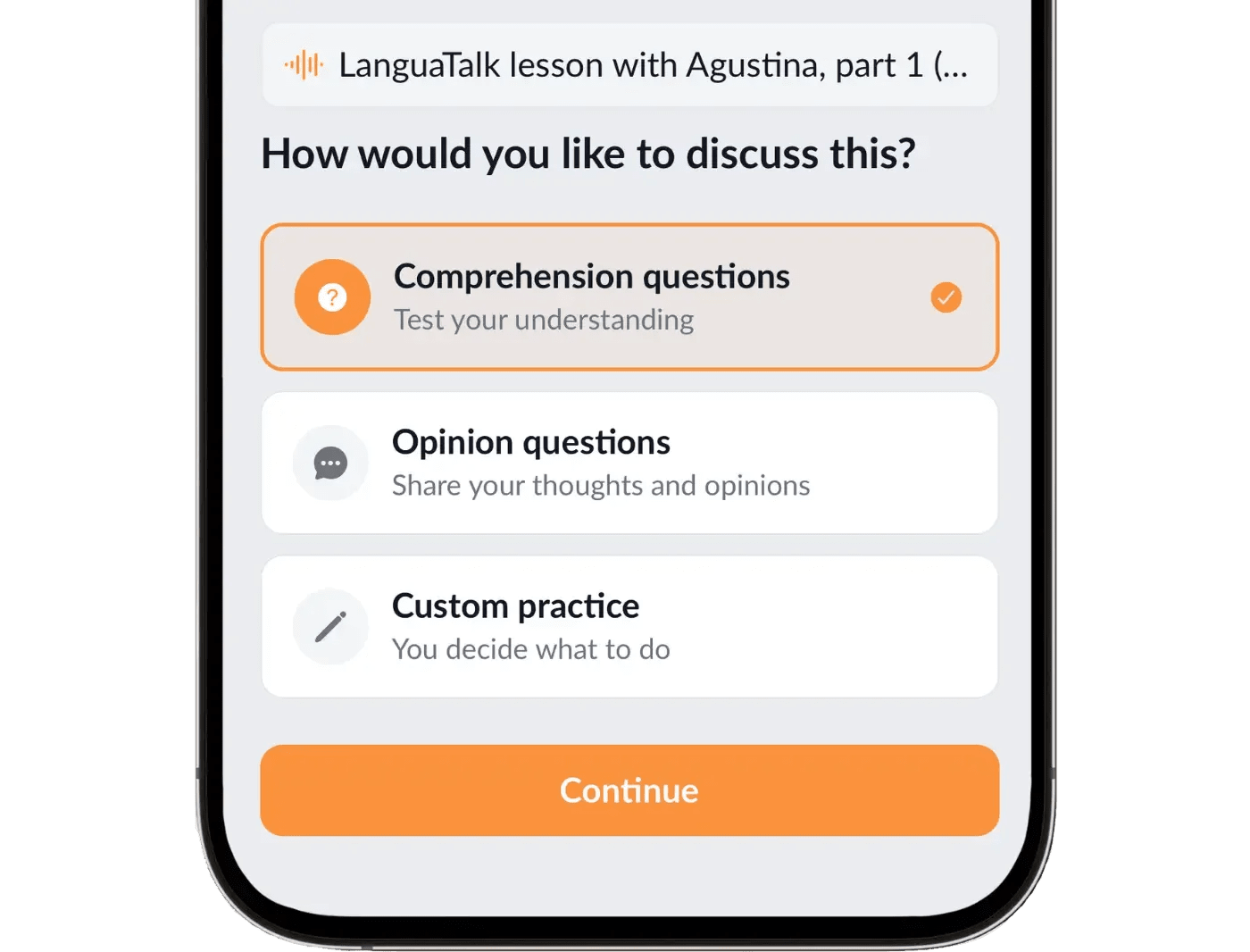
I imported the recording of my last online lesson with my Spanish tutor — Langua transcribed it and then quizzed me on it.
My Path and the Beginner Course
Langua used to be a freeform AI speaking app with little structure beyond the beginner course. Once you were past that, you were on your own, which suits people who like that freedom but not those who want more structure. That lack of structure used to be my biggest criticism of Langua. With My Path, the structure is there now, without giving up the freedom.
Langua's Beginner Course
Langua's beginner course has 40 lessons, and I'm using it to learn Korean. I'm on lesson 10a so far, so I can’t give the full picture yet. So treat this more as a progress report. I'll update it as I go.
Each lesson teaches a few set phrases, like introducing yourself or describing your morning, and the AI tutor walks you through them (with romanization in Korean), and lets you replay them as many times as needed. Then you practice them in a short role-play.
The best part is that you can make the lessons about your own life. The course teaches "I'm from England," but I asked for "I'm from Sweden, but now I live in Northern Finland," and it taught me that. The same goes for "I'm a blogger," "I usually wake up at five" and "when I get up, I make coffee right away" and things like that. It also handled my side questions well, like why Koreans ask your age so early and when saying 당신 ("you") to someone sounds odd.
It doesn't always go along with it right away, though. The course likes to stick to its script, and in a few lessons I had to ask twice before it taught my own sentence instead. My tip: be persistent. Once you've steered it, it's excellent. In a lesson about my morning routine, it went well beyond the script and taught me phrases like 일어나자마자 ("as soon as I wake up") and 아이들이 잠든 후에 ("after the kids are asleep").
Everything I ask for goes into my flashcards. Korean is hard, so I miss most of my cards. But a few days after saving 저는 보통 다섯 시에 일어나요 ("I usually wake up at five"), it came up in a lesson, and I already knew how to say it. That's the whole system working together: learn it in a lesson, review it in flashcards, use it in a conversation.
Note: the cards show “great job!” after you say it, but it currently does this even when you say the wrong thing.
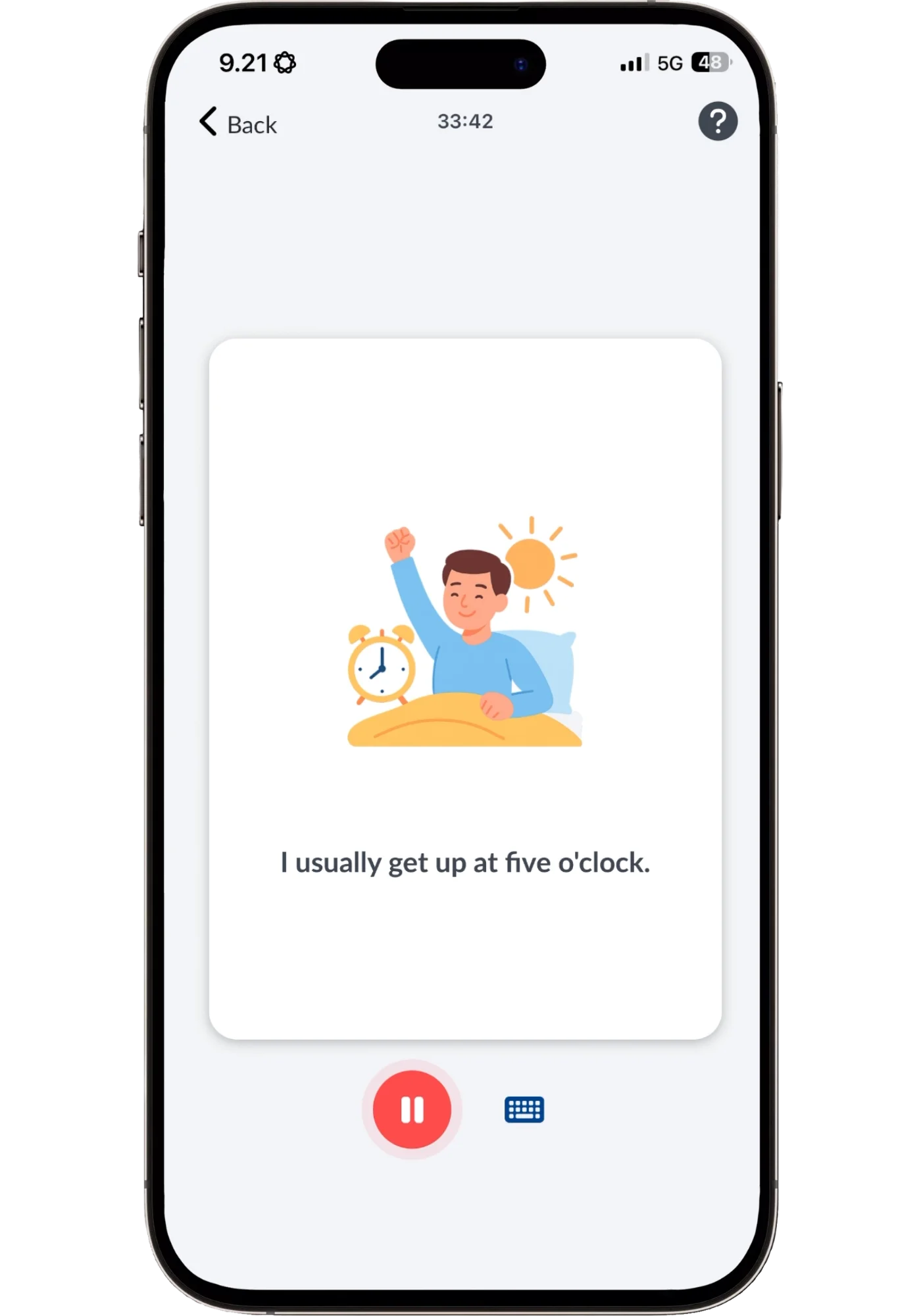
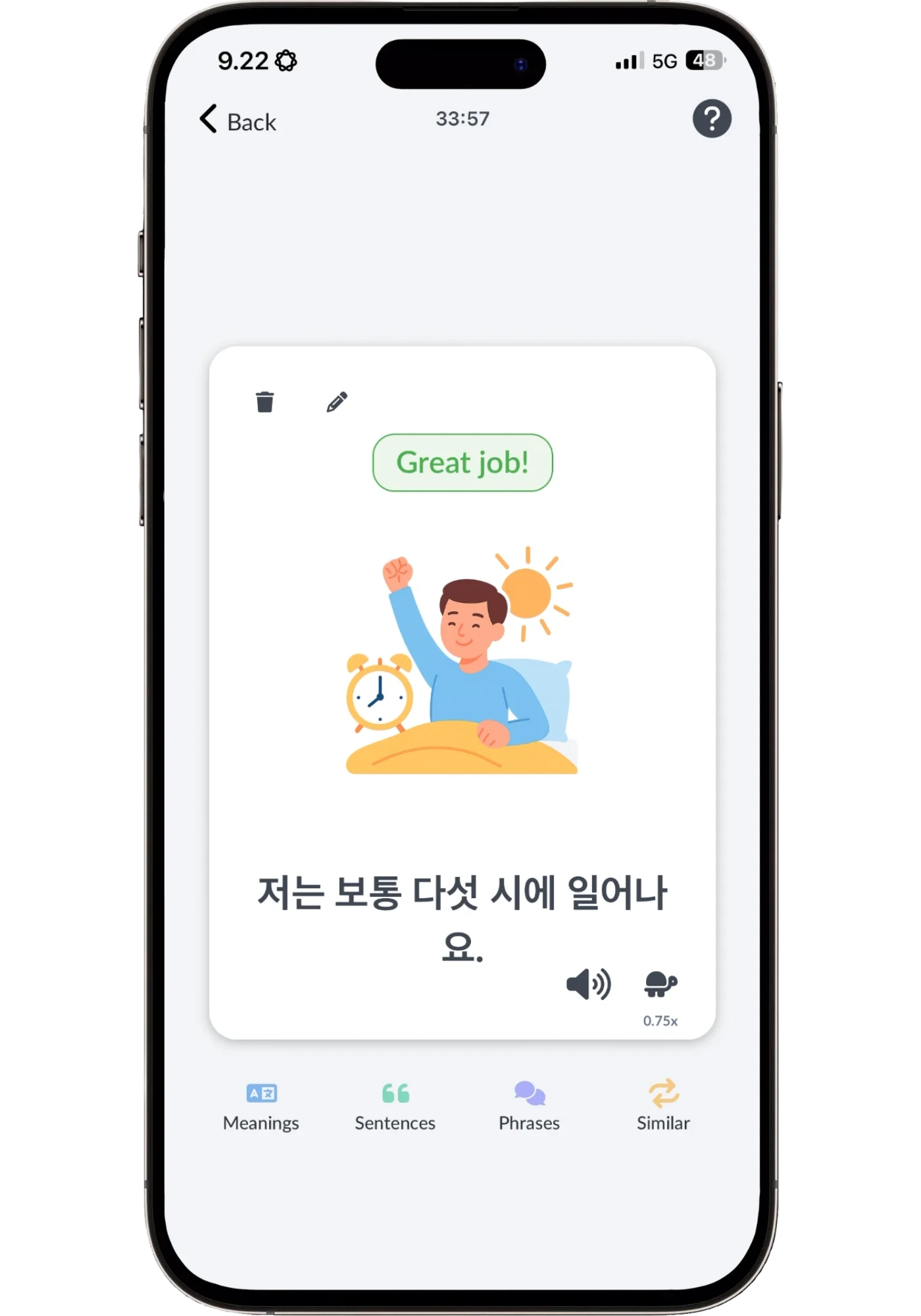
A production card: you see the English, say the Korean out loud, then flip it to check. This time, I really did get it right.
If you're starting a language from absolute zero, the course works, but it's not as hand-holding as Speak. Langua suits you better once you know a little — at least if you’re learning more challenging languages like Korean, Japanese, etc. — and want lessons where you can learn and practice phrases about your life you need for speaking. Also, the lack of romanization help for Chinese and Japanese is a real limitation.
My Path
My Path is a structured flow that lays out different activities — conversations of various kinds, grammar exercises, a round of vocabulary review — and each one you finish unlocks the next. If you grew up on Super Mario World, you already know the feeling: clear the stage, the path opens, keep going.
Plenty of AI apps have a structured path. What makes Langua's different is that it isn't a fixed sequence — it adapts as you go. The grammar exercises target mistakes you've actually made. The vocabulary review uses words you've collected in your own conversations. And the topics come from your interests: for me, in one of the freeform conversation tasks on my path the AI tutor opened up by asking me about South Korea, which is a country I've been fascinated with since I was a teenager — an example of its memory function in action.
I have used the path some in Spanish and Finnish, though I generally do either freeform or some kind of specific practice in those languages. I have enjoyed it and it takes away having to choose what to do on a tired day when you just want the app to tell you. And I really like how it’s built out of your own learning and adapts as you go.
I’ll probably continue on that path once my current Korean beginner course ends, so I’ll update you as I go of how the path works more long-term.
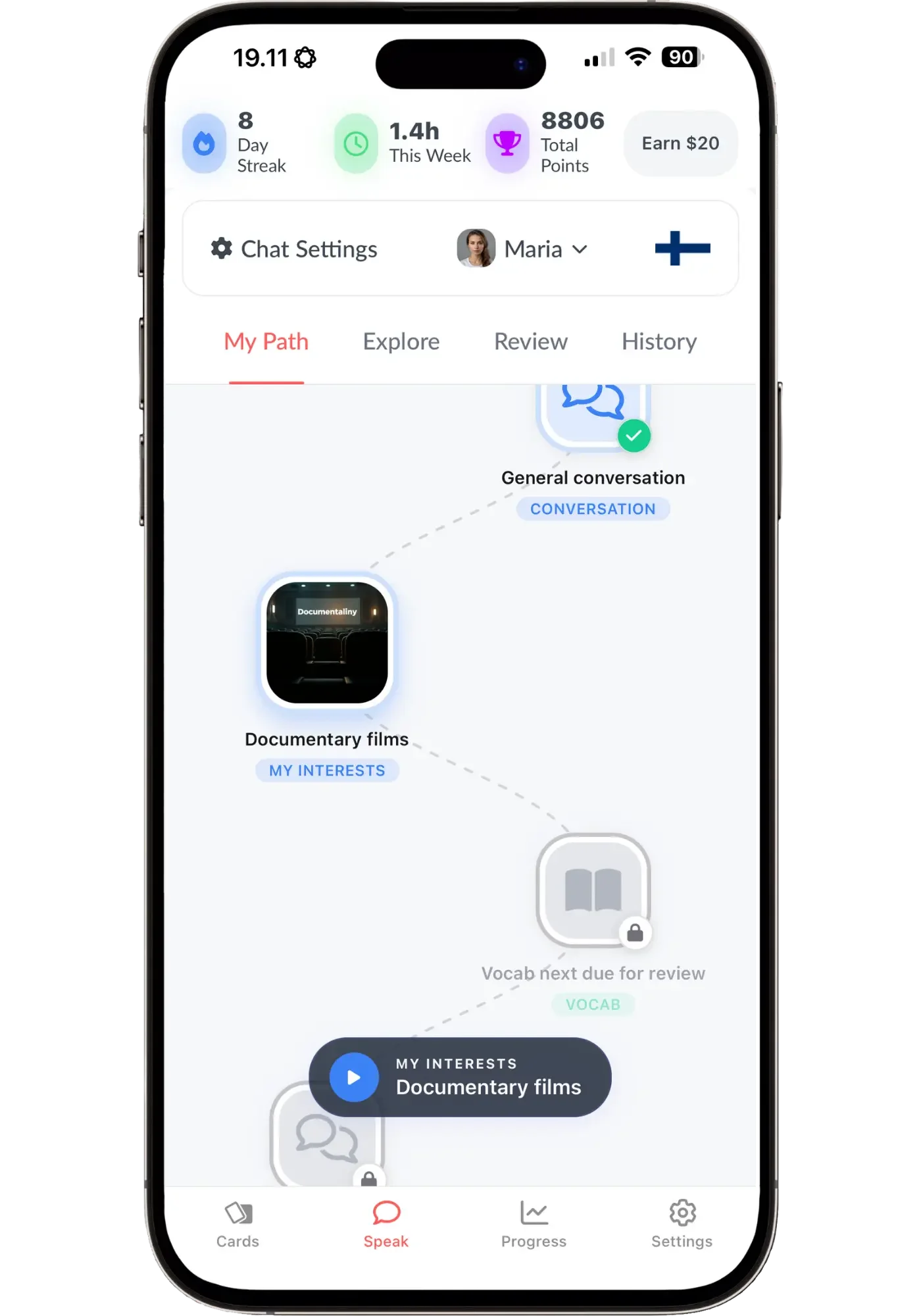
My Path extends and adapts to you — a structure of activities that evolves as you go.
Feedback and Corrections
Speaking practice with AI is valuable largely because it's completely judgment-free — you can say things badly, as often as you like, with nobody watching. But to really improve, you also need to find out what you got wrong. In Langua that happens at three separate moments: while you're talking, right after the conversation ends, and later when you come back to review.
Correction Modes
You can tell the AI how you want to be corrected mid-chat. But there's also a setting for it, with five options: off, text corrections below your replies, implicit corrections, explicit corrections, or being asked to repeat the correction out loud.
For keeping the conversation flow going, while still getting the benefit of corrections, the implicit option is the one I’d recommend. Instead of stopping to spell out the error, the AI folds the correct form into its own reply. If you say "yesterday I went to store" it might answer something like "oh, you went to the store yesterday?" — you get the correction, without interrupting the conversation. Teachers call this a recast, and it's what good ones do instinctively. It's the first time I've seen an app offer it as a setting.
Which mode works best depends on what you're working on and your level. For me it changes by language. In Finnish for example, where I'm working on cleaning up grammar in more complicated sentences, repeating the corrections out loud is what I need.
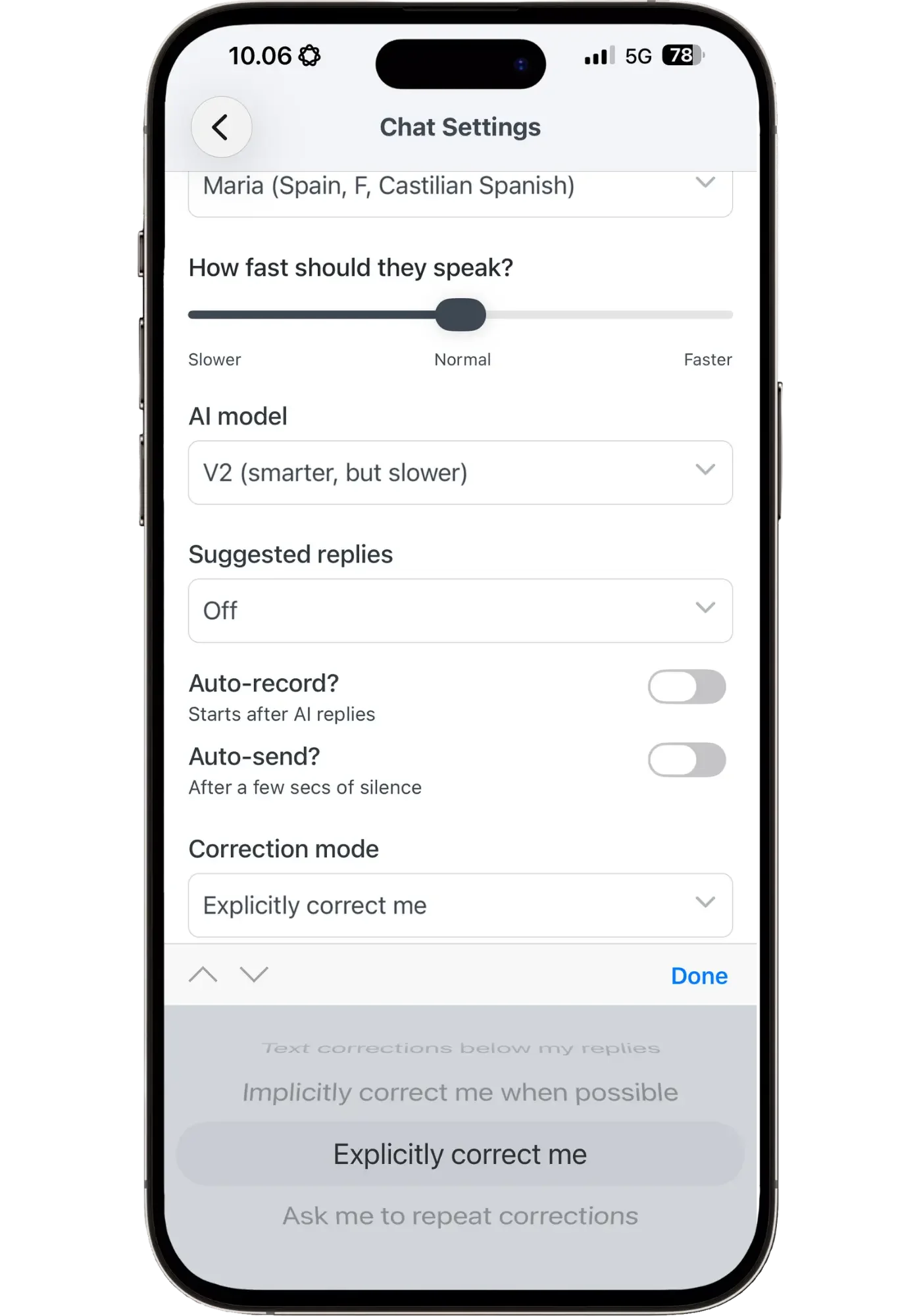
Five correction modes — the implicit one is the interesting one.
This is actually a bigger deal than it might sound, because being corrected in the wrong way is what makes AI practice frustrating. I've used apps that flag every single mistake until the conversation stops being a conversation and just becomes exhausting.
When a conversation ends, you can get a feedback report covering what you did well, what to work on, and every correction from the session. It comes in two versions: written, which you can save as a PDF, and audio, where your tutor reads the report out loud. The audio version ends with new vocabulary you can add to your flashcards with one tap.
The Review tab also suggests grammar lessons, and mine match the mistakes I actually make in Finnish, like the partitive plural.
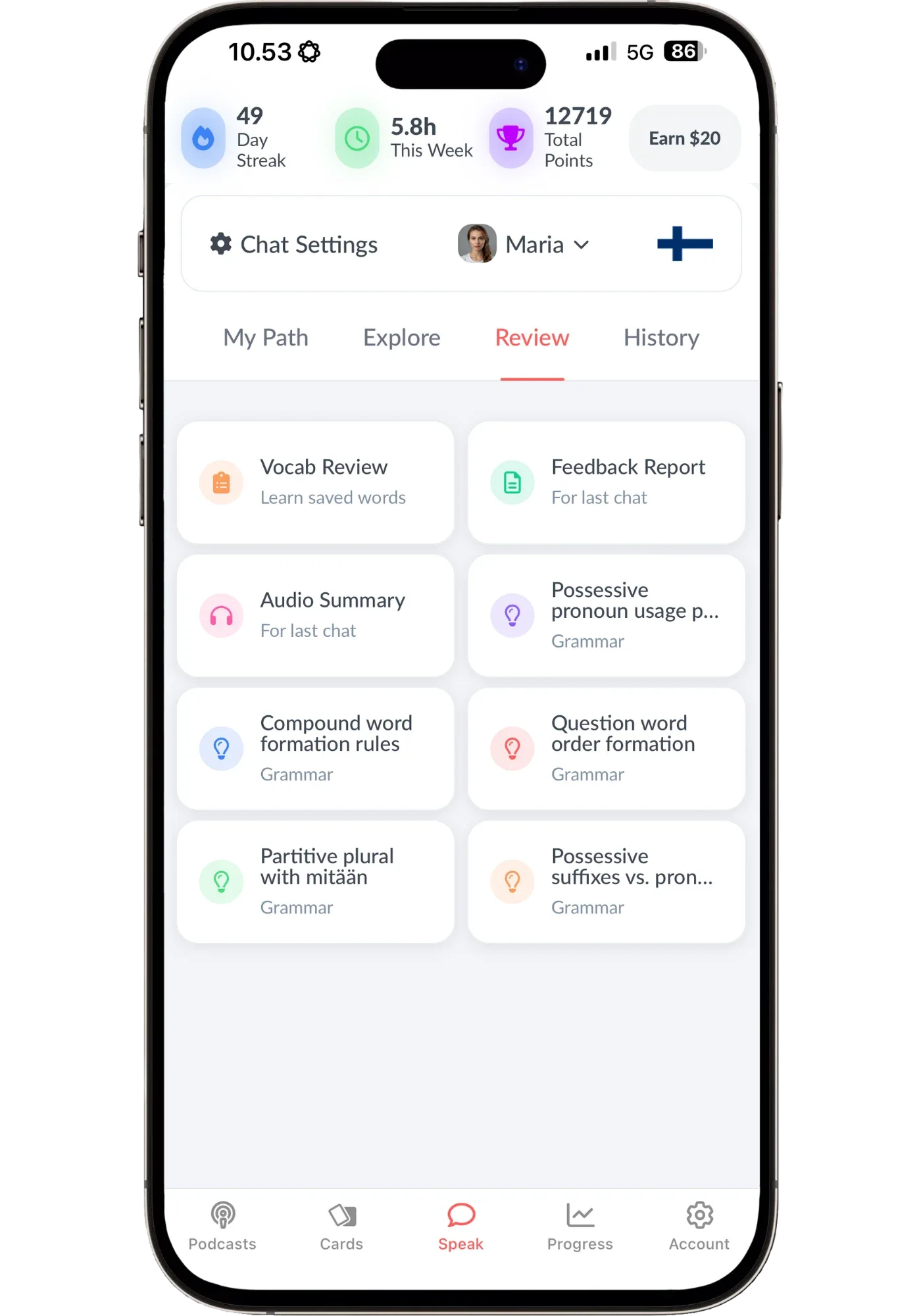
The Review tab after a Finnish chat: my reports, plus grammar topics that match the mistakes I keep making.
The feedback also includes a Cultural Tip based on your conversation. In my report from the conversation with Joe it brought up “guapa” (pretty girl), which he’d used to address the barista in the café. As a Scandinavian I read it as flirtatious. Turns out it wasn’t. That's the kind of useful cultural information you'd normally only find out by getting it wrong in front of someone!
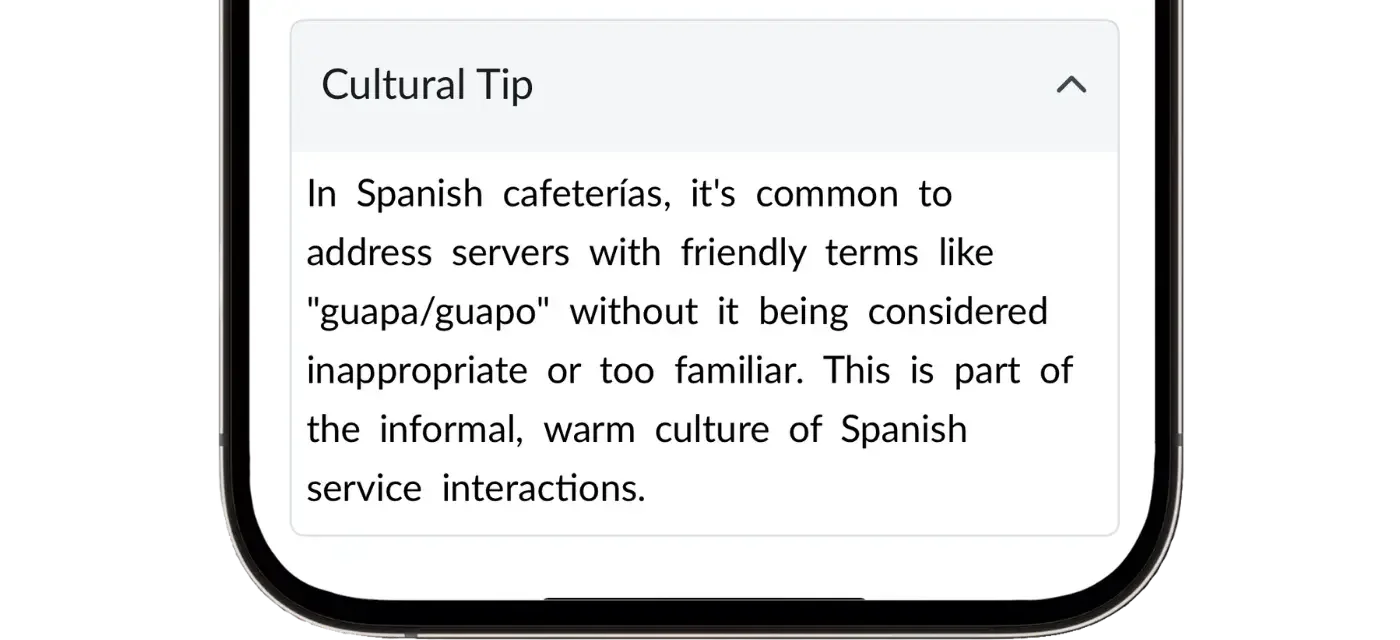
The tip that answered something I'd been wondering about the whole conversation.
Can It Correct Your Pronunciation?
Langua doesn't give pronunciation scores, and I think that's the right call. Apps like Talkpal and Praktika score every word out of 100, but in my testing, sloppy attempts sometimes scored higher than careful ones. What Langua does instead is transcribe what you actually said, so a mispronounced word shows up as the wrong word and the tutor can correct it. You can also listen back to every message you send.
That's how I caught a mistake I'd been making in Finnish for five years. Listening back, I noticed I said "e" more like "ä," an easy mistake for a Swedish speaker. My wife, who's Finnish, said she'd noticed it too. Once I knew, I could fix it (here's exactly how I did it). If you can't hear your own mistakes yet, a human tutor is the better tool for pronunciation.
When Langua Blew Me Away: 15 Corrections Saved in One Go
In Finnish, I use a custom prompt I call the Check-Mark Chat. While we talk, the tutor marks each corrected sentence with a ✅, without stopping the conversation. When I say "Review," it lists every corrected sentence from the chat.
The part that blew me away came next. The first time I asked it to save all of them to my flashcards, it did it in one go, so I didn’t have to save each one by hand. Then I practice them separately to ingrain natural Finnish word order and sentences.
Here's a session where I did exactly that, in the older call mode, which I find works best for this kind of structured practice. It has English subtitles and is edited for length, but the tutor's response times are unedited, and the saving at the end is sped up 4x:
This is a workflow I only found through experimenting and using it a lot, and it's now how I practice Finnish in every conversation. I just talk, it targets the specific challenges I have in Finnish, and the polishing happens in the background. I don't have to think about corrections in the moment, since they'll all be saved for later.
It isn't flawless, though. A few things I've run into:
It once backed down from a right answer. When I questioned one of its corrections, it agreed with me and saved my wrong version instead.
It sometimes stumbles. In this same session, one correction came out half-finished. When I asked about it, it apologized and finished the sentence.
It doesn't always save exactly what you asked for. Once it reworded a phrase before saving it. The new version was actually more accurate, but you might need to edit some of the cards.
Replies take a few seconds in the older call mode. It's quick enough for a natural conversation, but not instant.
None of these change how useful it is for me. But it's an AI tutor, not a teacher, so while I found it to be mostly highly accurate it’s not 100%.
Want to try it? Here's the exact prompt I use. Swap in your own language and details:
You are Maria, a warm, chatty Finnish woman in your mid-30s from Tampere. You're easygoing, curious, and a bit funny. We're having a natural, relaxed conversation entirely in Finnish about whatever comes up: everyday stuff, my day, opinions, small stories. Talk to me like a real friend: react, ask follow-up questions, share your own thoughts and little anecdotes. Keep your turns fairly short (2–4 sentences) so it's a real back-and-forth and I get to speak a lot.

How you speak: relaxed spoken Finnish the way people talk in Northern Lapland, because that's what I hear every day. Use "mie" and "sie", but "minun" and "sinun" (never "miun" or "siun"), and spoken forms like "oon", "oot", "tiiän", "nähä". Use the same forms in your corrections.

My Finnish comprehension is high, but my spoken confidence and accuracy lag, especially noun/verb cases and word endings. How to handle my mistakes:

- Give up to THREE ✅ lines per turn. Prioritize real errors (case ending, wrong word, grammar, unnatural phrasing, or something that came through garbled as the wrong word, usually a pronunciation slip). If there's room left, you may also include a sentence that came out noticeably hesitant or clumsy. If everything I said was natural, skip the ✅ lines.
- Write each one as the full corrected version of that sentence, the way I should have said it, on its own line at the start of your reply:
✅ [corrected sentence]

Stay fully in character as Maria; the ✅ line is the only time you step out of the conversation. Don't suggest exercises, drills or changes to how we're doing this unless I ask.

If I ask a question about Finnish, you know the language inside out: answer it clearly and in as much depth as I ask for, including why it works that way and what makes it tricky for learners. Then go back to the conversation.

When I say "review", list every ✅ sentence from our whole conversation as a clean numbered list, with nothing else. If there are more than 15, give the first 15 and wait until I say "jatka" for the rest.

Start by introducing yourself briefly and asking me one easy opening question.
Copy it, then paste it into Langua as a custom prompt, and adapt it to your language and preferences.
Saving and Reviewing Vocabulary
This is one of the parts of Langua I'd miss most if I switched apps. In Langua, you can save anything you hear or read, and it comes back to you later: in flashcards, in stories, in your next conversations and things you’ve saved will even show up on My Path. It's the deepest vocabulary system I've found in any AI app.
Saving Whole Phrases, Not Just Words
You can save a single word, but I almost always save whole phrases or sentences. You tap the first word of a phrase and then the last one, and the whole phrase is saved. This is what I prefer over individual words. A sentence gives you the natural word order and the grammar in use, and it shows how people actually express themselves. Slang and set expressions often make little sense one word at a time.
And in call mode, you don't even need the screen: you just say "save that for me." You can save from almost anywhere in Langua: your chats, podcast and video transcripts, the AI mini stories, and your own imports.
What sets it apart is that your words don't stay in a deck. You review them as flashcards, voiced by the same natural-sounding tutors, and each replay reads the sentence a little differently. I like the variety, though I'd also like the option to stick to one voice.
My one complaint: when I save a long phrase by hand, it sometimes only translates one word of it, so I have to mark it again to get the full translation. Saving by voice doesn't have this problem.
Vocab AI Stories
You can also have Langua write a short AI story with the words you pick. This is a very creative way to review new words for those who don’t like blasting through flashcards review. And it’s something you can do while doing the dishes, driving, and on the go. They feature the same high quality voices as in the chats.
Here’s an example of one in Spanish that I made quite a while ago, so you can hear and see what they sound like:
These AI generated vocab stories are currently only available on the website though, and not the app. And I wish I could reach them on the app since I would then probably use this feature a lot more. I’d love to be able to create playlists of stories for each language I’m learning, featuring new vocabulary.
Human Lessons with LanguaTalk
AI practice gets you lots of speaking time, but it doesn't replace a real teacher. Langua is made by the team behind LanguaTalk, a tutoring platform, and your Langua account works there too, so booking a lesson takes a couple of taps.
Where to find it: tap Tutoring in Langua's menu, and it takes you straight to the teacher page. Or go to LanguaTalk directly.
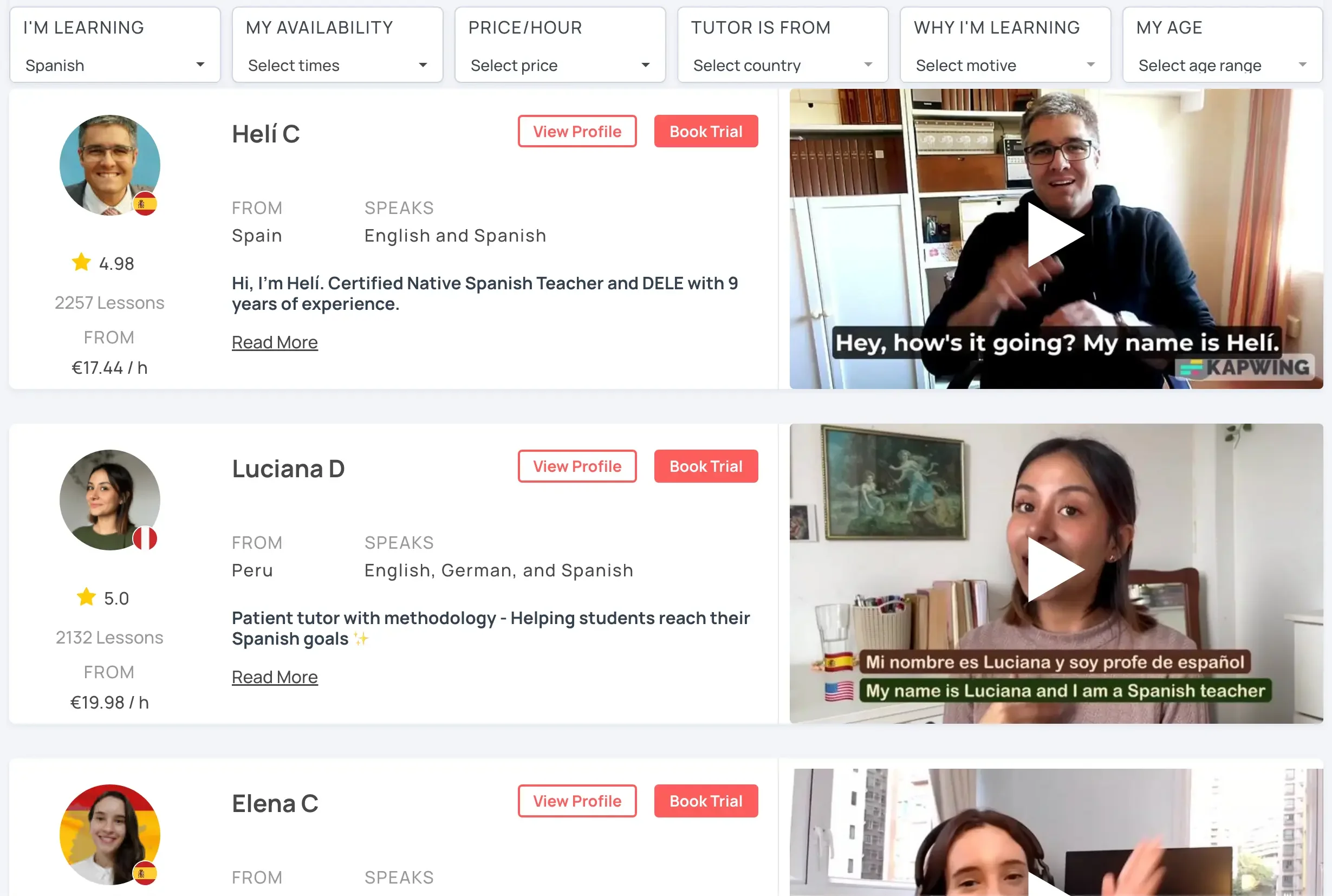
Finding a Spanish tutor on LanguaTalk: filter by price, availability and where the tutor is from, watch their intro video, then book a trial lesson.
Recently, I've been taking Spanish lessons on LanguaTalk, and I use Langua alongside them to save new vocabulary to my flashcards and to practice. For example, my teacher once asked me to pick a board game and explain the rules to her in Spanish. I picked one of my favorites, Carcassonne, and practiced explaining it with Langua first. By the time of the lesson, I already had the vocabulary I needed, so we could spend the time talking and refining things instead of me constantly searching for words. So I think using both Langua and LanguaTalk for practice is the best of both worlds.
Also, if you record your lessons (ask your teacher first), you can upload the recording to Langua and talk about it afterward. Audio files can be up to 45 minutes, and transcripts up to 500,000 characters. When I did this with one of my Spanish lessons, Langua quizzed me on it, and I could keep practicing what we'd covered.
Why LanguaTalk over other tutoring sites? I prefer LanguaTalk over other sites because it's simpler. You pay for each lesson by card instead of buying credits, and your booking is confirmed right away instead of waiting for the teacher to accept. In my experience, the teachers are also more carefully vetted. The trade-off is that a site like italki has more teachers and many more languages. For a language LanguaTalk doesn't offer, like Finnish or Cantonese, I'd use italki.
Langua Pricing and Free Plan
Langua has a free plan and two paid plans, Standard and Unlimited, billed monthly or yearly. Prices are in USD, so yours may differ.
Free
$0
- Short AI conversations to try it out
- One imported transcript a day
- Videos and podcasts
- No credit card needed
Standard
$19.99/month
or $149.99/year
- 75 messages a day, or 30 minutes of call mode
- All languages, voices and features
- Unlimited imports
Unlimited
$29.99/month
or $199.99/year
$159.99/year with code LING20
about $13.33 a month, every year
- No limits on conversations or call mode
- All languages, voices and features
- Unlimited imports
Which Plan Should You Pick?
Start with the free plan by making a free account. It gives you a short conversation and a feel for the app, with no credit card needed.
If you like it, my recommendation is Unlimited, billed yearly, with code LING20. Here's why:
It's the best price for unlimited use: $159.99 a year, about $13.33 a month. And it's not just a first-year deal: the discount stays for as long as you're subscribed. Paying monthly would cost $359.88 a year, so you save about $200 every year.
It's only $10 more a year than Standard, which caps you at 75 messages or 30 minutes of call mode a day.
Langua gets better the longer you use it. My Path builds on your mistakes and saved words, your tutor learns about you, and your flashcard deck grows with every conversation. Besides, the better you get at conversing the more fun it gets using it.
It's less of a commitment than it looks: 7 days free, then a 30-day money-back guarantee.
Only want to try it for a month? That's a fine choice too. Monthly Unlimited is $29.99 with a 5-day free trial, and you can still switch to yearly with the code later.
Good to know: the code and the money-back guarantee only work when you buy on Langua's website, not in the App Store or Google Play. After that, you use the app as normal so it’s only for the payment.
Then add code LING20 at checkout for $159.99/year, every year
How to Sign Up and Add the Discount Code
Do this in your browser, on your phone or computer, not in the Langua app. The code only works on Langua's website. Once you've subscribed, you use the app as normal.
Sign up (free)
Open Langua's website and tap Try it for free
Create your account with Google, Apple or your email. That's it: you now have the free plan, with no credit card needed.
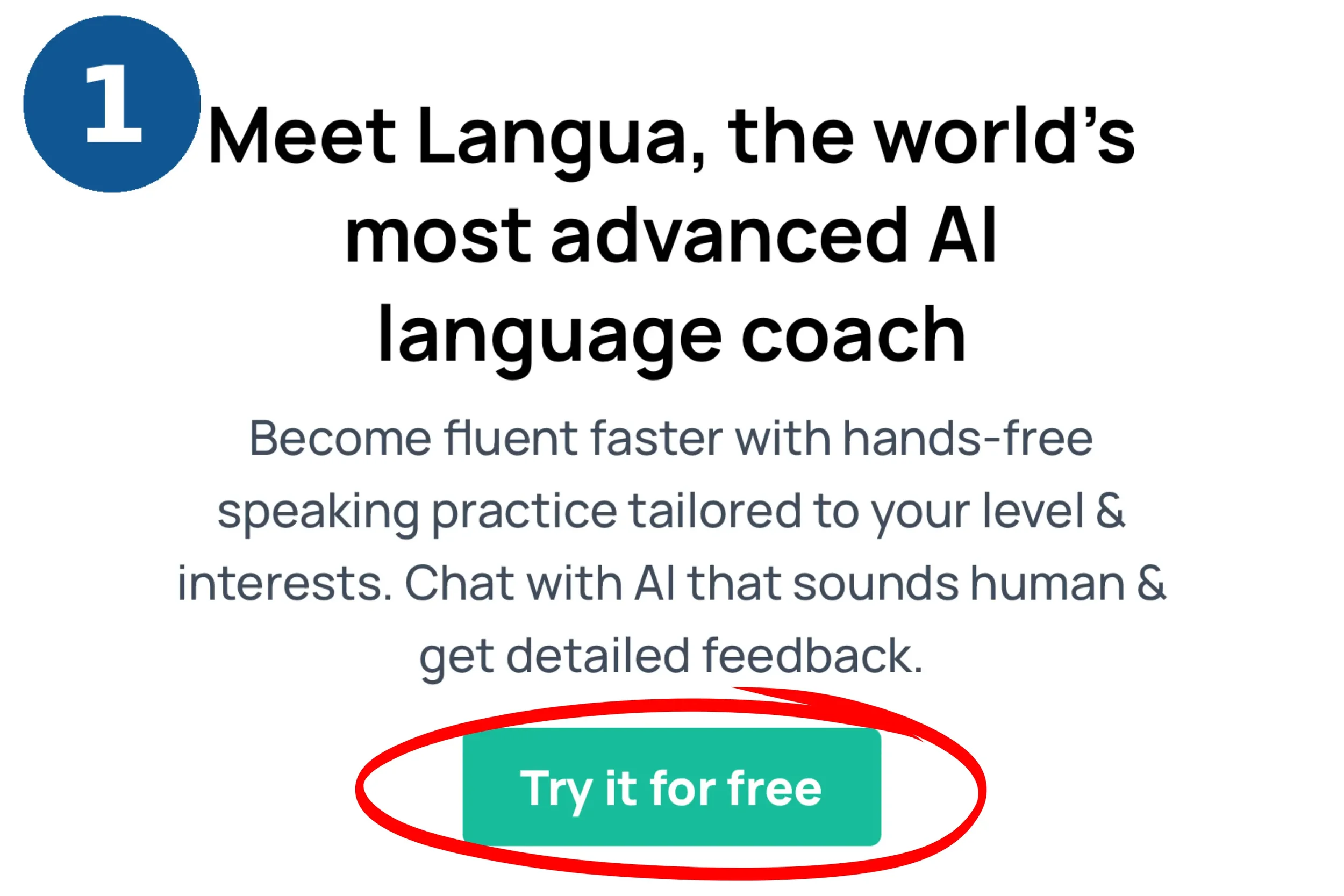
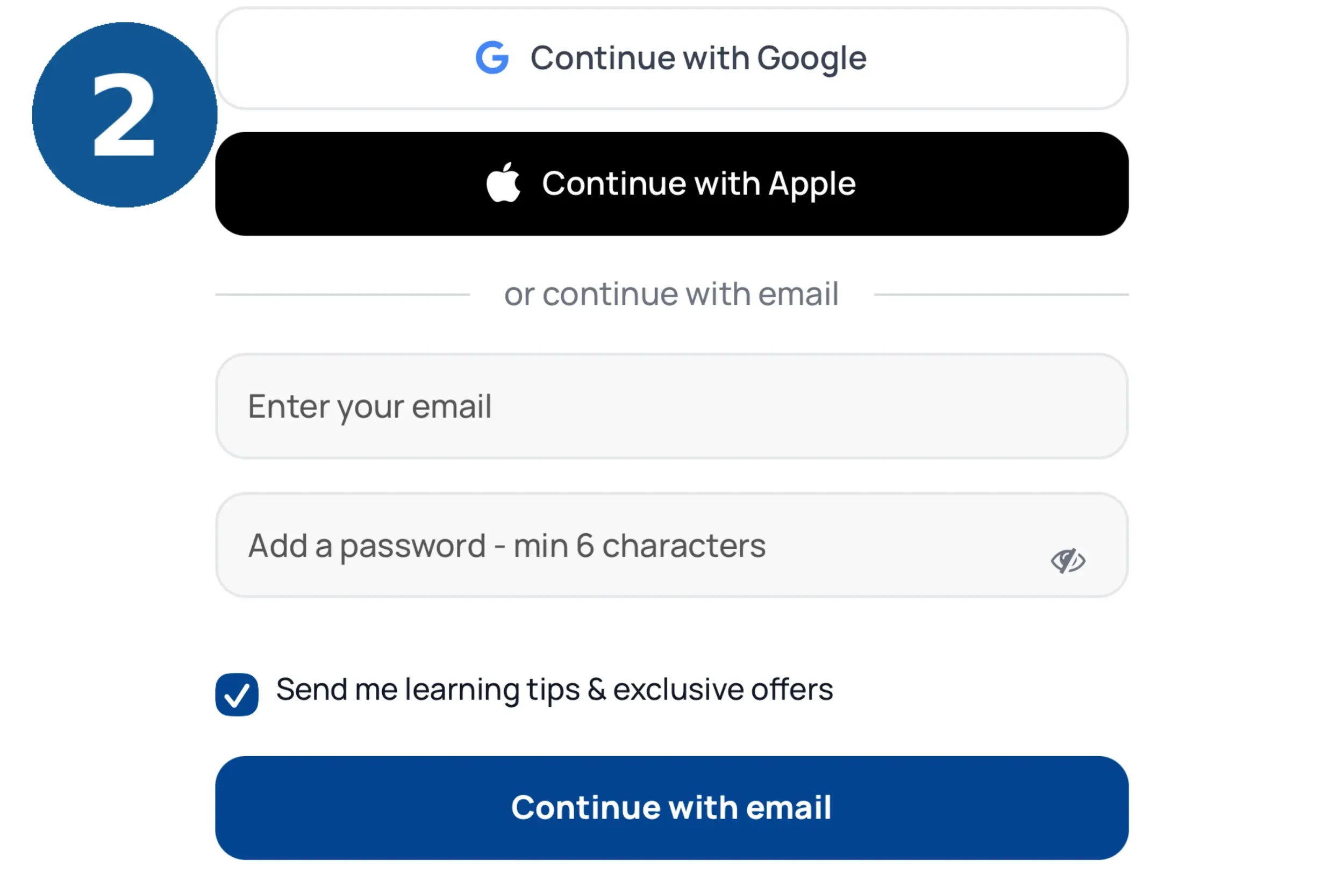
Add the discount code
20% off yearly Unlimited · enter it at checkout on Langua's website
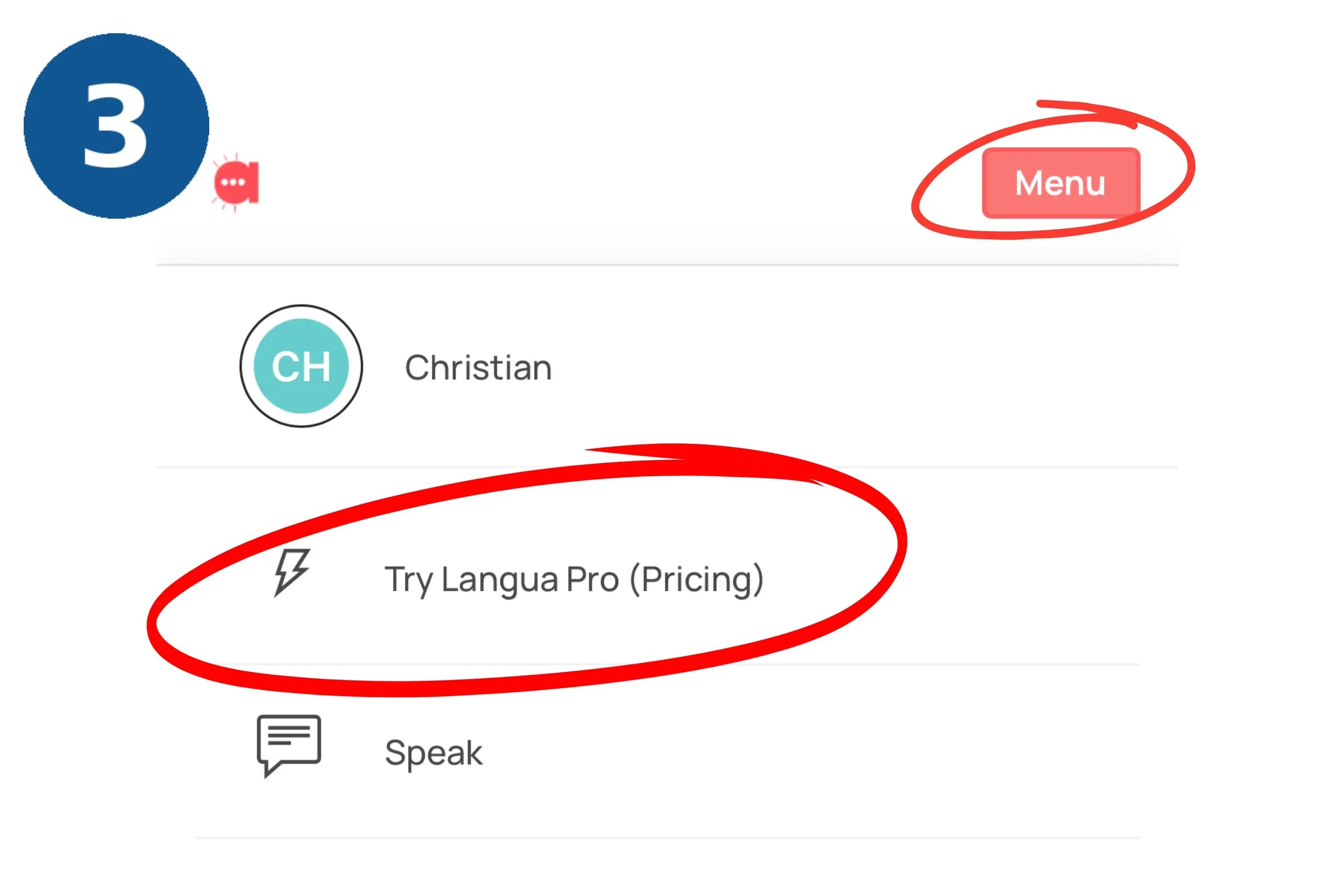
3. Tap Menu in the top right, then Try Langua Pro (Pricing)
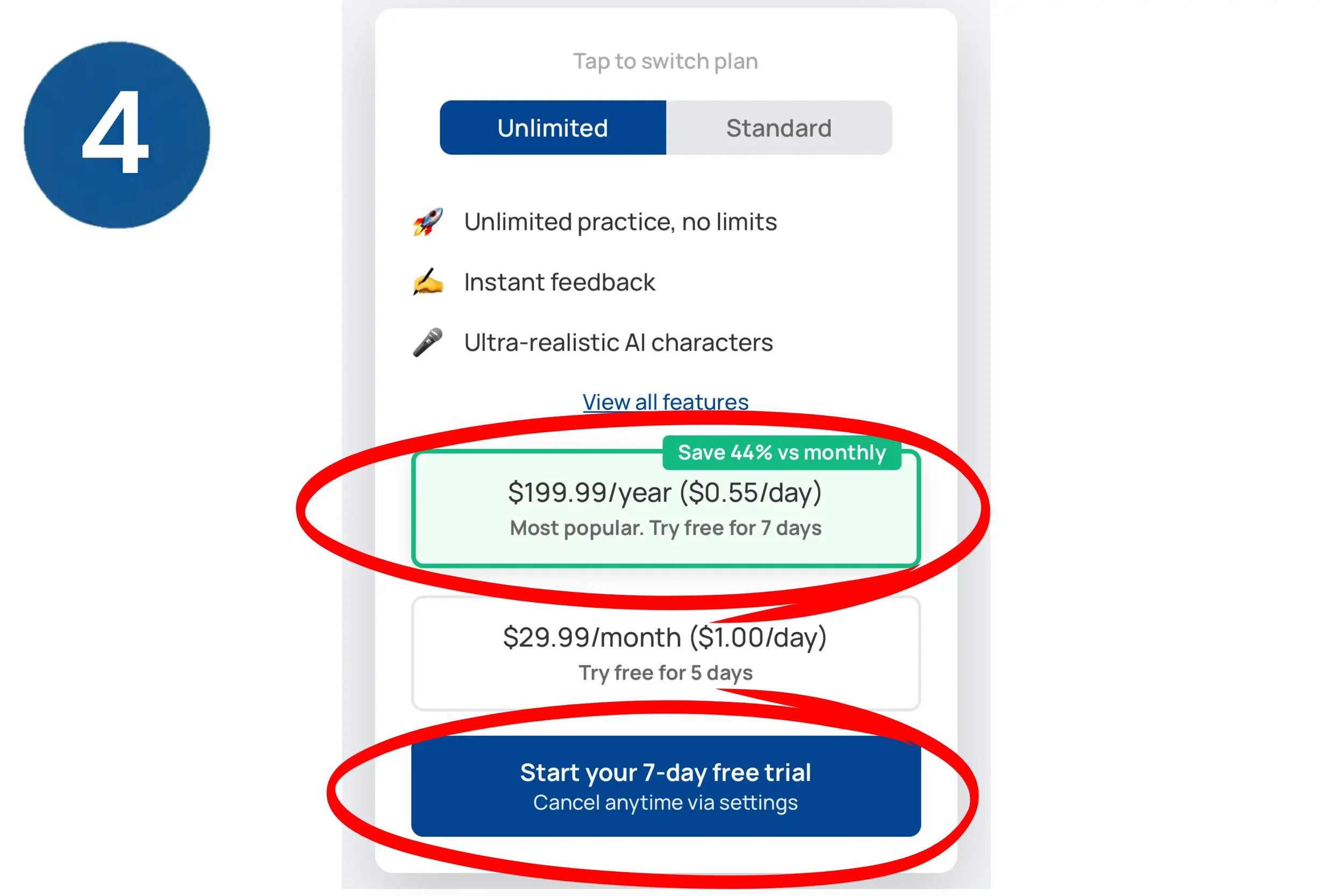
4. Choose Unlimited and the $199.99/year plan, then tap Start your 7-day free trial
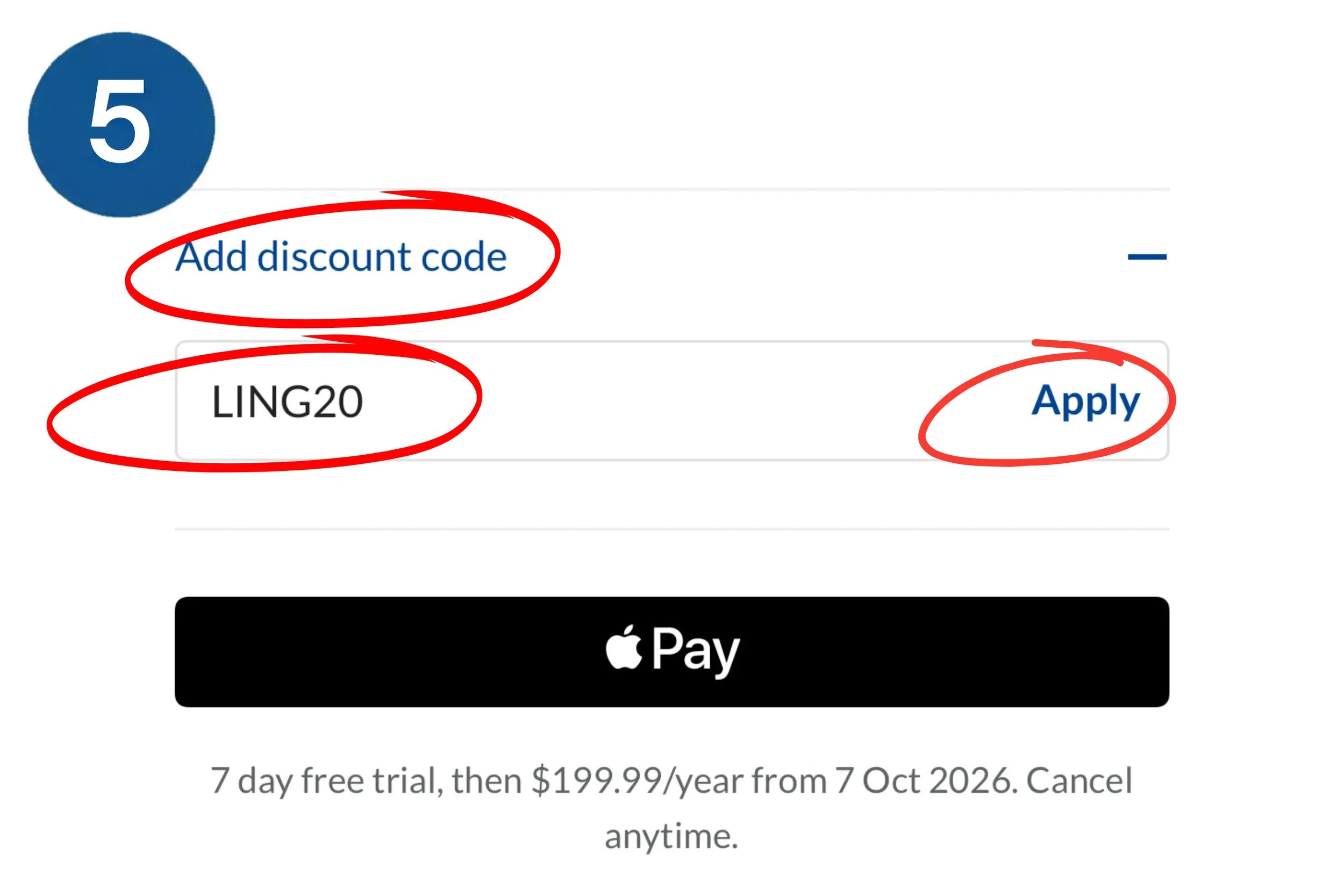
5. Tap Add discount code, enter LING20 and tap Apply
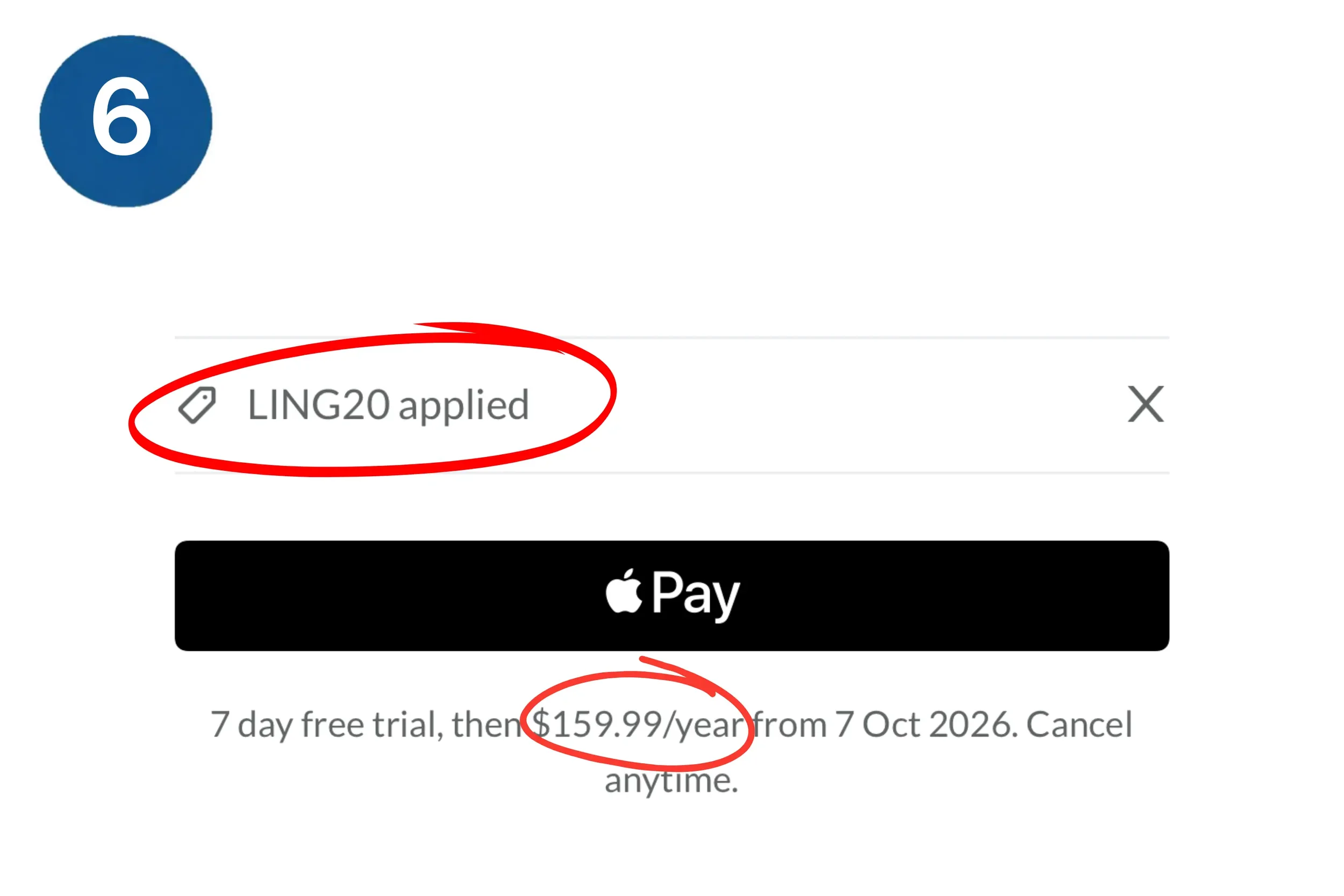
6. Check that it says LING20 applied and $159.99/year, then pay with card, PayPal or Apple Pay. On a computer, tick the agreement box and click Subscribe now.
You pay nothing today. After the 7-day trial, it's $159.99 a year (plus tax where it applies) until you cancel. The discount isn't just for your first year: you keep the same price every year.
Already using Langua? Start at step 3. The code also works when you upgrade, and my older code, LINGTUITIVE20, still works too.
Langua vs. Alternatives
Before comparing specific apps: after testing the five best AI speaking apps side by side, these are the things that set Langua apart:
Call Mode — The new version is the most natural conversation I've had with any AI app. When I interject, it adjusts and says things like "yeah, exactly" instead of stopping, which makes conversations feel even more real. It can also search the internet for things like the latest news, so you can talk about things that are happening right now.
Every conversation is saved, and you can pick it up again. My café chat with "Joe" is over a year old. I can still reread the transcript, open the feedback report, or continue the conversation right where we left off. Other apps treat each chat as a one-off.
It works on your phone and your computer. Your chats, saved words and progress sync between them. Many AI speaking apps are phone-only.
You can save whole phrases mid-conversation, even by voice. They go straight into your flashcards, AI stories and future chats, instead of a list you never look at again. You can even save many at once, like the 15 Finnish sentences I saved in one go (watch it in the video above).
The practice is shaped by you. Custom prompts you can save and reuse, a tutor that remembers your life, and a learning path built from your own mistakes and saved words.
Here's how it compares with the apps I'd recommend instead in specific situations:
Langua vs. the alternatives
When another app is the better pick
Every app here I've used for weeks to months, in several languages
Pros and Cons
What I love about it
- Natural conversations — chats are engaging and genuinely feel like talking to a person.
- Call mode that feels like a real call — hands-free, you can interrupt, you can save phrases by voice, and the new beta version can search the internet.
- It gets more personal the more you use it — it remembers facts about your life, so conversations don't start from a blank slate. When my tutor opens with "how's the blog going?", it feels like talking to someone who knows me. You can add, edit or delete anything it remembers, and together with My Path, the app keeps adapting to you over time.
- Effective feedback — corrections during the chat, plus written and audio reports afterward that help you sound more natural.
- The best vocabulary system of any AI app — save words or whole phrases, even by voice, then review them as flashcards, in AI stories, or woven back into conversations.
- Voice variety — many voices with distinct regional accents, including local slang.
- Conversation variety — chat about anything, role-plays, debates, games, or scenarios you design yourself with custom prompts.
- Conversations never disappear — every chat is saved with its transcript and feedback report, and you can continue any of them later, even a year later.
- Wide language support — every language on one subscription, including less common ones like Finnish, Romanian and Hindi.
- Import your own content — paste in text or upload audio, like an article, a podcast or a recorded lesson, then talk about it or have the tutor quiz you on it.
- They actually fix things — the two biggest criticisms in earlier versions of this review (no structured path, and not being able to save phrases in the app) have both been fixed. New features arrive regularly, often straight from user requests.
- Cost-effective — a month of unlimited AI practice costs about the same as a single hour with a human tutor.
What I'd still change
None of these are dealbreakers for me, but they're real.
- It's pricier than some other AI apps, especially monthly — that's the cost of using the best voice models rather than the cheapest. The annual plan with my code brings it down a long way.
- It can give in too easily when you push back — in Finnish, it agreed with my wrong version when I questioned a correct correction. In Spanish, it apologized for a mistake it hadn't made.
- Saving a long phrase manually sometimes needs a second try — when I mark a phrase on screen, it occasionally translates only one or a few of the words, so I have to mark it again. Saving by voice doesn't have this problem.
- The beginner lessons sometimes skip extra questions — if I say the phrase I'm prompted to say and ask a question in the same message, it sometimes only registers the phrase.
- AI stories are website-only — they're such a unique way to review words on the go, but they're not in the phone app yet. If they were, I'd probably use them a lot more.
- Reading help doesn't cover every language — Japanese and Chinese have furigana, romaji and pinyin in chats, but not in call mode or flashcards. Korean has romanization only in the beginner lessons, and Hindi, Arabic and Thai don't have any yet.
- No Cantonese — just my own personal con. I've been learning it for years and would love nothing more than to have these conversations in it. The day they add it will be a good day.
- There's a lot here — the number of features and options can feel overwhelming the first time you open it, though My Path now gives you a clear starting point.
Who Langua Is For (and Who It Isn't)
Langua suits a lot of learners, but not everyone. Here's how to tell if it’s for you or not:
A great fit if you…
- Are ready for real conversationsFrom upper beginner and up, if what you want most is to speak more fluently, this is the most effective practice I've found.
- Want to speak, not just studyYou understand more than you can say, and you want lots of low-pressure practice with nobody watching.
- Are short on timeTen minutes of call mode while cooking or out on a walk counts. No booking, no schedule.
- Like to steer your own learningYou want to talk about your own life, set up your own scenarios, and choose how you're corrected. Every language is included, too.
Probably not for you if you…
- Are starting from scratchSpeak is the easiest way I've found to get into a new language. Switch to Langua once you have some foundation.
- Only want to read and listenLangua is built around speaking, so an input-based app like LingQ or Lingopie would be a better fit.
- Want a human teacherAI practice doesn't replace a person. LanguaTalk's tutors are one tap away inside Langua.
- Need a language Langua doesn't haveLike Cantonese. Talkpal covers 130+ languages.
Still not sure? The free plan takes two minutes to set up and needs no credit card. Try Langua free and see how a conversation feels.
Langua is one of nine apps I use the most across several languages. If you want to see the whole setup — what each one does, how I use them together, and why each earned a spot on my home screen — I put it in a free guide:
Langua FAQ
Is Langua worth it?
For speaking practice, yes. After more than two years of use, it's still the most natural AI conversation partner I've found, and the only app I've used from beginner to advanced. The annual plan with my discount costs about the same as one or two hours with a human tutor. My full verdict is at the end of this review.
Does Langua actually help you learn a language?
It has for me. After two years of regular practice, my Spanish is more fluent and less choppy, I'm more confident speaking, and it helped me fix a Finnish vowel mistake I'd been making for five years. Like any app, it works if you use it often, not just now and then.
How much does Langua cost?
Standard is $19.99/month or $149.99/year. Unlimited is $29.99/month or $199.99/year, or $159.99/year with code LING20, every year you're subscribed. See pricing for the full breakdown.
Does Langua have a free plan or free trial?
Both. The free account has no time limit and needs no credit card, and it includes a short AI chat. Paid plans come with a free trial (7 days on annual, 5 days on monthly) and a 30-day money-back guarantee.
Is there a Langua discount code?
Yes. Code LING20 gives you 20% off yearly Unlimited, so it's $159.99 instead of $199.99. It's a lifetime discount: you keep that price every year for as long as you're subscribed. Enter it at checkout on Langua's website (it doesn't work in the App Store or Google Play). Here's how to add the code, step by step. My older code, LINGTUITIVE20, still works too.
What's the difference between Standard and Unlimited?
Standard caps you at 75 messages a day or 30 minutes of call mode. Unlimited has no caps. Both are what Langua calls Langua Pro, and both include all features and languages. With code LING20, annual Unlimited costs $159.99, only $10 more than annual Standard, so that's the one I'd pick.
Is Langua the same as LanguaTalk?
They're from the same company. LanguaTalk is the platform for booking lessons with human tutors, and Langua is its AI app. You can book LanguaTalk lessons from inside Langua under "Tutoring," with the same account. More in human lessons with LanguaTalk.
Which languages does Langua support?
24: 23 official languages plus Thai in beta, including Spanish, French, German, Japanese, Korean, Chinese, Finnish and Arabic. Many have several accents to choose from, like Mexican, Argentinian and Castilian Spanish. Cantonese isn't available yet. For translations it covers far more languages, including rare ones like Basque and Sinhala.
Is Langua good for complete beginners?
Yes. It has a 40-lesson beginner course, and My Path gives you a guided route after that. I'm using the beginner course for Korean right now. If you want the most structured start possible, Speak is my top pick for beginners, and Langua is a close second, the one you won't outgrow. I compare them in Langua vs Speak.
Does Langua work on phone and computer?
Both. I do most of my conversations on my phone, especially in call mode, and use the website on my laptop for flashcard reviews and creating AI stories, which aren't in the phone app yet. Your chats, saved words and progress sync between the two. Many other AI speaking apps are phone-only.
Does Langua give pronunciation feedback?
Not scores, and I think that's the right call, since pronunciation scoring in every app I've tested has been unreliable. Instead, Langua transcribes what you actually said, so mispronunciations show up on screen, and you can listen back to every message. That's how I caught a Finnish vowel mistake I'd been making for five years.
Can Langua replace a human tutor?
No. A real person gives you connection, accountability and a kind of feedback AI can't. What Langua does is give you unlimited practice between lessons, so the lessons go further. You can book LanguaTalk tutors from inside the app.
Is Langua Worth It? My Verdict
If you want to get better at speaking — yes, absolutely. After more than two years, and three languages at three very different levels, Langua is still the AI app I open when I actually want to talk. It came first in my test of the five best AI speaking apps, and it has only pulled further ahead since, with the new call mode, My Path, memory and imports all added or rebuilt along the way.
It ships updates regularly and improves itself faster than any other AI app I’ve tried. Having used and followed Langua for years, I can see they're always pushing to make it more useful.
Out of all the apps I’ve used (and I’ve used a lot) it’s actually the one that has evolved and improved the most these past two years.
What keeps me using it isn't one feature. It's that everything connects: a phrase from one conversation ends up in my flashcards, in a story and back on my path. In Finnish, one custom prompt turns every chat into grammar practice. In Spanish, I can talk about a StarCraft tournament with a tutor who looks up the latest results in real time. And in Korean, the beginner course and My Path give me structure while I'm still starting out.
It isn't perfect. It costs more than some AI apps, it sometimes agrees with you too easily when you push back, and it's an AI, not a teacher. And if you're starting from zero, Speak is an easier first step as long as they have your language.
But if you can already hold a simple conversation and want far more speaking practice than lessons alone can give you, Langua is the best AI tool I've found for it. The easiest way to find out is to have a conversation: the free plan needs no credit card, and with code LING20, yearly Unlimited is $159.99, about $13 a month, every year you're subscribed.
20% off yearly Unlimited · enter it at checkout on Langua's website
Related posts:
I Tested the Top 5 AI Speaking Apps for months — Here's What I Found
The Best Spanish AI Apps in 2026 (Tested Daily by a Real Learner)
The Language I Spoke Wrong for 5 Years (and How I Finally Fixed it)
4 Steps to Crush Your Foreign Language Interview—Follow My Process
9 Reasons AI Is the Fastest Way to Improve Your Speaking Fluency
