Published

This post contains affiliate links. If you buy through one of them, I may earn a commission at no extra cost to you. Some of the products I write about are also provided to me for free. See Full Affiliate Disclaimer.
Table of Contents
For 30 days, I’ve been learning Korean using Rocket Languages—and after not learning a new language for almost 4 years, it feels great to be a complete beginner again.
The strategies I’m using for Korean will work for all other languages (Rocket Languages uses the same format for 13 other languages). The general language learning principles will apply whether you’re learning Korean, Spanish, or any other language.
After 30 days of daily practice, here's my honest Rocket Languages Korean review of the results—sharing what’s working, what’s challenging, tactical techniques that will speed up learning new words, and more.
1. Day 12: The Day Nothing Stuck
Day 12 on my journey was just one of those days. It felt like nothing was sticking and that I wasn’t learning anything— even though I had listened to the lesson before and reviewed the vocab in the Listening Activity. Days like these are when many people quit learning languages.
You start questioning yourself:
“Am I in way over my head?”
“Maybe I’m just not cut out for this”
“I just don’t have what it takes to learn a new language.”
If I had never learned a language before, I would probably think those same things. I just happen to already have learned two difficult languages (Cantonese and Finnish), so I know these things are completely normal.
While I do feel those things, I know the truth about learning: even if you feel like you’re not making progress, you ARE.
It’s like an iceberg growing under the sea. You can only see it once it goes above the surface, but it was already growing way before that.
During days like these, I just show up anyway and engage with the language. Because I know (from experience) that it will pay off.
2. The Hidden Progress You Can’t Feel Yet
On Day 17 I had a breakthrough—I suddenly felt I could follow the Korean dialogue much better. This is exactly why it’s so important to show up and keep going even on days like Day 12, when it feels like you’re not progressing. Sooner or later, the breakthrough will come
Here’s the thing: the Korean words are not simply a matter of “don’t know it” or “know it”. There are levels in between. Getting a little more familiar with a word (even if you can’t recall it yet) is just as valuable progress.
One piece of advice in the Rocket Languages audio lessons I disagree with: “make sure you understand everything before moving on”. I find it better to just continue and let words “click” in their own timing. That way, you get exposure to more vocabulary and you learn the words more naturally. It’s way more enjoyable and honestly more effective than force-memorizing.
My goal: to let repetition do the work over time. I’ll eventually learn the vocab and phrases—the timing is just out of my hands.
Get My Free Language Learning Guide Intuitive Language Secrets!
Learn the foundations of how to learn any language intuitively—download now by clicking below!
Download Free Guide3. What's Working Well
The Role-Play Feature
The role-playing feature has become one of my favorites. Even though the conversations are completely pre-determined, it works well—you get to practice using the vocab in a conversation setting, and also get a feel for how well you know it.
The speech recognition isn’t perfect but it does its job. It gives enough leeway for Korean beginners to be very forgiving, but recognizes if you’re way off.
Like a mini-game: As you move from the Easy → Medium → Hard progression of the same dialogue it feels like a mini game that you’re trying to beat. Plus, you can do the conversation from BOTH perspectives and practice being either character from each dialogue.
In my 30 day Rocket Korean review, this is one of the standout elements—it's what makes the course feel interactive rather than passive.
Want to see this role-play feature in-action? Check out this brief video I recorded of me going through one of them (mistakes, laughs and all!)
What you just saw: First talking to ‘Sujung’ on Easy mode (full prompts), and then with ‘Taewoo’ on Medium (English prompts only). Medium mode will tell you whether you actually know the vocab or not, since you can’t rely on the Korean romanization (Hard mode has zero prompts).
As you probably noticed, I didn’t remember some of the phrases (like how to say “what’s your name?”) on Medium mode—that’s the point! I can then review those afterward and run through the role-play again as many times as I want, to keep improving.
Practicing both sides of the conversation is also beneficial. You get to hear how they say it, so that next time you can try to mimic it when you say those lines. You’re learning the full back-and-forth flow.
Want to try this role-play feature yourself? → Try Rocket Korean Free
New Listening Activity Workflow
On day 29 I decided to try a new workflow that actually changed things around. Instead of first listening to the audio lessons and doing the review activities, I decided to try something different:
Do listening activities FIRST (getting familiarized with the vocabulary)
THEN listen to the audio lesson
Result: The lesson breakdown made way more sense because I recognized the words and they weren’t complete gibberish. I got significantly more value out of the audio lesson this way, since the vocab was already familiar.
Maybe not how Rocket Languages intended it, but you gotta use the material however it works best for you.
Alternative approach: Audio lesson → listening activities → audio lesson again (the vocabulary is fresh in mind for the second listen).
I find the Listening Activities very helpful as they move phrases you don’t remember to the '“Hard queue” when you press the ‘Hard’ button. That way, you review only the ones (15 of 25 or whatever) you had trouble with.
Pro tip: Some sentences are too difficult to bother with (they are not part of the dialogues but “extras” that just happen to be spoken during the audio lessons). You can press “easy” on these ones simply to get them out of your review queue—to focus on the sentences you want to learn. Because frankly, a few of them are just too impractical to bother with learning at this point. Like this one:

You can mark complex phrases that's as "Easy" (to skip) or "Hard" (to review later) rather than trying to master on the first pass.
But this is true for any beginner course—you have to be selective with what you use.
The App's Design
The Rocket Languages app is clean and uncluttered, making it a Korean app that’s a pleasure to use.
Audio lessons can be done in 5-10 minute bursts (it picks up where you left off), making consistency easy even when you’re busy. Light and dark mode both look great too.
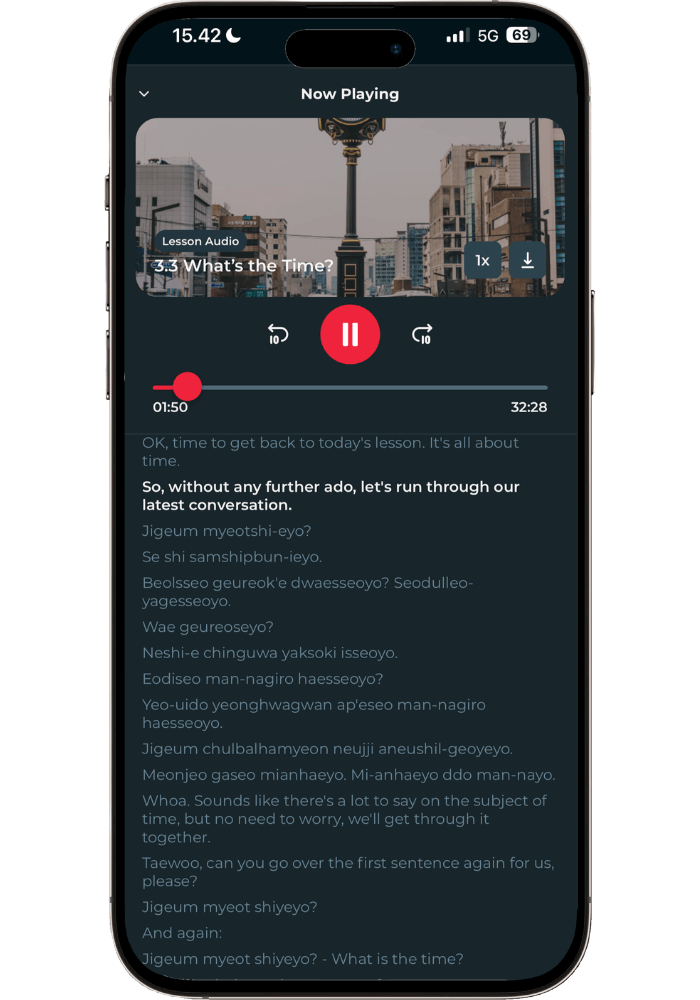
Rocket Languages Korean audio lesson, with rolling transcript that I like to listen to while doing the dishes (app looks great in dark mode too)
4. Tactical Techniques (To Make Words Stick Faster)
The Backwards Syllable Technique
Rocket Languages is all about getting you to speak. But some sentences are long and difficult to say out loud. By the time you reach the end of the phrase—you have already forgotten the start.
Here’s a trick: start backwards.
Take “Jeon oneul jom pigonhaneyo” (I am a little tired today). Instead of trying to hear and say the whole thing (and not being able to despite countless reps):
Start with the last syllables “ha-ne-yo”
Add "gon-ha-ne-yo"
And then: “pi-gon-ha-ne-yo
And keep adding syllables like this backwards (you can add more than one syllable at a time too)
Doing this—both when trying to speak and hear it— you get a handle on pronunciation much faster and get better speaking flow. From observing my own kids, this seems to be how toddlers learn to speak—saying the last word first, then adding more words backwards as their speaking develops.
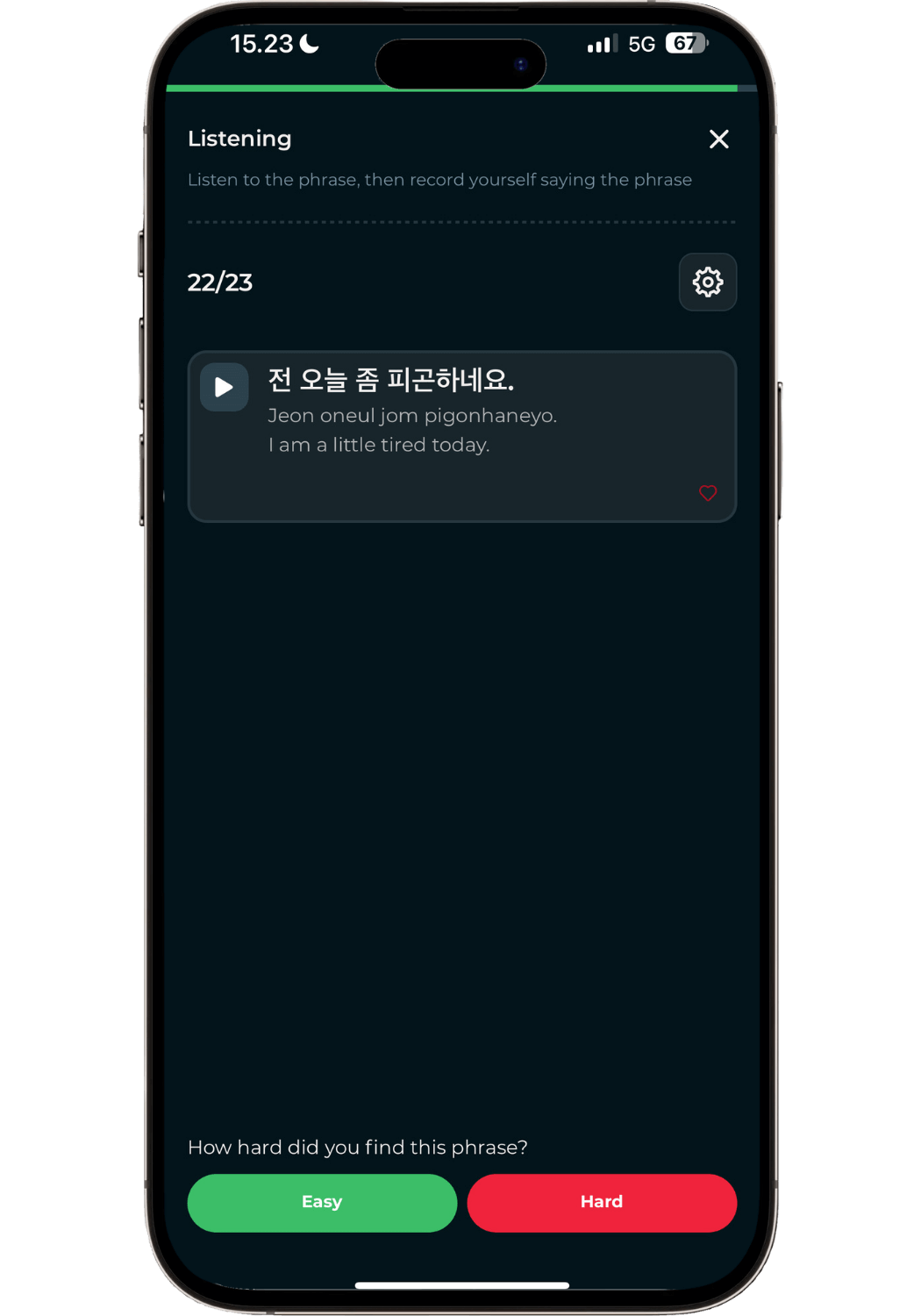
You can learn to hear and speak trickier sentences much easier by using a “backwards syllable technique”
Cantonese Logic Helping Me Out
Day 21 had one of my highlights so far: I correctly guessed the meaning of a word I’d never heard before, thanks to knowing Cantonese.
I heard 오늘 ("on-il") and thought: this might be "today" since 내일 ("nae-il") means "tomorrow." Cantonese works the same way—今日 “gam1 jat6” (today) and 聽日 “teng1 jat6” (tomorrow) share the same ending character/syllable, so I instantly made the connection.
While Cantonese and Korean don’t necessarily sound alike, they sometimes have these structural similarities that make words and phrases feel familiar. A nice advantage of already knowing another Asian language.
The "Don't Analyze, Just Mimic" Approach
Instead of analyzing what phrases mean, I started focusing on ONLY trying to hear and mimicking them out loud.
By doing this, phrases start ringing in my head during the day. Once the sounds have stuck, adding the meaning isn’t that big of a step. And when the meaning finally clicks—boom—it’s pretty much 10/10 retention because the phrase is already in your muscle memory.
This has been key for Korean, where the sentence structure is so different from English. Analyzing slows you down; just absorbing it works better.
This approach is very much aligned with my intuitive language learning philosophy—check out my Free guide Intuitive Language Secrets for more on this.
Using Mnemonics for Tricky Vocabulary
This is helpful for tricky vocabulary that just won’t stick with sheer repetition. An example I came across was trying to separate the words ‘beside’, ‘behind’, ‘above’—which was tough. For these types of words I use mnemonics, a habit I learn from learning and remembering how to read and write Chinese characters (and I should probably take advantage of it more to be honest.)
How does it work? You simply make up an image in your head that you associate with this word. The more vivid and personal the image, the better it sticks.
You'll still need to encounter the word repeatedly in different contexts to make it truly automatic. But mnemonics can accelerate your journey there—by helping you recall it faster from the start, so you're primed to absorb it without the frustration of constant forgetting.
Want to test these strategies? Try Rocket Languages for free:
5. The Written Lessons Surprise (I Expected Boring...)
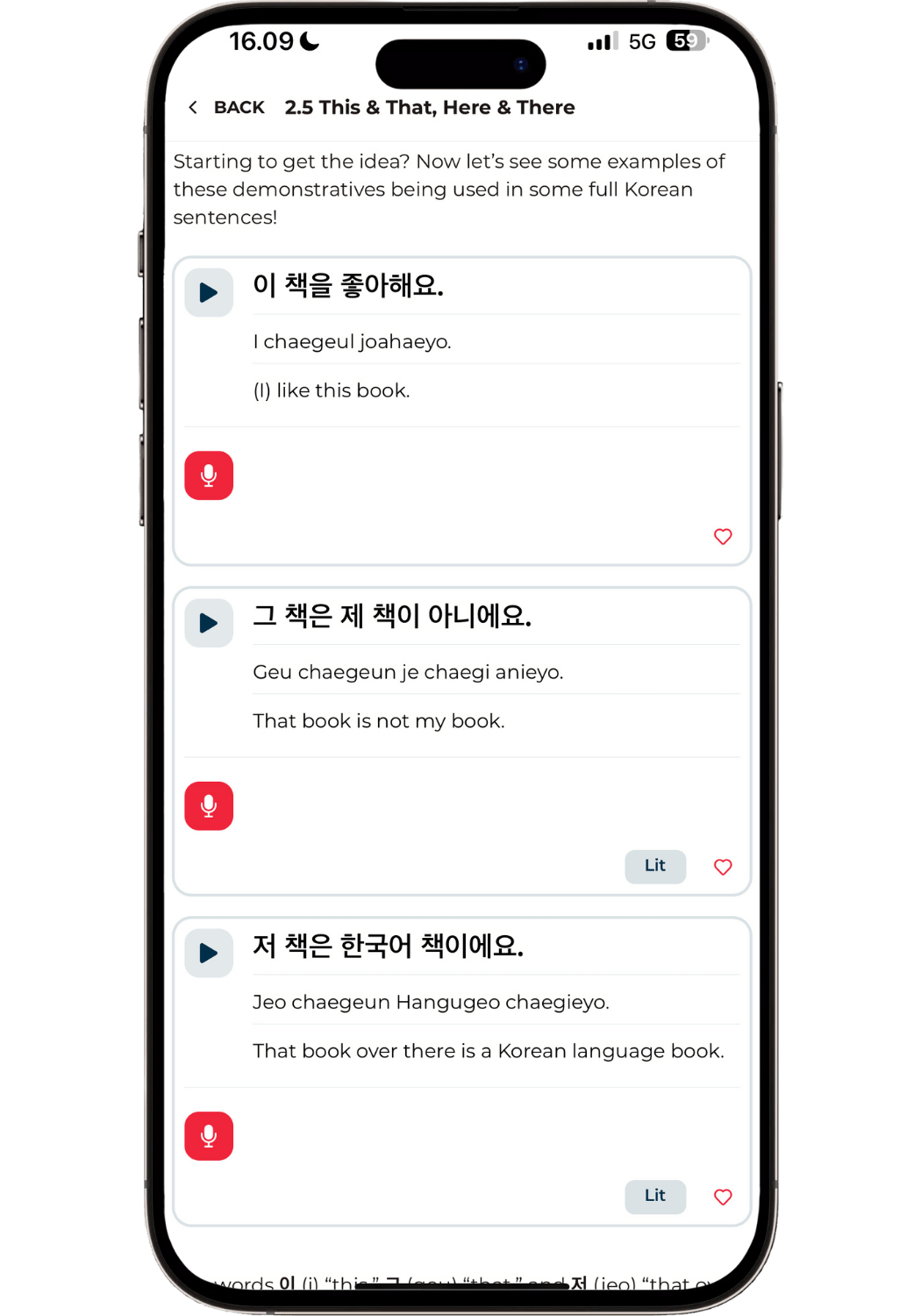
Not all Rocket Languages lessons are audio-based. Quite a few are text-based. There are both “Writing Lessons” (learning ‘Hangul’ - the Korean alphabet) and “Language & Culture” (grammar, like how to say “I like x” in the language and features unique to the language)
Normally, I find it a bit tough to get through reading-only lessons. I expected these to be tedious but they’re actually very enjoyable! I actually look forward to doing them. I think that’s because they are simple, clear, and you get a sense of progress going through them from start to finish.
Plus, there are audio examples of what’s being talked about which brings an interactive component to them, which is very much needed in these types of lessons.
6. Real Talk: The Struggles
Time Investment
The 30-ish minutes I’m averaging been doing is fine for slow but steady progress, but I think 60 minutes would be more ideal. That way I could fit in both listening activities, role-play, audio/written lessons on one day.
Right now, I do the role-play activities here and there but not necessarily every day, since I have been prioritizing Listening Activities and the audio lessons—so I’d like to work on doing them more often.
Polyglot Challenge
I’m currently learning four languages at the same time (Spanish, Cantonese, Finnish, Korean) which obviously limits the time I can spend on Korean. Very different from when I learned Cantonese with single-minded focus!
At some point, I’ll need to increase the time I spend on Korean if I want to see faster progress. But for now, the slow consistent pace with Rocket Languages is working.
Grammar is Still Fuzzy
I wouldn’t say I have a solid grip on Korean grammar yet, which is completely normal for Korean beginners and nothing to worry about. I often can't identify which word means what in a sentence. But word order is starting to feel normal: verbs always coming last just makes sense now—it just feels right.
Romanization Confusion (Fading)
Early on, romanization was confusing - "L" sounds like R, "N" sounds like D. And a big part of that is just that Korean is hard to romanize - it has sounds that doesn’t exist in English or other Latin-based languages.
However, this is bothering me less as I can separate words better now. And I don’t read the romanization for pronunciation, but only for a ‘memory cue’ of the word.
7. Progress Tracking & Motivation
I have tracked every minute spent learning Korean for two reasons:
Documentation — so that you can follow my progress
Motivation — time-based goals keep me accountable
I use the free Refold Tracker App to set daily goals and split activities (reading, listening, etc.) For Korean, I currently have a simple goal: 5 minutes daily (“Learn Every Day”).
Setting the bar low makes consistency easy, and once I start I almost always end up doing more. I can always increase the goal later.
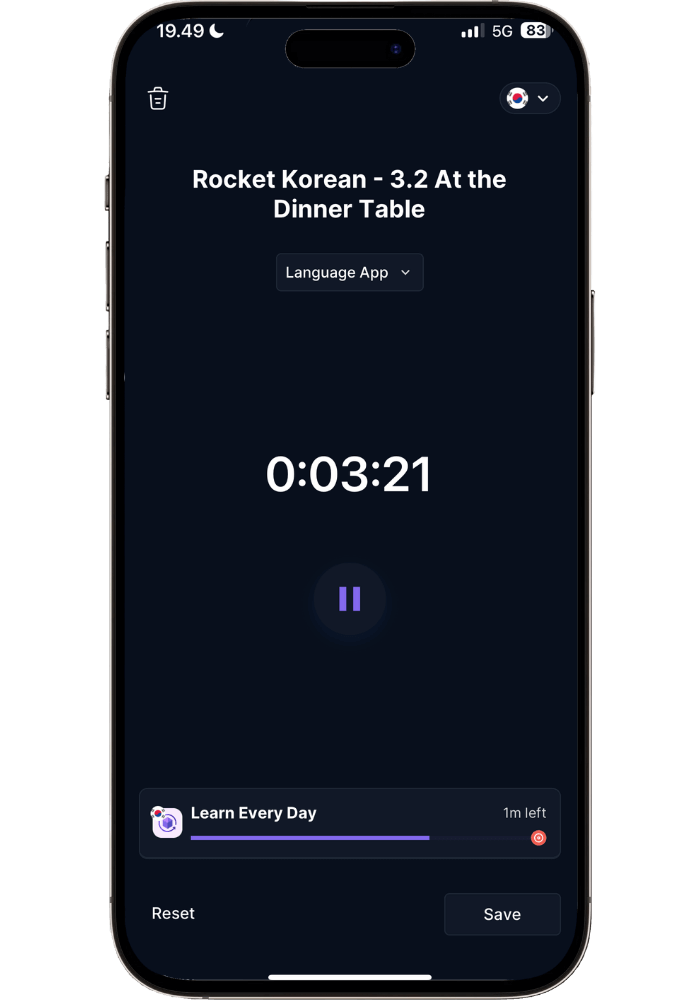
Refold’s Tracker App tracks my daily learning and shows clearly how much time I’ve spent and when I hit my daily goal. It’s been a game-changer for long-term motivation.
8. My 30 Day Progress Summary
The Results:
Total time spent over 30 days: 19 hours, 7 minutes
Average daily time spent: 38 minutes/day
After 30 days with Rocket Korean, here's my honest review of the results:
A month in, I feel like I’m barely getting started learning Korean—so much more to learn! And because of my commitment to other languages (and other things in life) the daily time I’ve spent haven’t been super high. And that’s totally fine! It just means that progress is slower.
But speed doesn’t matter—enjoying the process does. I have been interested in Korean culture since I was a teenager. That desire isn’t going anywhere. Going slow is better than skipping it altogether. Before you know it, three years have flown by, and all of a sudden you can speak a new language by just having been consistent.
That said, I want to do enough that I actually see progress and don’t stay stuck—and I definitely have seen good progress this past month that I feel satisfied with.
And honestly, it feels great to be a noob again—discovering a completely new language. It feels a bit like starting Cantonese 8 years ago all over again, which is a great feeling.
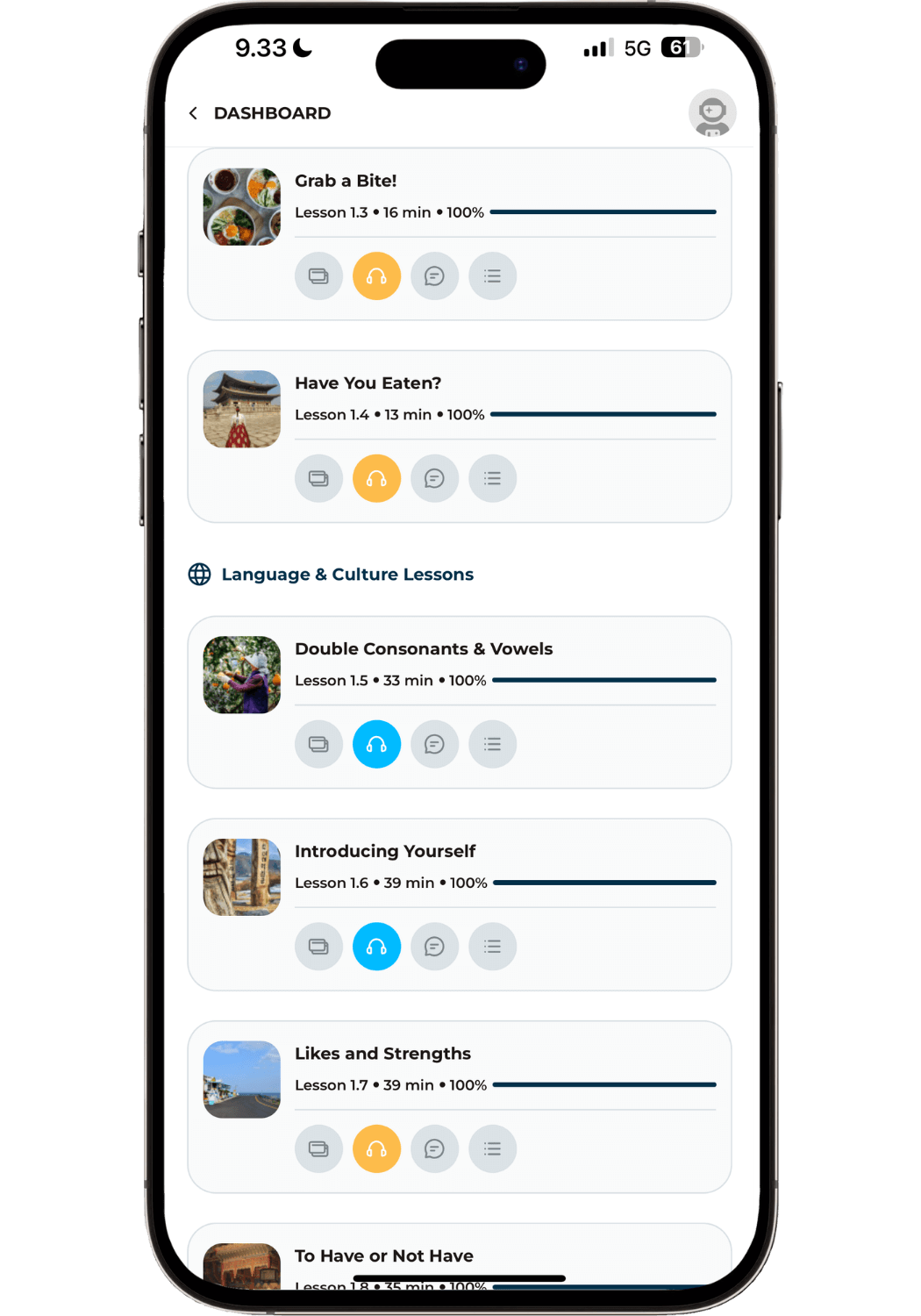
Module 1 progress - showing completed lessons and what's ahead. The course structure makes it easy to see your progress and plan your daily learning.
What’s next for my Korean?
Now that I’ve gotten a taste for learning Korean my desire has only grown. So I’ll be continuing with Rocket Languages Korean until I finish it. I’ll write a complete review of the course once I do. And I’ll update you on my progress as I go, because Rocket Korean, while I enjoy the course a lot, is only the beginning of learning Korean.
Want to start your own Korean journey? Rocket Korean offers a free trial with full access to lessons, role-play features, and all the activities I've mentioned.
Or check out my week 1 review: I Spent a Week Learning Korean with Rocket Languages (From Absolute Zero) if you’re still researching.
Have you ever used Rocket Languages (Korean or other language)? What was your experience? Let me know in the comments below!
Related posts:
