Updated
This post contains affiliate links. If you buy through one of them, I may earn a commission at no extra cost to you. Some of the products I write about are also provided to me for free. See Full Affiliate Disclaimer.
Table of Contents
- 1. Who is This For?
- 2. What You Get — Course Structure
- 3. How the Method Works — the 95/5 Rule
- 4. Teaching Lessons Breakdown
- 5. My Honest Journey — Phase By Phase
- 6. Activating Your Speaking
- 7. How to Get the Most Out of Uncovered Intermediate — Practical Tips
- 8. Pros & Cons
- 9. My Results — How My Spanish Changed
- 10. Is It Worth It? — Pricing & Recommendation
- 11. Final Verdict
To be honest, as someone who has been learning Spanish for almost 4 years, I didn’t have very high expectations of Storylearning’s Spanish Uncovered Intermediate. I thought it would be great for someone who wants clear structure — but for an independent learner like me, who has learned several languages on my own, would it really move the needle?
What I discovered was surprising, and even made me slightly re-think and evolve my current approach to learning languages, because it ended up having a profound effect on my Spanish.
This isn't a “I skimmed-the-modules” kind of review — I went through the course just like any learner, using it daily for 3+ months.
What this StoryLearning Uncovered review covers: This review is focused on the intermediate Spanish course but also Upper Intermediate (which you can only get once you finish Intermediate) since they are part 1 & 2 of the same story. I will share what you can expect to learn, who it’s for, honest pros & cons, and my own journey and progress. You’ll learn what the difference before and after actually was.
This review largely applies not only to Spanish, but to the 7 other languages that have also have Intermediate Uncovered courses (see the full lineup here). They follow the same format and method, though with different teachers for each language.
My verdict at a glance
daily use
I came in doubting a course could add much for an input-heavy independent learner. It filled grammar gaps I didn't know I had — and reinforced how going deep with a little beats going wide with a lot.
Best for: structured learners who want guidance, input-heavy independent learners whose grammar lags behind their comprehension, and anyone planning a long-term path toward advanced.
Not for: anyone after a quick fix or a traditional grammar-textbook approach. It takes patience, persistence, and daily commitment.
Try it free for 7 days →Full access for 7 days — you're not charged until day 8, and single courses have a 365-day double money-back guarantee.
1. Who is This For?
There are three types of learners who I think will benefit the most from this course:
The structured learner who wants guidance — this course is built for you. The StoryLearning method is clear and shows how to learn Spanish at intermediate. Not only is the content provided but there are easy-to-understand “Olly’s Tips” videos (by Olly Richards himself) that provide a clear framework but still enough flexibility to choose a path that fits you (for my personal StoryLearning framework, see my post The 3 Stages of Listening Comprehension.)
The independent learner who thinks they don't need a course like this — This was totally me. I had been learning from pure comprehensible input (listening & reading) for so long that I didn’t think the course was going to offer much more value beyond just getting more input. You might be surprised how it will impact your language skills. Even if the level feels somewhat easy (like it did to me), you’ll gain a much better command of grammar and Spanish patterns, which will improve your speaking ability.
By the time I started Uncovered, I had around 800 hours of Spanish listening — 350+ of those from Dreaming Spanish, which I think is a fantastic resource for building comprehension. But I found that after a while, I could understand a lot, but my natural grammar usage — especially things like the subjunctive — wasn't where it should have been for my level. Uncovered addressed exactly that gap — the awareness part gave me something pure input alone wasn't giving me.
People looking for a longterm learning strategy — Starting with Uncovered Intermediate and continuing with Uncovered Advanced is ideal if you are planning longterm learning. Most courses abandon you at beginner/early intermediate. They might “claim” to offer intermediate and advanced content, when in reality they are more like upper beginner/lower intermediate at best. Uncovered takes you from beginner all the way to mastery across six levels, using the same method throughout.
Who it's NOT for
If you’re someone who’s looking for a quick fix or a traditional grammar textbook approach, this course isn’t the right one for you. The course requires patience, persistence, and daily commitment. So if you know you’re not going to stick with it more than a week or two, it’s best to skip.
2. What You Get — Course Structure
Storylearning Uncovered Intermediate is an intermediate Spanish course that’s actually part one of a two-part story. The first part is Intermediate (level 3 — chapters 1-10) and the second part is Upper Intermediate (level 4 — chapters 11-20) — which all follow the same characters and plot.
In this review, I’m referring to my experience across all 20 chapters. If you decide to get it, you’ll get the first 10 chapters now and can then decide if you want to continue with the second half (you need to finish one level to unlock the next, unless you get the full course bundle.)
What's in the Course
Story length: Intermediate has ~41-50 min of audio story content — length varies between Spanish dialects (Upper Intermediate increases the length per chapter: ~67-74 min total.)
Teaching lessons: Each story chapter has teaching lessons — grammar, vocabulary, communication, pronunciation, plus Olly’s Tips. Lessons are anywhere from 5 min to 45 min long, averaging 20-25 min per lesson. Pronunciation lessons tend to be shorter and vocabulary/grammar lessons longer. Olly’s tips are short and to the point — around 5 minutes, but key to keep you on track with the method and learning philosophy.
Additional content: Including culture sections — based on what’s mentioned in the story, explaining the cultural background. Speaking activities —various activities to practice the structures/grammar/topics from the stories by yourself, bring to your online teacher (I recommend LanguaTalk), language exchange partner, or AI speaking app. There’s also a story comprehension check quiz — at the end of each chapter. All chapters have word-for-word Spanish transcripts and English translations.
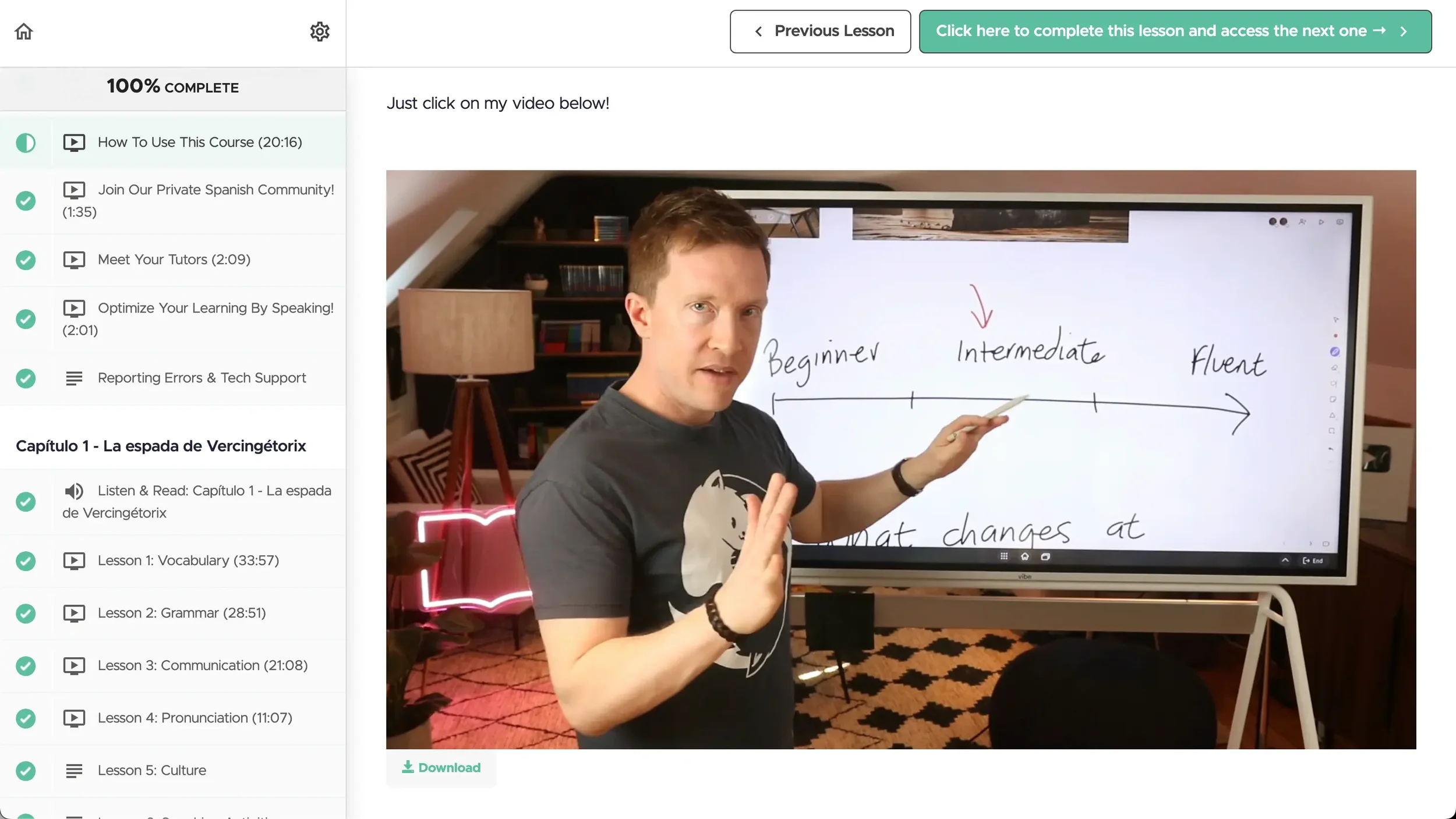
Introductory video by Olly Richards, showing how to get the most out of Uncovered Intermediate.
The two audio versions: Spanish has both Castilian vs Latin American Spanish. It’s the exact same story but differs slightly in vocab, phrasing, and pronunciation. Castilian is a bit more animated — the narrator does character voices. Latin American is more straightforward and spoken a bit faster. Both are included, which is nice for variety when re-listening, and noticing differences between dialects.
Platform: Course access is through Teachable, a common online course platform. It works great for the teaching lessons as they sync bookmarks between devices, but it’s not ideal for audio playback. The good thing is that all story audios, transcripts, and lesson videos are downloadable — you can just make your own playlists.
Pricing: Individual courses at $297 or all 6 levels for $997.
Want to know if Uncovered goes on sale? I'll send you a heads up:
Is the Story Any Good?
The story is about a mysterious sword that is found in the back of a car of a person who dies in a car accident. You follow detective Martinez and her new partner Sanchez trying to unravel the mystery of this sword.
The story didn’t grab me at first, but once I started understanding more I started really enjoying it. It only gets better as the plot progresses during its second part (Upper Intermediate). It’s not a New York Times bestseller but it’s engaging and comes to life once your comprehension improves enough to notice the details. The crime-based plot is actually quite clever at times too and not cheesy, though there are lighthearted moments.
3. How the Method Works — the 95/5 Rule
The bulk of Spanish Uncovered Intermediate content-wise are the teaching lessons — grammar, vocabulary, communication, and pronunciation.
So it makes sense to spend most of your time on those, right? Actually, no. To see meaningful language progress you should spend only about 5% of your time on these lessons. They are important, but the real meat and what’s going to move the needle for your Spanish is the story.
But if these story chapters are only 4-5 min long each how do you spend the most time on them? Through repetitive listening. The point is to immerse in each chapter so many times that you start downloading the language to your brain. This doesn’t happen overnight but with enough time and repetition.
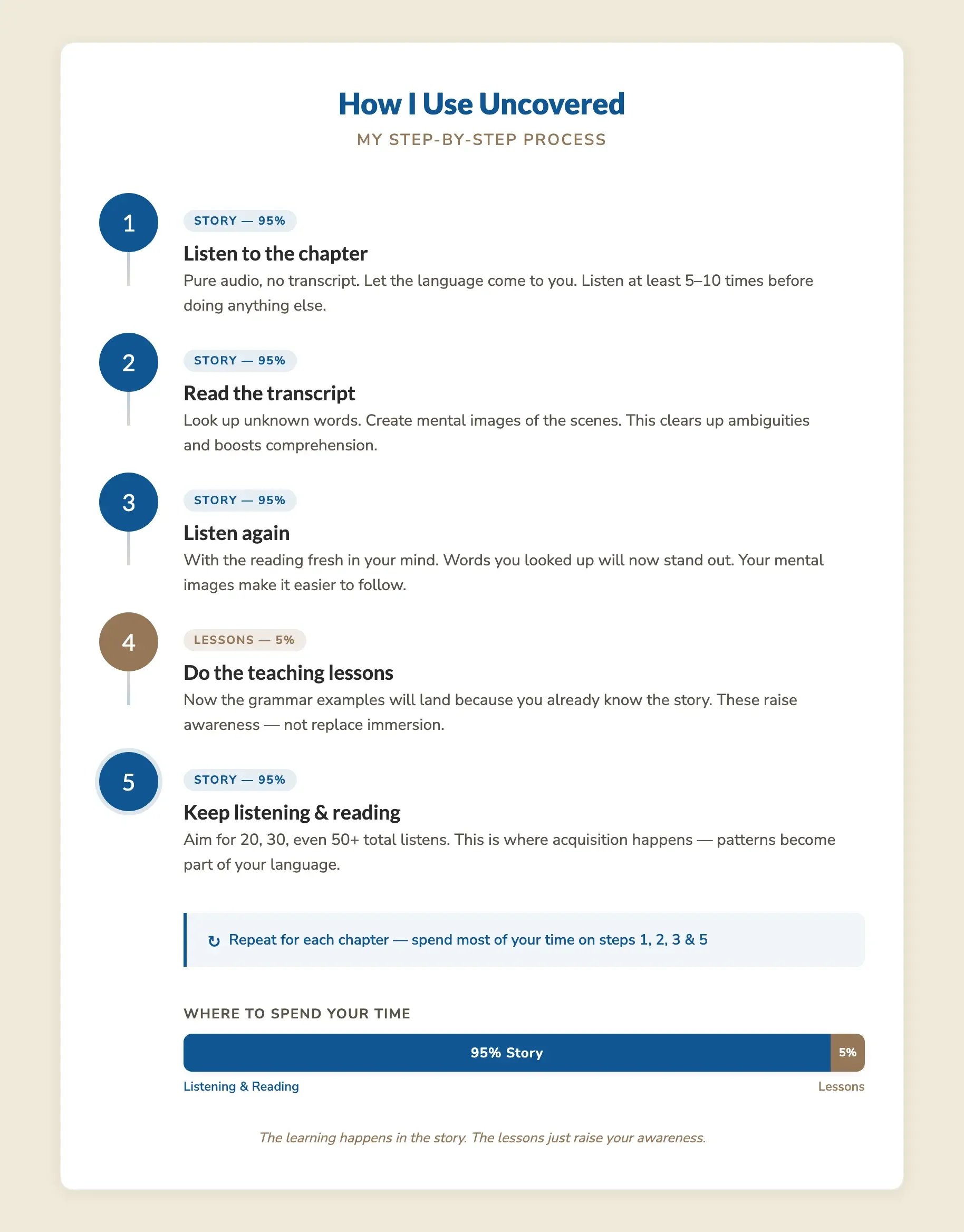
The actual process, step by step:
Listen to the chapter audio (pure listening, no transcript) — at least 5-10 times before doing anything else
Read through the transcript — look up unknown words (I import them to LingQ for easy look-ups but anything works)
Listen again, with the reading fresh in your mind
NOW do the teaching lessons for that chapter
Continue listening and reading — aim for 20, 30, 50, or more total listens per chapter.
Why this order matters — when you know the story well, the grammar examples from the lessons land so much better. It’s the difference of: “why are we talking about this rule” and “oh I know that part — so THAT'S why they say it like that”.
The common mistake. When watching the teaching lessons, it might feel like you’re learning a lot. But you’re learning about the language — which doesn’t translate to actual language skill. The story is the meal, the lessons are the vitamin supplements. People interested in technical grammar terms (I’m not one of those people) will learn those, but the real value (which is emphasized in Olly’s Tips) is in simply making you more aware in the language. This awareness doesn’t do anything alone, but helps you get more out of it when listening to the story — you’ll notice how the language is used and acquire more of it. I’ve seen this in my cohort too — the people who do the most listening are the ones progressing the fastest, no doubt.
“The story is the meal, the lessons are the vitamin supplements.”
The "at least 10 times" rule. My general recommendation: don't touch the lessons until you've listened to the chapter at least 10 times. If you do watch them earlier, then at least go back to them once you know the story and can understand it quite well, since that’s when you’ll get the most out of them.
For a deeper breakdown of this process, check out my post The 3 Stages of Listening Comprehension — where I lay out the exact framework I used with these courses.
4. Teaching Lessons Breakdown
These lessons are in video format breaking down different aspects of each chapter of the story. It’s the same teacher for each and she is overall clear and knowledgeable.
Grammar lessons — The most valuable for me. Even though I’m not someone who’s into grammar, these lessons were standouts. They highlight how to accurately use the language, focusing on all the different ways to use subjunctive, but also covering all sorts of things grammar-related while pulling examples from the story. Some highlights included hace/desde hace distinction, passive constructions like “me han contado que….” (I’ve been told that…) from Chapter 10, ya/ya no/todavía/no todavía, and more. The teacher takes examples from the story and also other texts, which at first, I thought was a bit odd. But it helps you recognize the patterns in other content, extending the value way beyond just what’s in the course.
Some lessons felt like they were explaining rules that weren’t necessary, and most of the grammatical terminology I ignored as I found it added an unnecessary layer of complexity. Though I will say, when I had an online lesson with a teacher it was helpful to know things like subjunctive and nominative just for the sake of saving time when referring to what to use when and where.
Vocabulary lessons — These were solid awareness builders. They help you be familiar with different vocabulary used in different countries (“suelo” used in Spain, vs “piso” used in Latin America — meaning “floor”), and giving you nuances of similar words.
Communication lessons — Typically somewhat shorter than the grammar and vocabulary lessons but helpful and practical. They take the grammar and vocabulary used in the story and show how it applies in other contexts, so that you can become a better communicator in Spanish. One example was how reflexive pronouns like se/me/te are used in Spanish, which is something that takes time to get used to. It also covers formal vs spoken language differences and nuances.
Pronunciation lessons — These are short and how useful they are depends on how much listening you've done. Having been listening-heavy since day one, I had already intuitively picked up most of what was covered. But if you're earlier in your journey or less tuned into pronunciation, these could be genuinely helpful — I would just make sure to not stress about memorizing any of the pronunciation rules. You’ll naturally absorb those with enough listening and awareness. So these are best used as awareness-builders just like the other lessons.
While most of the earlier lessons didn’t do much for me personally, I found some of the ones at Upper Intermediate to be really valuable. This included the Chapter 16 lesson on the b/d/v sounds — and one of the keys to sounding authentically Spanish. The final pronunciation lesson in Chapter 20 was also an excellent summary of what makes up good Spanish pronunciation.
Olly's tips videos — These I always looked forward to and are definitely worth watching. Typically around 3-5 minutes — short and to the point, encouraging, realistic, and practical. The style of Olly Richards is clear and approachable without being language nerdy or complicated. The timeline advice on how long it actually takes to reach different levels in a language was refreshingly honest (longer than people think), compared to the unrealistic timelines you often see online.
5. My Honest Journey — Phase By Phase
Phase 1: "It's Okay, I Guess" (First 2-3 weeks)
Like I mentioned previously, I initially had a somewhat lukewarm reaction to the Spanish Intermediate story. It was kind of okay, but it didn’t really grab me. But I kept going because I wanted to give it a fair shot. I just kept listening multiple times, gradually understanding more and more.
I did pure listening at first, which pushes your listening comprehension ability and your ears, so it’s an important starting point. And then I added reading the transcript in LingQ after 5-10 or so listens.
Phase 2: Things Start Clicking (Weeks 3-6)
The Intermediate story was fairly easy for me (I was already at an Upper Intermediate comprehension level when I began). So I went through the course in a month or so, instead of the usual 3 months it might take for a lower intermediate. However, my grammar usage was not that great so Intermediate helped fill in those gaps.
When I moved on to Upper Intermediate (though I still came back to re-listen to Intermediate from time to time) this one felt more in line with my current level. Comprehension-wise, still not that difficult but my recognition and ability to use grammar correctly was still quite poor.
How reading gave me mental images that really helped: When I start not seeing more progress by listening alone, I introduce the Spanish transcript. It helps clear up unknown words but also, since reading is easier than listening, you start creating mental images of the scene you’re reading. This can happen when listening too but I find that it’s much more vivid when reading — because you can take your time with the text you have much more time to create these images. These images of what the scene looked like I then carried with me when listening again, making it easier to follow and understand.
Learning the Subjunctive: What stood out the most throughout was learning how to use “the Subjunctive” — notoriously difficult for Spanish learners. This was really key as it was something I had largely ignored during my Spanish journey, and it had made my speaking sound more basic than it should at my level.
Both the Intermediate and Upper Intermediate courses put a heavy emphasis on this grammar point. It has many uses, it’s subtle, and difficult to grasp — so hammering it from different angles in the lessons, WITH getting lots of natural real-usage examples throughout the story, made it become clearer and clearer. I then practiced using it during my daily speaking practice sessions (more on this in the speaking section).
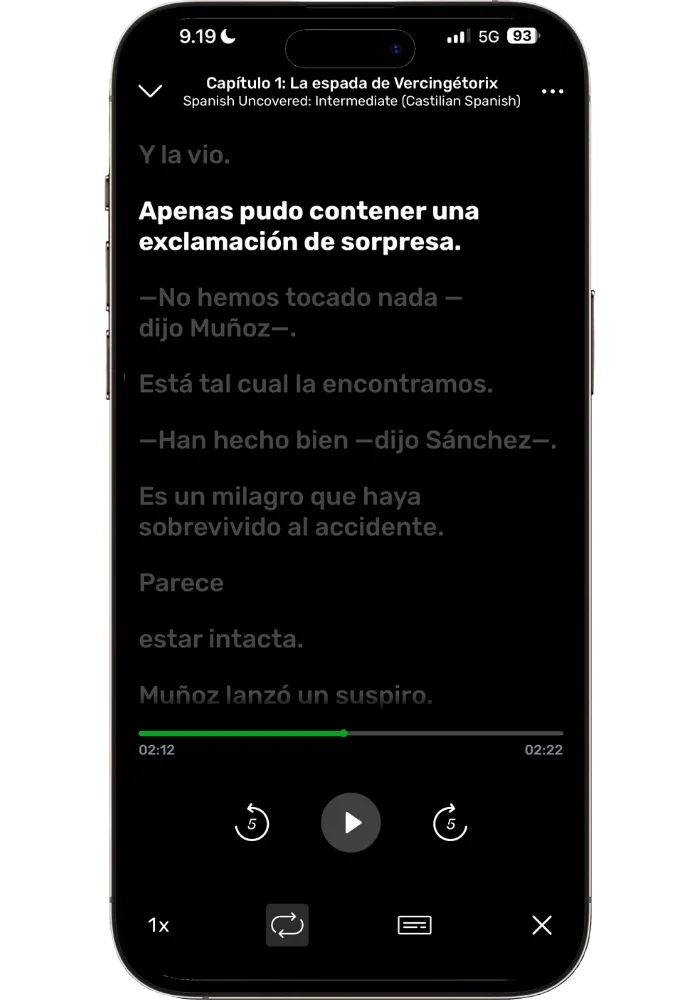
Listening to the story in LingQ, which auto-syncs the story audio to the transcript in a rolling format.
Phase 3: The Boring Middle (Weeks 6-8)
Now several weeks in — is when things started to become challenging. Comprehension got easier, but continuing and sticking with it was harder. When you first start, it’s fun because it’s new and exciting. But after getting to 80-90% comprehension, it starts getting a bit boring listening to the same story and the gains start to feel much more incremental.
At this point, the temptation to move on to the Advanced course was real. But, I stuck it out. Because I know from experience (from learning multiple languages and practicing music) that this is a VERY important stage to NOT quit — it’s when the most important growth happens. I knew I had to push past the part where it doesn’t feel fun anymore. One thing that helped keep me motivated was having the Uncovered Advanced levels as a reward that I would only start once I was done with the Intermediate ones.
“This is a VERY important stage to NOT quit — it’s when the most important growth happens.”
Phase 4: Pattern Recognition and Acquisition (Weeks 8-12)
This is when I started experiencing the payoff of sticking it out past the “boring middle”. I already understood most of the WHAT was going on (as I break down in this section of my post the 3 Stages of Listening Comprehension) and I could now focus on the HOW. I was no longer listening for comprehension, but for ACQUISITION.
This meant that instead of using all my brain capacity to understand the story, I could now shift my focus on how the language was being used. This happened very naturally — I would be listening and all of a sudden a phrase just jumped out at me, and I just intuitively knew it would be useful to learn.
Some “HOW”-examples I noticed during this phase:
When listening to Chapter 18, one phrase was highlighted to me: "Si el vendedor hubiera querido..." (“if the seller would have wanted to…”). It felt “rich” grammatically and like a highly useful pattern to learn. I re-listened to it several times, even saying it silently to myself, programming it into my Spanish muscle memory. And then something interesting happened — weeks later this exact phrase actually showed up in a grammar lesson breakdown, which confirmed I had noticed something important.
"Más vale que esto sea bueno" (“this better be important”) was another example of these sentences where the subjunctive just clicked. I just intuitively understood why "sea" (the subjunctive) was used since it was about uncertainty about whether something would be of value or not. By constantly being exposed to and noticing the subjunctive (also known as “the Spanish Mood”) from different angles in the teaching lessons, and hearing it in the story content, it now started to gel together.
"Deben haberse gastado todo el presupuesto..." (“must have spent the entire budget…”) was a pattern I could extract and start applying to my own speaking. These are the kinds of phrases that make you sound authentically Spanish.
In one of Olly’s Tips videos he mentions the quote "a rising tide floats all boats". It means that when we improve one aspect of our language, we’re improving at least ten other things at once, showing the value of really going deep with a limited amount of material. I experienced this firsthand — and it's honestly the best way I can describe what this course did for my Spanish.
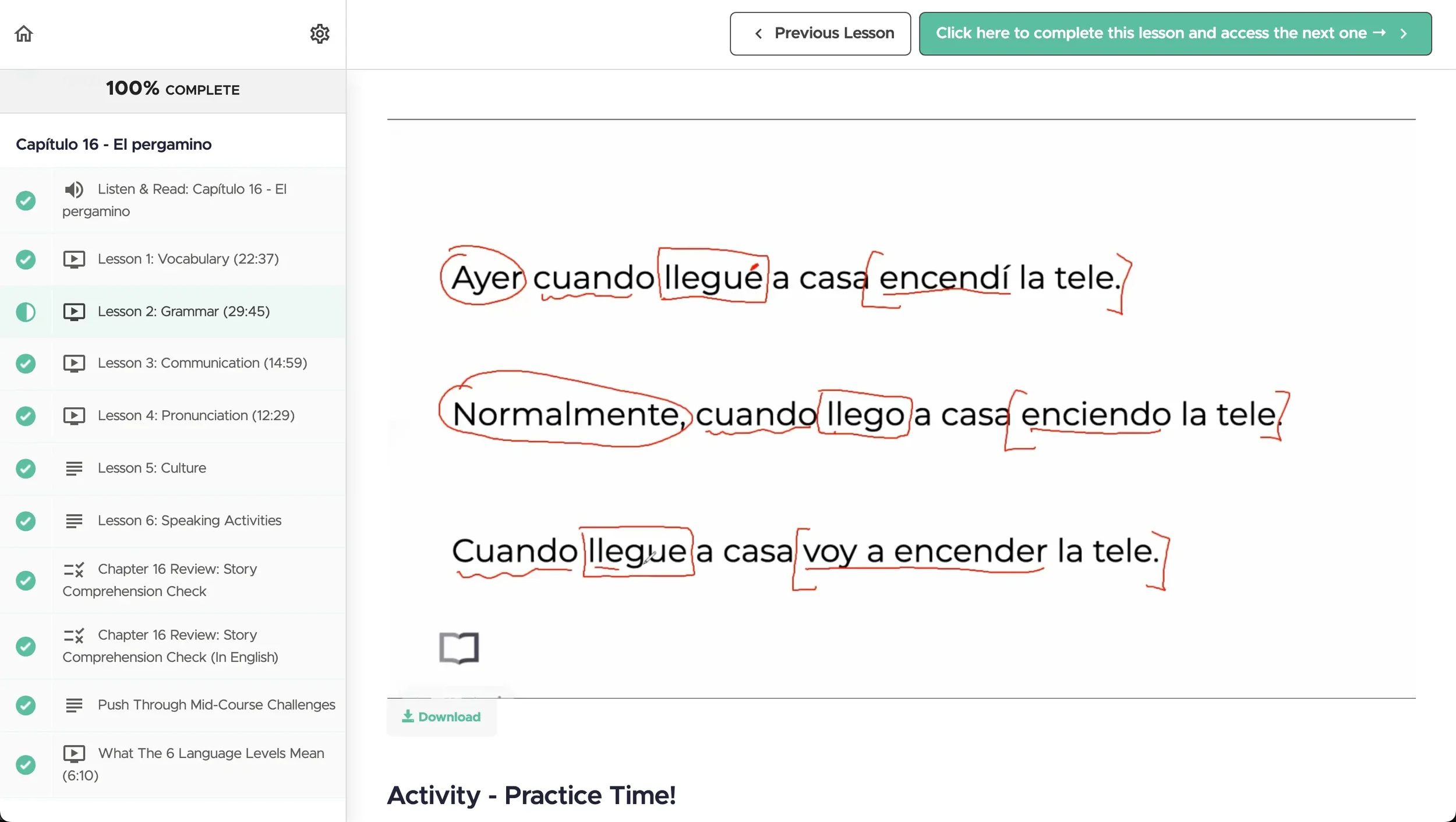
A grammar lesson from Chapter 16 breaking down how the subjunctive works across different tenses — with hand-drawn highlights showing the verb changes.
6. Activating Your Speaking
Uncovered is excellent for input (listening, reading, grammar awareness) but it doesn’t have a built-in way to practice speaking. Each chapter has dedicated Speaking Activities to activate what you have been learning through speaking. These can be done with a language exchange partner, 1-on-1 lessons with a teacher, or even by yourself.
Langua — the perfect pairing. While online lessons are something I highly recommend, it’s hard to get that daily practice in unless you schedule daily lessons — not practical for most. I solved this by using Langua, an AI speaking app featuring human-sounding AI tutors (see my full Langua AI tutor review for a detailed breakdown.)
This turned out to be a magic combo. I could practice speaking any time, even just for 5 mins, with my morning coffee or evening tea. It let me put into practice using what I had been learning— subjunctive, future tense, etc. — in actual conversation. Langua lets you make your own prompts so I even took the speaking activities and copy-pasted them into Langua. It gave me varied ways of practicing speaking that was related to what I was learning, because when you actually use it yourself it sticks on a much deeper level.
At one point, I was practicing the future tense with Langua in the evening (one of the Speaking Activities) and then the next day I noticed this future tense all over the place in the story chapters. This highlighted how speaking helps notice aspects of the language better when listening and reading.
I also started experimenting with feeding story transcripts to Langua and having a conversation about them. This was a super fun way to chat about the specifics of the story, discussing scenes, characters and their inner motivations. I could also practice turning specific sentences into the subjunctive and ask the AI tutor to highlight specific grammar points.
Real learner example: Todd, a Spanish learner I know that’s currently at the Uncovered beginner level, has really taken full advantage of this. His approach is essentially: take what Uncovered teaches you in a chapter → build a Langua prompt around those exact concepts → practice translating and conversing about those concepts throughout the week.
My recommendation: You don't need to use Langua specifically, but I do recommend some form of speaking practice alongside the course — whether that’s a tutor, a language partner, or an AI tool. Langua pairs particularly well because of the flexibility of the app. You can also upload your Uncovered transcripts as an interactive transcript — click on words, make flashcards of useful phrases, and review them in the app.
Try Langua Free → (lets you try a brief chat with your free account). Use code LINGTUITIVE20 for 20% OFF annual Unlimited plans.
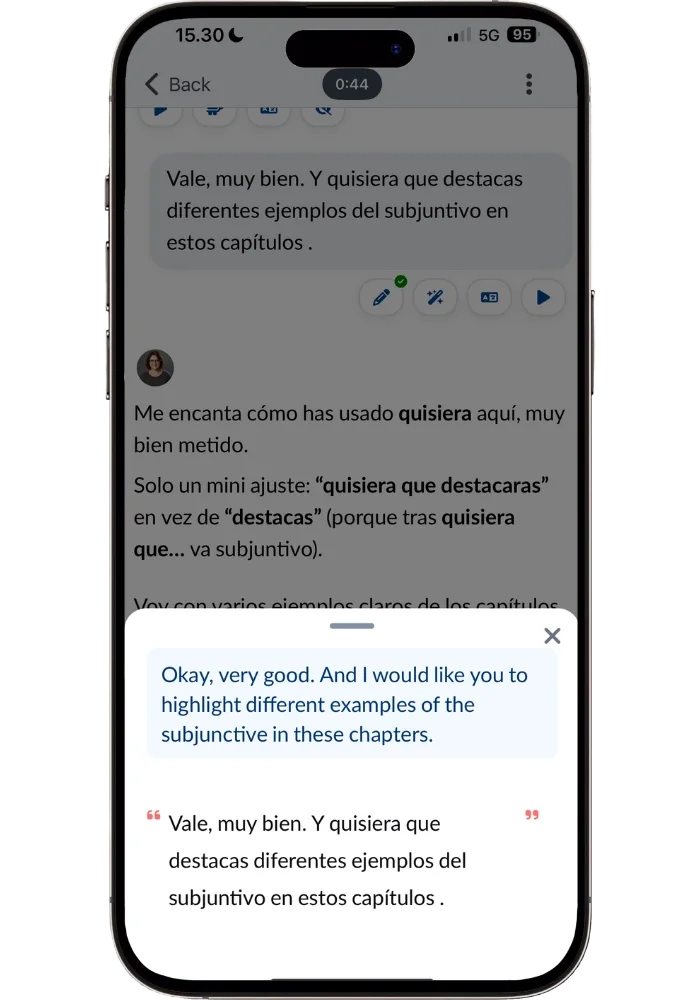
Excerpt of a conversation with the Castilian Langua AI tutor 'Maria', where I asked her to highlight subjunctive uses from the Uncovered chapters.
7. How to Get the Most Out of Uncovered Intermediate — Practical Tips
Here are some practical tips to get the most out of Uncovered.
Download the audio immediately — The Teachable platform isn’t great for story listening. You want things organized so it’s easy to listen to the chapters on repeat and the entire story from start to finish. Download all the chapter audio files and put them in a playlist on your phone. I did this on my LingQ app for organization, word look ups while reading, rolling transcript while listening, and keeping track of my listening times for each chapter.
Use both dialect versions — Switching between Castilian and Latin American keeps things fresh, especially after you’ve listened 10-20 times.
Listen to the teaching lessons at higher speed — 1.5-1.75x works well since the English is spoken quite slowly (at least in the Spanish course.) Don't try to memorize everything — just catch the insights that grab you, ignore the rest, and move on. I found this much more effective than trying to absorb every detail. Focus on what makes sense to you right now and let the rest come later.
Push through the boring middle — the real gains are just past this stage (I explain why in my journey section)
Read the transcript more — Being listening-heavy is great, but I wish I had added a bit more reading. Whenever I read through a chapter and then re-listened, my comprehension took a noticeable jump. Reading clears up things you've been mishearing and gives you mental images that stick when you go back to pure listening.
8. Pros & Cons
What I loved
- The grammar lessons are the standout — especially on the subjunctive, with examples pulled from the story and beyond it
- It's one story across 20 chapters, following the same characters from Intermediate into Upper Intermediate
- Both Castilian and Latin American narrations included, which keeps re-listening fresh
- Olly's Tips are short, practical, and refreshingly honest about how long things actually take
- Still worth it even if the level feels easy — it did for me, and I filled gaps I didn't know I had
- 7-day free trial, plus a 365-day double money-back guarantee on single courses
What I didn't
- Teachable is clunky for story listening — you'll want to download and build your own playlist
- The same VIP/cohort promo turns up in every single chapter
- The identical 20-minute intro lesson video repeats in Upper Intermediate
- Some grammar lessons stretch slightly longer than they need to
- The quizzes and review games are forgettable — I skipped them entirely
- The method of repetitive listening is very effective but not for everyone
None of the cons are deal-breakers for me. The core — the story, the method, the teaching lessons — is very strong. The Teachable annoyance is solved by downloading everything into your own playlist, and the VIP promo text you just press skip on.
9. My Results — How My Spanish Changed
At the end of the day, a course is only as good as the results it gives you. Here's what changed in my Spanish after 3+ months of daily use:
“Spanish Conversations” comprehension + acquisition jump: Going back and re-listening to Spanish Conversations, I noticed my comprehension had noticeably jumped and I was able to notice grammatical details better than before. It made it a breeze to listen to and I got even more out of it.
Grammar awareness, especially the subjunctive: The subjunctive changed from “intimidating” and “confusing” to something I actually use in my own speaking. I still make mistakes, but my awareness and confidence is on a whole new level. I noticed this in particular when taking a 1-on-1 Spanish lesson with a teacher on LanguaTalk. I noticed that I often spontaneously used it correctly, which was new. Often my first instinct was correct, so when I doubted myself the teacher just reinforced it. Because of this, it was possible to further refine my usage of it in conversation in an organic way. I now also recognize it instantly when I hear it in input — making it easier to internalize and acquire than before the course.
Real conversation ability — 2+ hour conversations over coffee: This was definitely my biggest win. I recently made a new friend from Mexico. We went for coffee and chat and he’s proficient in English so I honestly had no idea what language we would end up speaking. To my surprise, our entire 2+ hour hangout ended up being in Spanish. And the weirdest part of all — it felt natural. Sometimes I had to say a word in English, or ask for a word, but overall there was enough conversational flow to be comfortable for both of us.
It wasn't like I was quoting sentences from the story — it was that my overall ability to form sentences and use grammar naturally had noticeably improved. The patterns and structures from months of repeated listening had become part of how I process and produce Spanish.
Only 4-5 months ago, I had a 20 minute conversation with a native speaker at a conference where I could follow but ended up missing a lot more details than I did during my 2-hour conversation. And I certainly couldn’t express myself well. That’s actually a huge difference, now that I think about it.
“It wasn’t like I was quoting sentences from the story — it was that my overall ability to form sentences and use grammar naturally had noticeably improved.”
Better ability to learn from all input — The course didn't just teach me what was in it — it made me better at acquiring Spanish from everything else. Other courses, YouTube videos, or talking to natives — I was picking up patterns I would have missed before.
Honest caveat: The results took 3+ months of daily use. If I hadn’t already been at an Upper Intermediate level when I started, it would have probably taken 5-6 months. The results from this course don’t happen overnight — but it compounds, especially towards the end.
And it's still paying out. I finished both Intermediate courses, then Advanced, then Mastery. And I'm now back re-listening to the Intermediate story — still absorbing patterns and phrasings I missed the first time round. So the value didn't stop when I moved on. Nine months later it's still material I go back to and benefit from.
10. Is It Worth It? — Pricing & Recommendation
Is Spanish Uncovered Intermediate worth it? If you’re looking to learn Spanish online, boost your listening and reading comprehension, raise grammar awareness, get better pattern recognition, and push through the intermediate plateau — then this course is definitely worthwhile. As long as you’re willing to take the time to go deep enough with the material.
Should you get Uncovered Upper Intermediate too? Definitely. It's one story. Getting only Uncovered Intermediate is like reading half a book. I found that a lot of the things really started to come together for me in the Upper Intermediate course. However, you can just get Intermediate now, see how you like it, and then get Upper Intermediate once you finish it (it doesn’t unlock until you’re done anyway.)
Should you buy all 6 levels? Depends on your commitment level. The all-levels bundle at $997 saves you $785 compared to buying each course individually at $297 — a great deal if you're in it for the long haul. If you're already past beginner, you won't need the earlier levels, which of course reduces the value.
(For other languages, see the full lineup here)
I've since finished the whole path — Advanced (Level 5) and Mastery (Level 6) included. I'm glad I bought all the courses. Having the next level sitting there ready, and being able to go back to an earlier one whenever I want, has been more useful than I expected — I'm re-listening to the Intermediate story right now and still picking up grammar patterns I missed the first time. If you want to see where the complete path leads, read my Spanish Uncovered Advanced review.
Double Money-back guarantee — StoryLearning is so confident in their method that they offer a 365-day double money-back guarantee. What does that mean? It means that if you’re not happy, within a year, you get 100% of your money back PLUS up to $300 in credits to purchase a competing program. That’s pretty insane. Not only that, but all Uncovered courses have a 7-day free trial — you don’t get charged until day 8 and can cancel before that — super rare among online courses. Useful to know is that the bundle has a 30-day money-back guarantee.
Want to know about any upcoming deals on Uncovered? Uncovered occasionally offers seasonal discounts. Sign up to my email list — I'll let you know as soon as any promos are live:
11. Final Verdict
I came into Uncovered a bit skeptical, thinking it would be too teaching and grammar-heavy for me, and ended up thoroughly enjoying the whole process — especially when seeing profound results in my Spanish.
It’s not because it’s a perfect course, but because the StoryLearning method actually works when you commit to it — not for a week, but for months. My biggest surprise was how much you can actually get out of a relatively small amount of content when you go deep with it.
This is something I learned from 10,000+ hours of serious drumming — going deep with one thing gives much better results overall than spreading yourself thin over 10-20 different things.
I've since gone all the way through Advanced and Mastery — and I wrote about exactly how far it took my Spanish in my Spanish Uncovered Advanced review.
Learning a different language? See all Uncovered courses and languages
Related posts:
Spanish Uncovered Advanced Review: 5 Months In, All the Way to Mastery
The 3 Stages of Listening Comprehension (and Why Most Never Reach Stage 3)
StoryLearning Spanish Conversations Review: Breaking Through the Intermediate Plateau
Cantonese Conversations Review: The Course That Launched Me Into Intermediate
