5 Best Beginner Spanish Apps & Courses 2026 (Tested by a Real Learner)
Updated
What's new: added a short answer at the top, updated my Speak testing period to 209 days of daily use, and refreshed the StoryLearning and LanguaTalk sections to reflect my current usage.
This post contains affiliate links. If you buy through one of them, I may earn a commission at no extra cost to you. Some of the products I write about are also provided to me for free. See Full Affiliate Disclaimer.
Table of Contents
- Quick Comparison Table
- #1: Speak — Best for Getting You Speaking Fast ⭐ Top Pick
- #2: Storylearning Spanish Uncovered — Best for Deep Comprehension
- #3: Rocket Spanish — Best Budget Pick
- #4: Dreaming Spanish — Best Free Comprehensible Input
- #5: LanguaTalk — Best for Lessons with Native Tutors
- Honorable Mention: Pimsleur
- My Recommended Beginner Path
- Frequently Asked Questions
- Conclusion
The short answer
For most beginners, the best app to learn Spanish is Speak. After 209 days of daily use, it's the one I'd recommend to anyone starting from zero: it gets you speaking from lesson 1, on a clear path, with built-in review so the vocab actually sticks. And it's seriously fun to use, so you'll want to open it every day. From $6.99/month, with a 7-day free trial.
Looking for something different, like deep listening practice, free videos or a real tutor? See the quick comparison table.
Starting to learn Spanish is exciting. I was there 4.5 years ago — pumped to finally move past Duolingo, which hadn't worked for me after 6 months of daily use. Now I have Spanish-speaking friendships and understand most of what I hear and read.
The great thing about learning Spanish? There are tons of quality resources. The problem? Too many options = overwhelm.
That's why I created this guide.
I've spent nearly a decade learning languages daily — Spanish, Cantonese, Finnish, Korean seriously, plus three months of daily Japanese and some Mandarin on the side — tested dozens of Spanish apps and courses, and taught and coached more than a hundred learners personally. So I have a pretty good sense of what works for beginners in 2026 — and more importantly, what gets them to stick with it long enough to see results.
Most beginners hit the same walls: you learn phrases but can't remember them a week later (or even the next day). You study vocabulary but freeze when you try to actually speak. You don't know what to study next, so you bounce between apps and never make real progress.
Here’s my honest take: Speak is the app I’d recommend to my own wife, my best friend, or anyone starting Spanish today. It’s the closest thing to a sure bet I’ve found for beginners: you open it, follow the path, say every phrase out loud, and it sticks.
If you're a serious learner for the long haul with a bigger budget and want the deepest comprehension gains, Storylearning Spanish Uncovered is the other pick worth considering — I've worked through four of its six courses myself, intermediate all the way to mastery.
The other three tools on this list are excellent in specific situations — and I'll tell you exactly when each one makes sense. Let's get into it.
📌 How to Use This Guide
You don't need all 5 tools — you probably just need one. If you're not sure where to start, go with my #1 pick and commit to it for 2-3 months before considering anything else.
The "Best way to use it" sections show how I'd combine tools once you have a foundation, but they're suggestions, not requirements. What's important is to start with one resource — you can always add more later when needed.
One thing on the daily times below: they're targets, not starting points. If you're starting from zero, begin with five minutes a day and build up from there. In your first month, the habit matters far more than the minutes.
This list changes. It doesn't look the same as it did when I first published it — the tool at #1 isn't the one that started there, and the order below it has shifted too. Nothing here has a permanent seat: everything has to keep earning its spot, my top pick included. I update this post whenever something I've tested changes my mind, and the date at the top tells you when I last did.
Quick Comparison Table
| Rank | Tool | Best For | Try It |
|---|---|---|---|
| 1 | Speak* | Getting you speaking Spanish fast — from $6.99/mo | Start 7-Day Free Trial |
| 2 | Storylearning Spanish Uncovered* | Deep comprehension (long-term investment) | Start 7-Day Free Trial |
| 3 | Rocket Spanish* | Budget pick (often discounted) | Try Free Lessons |
| 4 | Dreaming Spanish | Free comprehensible input videos | Start Watching Free |
| 5 | LanguaTalk* | 1-on-1 lessons with native tutors | Book Free 30-Min Lesson |
* = Affiliate link (I may earn a commission at no extra cost to you)
Also tested: Pimsleur (honorable mention) and several others that didn't make the cut.
#1: Speak — Best for Getting You Speaking Fast
⭐ Top PickPricing: Premium at $6.99/month ($83.99 billed annually), and Premium Plus at $13.74/month ($164.99 billed annually).
After 209 days of daily use — through the beginner path and well into the intermediate courses — Speak is my top recommendation for beginners learning Spanish. It’s the app and course I wish I’d had when I started learning Spanish. It does what’s most important at this stage: it gets you speaking, on a clear structured path, with enough built-in repetition that vocab actually sticks. Plus, it’s so fun to use that opening it every day never feels like discipline.
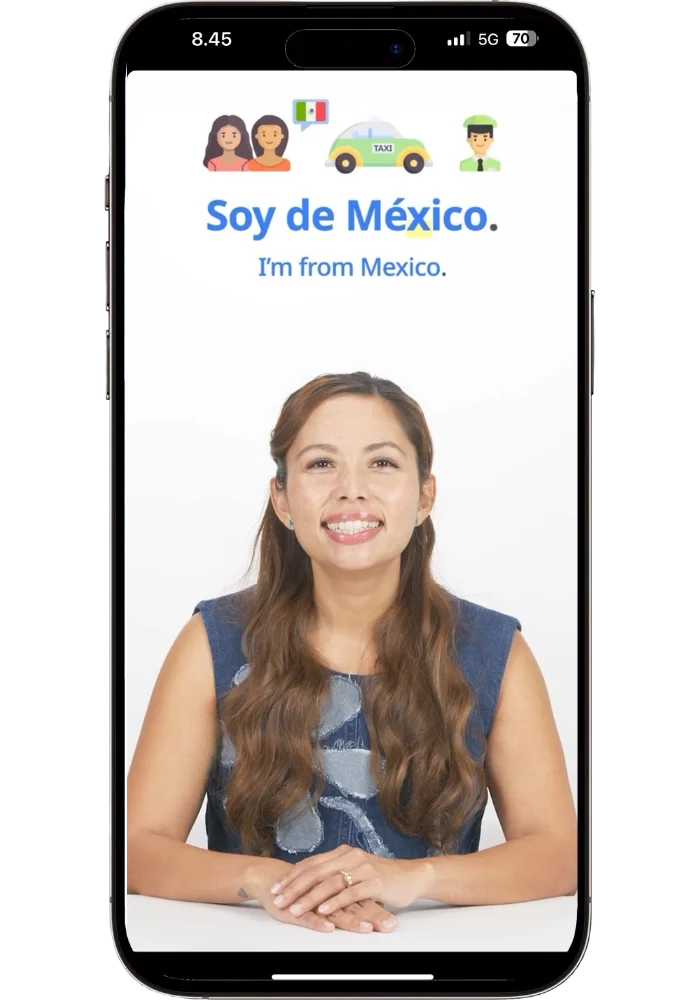
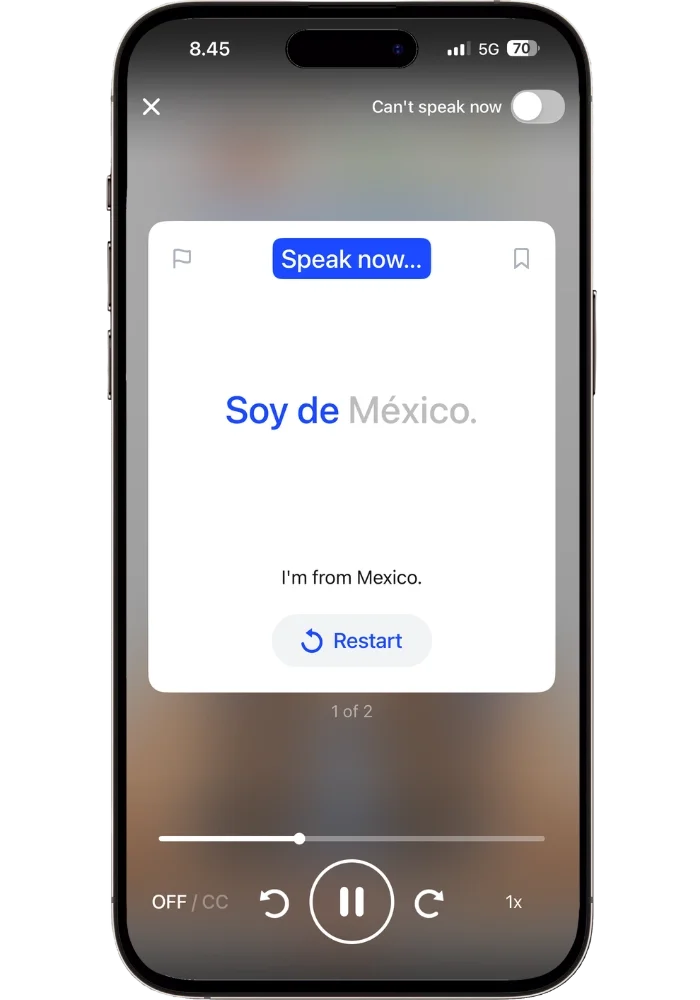
Most beginner apps either explain the language to you or quiz you passively. Speak is different. Every lesson prompts you to speak out loud, through smart drills and short AI conversation exchanges. And it doesn't just drill a phrase — it drills the pattern underneath it. You learn me gusta la comida mexicana, then say it again with Italian food, Thai, Japanese, Korean. After five or six of those you don't just know a fixed sentence, you own the structure.
That's the difference between reciting a phrase and being able to say what you actually mean. The reviewing is built in too — Speak tracks what sentences are giving you trouble and will surface reviews on those more often than the ones you get right every time, so the phrases stick without you having to manage any of it.
You also never have to wonder what to do next. You just follow the path Speak lays out, going from one lesson to the next. That alone removes the decision fatigue that keeps most beginners from actually making progress.
Even for me — a seasoned, independent language learner — I appreciate this structure. It makes it easier to open the app than to skip a day.
Who it's for:
Beginners who want to speak as fast as possible
Learners who need structure (a clear "what's next")
Anyone frustrated by passive apps where nothing sticks
People who want hands-free practice (walking, cooking, commuting)
✓ What I Love
- Gets you speaking from day 1 — in a way that feels doable, not intimidating
- Everything taught in full sentences — you absorb grammar through context, not rules
- Clear structured path (no guessing what to do next)
- AI adapts to you — weak areas come back more, mastered ones don't (vocab actually sticks)
- Clear, to-the-point, genuinely funny Spanish video hosts
- Gamification that's actually effective (unlike Duolingo — more on this below)
- Hands-free friendly (do lessons while making coffee, walking, cooking)
- Short bite-sized lessons that are effective and enjoyable
- Practical, real-world vocabulary you'll actually use (ordering at the taco truck, talking about your favorite movie, etc.)
- Affordable ($6.99/mo on annual Premium plan)
⚠ Honest Cons
- Annual subscription only (no lifetime or monthly options)
- Latin American Spanish only (no Castilian option)
- Speech recognition is occasionally too lenient — great for keeping beginners in flow, but you might not catch every pronunciation mistake
- AI conversation partner occasionally replies to something you didn't say
- No way to save individual vocabulary words (though Smart Review handles spaced repetition automatically)
- Best suited for beginner to intermediate — advanced learners will eventually want deeper conversation practice elsewhere
My Experience
I've used Speak every single day for 209 days. The difference was obvious within the first week: I'd finish a session already having said each phrase 10+ times in different contexts and slight variations, which meant the vocab was actually landing and I could use it confidently.
Speak feels like a combination of the best parts of Pimsleur and Glossika — the prompting you to speak, the structured repetition, the audio-friendly format — but with AI customization, real-time feedback, and genuinely engaging video lessons added on top. It's what happens when someone rebuilds those classic methods from the ground up with modern tools.
What surprised me most is how much you can do hands-free. I've done full lessons while walking, cooking, and doing chores — the app keeps you engaged because it's constantly prompting you to respond. It's genuinely rare for a language app to feel this effective and this easy to fit into a real day. That said, the actual conversation-style lessons require the screen, so not everything can be done hands-free.
The gamification deserves a specific mention because most language apps get it wrong. Like Duolingo — it's fun, but a lot of what you're doing isn't actually effective language learning. Speak is different: the streaks, leagues, and unlocking of new conversation scenarios are all tied to activities that bring real results. You're not getting dopamine for tapping the right multiple-choice answer; you're getting it for actually producing correct Spanish out loud. Completing a level and increasing your score feels like completing a game — except that score translates to actual language skill.
Two screenshots of my Speak progress 54 days in (when I first published this post) — 86% through Beginner 1 and fully complete on Intermediate 1, then working through Intermediate 2. I started at Intermediate but have been working back through Beginner content too.
It would normally feel like torture to go through beginner content for a language I'm already upper intermediate in. But Speak adapts so well that it becomes enjoyable. It helps me fill in gaps and it feels like replaying the early levels of a game you love:
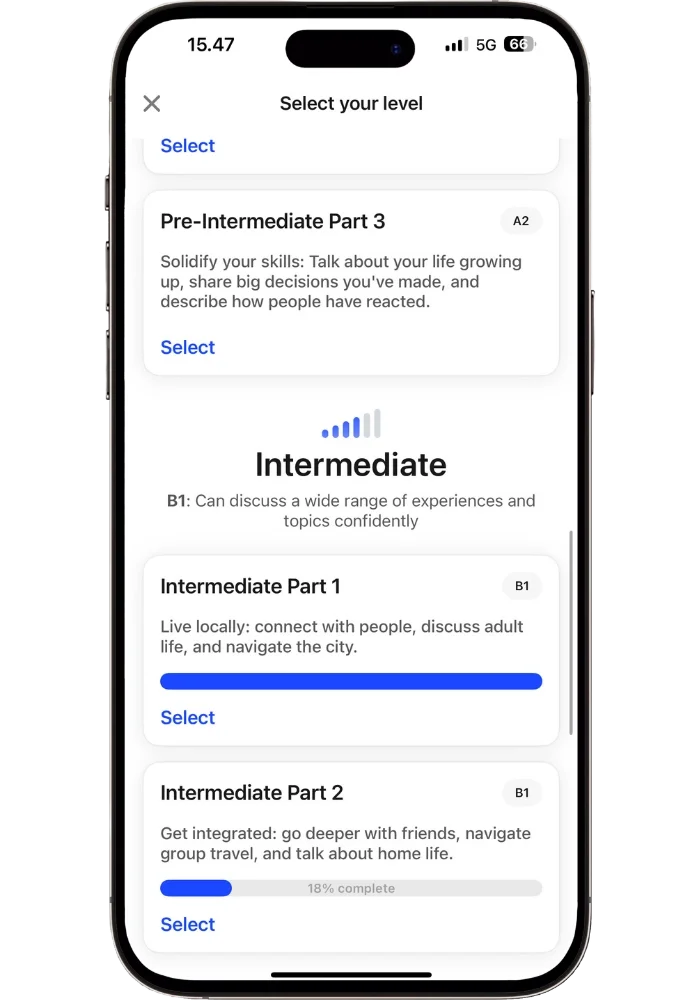
Beginner Part 1: 86% complete — at 54 days
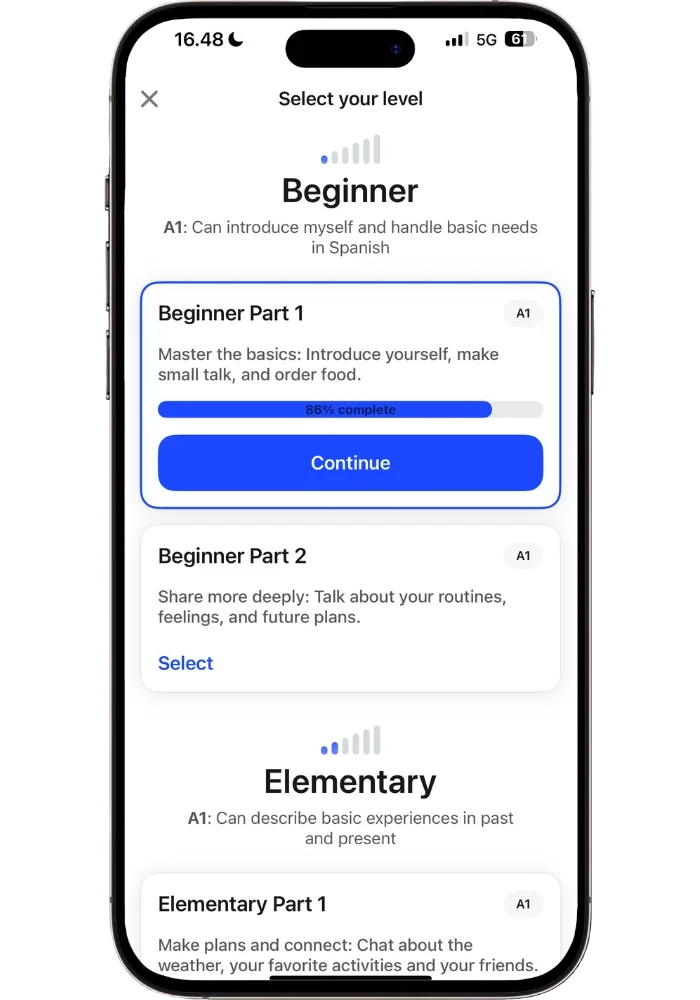
Intermediate Part 2: in progress — at 54 days
What seven months told me that two months couldn’t. When I first published this post, I had used Speak for 54 days. That's long enough to know whether an app teaches well from zero. It isn't long enough to know whether it lasts in the long run — and if you're deciding what to commit to, that's probably the question on your mind.
So after seven months of daily use, here's what I can tell you: I keep getting close to the end of a course and new lesson units appear. I'm well past the beginner material this post is about and still haven't reached the end. And if you’re starting from scratch, you'd have more of the path ahead of you than I did — I started at intermediate and worked backwards through the beginner content — so it's easily a year's worth, even if you use it heavily every day.
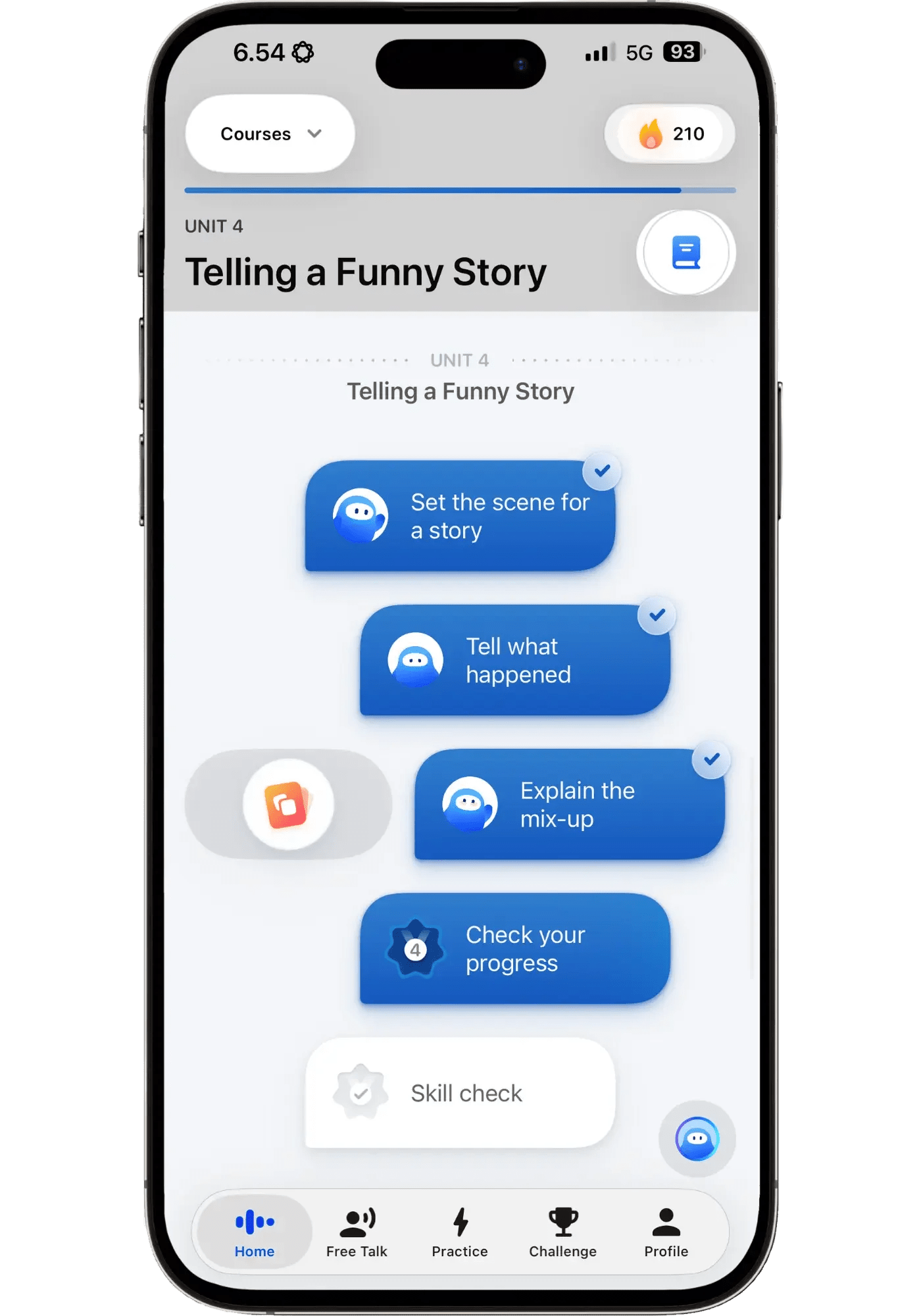
210 days by the time I took this screenshot — on a unit about telling a funny story, a long way from ordering at the taco truck.
One more thing I couldn’t tell you months ago: I’ve since used Speak in Japanese, Korean and Mandarin too. The courses aren’t copy-pasted from one template — each is paced for the language it’s teaching — and the Spanish course is the most developed of the four. If Spanish is your language, you’re getting their strongest work.
What I've noticed most is how comfortable Speak makes you at actually using what it's teaching. That's what I care about: am I more comfortable speaking? With Speak, it happens faster than with any other beginner tool I've tried — and it's the pattern drilling that does it, since speaking is mostly about muscle memory and automaticity. Everything is taught in full sentences, so you absorb grammar naturally, without needing to learn rules.
And the vocabulary you learn is seriously useful too. An early lesson teaches you how to order at a taco truck — and not just "one chicken taco, please," but variations: two or three tacos, two quesadillas, with or without onions, extra this or that. Then you get to try a completely customized order in the roleplay, with feedback if you're off. This is why Speak's content translates to real life so well. You're not just doing a language learning exercise — you're rehearsing situations you'll actually use. You can try Speak free for 7 days here.
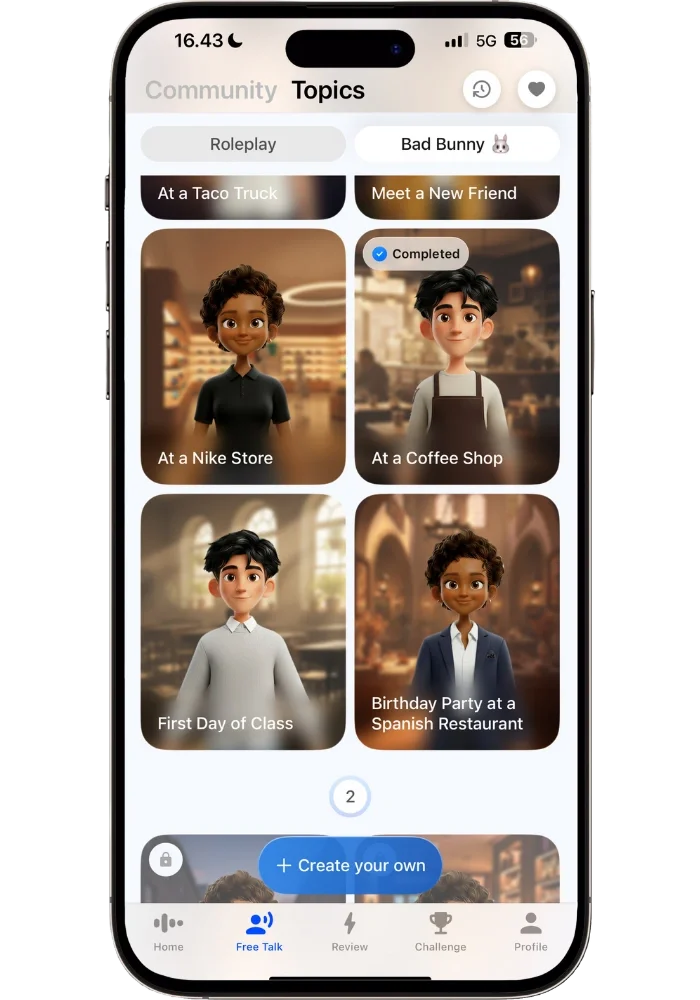
Speak also has dozens of AI ‘Free Talk’ speaking scenarios — from ordering coffee to meeting your partner's family.
Speak's speech recognition also strikes the right balance for beginners: it flags real mistakes while staying forgiving enough that you can keep speaking as you find your pronunciation. It's not perfect — no voice AI is — and occasionally it'll mark you wrong when you were actually right. And in the roleplays, the AI itself will sometimes reply to something you didn't say. But in 209 days of daily use, nothing about it has been a dealbreaker. I’ve been more impressed with it than anything. And because it's AI-based, it gives you credit when you use a different word that means the same thing — correcting what actually matters without being rigid.
It’s also one of the best-looking apps I’ve ever used, with one of the smoothest user experiences. I've written a full in-depth review of the Speak beginner experience — covering the lesson flow, how the Smart review system works, the AI tutor, and the five things Speak gets right that other beginner apps don't. Read my full Speak review here.
💡 When to Choose This
Choose Speak if: You're a beginner who wants to actually speak Spanish, fast, on a clear path you can follow daily without thinking about what to do next.
If you're traveling soon, Speak is honestly what I think will help you prepare for your trip the most — everything is designed to get you to speak right away and even improvise in different situations using very limited vocabulary.
Best way to use it:
Do 15-30 minutes daily on the structured Spanish path
Add Dreaming Spanish (free) after 1-3 months for more listening-only practice
Optional: Add LanguaTalk lessons for real human practice once you have a foundation
💡 Which Plan Should You Start With?
Start with Premium ($6.99/mo, billed annually). It's everything beginners need — the full structured path, all core lessons, AI feedback, spaced repetition, and conversation practice. For under $7 a month, it's one of the best values in language learning.
Premium Plus ($13.74/mo, billed annually) adds deeper personalization — custom lessons built around your mistakes and interests. You can always upgrade later if you want more. There's no pressure to commit to the higher tier from day one.
Once you’re past the basics and want real conversation practice, I compare the best AI apps for speaking Spanish in my best Spanish AI apps breakdown.

#2: Storylearning Spanish Uncovered — Best for Deep Comprehension
Pricing: $297 per level ($997 for 6-level bundle: beginner — advanced + bonuses)
If you want the deepest listening comprehension gains and you’re willing to invest, Spanish Uncovered is it.
The story-based, "repetitive listening" method trains your ears to understand Spanish, which in turn trains you not to feel lost in conversations with native speakers. However, compared to Speak, or even Rocket Languages, it’s not as beginner friendly in terms of instant gratification, and it takes a leap of faith in the method since it’s backwards from the usual school approach.
However, if you do use it, the learning method works very effectively long-term, even for intermediate and beyond — which means you don’t need to change your learning approach at the upper beginner/lower intermediate plateau like with most other methods.
Storylearning is for you if:
You're in it for the long haul — months and years, not weeks
You care more about deeply understanding Spanish than speaking it quickly
You can invest $297 (or $997 for the full 6-level bundle — my recommendation if you can swing it)
You enjoy story-based learning over drill-style lessons
✓ What I Love
- Olly Richards is an incredibly clear teacher and motivator
- Story-based = you learn everything in context (without memorizing)
- Grammar lessons don't focus on rules but specific examples from the story
- Comprehension-focused (you'll understand more, faster)
- Effective long-term path (bundles offer beginner → advanced)
- Both Castilian (Spain) and Latin American options included
- Method is proven (lots of success stories)
- No need to change study approach at upper beginner/intermediate like with other methods
⚠ Honest Cons
- $297 regular price is steep for many beginners
- Less instant gratification than app-based tools
- Requires commitment to work through the course — using a learning approach most aren't used to
- No native app — uses the Teachable platform (you'll need to download materials)
- Provides speaking exercises but requires external tools to practice
My Experience
I've worked through Spanish Uncovered Intermediate (Levels 3 and 4), Advanced (Level 5) and Mastery (Level 6). I skipped the Spanish beginner courses — I was already past that level when I started. But I am doing Korean Uncovered as a beginner, and it's already been massive for my listening comprehension. Same method, in a language way more challenging than Spanish.
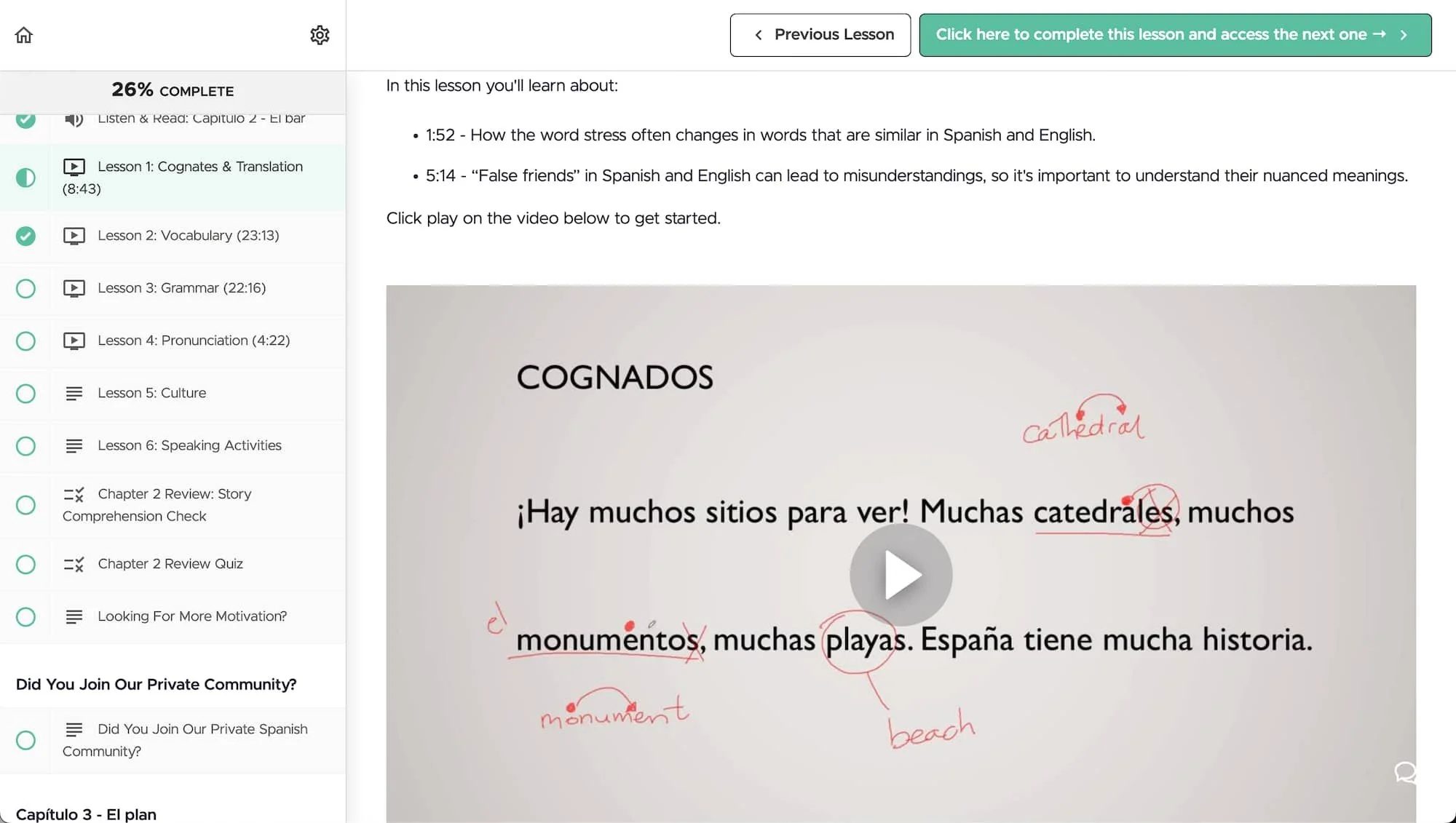
The Spanish Gold Bundle (For Long-term Learners)
If you're committed long-term, consider the Spanish Gold Bundle ($997 for all 6 courses, beginner through advanced).
Here's the value:
Individual courses: $297 × 6 = $1,782
Bundle: $997 (save $785)
I've used this bundle myself (finished Levels 3-6) and I love the cohesive progression. Each course builds naturally on the previous one — no need to switch methods.
Who the bundle is for:
Learners in it for the long haul (get set up with materials for years)
Those who want one complete path to fluency
People who can invest $997 upfront
My honest take: Only get this if you’re committed. If not, try the single beginner course first to see if the method clicks ($297, or wait for occasional sales — I've seen it as low as $147-97). If the method clicks, the bundle is one of the best deals in language learning as it will truly take you to high levels of comprehension (I've finished Mastery, the final course, myself — so I can vouch for this.)
Best Way to Use it
Work through it consistently (30-45 min/day), focusing 95% of your time immersing (listening/reading) in the story
Optional: Pair with LanguaTalk or Speak for speaking practice
See my post about the 3 Stages of Listening Comprehension for the most effective method to use it.
Try it Free
Try the 7-day free trial (you won't be charged until day 8):
Want the full path to fluency?
See the Spanish Gold Bundle (all 6 levels):

#3: Rocket Spanish — Best Budget Pick
Pricing: $149.95 per level — any current discounts automatically applied through my links
Why is it my best budget pick? Because Rocket is a well-made course with lifetime access and lifetime updates — you pay once and you're done. Full price is $149.95 per level, but Rocket frequently runs sales (often 60% off — around Easter, summer, Black Friday, and occasionally in between). When they do, a level drops to around $60, which is excellent value for everything you're getting. If you don't see a sale when you visit, keep an eye out — they come around fairly often.
It’s approachable, well-organized and has some useful and fun features. Listen to audio lessons while doing house chores, improve listening with ‘Listening Activities’, and get a foundation in the language through their lessons. You learn whole sentences right away, which is something I’m a firm believer in as it’s key for speaking.
Many language courses use short conversations to teach you the language — a great way to get bite-sized learning while still getting real language. What sets Rocket Languages apart from many other courses is how you practice this vocab: in predetermined interactive video role-plays. It lets you practice the dialogues assuming the role of either speaker, practicing the back-and-forth with the other speaker like in a Facetime video call. It’s simple yet engaging practice — even though the conversations are pre-determined.
Who it's for:
Beginners who want a little bit of everything, including grammar lessons
Learners wanting to focus on speaking
Those who like interactive lessons (not just passive videos)
Those who like to take their time learning (lifetime access, no subscription costs)
✓ What I Love
- Role-play video conversations
- Learn complete sentences from day 1 (key for speaking)
- Balanced approach: listening, speaking, reading, writing, culture, grammar
- Nice-looking app
- Lifetime access deals (pay once, use forever)
- Downloadable lessons (offline use)
⚠ Honest Cons
- No automatic review — it's up to you to practice the vocab until it sticks
- American speaker's Spanish doesn't have native pronunciation (though not the main instructor)
- Some conversation scenarios are a bit standard and less practical than others
- Latin American Spanish accent only
My Experience
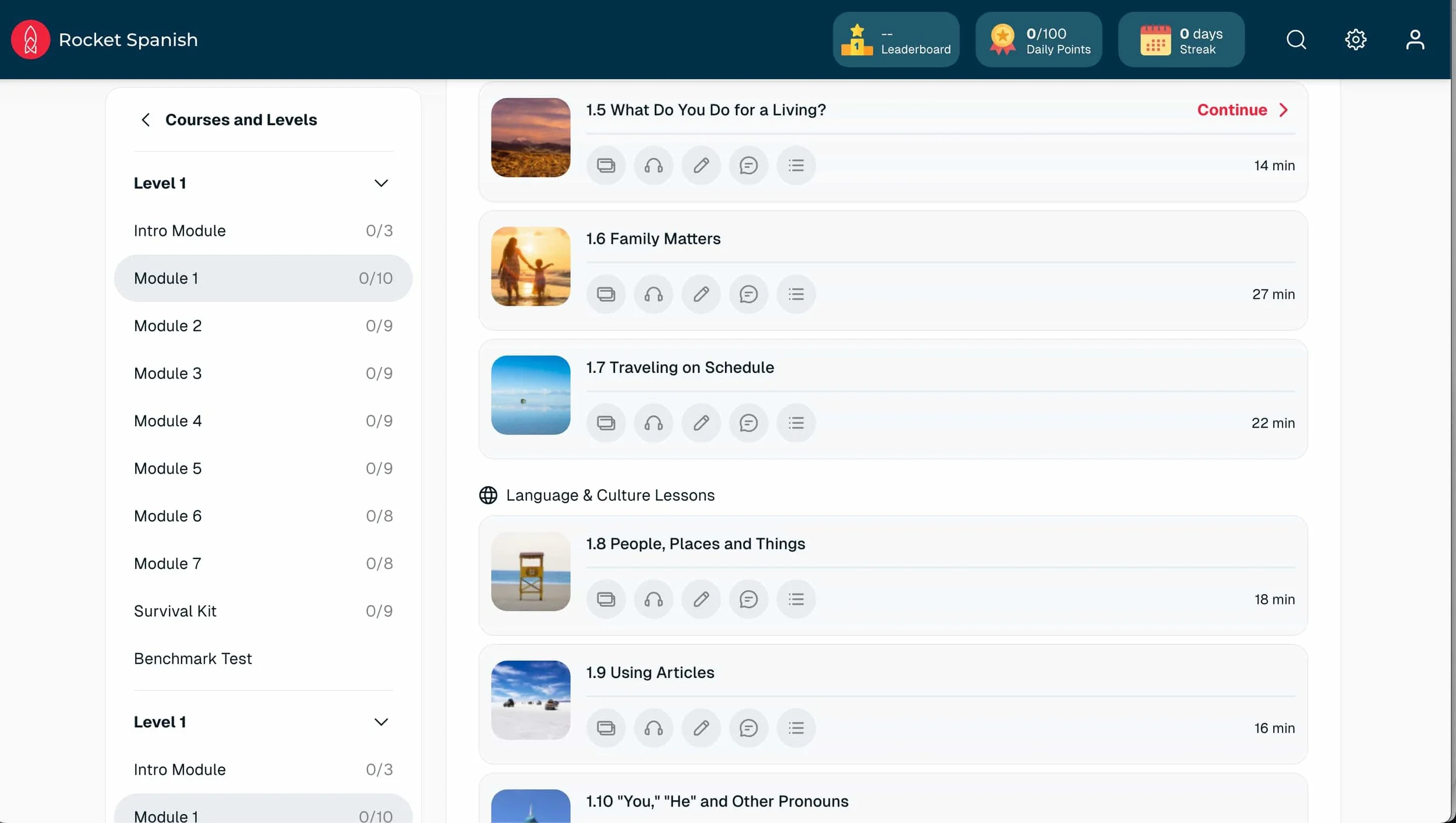
I've been using Rocket Korean for over 3 months and genuinely enjoying it — the role-play conversations are a fun way to practice the dialogues you learn, and it builds confidence because you're speaking from lesson 1. I also appreciate how little parts of the culture are sprinkled throughout the lessons — culture is a big part of any language, and Rocket handles it well.
That said, I've found the audio lessons hard to fully grasp the first time through. That's normal with a course like this, and something I'm used to from other methods. But unlike my #1 pick on this list, Speak, Rocket requires you to take charge of your own reviewing — the vocab won't stick unless you do the work between lessons. Some learners thrive with that independence; others might get stuck without built-in repetition.
The grammar lessons are genuinely clear, with interactive elements that keep you engaged. Overall, Rocket is a solid beginner's course that covers a little bit of everything — culture, grammar, reading and writing, listening practice, with an emphasis on speaking from day 1.
Read more about my Korean experience in these posts:
Best way to use it:
Study daily (15-30 min minimum) — focus on audio lessons, language & culture lessons, listening activities, and role-plays.
Want more input? Add Dreaming Spanish (free) after 1-3 months.
Optional: After 2-3 months, add LanguaTalk lessons to practice conversations with real humans and add accountability
Want to try it? Try some free Rocket Spanish lessons — any current discounts will be automatically applied via my link:
#4: Dreaming Spanish — Best Free Comprehensible Input
Pricing: Free (with $8/mo for Premium subscription—unlocking more videos)
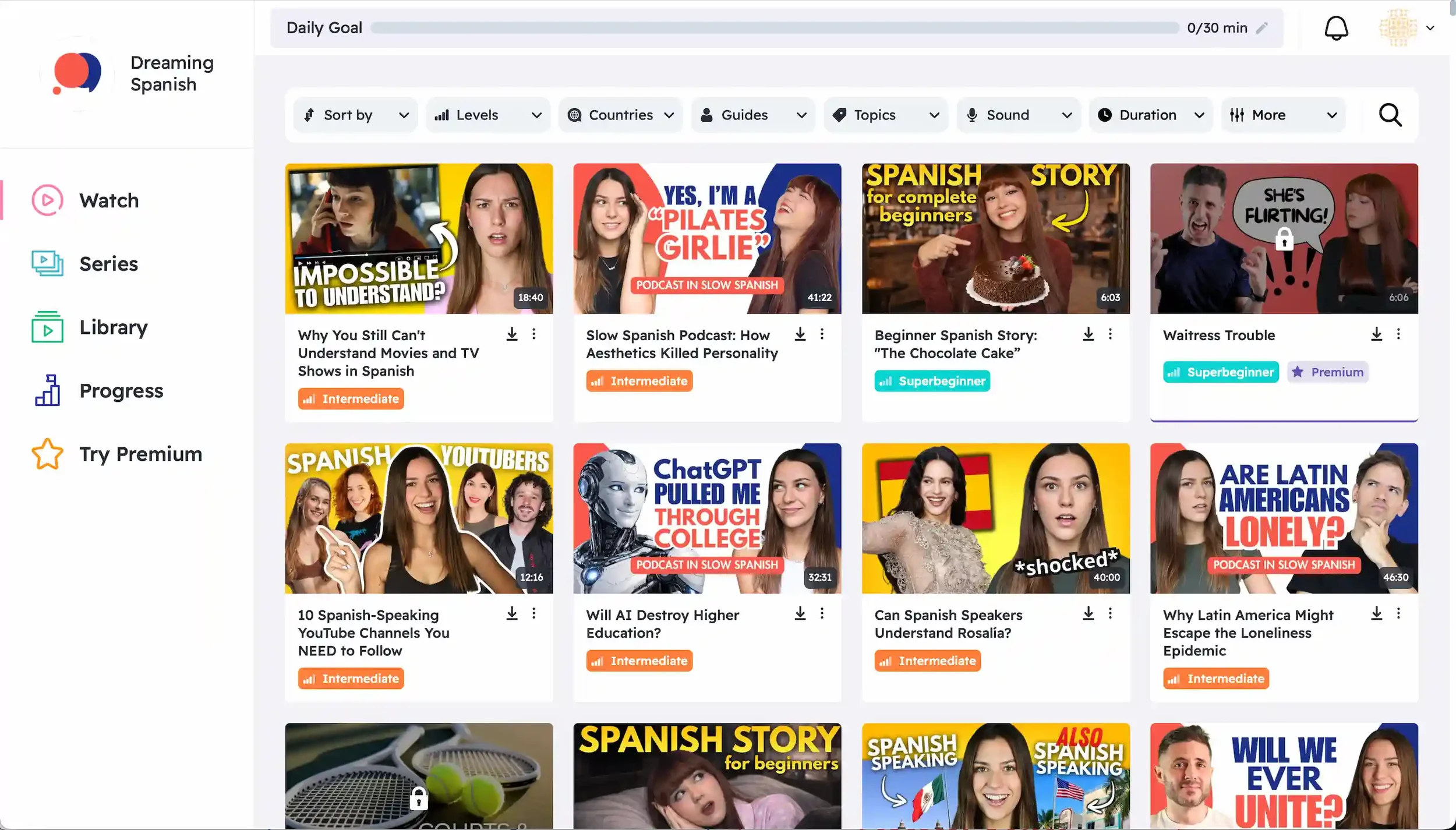
This is an incredible free resource (paid option unlocks more content) to train your listening comprehension. It offers more than a thousand free videos, completely in Spanish, with level ranging from Super Beginner to Advanced.
Who it's for
Budget-conscious learners
Those who want natural input (not drills/grammar)
Learners who enjoy watching videos daily
People who've done at least 1-3 months of structured course/app
✓ What I Love
- Hundreds of free videos (sorted by level, topic, accent, speaker)
- Pure comprehensible input method
- Native speakers, natural content
- Premium tier adds lots of extra videos ($8/mo)
- Build your "listening hours" naturally
- Set a daily listening goal — clear indication when you reach it
- Keeps track of your listening time (very motivating long-term)
⚠ Honest Cons
- You have to figure out words by visual cues
- Requires patience (input takes time to "click")
- Advanced videos are more at an intermediate level
- No structure, up to you to create your learning path
- No speaking practice
My Experience
After 1-2 months of foundation work, I started watching Dreaming Spanish. It was an amazing way to start training my listening comprehension in an engaging way. Spanish learners all over have seen tons of success using it.
However, I do think progress is quite slow if you do nothing else than watching easier videos so I’ve always used reading and speaking tools alongside. And at some point at intermediate, I started seeing diminishing returns — but before that, it’s amazing.
When to Add This
My recommendation: Add Dreaming Spanish after 1-3 months of structured learning (Speak/Storylearning/Rocket). This way you recognize some words and the input feels more productive.
Can you use ONLY Dreaming Spanish? Sure, and some do. But it takes hundreds and hundreds of hours to reach intermediate — so I don’t think it’s the most efficient time-wise, when used only on its own. I recommend pairing it with at least one more structured resource.
Best Way to Use it
Watch 30 min daily (start with the easier videos)
Pair with structured course (Speak/Storylearning/Rocket)
Try Dreaming Spanish Free
Start with their free videos here. It’s plenty of content for most people. And if you’re hooked and want more content, you can always upgrade to premium for $8/mo:
#5: LanguaTalk — Best for Lessons with Native Tutors
Pricing: Varies by teacher ($11-60/hour)
For those who want to practice with real humans, get personalized feedback, and stay accountable — LanguaTalk is the best platform for Spanish tutoring.
Who it's for:
Beginners who want human feedback
People who need accountability (scheduled lessons = you show up)
Learners who value interactive learning with natives
Those willing to invest in 1-on-1 lessons ($11-60/hour)
✓ What I Love
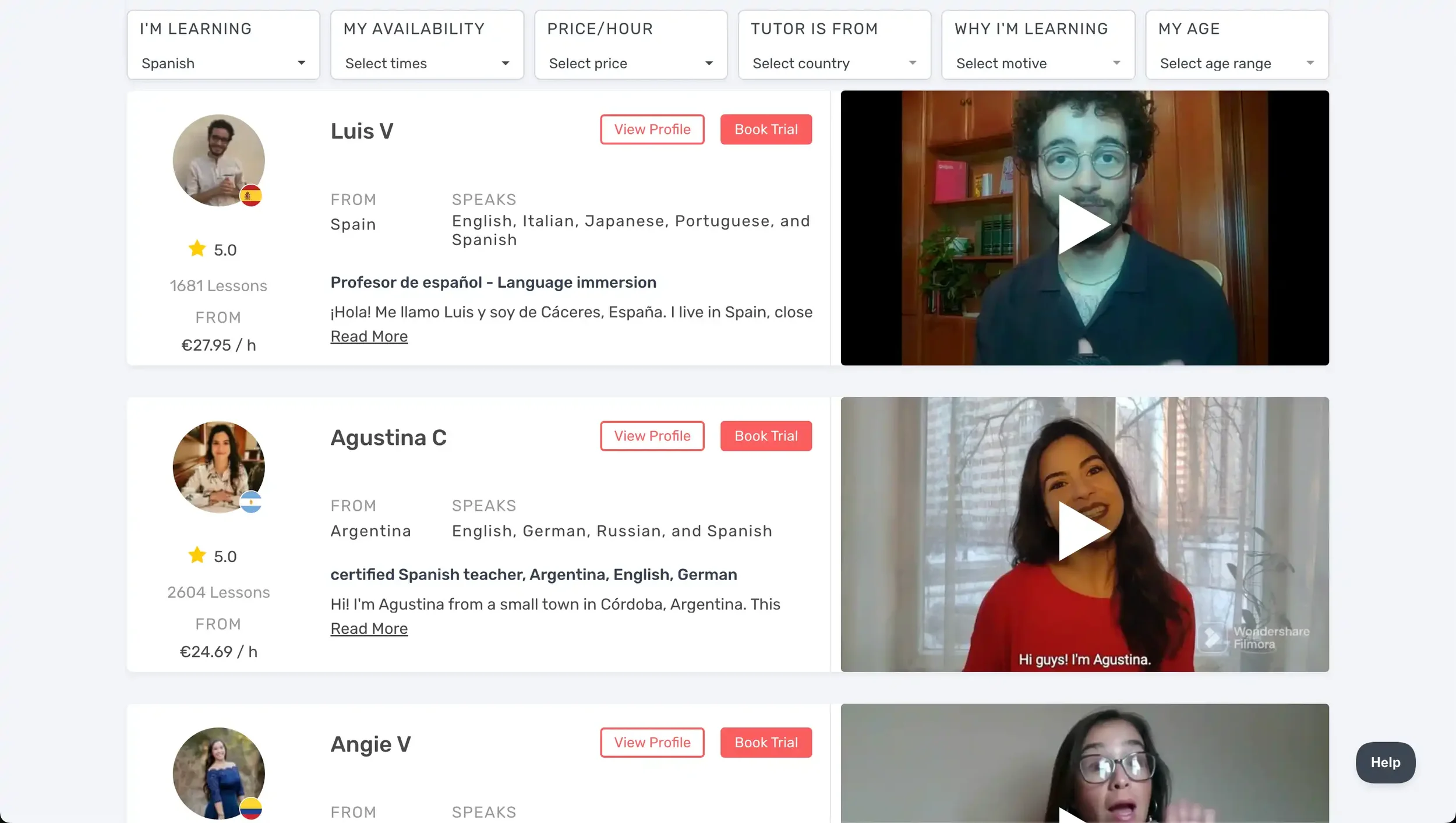
- Choose from high quality Spanish tutors (filter by accent, time, price)
- Easy-to-navigate website
- Tutors adapt to absolute beginners
- Flexible scheduling — book when you want, and reschedule or cancel up to 24 hours before
- Pay-as-you-go (no subscription required)
- Many teachers offer a Free 30 min Trial Lesson
- Better than iTalki for Spanish (cleaner interface, better tutor vetting, instant booking confirmations)
⚠ Honest Cons
- Not enough as a standalone resource (learning between lessons is a must for progress)
- Requires scheduling/commitment
- Can feel intimidating for shy learners
- Need consistent lessons to see results (1x/week minimum)
My Experience
I've taken 120+ online lessons across three languages. When I started Cantonese, I took weekly lessons for my entire first year — it became the most meaningful part of my learning and trained me to converse comfortably.
With Spanish, I took my first lesson after just one week (to prepare for a trip to Spain). Now, 4.5 years in, I take lessons here and there rather than continuously — I might do a ten-week push when I want to sharpen my conversational skills. I'm in one as I write this, actually.
That's a compromise, though, not a recommendation. It's because I'm juggling four languages. If Spanish was the only language I was learning, I'd do what I did with Cantonese: weekly lessons, every week. The lessons do real work on their own, and the standing slot adds more on top — it motivates you to squeeze in extra practice between them, which gives your Spanish another boost. Something I'm noticing again right now.
Years ago, I switched from iTalki to LanguaTalk. I found LanguaTalk had more consistent tutor quality and a better user experience — no buying credits, no waiting for confirmation. When you book a lesson, it's booked. And it's super easy to reschedule or cancel, as long as you do it more than 24 hours before. iTalki is still useful for less common languages, but for Spanish I'd go with LanguaTalk.
When to Start Taking Lessons
Day 1 is maybe not ideal as you’ll get more out of it once you have some foundational vocab. I started 6-7 weeks in when I learned Cantonese (which is a much trickier language than Spanish) — it helped tons and motivated me to practice even more between lessons.
Two options:
Start early if you’d like accountability, motivation, and start working on conversational skills early in an authentic context
Add later if you want to build foundational skills and comprehension first
Keep in mind: There's no perfect time to start. You don't need to feel ready — the teachers will adapt the lessons to your current level. LanguaTalk and Langua run on the same account, so if you add their AI speaking platform later there's nothing new to set up (see my Langua AI Tutor review for more on Langua). I recommend adding it once you're around intermediate and ready to start practicing full conversations.
Best way to use it:
Find a tutor you connect with (try 2-3 if needed)
Take 1-2 lessons/week consistently and focus on conversation (not being taught the language)
Add new vocab and practice using Langua’s flashcards (free feature) or any spaced repetition app
Practice between lessons (Speak, Storylearning, Dreaming Spanish, etc.)
The first lesson can feel scary (it did for me!), but those nerves vanish a few seconds in. My bet: you'll be hooked.
Honorable Mention: Pimsleur
I completed all 5 levels of Pimsleur Spanish and genuinely enjoyed it (at least the first 3 levels) — the backwards-syllable pronunciation technique is smart, and the audio-only format is perfect for commutes. But after testing Speak extensively, I can't recommend Pimsleur as one of my top 5 anymore.
Here's why: Speak does nearly everything Pimsleur does — forces you to speak out loud, uses spaced repetition, works hands-free while you multitask — and then adds AI-customized practice, genuinely engaging video hosts, real-time feedback, and bite-sized lessons that don't get repetitive after 30 lessons. At $6.99/month vs. Pimsleur's $20/month, Speak is also significantly cheaper. Plus, you'll outgrow Pimsleur way before Speak.
If you specifically need 100% audio, no-screen learning (truck drivers, long commuters), Pimsleur still has its niche. Otherwise, Speak wins across the board. Read my full Pimsleur guide if you want the deep dive.
My Recommended Beginner Path
The simplest path: Start with Speak. After 1-3 months, add more listening input. Dreaming Spanish (free) is a great one. If you're ready for human practice, add LanguaTalk lessons.
If you're specifically committed to a deep, long-term comprehension path from day one, start with Storylearning Spanish Uncovered instead — and add LanguaTalk lessons or Speak after a month or two for speaking practice.
Frequently Asked Questions
What's the best app to learn Spanish for beginners?
For most beginners, I recommend Speak. It's effective, fun, and gets you actually speaking from day 1 on a structured path with built-in repetition, yet flexibility with its AI features. If you prioritize deep comprehension, Storylearning Spanish Uncovered is the pick for those looking to invest in their learning for the long haul.
Can I learn Spanish with just an app?
Yes. In fact, I recommend starting with just one resource to keep things simple. For most beginners, I’d go with Speak — the structured path and built-in repetition mean you don't have to think about what to do next. Once you have a foundation (2-3 months), you can add comprehensible input from Dreaming Spanish and book conversational lessons with LanguaTalk tutors to expand your skills. But Speak’s Spanish course will last you a long time — I’m seven months of daily use in and still haven’t reached the end of it.
How long does it take to learn Spanish as a beginner?
With consistent daily practice (30-60 min), and enough speaking practice, you can have basic conversations in 2-3 months. Reaching intermediate comprehension typically takes 6-12 months depending on your method and dedication.
Is Speak better than Duolingo?
100%. In my experience — and I used Duolingo daily for 6 months — I never got to a point where I could have even simple conversations. Speak takes the gamified fun that makes Duolingo so addicting, but wraps it around actually effective language learning. I know that's a bold claim, but I've tested a lot of these apps, and Speak is the real deal.
What's the best free Spanish app?
Dreaming Spanish offers hundreds of free comprehensible input videos. Language Transfer is also excellent for grammar understanding through a unique (though challenging) approach. Both are legitimately useful for free, not just limited trial versions.
Conclusion
The best beginner resource is the one you’ll actually use and enjoy. All resources on this list will give you results — if you use them daily and put in the time and effort.
For most people, Speak is the best place to start — it gets you speaking from day 1, adapts to your level, and makes daily practice genuinely fun. If you're a serious learner ready to invest in deep comprehension, Storylearning Spanish Uncovered is the other pick worth considering (the 6-level Gold Bundle is one of the best long-term investments in language learning if you can swing it).
Rocket Spanish is a great budget option, especially when on sale. Dreaming Spanish (free input), and LanguaTalk (human tutors) — are excellent additions once you have a foundation, but I don't recommend starting with them alone.
The main thing: don’t overthink it. Pick one resource and stick with it. You'll eventually need combinations, but for at least the first month or two, focus on one app or course ONLY. This prevents overwhelm and spreading yourself too thin, slowing down results.
Keep it simple, show up every day, and challenge yourself. If you do that, you’ll for sure learn Spanish and speak with the locals on your next trip to Spain or Latin America!
Are you just starting Spanish or have you tried one of these already?
