Speak App Japanese Review: 30 Days Starting from Zero
Updated
What's new: added the 90-day follow-up.
This post contains affiliate links. If you buy through one of them, I may earn a commission at no extra cost to you. Some of the products I write about are also provided to me for free. See Full Affiliate Disclaimer.
Table of Contents
In my Speak Beginner review I covered why this app has quickly become my favorite for learning a language from scratch — that post is the best place to start if you want a full picture of how Speak works.
This post is my follow-up specifically for Japanese: what 30 days of learning Japanese from scratch with Speak actually looked like — what stood out, where it fell short, and why I ended up continuing past 30 days.
(I took it all the way to 90 days in the end — that story, with video, is here.)
I'll also share my five favorite moments (with screenshots) — one involving ¥5,000 yen and an AI response that made me laugh out loud.
Over more than 30 days (34 to be exact), I spent a total of 350 minutes (5 hours and 50 minutes) on Speak — about 12 minutes a day on average (some days as little as 3 minutes when life got busy), and here's what that got me.

Why I Started Japanese With No Big Goals
Language learning journeys that end up in fluency don’t have to start with big goals. In fact, I don’t think I’ve ever started a new language with one. Cantonese probably comes closest, but even there I started with very modest daily goals.
The problem is that fluency feels like such a massive commitment that it scares people off before they start. I’ve watched friends say: “Some day I’d like to learn Spanish” for ten years, and the “some day” simply never comes.
Spanish is a good example for me. I started learning it for an upcoming Spain trip, and my only goal was to see how much I could learn in the two weeks before we left. After the trip, I just kept going. Four years later, I can understand most of what I hear in podcasts, TV shows, and I even have real friendships in Spanish — none of which I planned when I started. I just kept at it every day on the side, and it all added up over time.
Japanese is a language I’ve been curious about for years, decades even. I tried learning it as a teenager with Rosetta Stone and quit within a week, then tried again two years ago with another app for two months before stopping. By the time I picked it up again, I'd forgotten everything — hiragana, katakana, and the few phrases I'd learned.
When I started using Speak for Spanish I saw how easy it made showing up every day. I got curious if I’d have the same experience with Japanese. After a few days of testing it out, and already learning valuable things I could use with Japanese people, I thought “why not learn even a little bit just for fun and see what happens?”
Instead of waiting another three or five years until I have more bandwidth, why not start now, in the background of the languages I'm already learning?
Because here’s the thing: there are many rewarding levels before fluency. Even a handful of useful phrases is valuable. Being able to have a simple exchange is another level. A meaningful conversation is another. Watching a TV show (without subtitles) with more or less full comprehension is another. And making friends in your target language is probably the most valuable out of all of them (I have done it in multiple languages and it really is the peak). But you don't have to aim for the highest level right away.
As you reach small milestones along the way — ordering food, understanding directions, having a short chat with a native — the next one becomes possible without you having to make a big deal about it. And even if all you do is learn some simple exchanges that you can fire off with Japanese tourists, that’s still something that will enhance your life in ways you can’t predict.
So instead of going with a big plan, I decided to go with curiosity — and just see where the adventure would take me.
How Speak's Japanese Course is Built For Japanese-Specific Challenges
After using Speak daily in three languages — Spanish, Korean, and now Japanese — I quickly realized something: Speak is not one course copy–pasted across all languages.
The core philosophy and structure are the same, but each language is built uniquely for the language it’s teaching. I started noticing this during the first lesson, and even more on Day 4.
Take vocabulary, for example. In Spanish, new words can be introduced directly inside the Speaking Drills since many are so similar to English that your brain has something to grab onto — restaurante, taxi, música. Even something like la cuenta makes sense when you connect it to the word "count" and realize it means "the bill."
Japanese has some English loanwords, but most words sound nothing like English. Speak handles this by adding extra lessons to introduce new vocabulary before the Speaking Drills. They are short — usually 1-3 minutes — but these small design choices are exactly what Japanese needs and Spanish doesn't.
The Japanese course also has more repetition overall — more touch points with the same vocabulary, and more variations of the same structures before moving on. There were moments when I almost felt “alright, I got it now” — but just as I started feeling that, the course moved on and introduced something new. It strikes a really good balance of: enough repetition that things actually stick, but not so much you get bored.
One of the clearest examples of how Speak builds step by step is what happened with the phrase "where is it?". On Day 3, I learned kore, doko desu ka? — a simple way to ask where something is. This is useful from your first hour in Japan when you need to ask where the convenience store or hotel is. Then on Day 20, in the manga café lesson, I was asking Naruto no manga wa doko desu ka? — "Where is the Naruto manga?". It built on the structure I already knew, just plugging in new vocabulary into a familiar sentence structure, and at the same time expanding that structure.
That kind of progression is rare in beginner courses. Other Japanese courses I’ve tried got overwhelming: I either had to decide to really buckle down and commit, or quit and focus my energies on other languages (which is what I did). In Speak, I never felt out of my depth. I was building on what was already familiar, while also moving forward and expanding my skills. That balance is hard to get right, and Speak does it better than any app I've tried.

Day 3 — Learning the basic structure

Day 20 — Expanding the structure and plugging in new vocabulary
Here are a few more things where the Japanese course is shaped specifically for the language. They are all examples of Speak’s ‘useful first' philosophy.
Learning through topics that are uniquely Japanese. In Spanish, you learn to order from the taco truck. In Japanese, you’re asking for directions to the convenience store or shrine, paying at a conveyor-belt sushi restaurant, ordering a Pikachu cake at the Pokémon café, and asking where they keep the One Piece manga. Which makes sense — most people learn Japanese because they love the culture. So the lessons are built around the things that probably drew you in to learn in the first place.
Numbers in context, not in isolation. Numbers take a surprisingly long time to master in any language. So I've always thought it's a mistake when apps just teach them all at once — it just gets overwhelming. Speak introduces them gradually, inside a specific situation — like asking for a table for two or three at a restaurant. This way, you're not trying to memorize numbers by force, you're using them in situations where you’ll actually need them. Once you learn a few, adding a few more isn’t as difficult.
One counter word at a time. Japanese (like Cantonese) uses counter suffixes that change depending on whether something is flat, round and small, round and big, and so on. In Japanese, there are roughly 15-30 used in daily conversation, which would get overwhelming quickly if you had to learn all of them at once. Speak introduces just one — the counter for flat things — inside a conveyor-belt sushi lesson where you're paying for the plates you stacked up. One counter, in a concrete situation. The rest comes later.
Hiragana, woven in. Many apps teach Hiragana and Katakana as the first thing. That's not necessarily wrong, but it means you have to slog through both before you can use the language. Speak takes a different approach: you learn phrases that you can use in real life from day one, with Hiragana introduced gradually using simple mnemonics, then immediately combined into short two-character words you practice. I'm still early on with this, but it's been the most pain-free approach to learning the writing system I've tried (there is also a dedicated, separate Hiragana course that you can take if you want to focus on it. No Katakana course yet though).
None of these are huge individual things. But taken together, they tell me that Speak didn't just translate a Spanish template into Japanese and call it done. They actually thought about what this language needs — and built a course around it.
The Top 5 Moments That Stood Out
Over 30+ days there have been several moments that stood out. I already covered the first one — learning to improvise on Day 2 with how to ask a stranger if a seat was taken — in my Speak beginner review, so I won’t repeat it here.
The rest are below, with screenshots from my actual sessions since I documented everything as I went.
1.) My laugh-out-loud moment: The 5,000 yen reaction (Day 18)
In one of the AI Q&A sessions — which is where you practice using the vocabulary you've just learned in a short exchange — the AI was posing as my friend and asked me how much the check was. I said "5,000 yen." I just picked a number, because I have no idea what's expensive in yen.
The AI immediately reacted: "E, gosen en?! Takai desu ne!" — "What?! 5,000 yen?! That's expensive!"
I laughed out loud. It sounded so over-the-top, so Japanese, and the AI was reacting specifically to the number I'd made up, being in shock over the price. The Japanese AI voice itself is what made this funny — it sounds just like a real person (Korean does too. Spanish doesn’t — it sounds fine, but you can tell it's AI.)

2.) The H&M mnemonic for left/right (Day 3)
Early on, you’re taught to ask for directions to a place. I have learned this in other languages, but wasn’t able to understand the answers like “to the right” or “straight ahead” until I was quite competent in the language. Speak addresses this challenge directly — and uses a brilliant mnemonic to make it stick.
The Japanese for left is hidari and for right is migi. Speak points out that the first letters — H and M — happen to match the store H&M. That's it. Once I saw it, I never had to think about left and right in Japanese again.
Compare this to other courses where several directions were thrown at me at once. I couldn't remember any of them (or I had to make up my own elaborate mnemonics to make it work). Speak's mnemonic does what good design always does: it makes something hard feel easy.

Speak teaches simple mnemonics for things that can be tricky to remember as a beginner.
3.) The "would you like it heated up?" design choice (Day 6)
A clerk at the convenience store asked me: "Obentō, atatamemasu ka?" — "Would you like me to heat up your bento?"
What's brilliant is that Speak doesn't have me practice producing that question. It has me practice hearing it and responding to it — "yes please" or "no, that's okay." Because realistically, when am I ever going to ask someone if they want their food heated up? Never, unless I work in a convenience store. But I will absolutely be asked that question if I visit Japan and I definitely want to be able to understand it and answer it.
This is another good example of how everything in Speak has a reason for being there. It’s never drilling for the sake of drilling.
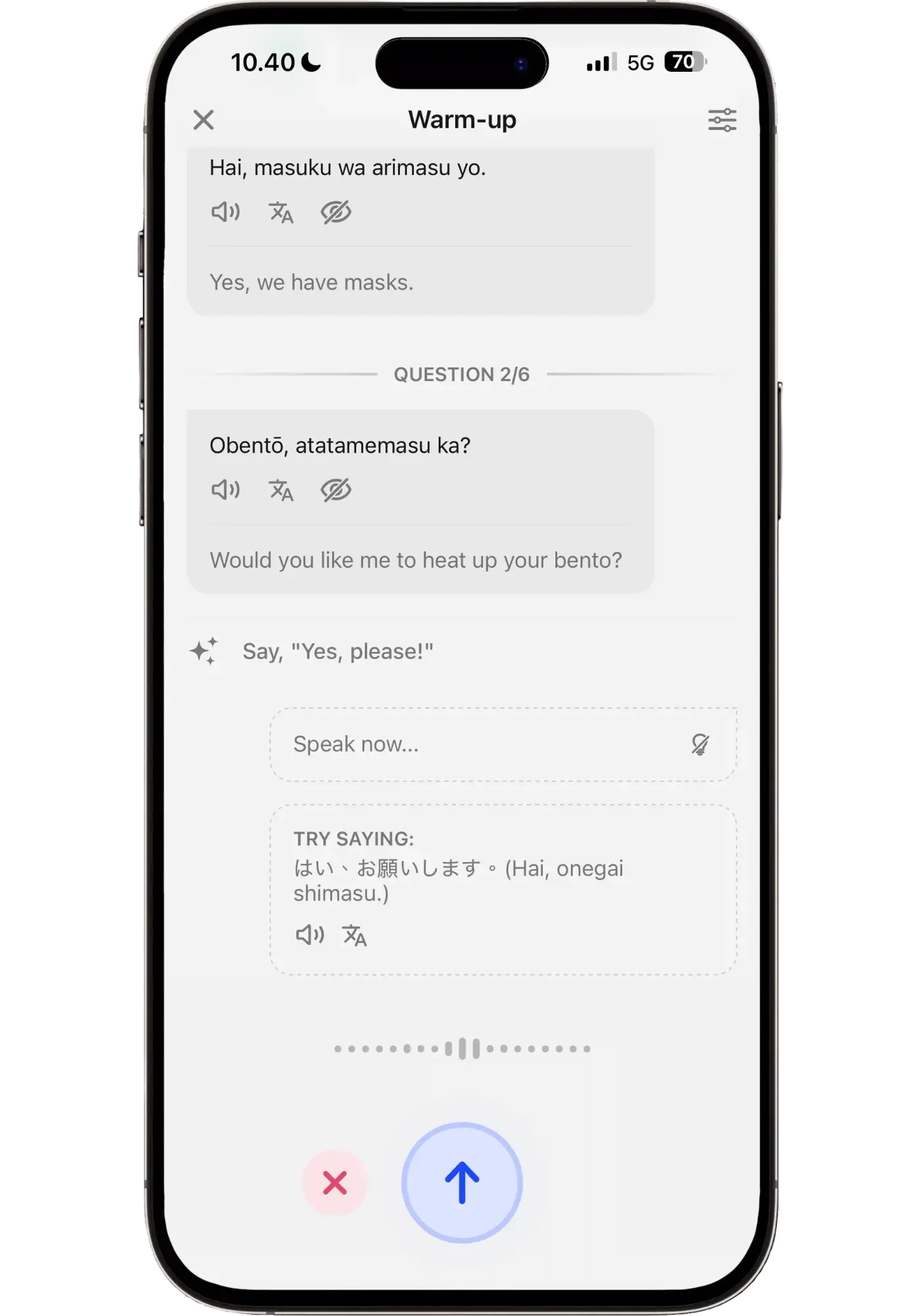
Tap the 💡 icon if you need a hint what to say.
4.) Kawaii vs kowai warning (Day 16)
In a lesson teaching the word kawaii ("cute") — one of the most commonly used Japanese words — the host warned that if you mispronounce it slightly, you end up saying kowai — which means "scary."
I thought this was such a thoughtful thing to make you aware of. Because it's exactly those types of things that will lead to awkward situations or misunderstandings, which could make you feel discouraged. They flag the trap, then let you practice both side by side (the video lessons have interactive speaking prompts in them) to hear the difference and learn to say it correctly. Simple, effective.

5. "Now tell me how many plates your friend had" (Day 18)
This one’s a small moment but it really captures how Speak trains you for actual real-life situations. I was in an AI Q&A session practicing saying how many plates I'd eaten at a conveyor-belt sushi restaurant. Then the AI suddenly asked me: ‘how many plates did your friend have?’
My first reaction was 'I don't know how to say he had.' But then I thought — wait, Speak only taught me one way to say it. So maybe the same phrasing works for both? I tried it, and it did.
Speak deliberately put me in a spot where I had to try using what I had. Real life conversations are full of these moments — when you're not sure what to say and end up saying nothing. Speak gets you through them in a low-stakes setting first, so you can use the language confidently in real life.
The Parts That Need Work (and Why it Doesn't Dim My Enthusiasm)
As much as I love this app, it’s not perfect. A few things cause friction. None of them are deal-breakers, and none of them have made me want to use it less, but they are things to be aware of.
Speech recognition issues on short words: In Japanese, the app sometimes doesn't pick up what I'm saying, especially on short single-word prompts. For full sentences (which is the majority) it's rarely an issue, but in video lessons where you say one word before the full phrase, it can take 2-4 seconds to register — or it doesn't register at all and I have to repeat. It does break up the usual effortless flow.
This isn't a Japanese-specific complaint, exactly. I've noticed it in Korean too. I suspect it's because these languages have less training data behind their speech recognition than Spanish does (Rocket Languages has the same issue with short Korean words). There's a workaround though: tap "can't speak right now" and the AI fills in the line so you can continue. I've also noticed that exaggerating the pronunciation — really leaning into the Japanese sounds and intonation — works better.
Speak's speech recognition is fairly lenient overall, which I think is the right call. It gives you space to grow into your pronunciation rather than blocking you on imperfect attempts. The downside: it occasionally accepts things it shouldn't. In one hiragana exercise I said "an" when I should have said "en" and got marked correct.
No way to pick the voice gender. Speak uses female and male AI voices interchangeably. This is not a huge deal but I’d like to be able to choose only the male voice, since I find it easier to mimic male intonation. In Spanish, I didn’t feel this need. In Japanese, I find male and female speech more noticeably different. I think it would be really easy to implement since both voices are already in the app.
AI answers are sometimes off. Sometimes the AI responds to something other than what you said, which doesn’t exactly hinder the learning process (unless you’re in Free Talk), but when they occur it takes you out of that immersive feel for a second.
Speak alone won't get you fluent. If you want to seriously learn Japanese, you'll eventually need to add tools for listening comprehension and reading (Speak currently only teaches Hiragana). That's why I also added Lingopie to my Korean routine — to work on understanding native media. No single app does it all. Speak focuses on building a speaking foundation and internalizing sentence patterns intuitively — and it does both better than any beginner app I've used.
Despite some of the flaws: I still love opening this app every day. There's a "what are we going to learn today?" feeling that I don't get from other beginner apps and courses in the same way. After 34 days of Japanese, 80 days of Spanish, and over two weeks of Korean, these cons haven’t dimmed that at all.
Why 'Starting Light' Works So Well With Speak
Everything I described in the previous sections — the careful progression, the building on what you already know, the practical-first focus — adds up to something specific: Speak makes 'starting light' doable, even for a language like Japanese.
You conserve your energy by not feeling overwhelmed (which is a big deal when you’re learning a language alongside everything else going on in life), but it’s also challenging enough that you move forward and don’t feel stuck just doing “more of the same”.
After more than 30 days, my Japanese vocabulary is still tiny. But the things I have learned are practical things I could use, and they have actually stuck to my muscle memory: I can ask things like doko desu ka? (where is it?), ... arimasu ka? (do you have...?), and choshuku nanji kara desu ka? (what time does breakfast start?) without thinking or having to pull up Google Translate (I still need to learn more numbers to actually understand the answer to the breakfast times hah, but that'll come.)
Compare that to other beginner apps I've used for twice as long, where I still couldn't say anything useful. The difference is how Speak connects everything into a progression that makes sense, instead of teaching random disconnected things.
If you want to start a language, without knowing whether you’ll want to commit hard yet, Speak is probably the best app for that right now. For a few reasons:
The daily streak makes it easy to keep showing up. One lesson takes 3–5 minutes, which you can always do even on your busiest day.
There's a clear learning path. You don't have to spend any energy figuring out what to do next — you just tap the next lesson.
The lessons, drills, and roleplays actually work. Even though it’s gamified learning, there are no gimmicky fillers, and you don’t have to wait weeks or months before you have language you can actually use.
The real reason for me why it works longterm, without forcing me to decide whether to commit fully or not, is this: I could pause Japanese for six months while I focus on other languages, then come back — and all the sentence patterns and structures I've collected (Speak calls them "concepts") would still be there.
Smart Review sessions for a few days or weeks would bring me back to where I left off. That's not how most apps work. With most, a six-month break means starting over (like I had to do this time). With Speak, you have a way to actually refresh what you've learned without having to redo any lessons — which makes it feel like you're never really losing your progress.
If you want to try this approach yourself, Speak offers a 7-day free trial — no commitment if it's not for you.
Curious how Speak fits into a broader daily routine? Here's the rest of my setup:
Who Speak Japanese is For
After 34 days of using Speak daily for Japanese (alongside intermediate Spanish and beginner Korean), here are the types of Japanese beginners I think Speak is best for:
People who want useful phrases they can actually use after their first session
People who want a modern, well-designed app with motivating gamification that doesn't sacrifice effectiveness
People who want to internalize grammar patterns intuitively (Glossika-style) rather than learning rules
People who want to practice hands-free during chores or commutes (Smart Review is ideal for this)
Those who have gotten discouraged with other Japanese apps being too difficult and too steep of a learning path
The last one is honestly the biggest one for me and the reason why I can take such a casual approach to learning such a challenging language like Japanese. Speak's strength is that the progression makes it feel manageable.
If any of this sounds like you, the 7-day free trial is the easiest way to see if it clicks.
Who it isn’t for
If you're committed to an input-only approach — building comprehension through immersion before speaking — Speak won't fit your method. The whole point of the app is to get you producing the language from day one. If your plan is to build understanding first and wait with speaking, skip Speak (at least for now). You can always add it later when you're ready to start outputting.
What I'm Doing Next
Twelve minutes a day. That's all it took to go from zero Japanese to being able to order food, ask directions, and have small exchanges I'd genuinely use on a trip. If you want practical, useful Japanese for travel — or just to start a language you've been thinking about for years — out of the handful of Japanese apps I’ve tried over the years, Speak is what I'd recommend as the best app to learn Japanese as a beginner right now. It’s the only one that made it so easy for me to stick with it and continue, even when not committing fully to Japanese fluency just yet.
I haven’t even touched the Smart Reviews yet — that will make sense once I’ve built up much more ‘concepts’ and vocabulary to manage. I also haven’t tried Free Talk, where you do extended roleplays like ordering coffee, attending a coworker's get-together at a sushi restaurant, or going to a movie.
That's one of the things I find so motivating about Speak — because you can feel the lessons are building toward it. Video lessons introduce new vocabulary and sentence structures, Speaking Drills cement it, Vocab Builders expand your vocabulary within the structures, and AI Q&As apply it. Roleplays that show up later take it one step further and Free Talks lets you practice targeted, short-form conversations. The whole thing is pointed at full conversations, and you can clearly see the path.
A quick note on plans: I used regular Premium for this 30-day Japanese run, and Premium Plus for Korean (which I'm more serious about). When you're starting out, I honestly think Premium is more than enough — I never felt like I was missing anything. You can always upgrade later if you want the full experience. More on the difference between the two plans →
My original plan was 30 days. I ended up going all the way to 90 — and filmed every single session. Here's the full 90-day story — day by day, including the week I nearly quit, plus a short video summarizing the journey (with footage from my actual learning sessions).
Or get acquainted with Speak and try it for yourself:
