Published

This post contains affiliate links. If you buy through one of them, I may earn a commission at no extra cost to you. Some of the products I write about are also provided to me for free. See Full Affiliate Disclaimer.
Table of Contents
- Who Spanish Uncovered Advanced is for (where you need to be)
- What's inside Spanish Uncovered Advanced
- What changes at the advanced level
- The teaching lessons: my favorite part of these levels
- How good is the story?
- What Mastery (Level 6) adds
- Pairing it with a speaking app (or a real tutor)
- Is Spanish Uncovered Worth it?
- Pros & Cons
- Pricing: bundles and discounts
- The verdict: should you buy Spanish Uncovered Advanced?
Nine months ago, I was looking for something that would push my Spanish past the intermediate level. I'd been learning for years, mostly by immersing in random stuff. It had worked but I wanted to try an approach with more structure to it. So I tried Spanish Uncovered to see if they could take my Spanish to the next level.
I started with Intermediate (Level 3) and I enjoyed it so much that I just kept going — through Upper Intermediate, then Advanced, and lastly Mastery. For those nine months, 80% of everything I read and listened to in Spanish came from these courses.
This is primarily a review of Advanced (Level 5), though also Mastery (Level 6), the final course — so you'll get a picture of where the whole path leads. After that many months it's honestly hard to say which insight came from which course. It's been pieces falling into place bit by bit.
I'll say this, though. When I heard the top levels were called "Advanced" and "Mastery," I was quite skeptical. Plenty of courses promise more than they deliver, and "Mastery" is a big word. I doubted a course could actually take you that far.
My verdict at a glance
5 monthsnear-daily
The rare advanced course that actually gets you to the point where you don't need courses anymore.
Best for: confident intermediate learners ready to iron out the trickier parts of Spanish.
Not for: beginners, or anyone looking for a quick win — the results come from working through the whole course, not skimming each chapter a few times.
Try Spanish Uncovered Advanced free for 7 days →Who Spanish Uncovered Advanced is for (where you need to be)
These courses are not for complete beginners or those who just entered intermediate. It’s for those of you who have been learning for quite some time but feel your Spanish lacking to feel really comfortable. You want to speak more naturally and understand native content more effortlessly.
If you can understand the Spanish Uncovered Upper Intermediate course well, then this one is the logical next step. If you’re new to Uncovered courses then I’d recommend having at least 500 listening hours before starting (I had 800-900).
These courses are for the self-directed learners — they give you a format and method, but not a learning schedule. And you’ll need to download the content and make playlists for easy listening. Teachable is too clunky for the repeated listening (and reading) you’ll be doing. I use LingQ for listening organization and easy reading on my phone, but just the native music app is just fine.
My routine: listening for 30 minutes daily (to the story chapters or teaching lessons). Reading through the chapters in LingQ, saving and looking up words (even though they don’t recommend looking up words, but I just found it easier this way than learning through context alone).
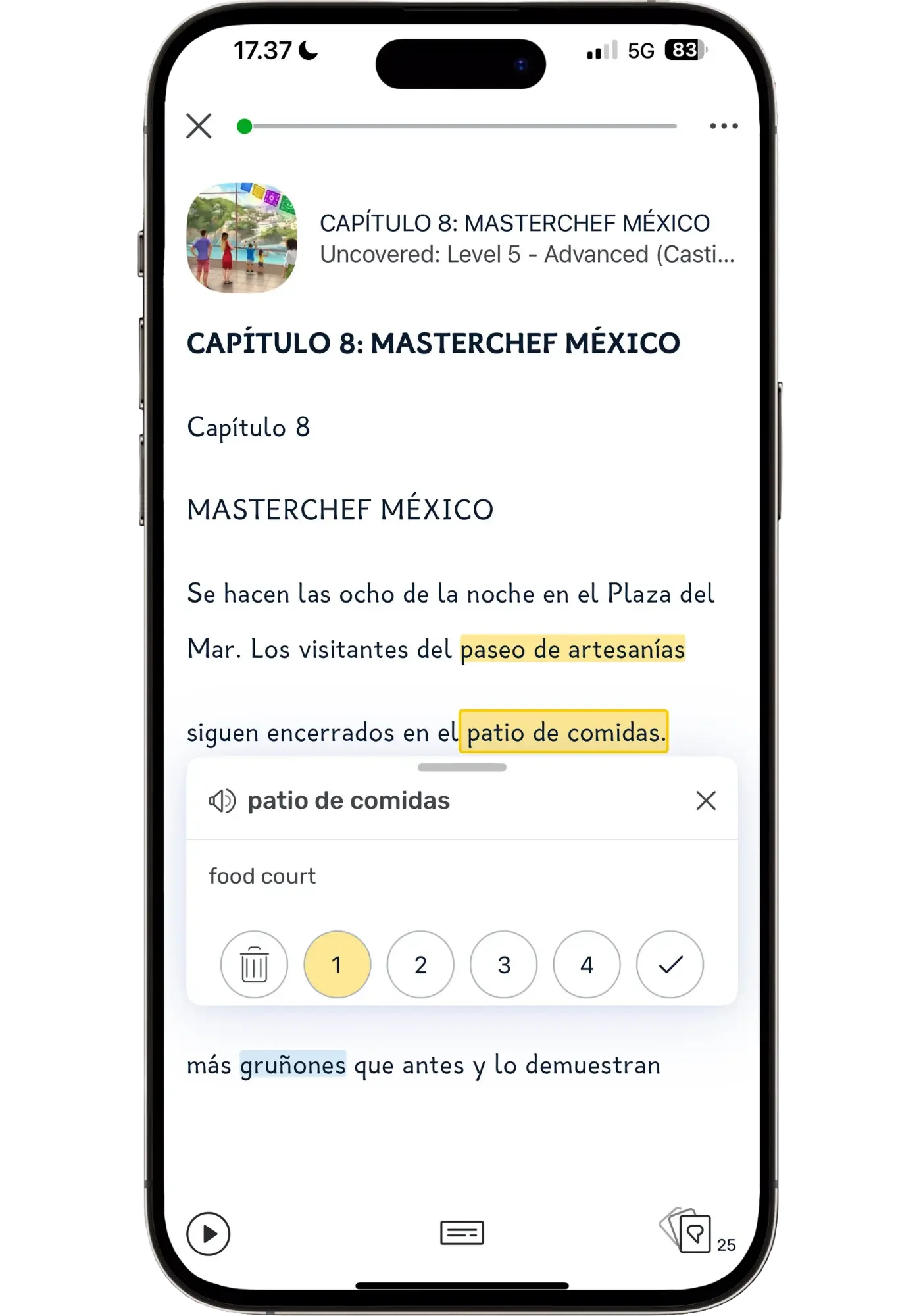
How I actually read the chapters: imported into LingQ, yellow words looked up as I go. Though this is my own choice and not necessarily part of the Storylearning method.
What's inside Spanish Uncovered Advanced
Every Uncovered course is built around a single long story, split into ten chapters. The story is where the learning happens and everything else exists to help you get the most out of it.
Each chapter gives you:
The story chapter — audio plus the full transcript, 6–9 minutes at Advanced (9-13 minutes in Mastery)
Vocabulario — the words and phrases from that chapter, in context
Gramática — taught through examples from the story
Comunicación — applying what you’ve learned in Vocabulario and Gramática to other contexts
Expresiones — fixed phrases and idioms (new lesson type)
Cultura — a written piece on Spanish or Latin American culture
Actividades para hablar — speaking prompts you can take to a tutor or an AI app
A comprehension check — a short quiz on the chapter
One thing worth knowing: every chapter comes in two narrations, Castilian and Latin American. They're not just different accents. The Castilian is more animated, dynamic, and slightly slower. The Latin American is more neutral, read straighter, and a tiny bit faster.
I slightly prefer the Castilian, but there’s a real benefit of having both. A few months in, after multiple listens, I switched to the Latin American version and immediately noticed por más que lo intente in Chapter 1 — a phrase I'd heard at least ten times already but it never registered. Nothing about the words had changed. But the voice had, and that was enough for it to stand out. Switching versions makes it feel fresh again.
Spanish Uncovered Advanced is here. StoryLearning also has Uncovered courses in 15 languages total — levels vary by language.
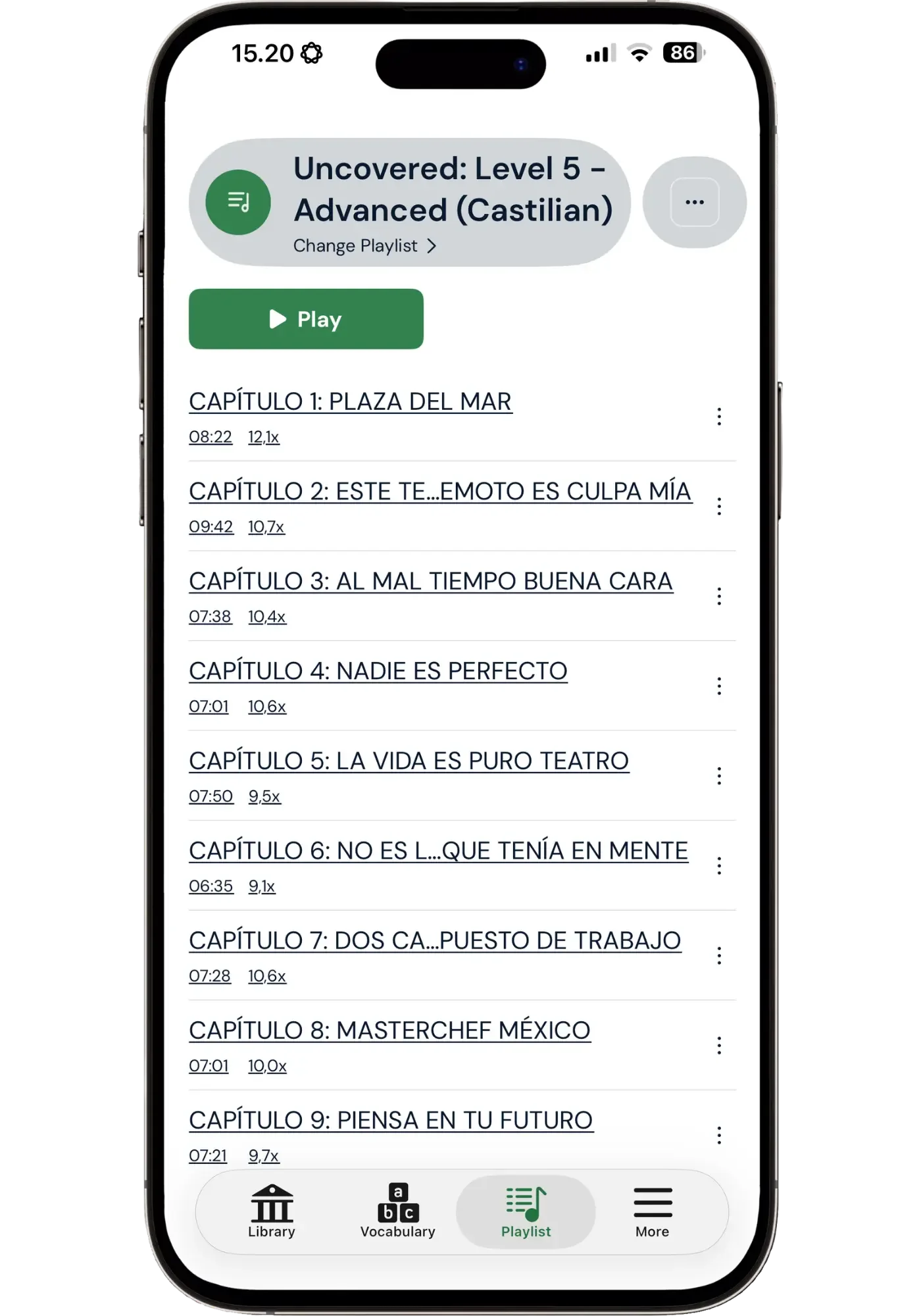
Chapter lengths and my replay counts. Around 10 listens each (+ another 4-10 listens in Latin American which is not in the screenshot), still not done listening to them.
What changes at the advanced level
Every Uncovered course follows the same format, which is one of its real strengths. You learn the method once and use it more or less from beginner to Mastery, instead of rebuilding your approach at every level.
Here’s what does change:
| Beginner & Intermediate | Advanced | |
|---|---|---|
| Teaching lessons | In English | Entirely in Spanish, no subtitles |
| Culture lessons | In English | In Spanish |
| Vocabulary | Everyday | Specialized — fashion, work, food, media (Mastery adds law, medicine, economics, politics) |
| English translation | Included | Gone |
| Pronunciation lessons | Included | Gone |
| Olly's learning tips | Included | Gone |
| Expresiones lessons | — | New at this level |
The teaching lessons: my favorite part of these levels
For the lower levels I follow a 95/5 rule: ninety-five percent of my time on the story, five percent on the teaching lessons. Once you get to Advanced, that rule disappears — because the lessons are now completely in Spanish.
(I explain the 95/5 rule in detail in my Spanish Uncovered Intermediate review.)
These lessons made me especially excited to transition from the Upper Intermediate course to the Advanced one. I loved the fact that I’d get teaching and immersion at the same time. Hearing things like “espero que hayas disfrutado esta lección” at the end you eventually start internalizing this use of the subjunctive (“hayas”).
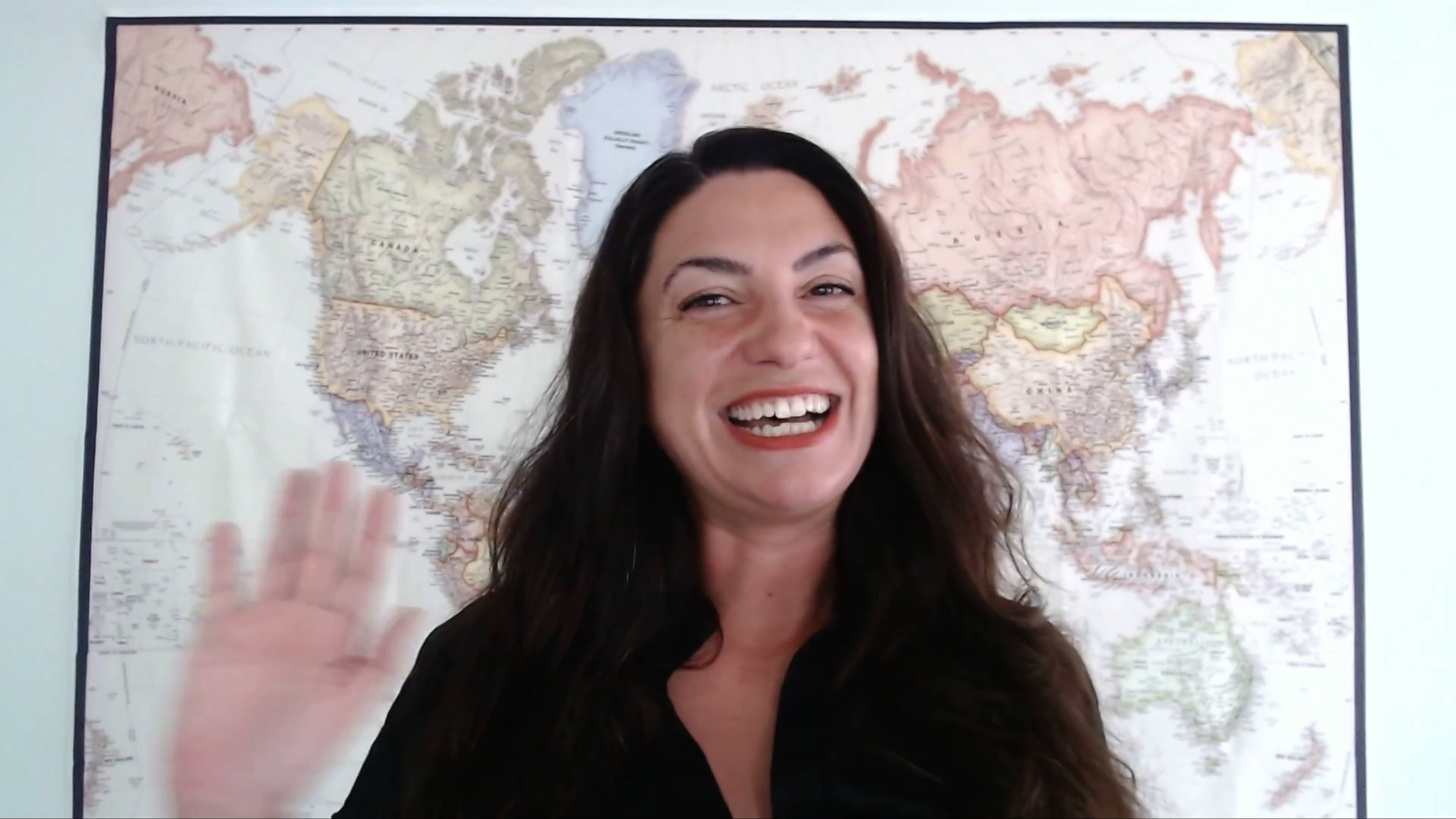
Rocío, the course tutor. You only see her face in the first lesson, but her voice carries the whole course.
I really liked the teacher, Rocío. She’s animated, a little cheeky, and very clear without ever dumbing the language down — I never once felt lost.
She also doesn't over-explain. She makes the point and moves on, which suits video — because if something catches you, just replay it (which I did when those moments came).
Her style is example-heavy, which I prefer to long, complicated explanations. She pulls sentences straight from the chapter you've been listening to, then expands outward so you have something you can actually use.
I loved that even the grammar lessons now counted toward my daily 30 minute Spanish listening goal that I’ve had for four years. It means that the grammar lessons no longer were something I was adding on top of my Spanish learning — it was part of it.
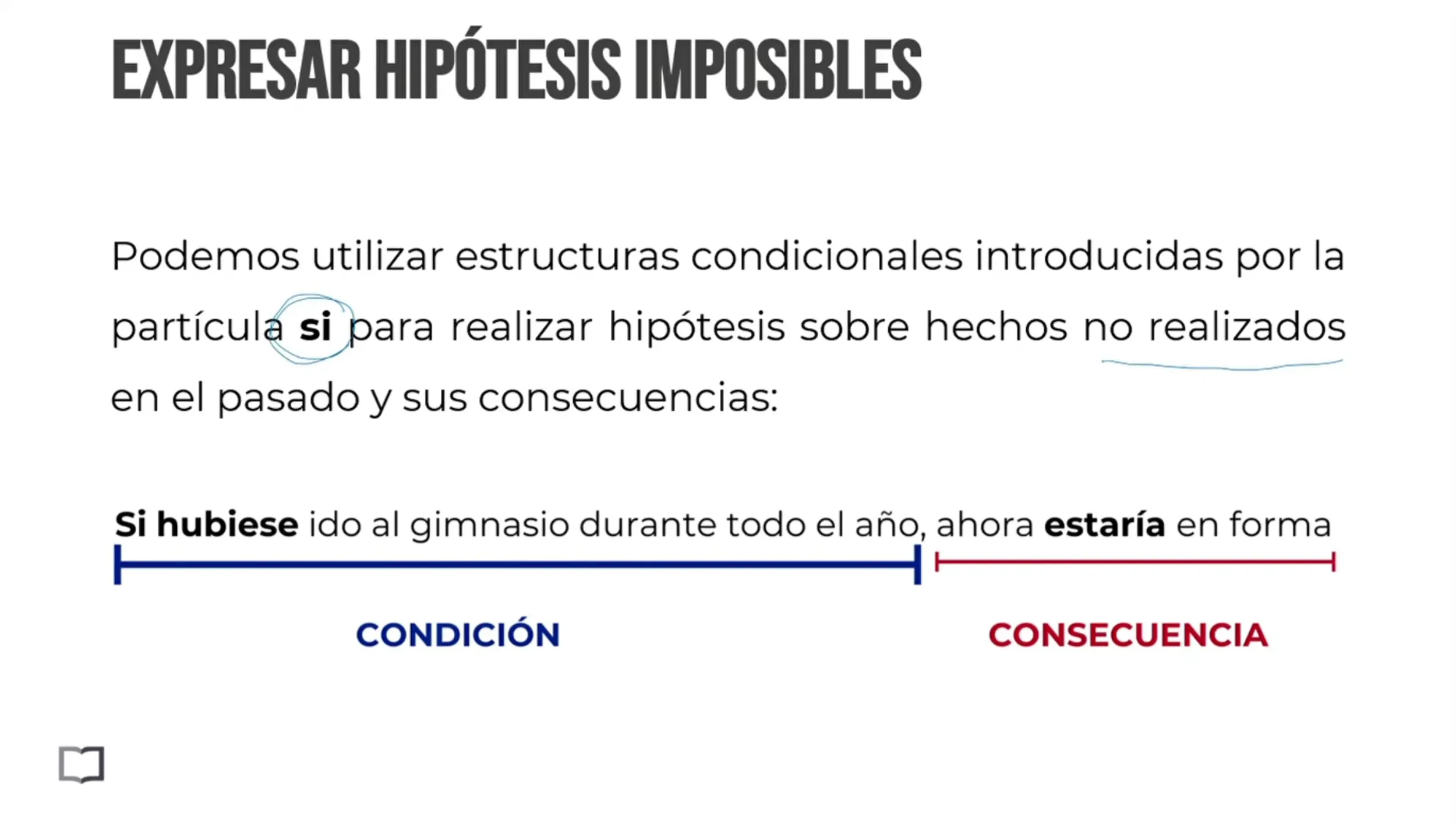
Impossible past hypotheticals — si hubiese… estaría — taught in Spanish, with the condition and the consequence mapped out. This is what a grammar lesson can look like at this level.
My favorite was probably the grammar lesson in Chapter 7, which works through connectors, organized by type — además, encima, igualmente, asimismo, del mismo modo for adding information; de ahí que, por todo ello, en consecuencia, por consiguiente for structuring ideas to name a few. There must be close to a hundred in total. Probably just about every connector you'll ever need in Spanish.
What makes this so powerful is that she then finds many of these in a chapter you’re already familiar with. That’s how a decir verdad or en lo que se refiere a… becomes a phrase you don’t only recognize but something you can actually use in your own speaking.
The same lesson digs into subjunctive versus indicative, and el cual / la cual / lo cual against quien / quienes — the types of fine nuances that are very difficult to pick up from exposure alone.
Other lessons include de versus que in comparatives, cuyo, the futuro compuesto, and the many uses of se, to name a few. There’s a lot of information, but none of it feels like it drags.
These double as a grammar reference you’ll come back to. Something I’ll probably do a few months or even a year or two from now, which the lifetime access of these courses lets you do.
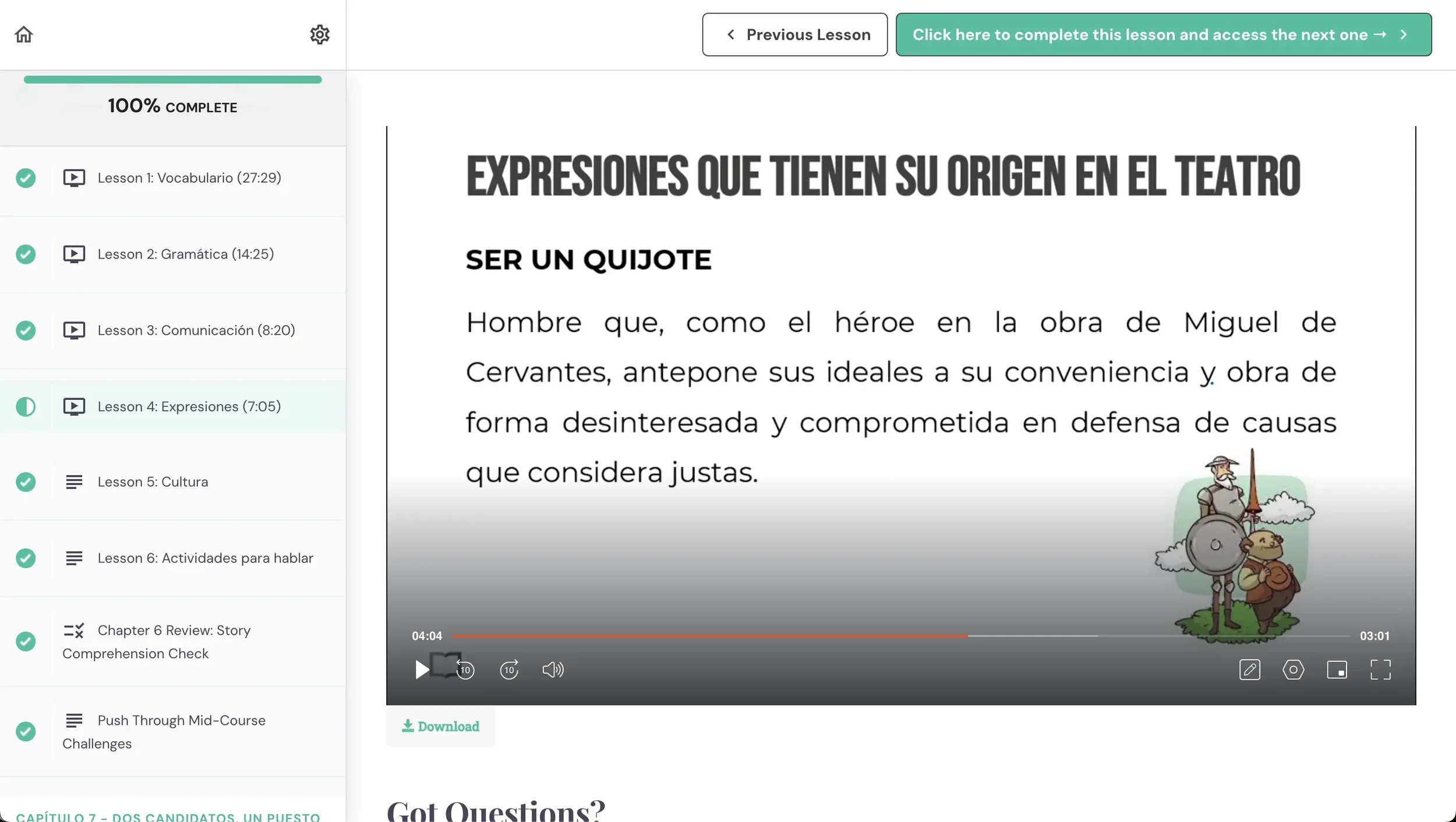
"Expressions" — a new lesson type at Advanced, where you pick up phrases, sayings, and idioms.
The Expressions lessons are a new lesson type at the advanced level. They’re where you pick up the phrases that make you sound less textbook-y and more native-like: antes que nada · a mi entender · en otro orden de cosas · lo tengo en la punta de la lengua.
My one gripe: the audio during the teaching lessons is clear but not podcast-crisp. More of a “could be better” than a glaring flaw. And it’s a small thing in a course that made grammar enjoyable for someone who doesn't enjoy grammar.
How good is the story?
The whole method is about the story, so you're probably wondering whether it's any good. Here's the most useful answer I can give: I’ve listened to each Advanced chapter lots of times without it feeling like a chore. Which is actually a higher bar than it sounds. Most things that are fun the first or second time lose their appeal on the third.
Is it amazing and gripping? No. But it doesn’t need to be. But I'll tell you where it's good and where it isn't.
The Advanced premise is good: a group of people trapped in a mall during a storm. It feels quite cinematic, with winks at the films it borrows from, and each chapter follows different people through the same event. Some chapters I enjoyed a lot — a young couple whose first date is interrupted by the storm, wandering the mall talking about films. Others I didn’t, like an influencer whose change of heart arrives too fast to believe.
The Mastery story is my least favorite of the six. Its premise is quite clever — a man working out what to do with his life, talking his way through professions, which lets the course cover law, medicine, economics, tech, politics without ever feeling like a vocabulary list. I liked that it spins off from the mall story, following one of those characters. But several characters feel like caricatures — one dimensional, with the story telling you how you should feel about them instead of letting you decide. Real people have more nuance than that.
The story still survives repeated listens, and after a while you're not following the plot anymore — you're listening for the language. An imperfect story does that job just fine because the language that’s chosen is strong.
That’s my honest summary. Some chapters are better than others. The Advanced story is good, the intermediate one is better — it follows the same characters for twenty chapters — and the crime-mystery frame suited the method beautifully, because you were unravelling the plot and the language at the same time.
What Mastery (Level 6) adds
You can take a single Uncovered course and make real progress. But the real strength is when you do multiple courses — they build upon each other and it’s the natural progression if you like the format and you’re serious about fluency. That’s why I continued on with Mastery, the sixth and final level.
This one has the longest story chapters, at 9-13 minutes. Since the story follows a man trying to figure out what to do with his life, each chapter puts him in conversation with someone in a different profession: talking to a doctor, an economist, a priest, as well as attending a sports game, a trial and more. That way, the vocabulary spreads wider than any of the other courses.
Grammatically, it's a last pass over the hardest things in Spanish — the many uses of se, the futuro compuesto, cuyo, and the subjunctive from angles I hadn't come across before. It both summarizes and introduces the last new bits, all taught again by the excellent Rocío.
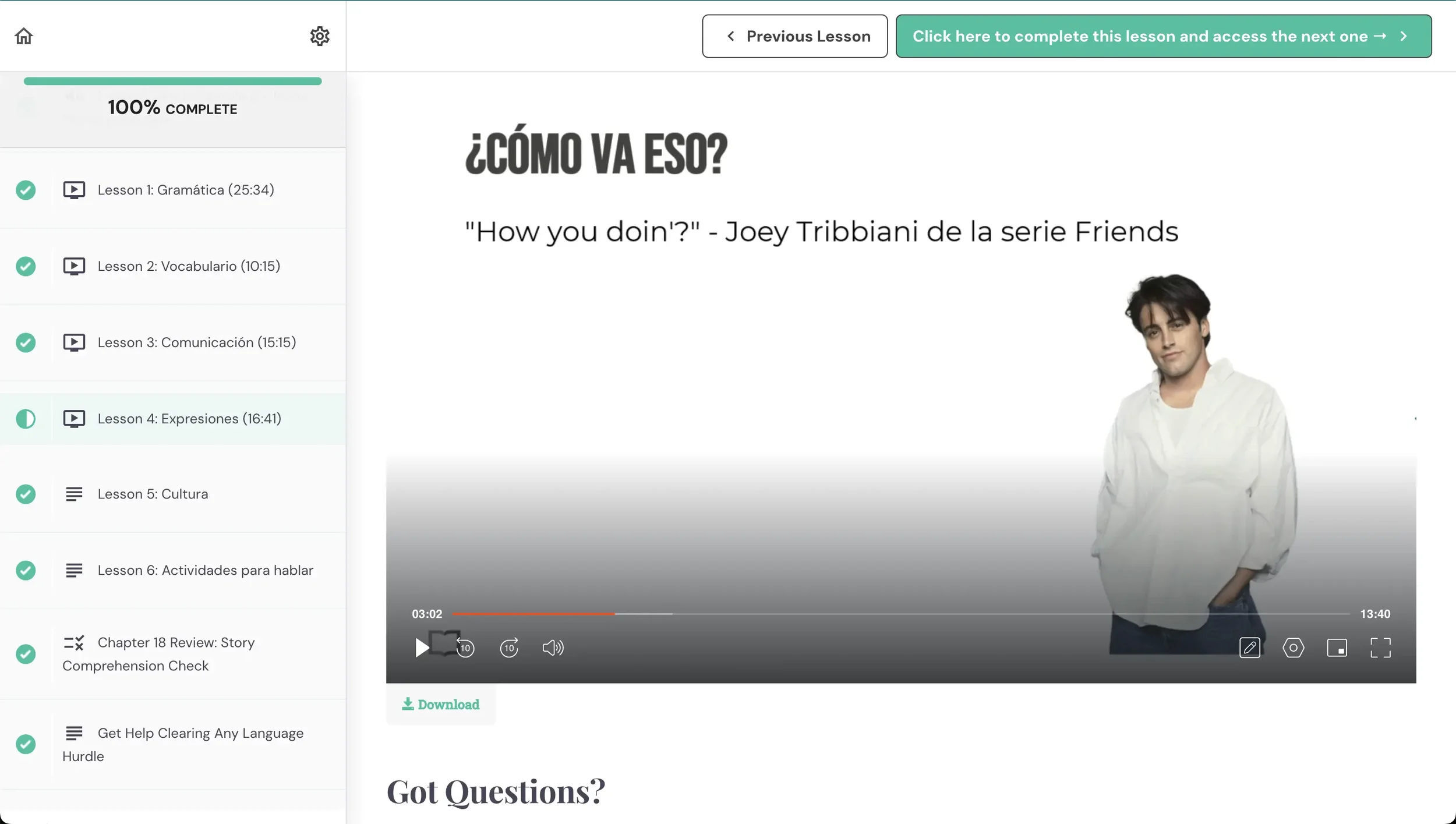
Mastery, Chapter 18 — where you find out what Joey actually says in Spanish, and many other classic TV and movie quotes.
My favorite lesson in this course was Chapter 18: an Expressions lesson on what movie and television lines are in their Spanish dubs. Joey's "How you doin'?" from Friends. When Harry Met Sally's "I'll have what she's having" — tomaré lo mismo que ella. Looney Tunes signing off with ¡Eso es todo, amigos! Plus lines from The Godfather, Star Wars, Terminator 2, The Simpsons, Jerry Maguire, and others.
It's tons of fun, and more useful than it sounds: those dubs are how a great many Spanish speakers know these films, so the lines are an actual part of the culture. And culture is a big part of both advanced level courses.
A couple of content notes: One chapter in Mastery is about a tarot reading, which as a Christian isn't something I’d like to spend time on. It's entirely self-contained, so I skipped it after one or two listens and lost nothing. And one Expressions lesson covers swearing. I don't curse, so it wasn't for me, though I'd say there's actually real value in recognizing the words you don't intend to use, and the teacher handled it gracefully.
Pairing it with a speaking app (or a real tutor)
Uncovered is an input course. It focuses on building comprehension. And to turn all that into speaking, you have to practice producing the language and using these structures. Here are my best recommendations that pair perfectly with Uncovered at the advanced level:
Langua — my favorite AI speaking app, and it’s especially well suited to advanced learners: unpredictable, natural conversation about whatever you want, with the best voices and the widest dialect range I've found, and deep feedback features. It's made the biggest difference in my spoken Spanish.
LanguaTalk — lessons with real teachers, on the same platform as Langua. While AI is great for daily practice, nothing beats the motivation and support of conversing with an actual human. You can book a free 30-minute lesson with a teacher of your choice.
Speak — my top pick for beginners and still highly useful for intermediates, built around building speaking skills from the ground up, starting with the most useful sentences. It’s a less obvious choice for advanced learners, but I've personally used it daily for over four months and it has made my sentences more grammatically accurate and more natural. It's not free-form conversation, so it complements Langua as more of a tool to drill structures.
Speaking activities: The course also includes optional speaking activities for each chapter — you can feed these into Langua as prompts or bring to a tutor to apply what you’re learning in the course.
Is Spanish Uncovered Worth it?
Is this course worth it when there's endless free Spanish content? I actually asked myself this before I started. For years I'd learned by listening to whatever I felt like, pretty much no structure besides hitting my 30-minute listening goal each day. So why pay for a course?
With these courses, the language itself is actually the product. The story and the lessons are just how it's delivered. A random YouTube clip has useful Spanish in it too — but here the useful language is deliberately concentrated, chosen and packed into the stories on purpose. That's what you're paying for, and it's why four things happened that free content never quite gave me:
Everything is served. Free material exists in every language — but when I wanted to build my Korean comprehension, I reached for Uncovered anyway, not YouTube. Most learning dies at friction, and having level-appropriate, dense language ready to put on repeat, with lessons to break it down later, is what tipped it over for me.
Going deep with a little beats going wide with a lot. There's something powerful about a limited set of content you work through deeply. Listening to anything works — I did it for years — but going deep with one story got me there faster. And once you've gone deep, you're ready to go wide.
You get more out of native content afterward. I didn't know how deep the subjunctive went. I had a surface understanding of it. Encountering its many uses from every angle, with the teaching lessons highlighting them, sharpened my ability to notice it — and noticing is the whole thing. You start recognizing patterns. Patterns you’re then able to use in your own speaking.
It doesn't expire. Lifetime access turns the teaching lessons into a reference library. They're dense, and with more exposure and time for things to sink in I'll get more from them in a year than I did the first time.
The payoff: Near the end of Mastery I got bored with the story. I thought it had just gotten less interesting — until I remembered (easy to forget) that this is what happens when your listening shifts from comprehension to acquisition, the stage most people quit before they reach. I wrote about why in The 3 Stages of Listening Comprehension.
So no — I'm not done with these. I'm even re-listening to the Intermediate story now and picking up grammar I didn’t notice the first time. And I’ll be doing the same with the advanced one. That's the acquisition stage, and it's where you get the gains that influence your speaking the most.
So yes, you could totally learn from free content. But I came out of these courses ready to learn from and enjoy native content, in a way I simply wasn't before. That readiness is what you're actually buying.
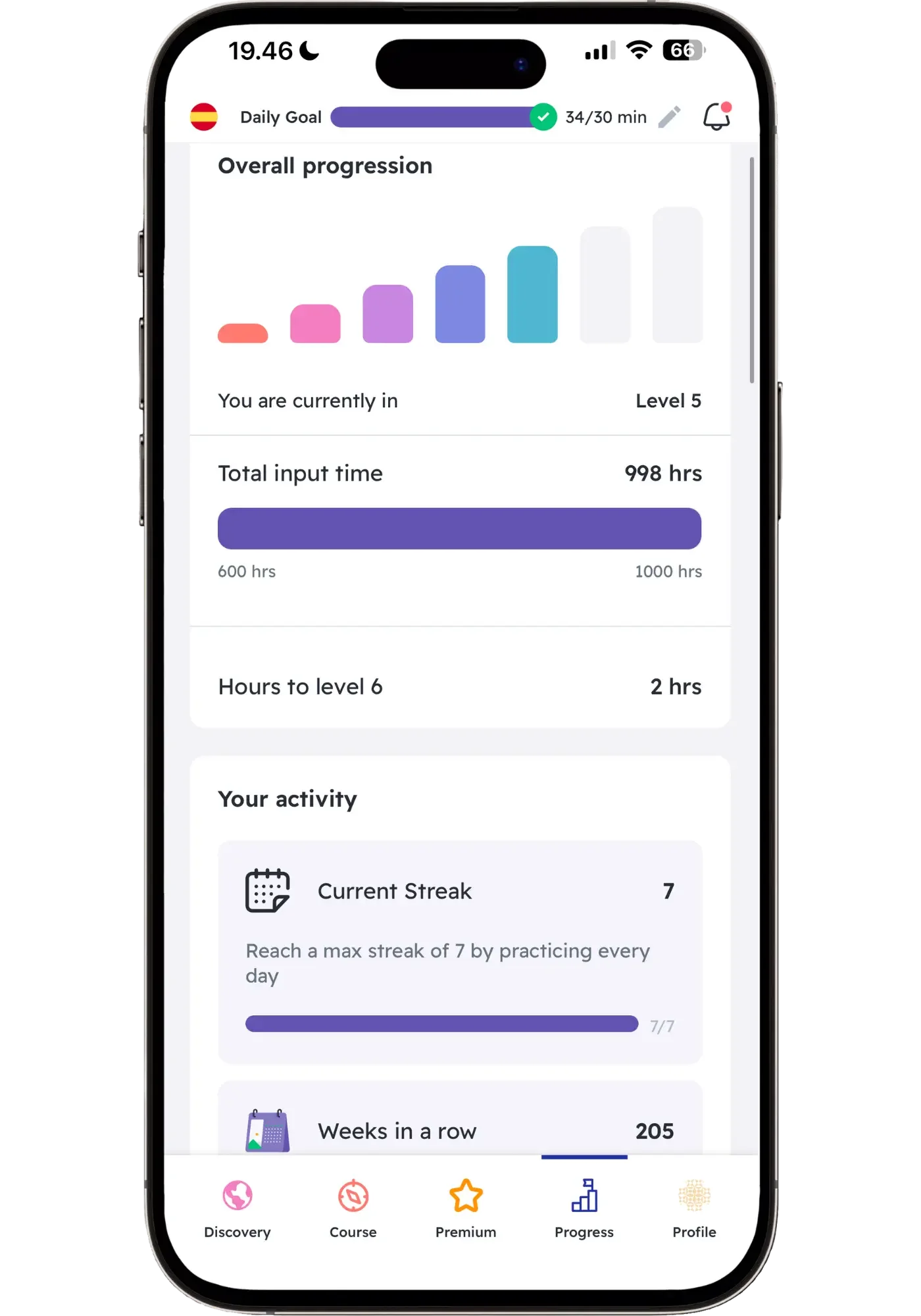
Just under a thousand hours of Spanish input, and 205 weeks without missing one. That's everything I've listened to, though — not only these courses.
Pros & Cons
Spanish Uncovered Advanced: pros & cons
What I loved
- Leaves you ready for just about any native content
- The teaching lessons are entirely in Spanish — you get immersion while studying grammar
- Two narrations included — Castilian and Latin American — which keeps re-listening fresh
- Expression-rich language highly useful for your own speaking
- Lifetime access, great for re-listens and grammar reference, even years from now
- Clears up the trickiest advanced grammar
What I didn't
- Teachable is okay for lessons but clunky for listening — you'll want your own listening setup
- Lesson audio is fine, but not podcast-crisp
- Demands self-direction — there's no schedule for you
- The story is uneven in places
- The same VIP cohort promo recurs throughout the course — understandable, but you'll be skipping it a lot
- High price point when not on sale
Pricing: bundles and discounts
Spanish Uncovered Advanced costs $297, and there's a 7-day free trial — full access, and you're only charged if you continue on day 8. A week is enough to hear a couple of chapters, watch a grammar lesson, and find out if the level fits. But this is a course you commit to, not dip into — the results come from months of real listening, not a week of clicking around.
Worth remembering: three to four months at 30–45 minutes a day puts $297 at roughly $75–100 a month — and that’s not counting going back later since you keep it for life. I'm still not finished with mine. I fairly recently even went back to a StoryLearning Cantonese course seven years after I first took it.
One thing worth knowing: Mastery (Level 6) isn't included. It's offered as an add-on once you own Advanced — so if you're planning to go all the way to the top, budget for two courses rather than one.
The guarantee is unusually strong: if you complete the course and you're not happy, StoryLearning will refund you in full and pay up to $300 toward a competing program. You have a full 365 days to decide. That applies to single courses, though — the six-course Gold Bundle has a standard 30-day guarantee instead — still great (the 30-day money-back guarantee applies during any sale).
What about the bundle?
The Spanish Gold Bundle is $997 for all six levels, Beginner through Mastery, plus bonuses. That's around $166 a course instead of $297 — which is definitely the best per-course price.
But unless you'll actually use the lower levels you’re just paying extra for content you don’t need.
Though I'll say this: I was well past intermediate when I took the Intermediate course, and still filled grammar gaps I didn't know I had. I could already watch Friends in Spanish and follow it without much trouble. But following a sentence and being able to build one like it when you’re speaking are different things. Comprehension lets you skip that — you get the meaning from context without necessarily fully noticing the structure underneath. And you can't use what you don’t notice. That's why your speaking lags behind your understanding, no matter how much you listen. These courses raise your awareness to actually notice these things, which I think is their greatest value.
So the bundle is the obvious pick if you're starting near the beginning, and probably not if you're already advanced — though a good sale narrows the gap enough that the whole ladder can be worth it even then.
See what's in the Gold Bundle here →
Learning a different language? French, Italian and German run the same full six-level path, all the way to Mastery. Korean, Japanese, Mandarin Chinese and Russian go four levels deep — beginner through upper intermediate. The rest have fewer levels, so check the current lineup for your language.
One more thing on timing. These courses typically go on sale twice a year, and the discounts are steep. If one's running when you read this, take it. If it’s not, you can join my list below and I'll tell you the moment the next one starts:
The verdict: should you buy Spanish Uncovered Advanced?
If you're a confident intermediate learner ready to iron out the trickier parts of Spanish, then yes — Advanced is worth it, and my own results vouch for it. I'd strongly consider Mastery too. It ties everything together and has some of the best grammar summaries in the series.
The stories aren’t flawless — Mastery is my least favorite of the six, though it has enjoyable parts and the language is smartly chosen throughout. The in-Spanish teaching lessons are the best part, and when you finish you'll be ready for whatever native content you want.
Though I’ve “graduated” from these courses it doesn’t mean I’m “done”. I’ll keep coming back to these stories to get more out of them, and I’ll likely re-watch the grammar lessons a few months or even a year or two from now. I'm already re-listening to the Intermediate story and hearing things I missed — and I've just started Korean Uncovered Beginner, which is a very different yet familiar experience to the advanced courses.
Here's what surprised me most though: I went in doubting these courses could deliver what the names "Advanced" and "Mastery" promise. I came out thinking they give you just about every grammatical tool Spanish has — the connectors, the subjunctive from every angle, the structures that trip advanced learners up, all cleared up. No course makes you fluent on its own, you still need to go live in the language. But if you take your time with these you’ll have all the bones for advanced Spanish. Everything after is just exposure through input and speaking. That's more than I expected.
Learning a different language? See all Uncovered courses and languages
Related posts:
Spanish Uncovered Intermediate: In-Depth Review After 3+ Months of Daily Use
The 3 Stages of Listening Comprehension (and Why Most Never Reach Stage 3) (the method I use for StoryLearning courses explained in-depth)
Langua AI Tutor Review: Best AI Language Learning App for Speaking Fluency?
