The App That Made Japanese Stop Feeling Intimidating (90 Days, Filmed)
Published

This post contains affiliate links. If you buy through one of them, I may earn a commission at no extra cost to you. Some of the products I write about are also provided to me for free. See Full Affiliate Disclaimer.
Four days into learning Japanese, the app gave me an English sentence and asked me to say it back — in Japanese.
I thought to myself: am I actually going to be able to do this?
And then it just came out. I didn't try to analyze it or work it out in my head first — I just went with what felt right, and then I got that satisfying "bling" you get when saying it correctly.
That was the moment I realized this was going to be quite different from every other attempt I'd made at Japanese.
But let’s back up for a minute.
Here's the whole 90 days in less than three minutes in video format — then I'll break down how it went in more detail:
Why I spent 90 days learning Japanese with Speak
I’d been having so much success with Speak for my Spanish that I got curious — what would it be like as a complete beginner?
I had doubled back and gone through all the beginner lessons in Spanish, but being a solid intermediate I naturally just blasted through them — so I never got that beginner feeling. And I wanted to experience what it was like to learn with this app from zero.
“Just for a week”, I thought. That week got extended to 30 days. And then to 90.
Something I honestly wouldn’t have done using a different app. Because the thing is, Japanese is a mountain of a language. It has challenges that Spanish doesn’t — almost no words you recognize, different writing system(s), completely jumbled word order, and how you express things is just completely different.
So I completely get why people find Japanese intimidating. I've bounced off it enough times myself to know the feeling. And it’s not that I’m a stranger to learning difficult languages. I’ve learned arguably the hardest language there is in Cantonese to an advanced level, learned Finnish to fluency (another crazy language), and I started the process all over again with Korean about six months ago, which I also find very challenging.
And since I’m still working on all those languages, adding a fifth to the mix would just be madness. It’s already crazy enough as is.
I'd tried several Japanese apps and courses over the years, anywhere from a few days to a couple of months each. I basically just dipped my toes in and never walked away with any meaningful Japanese that I could use. I figured it was just a matter of committing and spending more time on the language.
But after only a few days of this app, my perspective started changing.
And it wasn’t that Speak removed the mountain. That Mount Fuji was still there, and there are no shortcuts to climb it. But instead of one long unbroken hike, it was like someone had put coffee shops and resting spots along the trail for me.
With other apps, I felt like I’d have to commit to at least 30-60 minutes daily before learning things I could actually use. But with Speak, even 5-10 minutes was doing something.
So instead of Japanese being "a language I'll learn some day," I just... started. Casually, on the side, just for fun.
The 90 days, day by day
I screen-recorded every session on my phone, audio and all, so I've got the whole thing on file — the wins, the fumbles, and the days I did the bare minimum (see the video above).
Most days were five to fifteen minutes. Some were even just three.
Here's how it actually went, from day 1 all the way up to day 90.
Days 1–6: the disarming start
I opened up the first lesson — a video lesson with the course teacher, only a few minutes long. And right away, it showed me things about Japanese pronunciation that other apps had never taught me. Simple things — but the kind that makes a difference knowing early, rather than mispronouncing things for months — drawing out the “n” in “konnichiwa”, and the “ō” in “arigatō”.
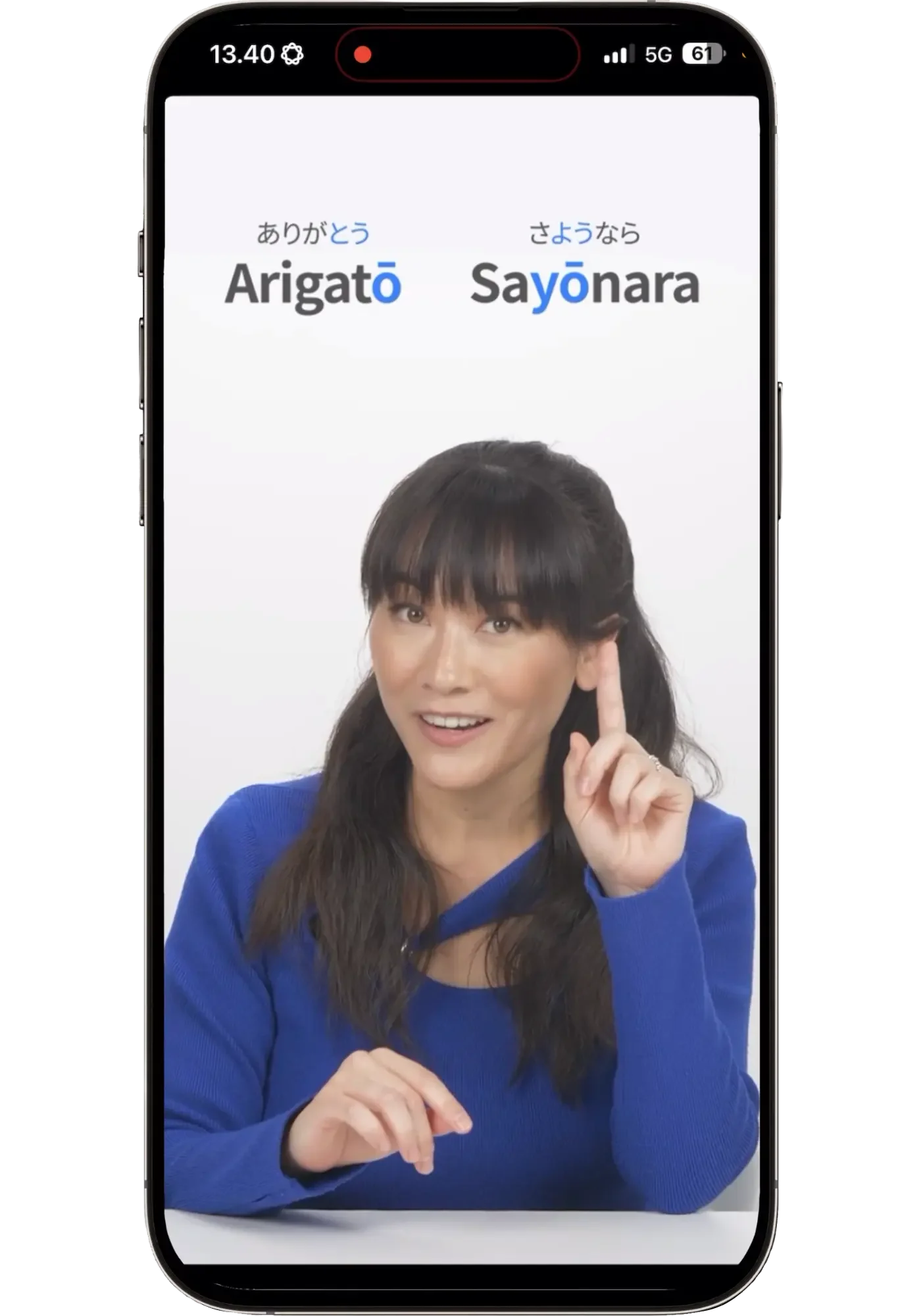
The first thing Speak taught me: the long ō’s in arigatō and sayōnara — highlighted right there on screen.
I learned some basics like: thank you, hi, goodbye — things I actually knew from before.
But it didn’t just give me the polite versions you always get in textbooks — I also got a casual phrase too. I just got the feeling that it was going to be practical and fun rather than the typical “let’s do the logical-but-super-boring-order of learning the basics."
Not alone. Having a real teacher and video lessons actually made a big difference too. Yumi-sensei made it feel like I had someone with me on my Japanese journey rather than just tapping through lessons alone.
And everything taught, I had to say out loud — with the app waiting until I had said it correctly before it continued. That might sound like a small thing, but it’s actually not. Actually speaking it out loud after hearing it makes it stick in a way reading it off a screen never does — it starts building the muscle memory you need for actually speaking. Watching the words light up with that little "bling" when I got it right gave me a small feeling of accomplishment you don't get by just talking to yourself. It felt like clearing an obstacle in a video game. Except the game is Japanese.
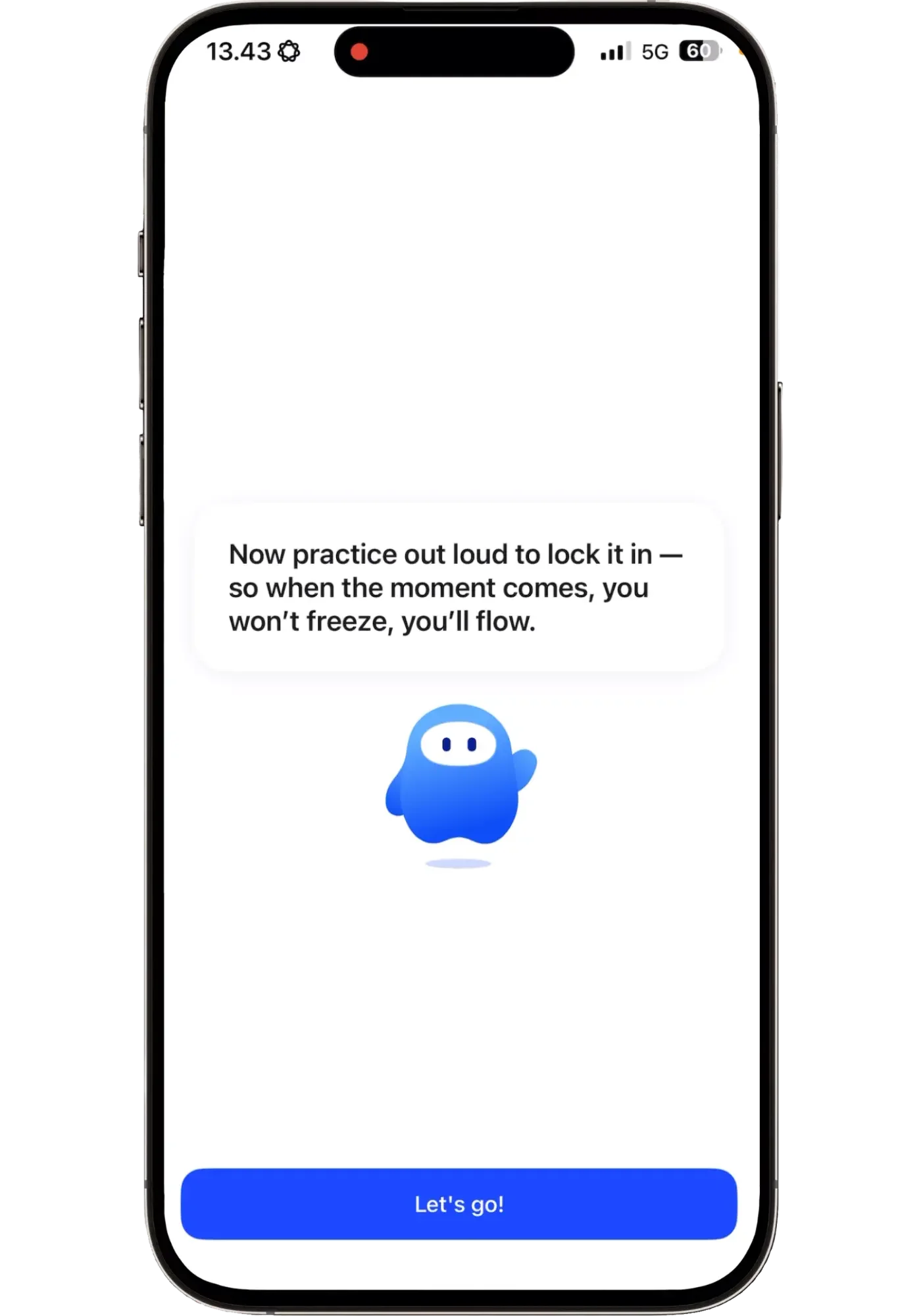
Couldn't have said it better myself.
Making the phrases mine. Having a good instructional lesson and saying something once or twice won’t make these phrases stick. So starting the next lesson, called “speaking drill”, the screen said: “Now practice out loud to lock it in — so when the moment comes, you won’t freeze, you’ll flow”.
Then the vocab learned in the video lesson was drilled over and over again, mimicking the Japanese, being prompted from English with more and more words covered, to eventually being able to say it in Japanese by just hearing the English prompt. The biggest thing was how low-pressure it felt, without losing the effectiveness — if I couldn’t remember something, I could just tap the covered words to see how to say it.
It wasn’t testing my ability. It was training it.
After the drill, it had me apply this vocabulary in brief Q&A-style exchanges with AI. On day two, in one of these AI Q&A’s, it had me ask whether a seat on a plane was taken — except I didn't know how to say that. What I had was pointing and saying "is it okay?", which was all I needed. And that right there is the secret to speaking a language early: finding ways to get the job done, with the little you have. I just loved how this was built into how the app was teaching me Japanese.
Useful first. Then on day six, I was taught the phrase “would you like it heated up?” — but I wasn’t once asked to say it. It taught me how to respond instead: “yes, please” or “no, I'm okay.” Which is completely different from every other course I’d done. I mean, how often am I going to need to ask someone if they want their food heated up? Well, probably never. But I will hear it every time I buy food at a Japanese convenience store. So what I need is to understand the phrase and be able to answer.
Nothing I learned that week felt wasted. It was all stuff I could start using right away.
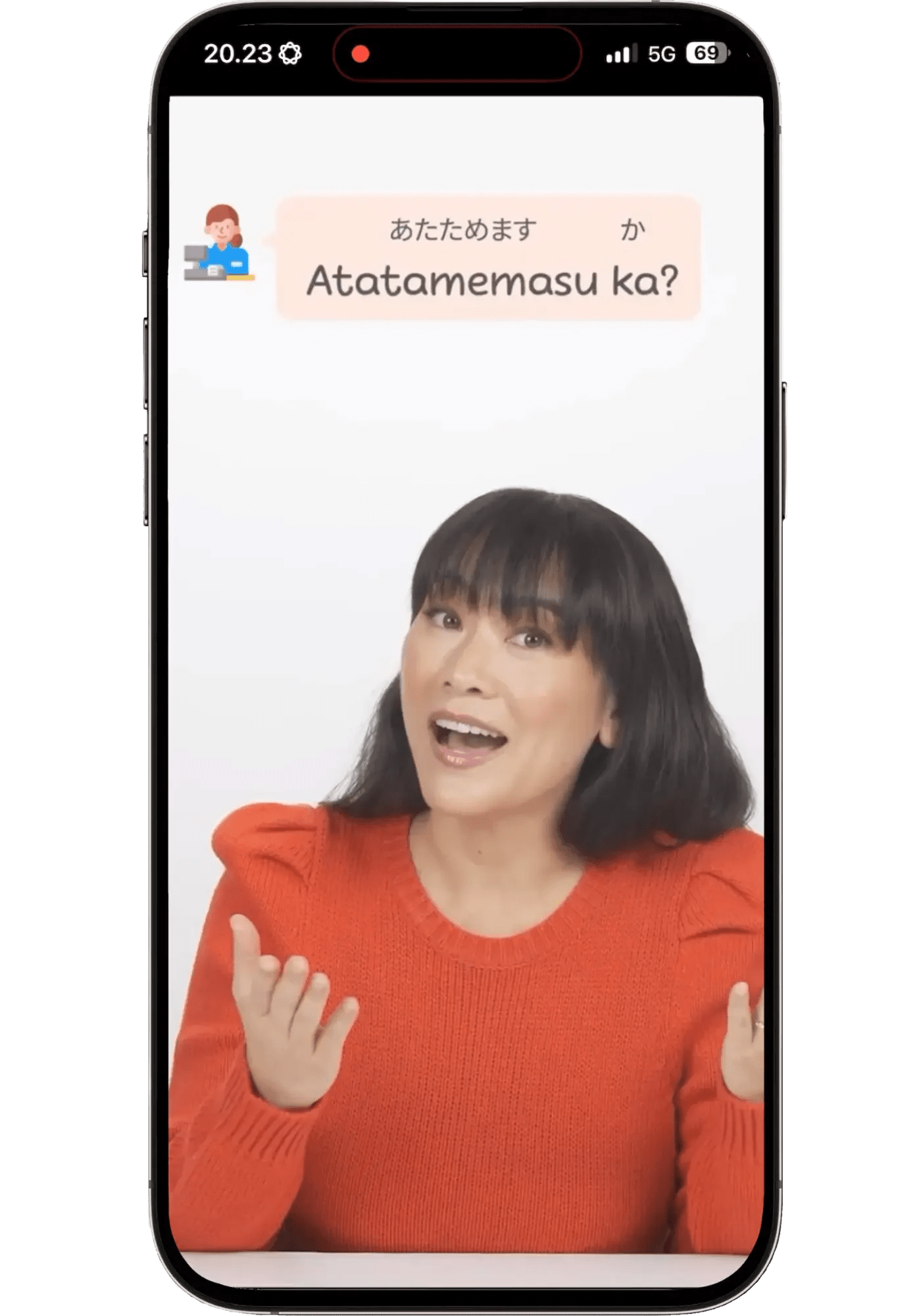
The lesson taught me the question so I'd recognise it…

…then instantly prompting me to practice responding to it.
How Speak kept Japanese feeling doable
Any app can be easy at first. You get the quick win, you think I've got this, and then the difficulty ramps up and it starts slipping through your fingers.
In 90 days, that never happened once. It was challenging plenty of times — but challenging in a way that kept me engaged instead of discouraged.
A lot of that is the basic flow: video lesson → speaking drills → a short Q&A chat with the AI. You learn it, cement it, then use it in a situation you'd actually find yourself in. So it was never something I just read once and would later forget.
The progress felt more like building Lego blocks rather than a pile of random vocabulary dumped on me. It would take a sentence structure I already knew, swap out a word. Or add one new thing to it. One new piece at a time, not five.
And things came back exactly when I needed them. On day 3, I was going about my day and realised I'd forgotten the word for "excuse me." I knew it started with an S and I was fairly sure it ended in masen. I opened the app — and sumimasen was literally the first thing that was being reviewed. Same thing happened later with wakarimasen ("I don't understand" — now that’s a useful word for a Japanese beginner if I ever saw one!).
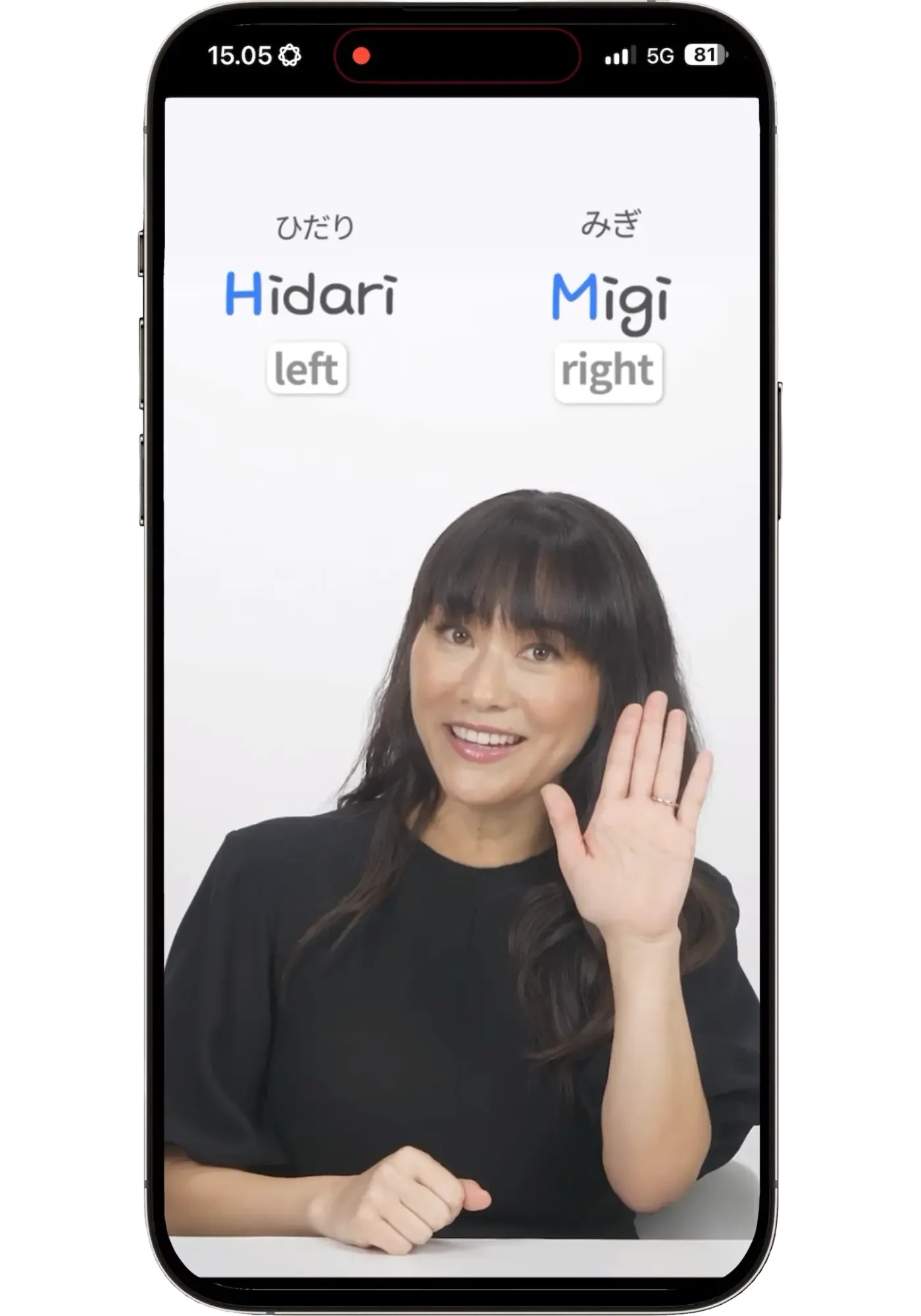
Yumi-sensei’s H&M mnemonic for hidari (left) and migi (right) stuck with me from day 3 all the way to the end.
On that same day 3, when Yumi-sensei taught left and right, she gave a clear mnemonic — picture the clothing store H&M to remember that left starts with H (hidari) and right starts with M (migi). Simple. But it worked, and I’ll never forget it.
I also wasn't handed six direction words at once, the way another app once did to me. Just the two I'd actually use the most. That's part of what kept it feeling doable — learning a few more later, once you know those two, is far easier than trying to memorize six all at once.
Then on day 4, I even surprised myself.
The video lesson had given me a handful of new words — convenience store, supermarket, hotel, temple, shrine — and folded them into a question structure I’d already learned. Until then I could only say "where is this?" while pointing at something. Now I could start naming some of the things.
Then the speaking drill got to the part where it gives you the English and you have to produce the Japanese. It prompted me to say: “where is the temple?” and I remember thinking: am I really going to be able to say this?
And then it just came out. *Bling*. I didn't even think about it or analyze it — I just went with what felt right, and my instinct was correct. It had built itself into my muscle memory without me even trying. I had just followed the lesson path and flow.
That's exactly what you need to use a language out on the streets, instead of standing there stiff as a popsicle in a Lapland winter.
![Speak app speaking drill showing "Sumimasen, [hidden word] kudasai" with the English prompt "Excuse me, please give me coffee" below, requiring the missing word to be recalled from memory](https://images.squarespace-cdn.com/content/v1/609321392c4bb5097c40f34d/93f55ede-fead-4d20-a45a-e923302cece6/A+Speak+speaking+drill+with+a+word+hidden+%E2%80%94+%22Sumimasen%2C+___+kudasai%22)
Here's what that looks like in a later lesson: the drill hides more and more words to make you pull it out of your own memory — here it’s just one, which is the easy end.
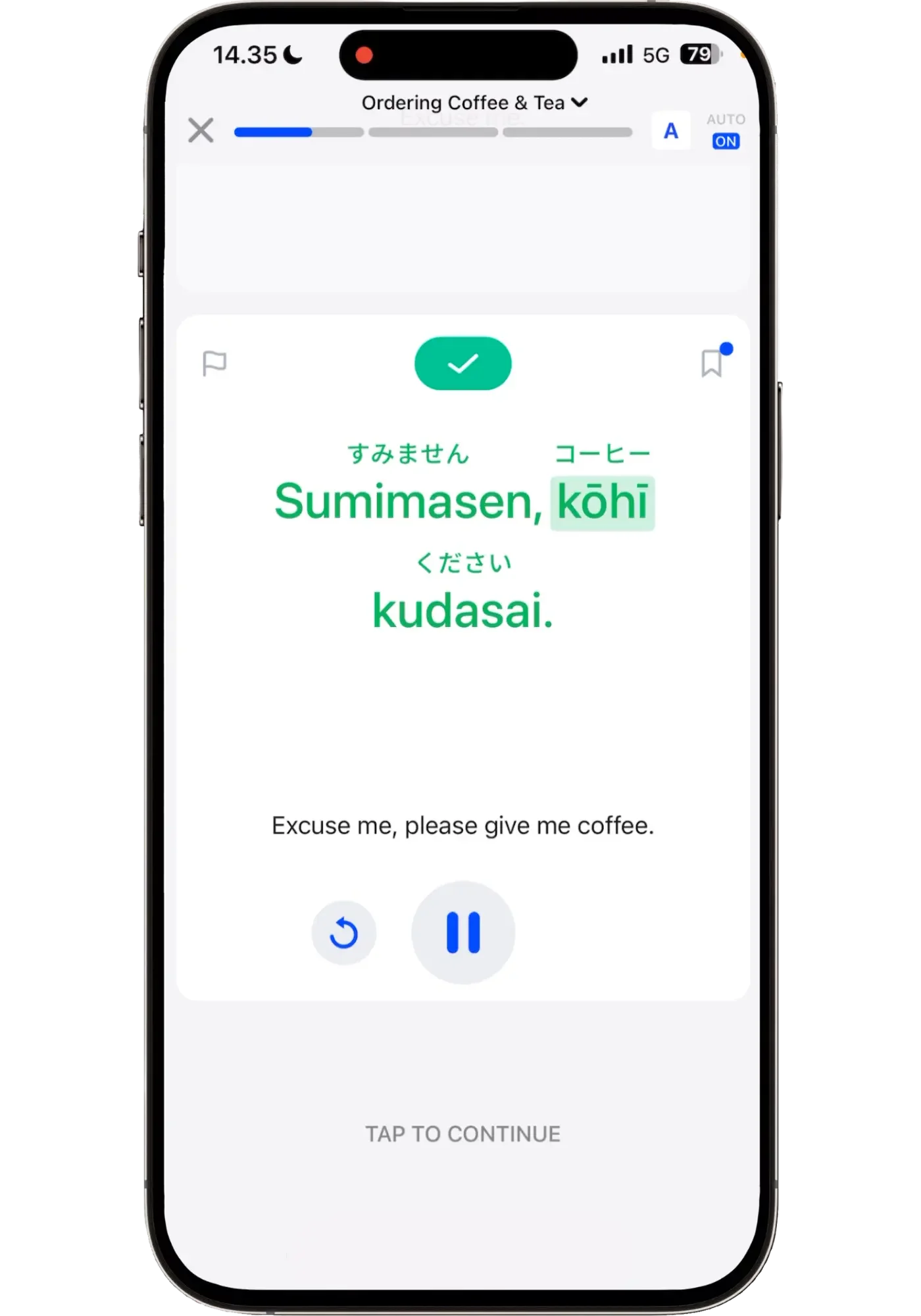
Instant confirmation when you got it right. When I could produce the whole thing from English alone, I knew I owned the phrase.
That doesn’t mean I got everything right. It was somewhere around 70-80%, which felt like the sweet spot: enough wins to feel encouraging, enough misses to know I was being stretched. This was so refreshing to me because I had tried other apps where I got most things wrong — that's just discouraging, and your brain starts hurting from being asked to do something it isn't ready for.
On day 18 I was practicing paying at one of those conveyor-belt sushi places, and the AI asked how many plates my friend had eaten. My first thought was: “hang on, I've never been taught how to say that about someone else.” Then I remembered Japanese usually drops the I/you/he entirely — so I just tried the same construction I'd used for myself. And it worked.
It’s such a small thing, but learning a language as a beginner is all about small wins like that. And these types of moments were some of the most satisfying of the whole 90 days. They're a clever simulation of what actually happens out in the wild, where you have to make split-second decisions even with very limited language ability.
The "scary" stuff — counters, big numbers, Hiragana
There are some things about Japanese that feel intimidating, because they are so different from English. Counter words that change depending on what kind of object it is. Big numbers that count ten thousands rather than millions, and a completely different writing system in Hiragana (there’s obviously Katakana and Kanji too, but Speak currently only teaches Hiragana).
I have a big head start on the first two from Cantonese, which uses the same concepts. But knowing the concept and knowing the actual Japanese words are different things, and it still felt like a lot to take on, because these take a long time to become automatic.
On day 16 the big numbers turned up — and there was no pressure for me to produce them. Speak introduced them in the context of asking what something costs in a shop and hearing the answer. Which is exactly how it goes in real life: you're not the one saying "three thousand four hundred yen," the shop clerk is. Just like with the “would you like it heated up?” from earlier lessons. I was just practicing recognizing them, which made something hard feel more approachable.
Numbers in general got the same treatment. Instead of counting to twenty for no reason, I learned them a few at a time inside a situation I'd actually need them in — getting a table at a restaurant. Being asked how many are in your party, and answering "a table for two." You're far more likely to need that early on than the word for eight (unless you have a very large family or are a bigger party of people). And besides, once you feel confident with the first few it’s easier to learn the rest.
Speak used this slow drip method for Hiragana too. There's a dedicated Hiragana course if you want to go at it directly, but it also just gets woven into the normal path. For me it started on day 8: a few characters at a time, each with a simple shape-based mnemonic — く looks like a cuckoo's beak, こ like a coin — and then straight into combining them into short two-character words rather than drilling them in isolation.
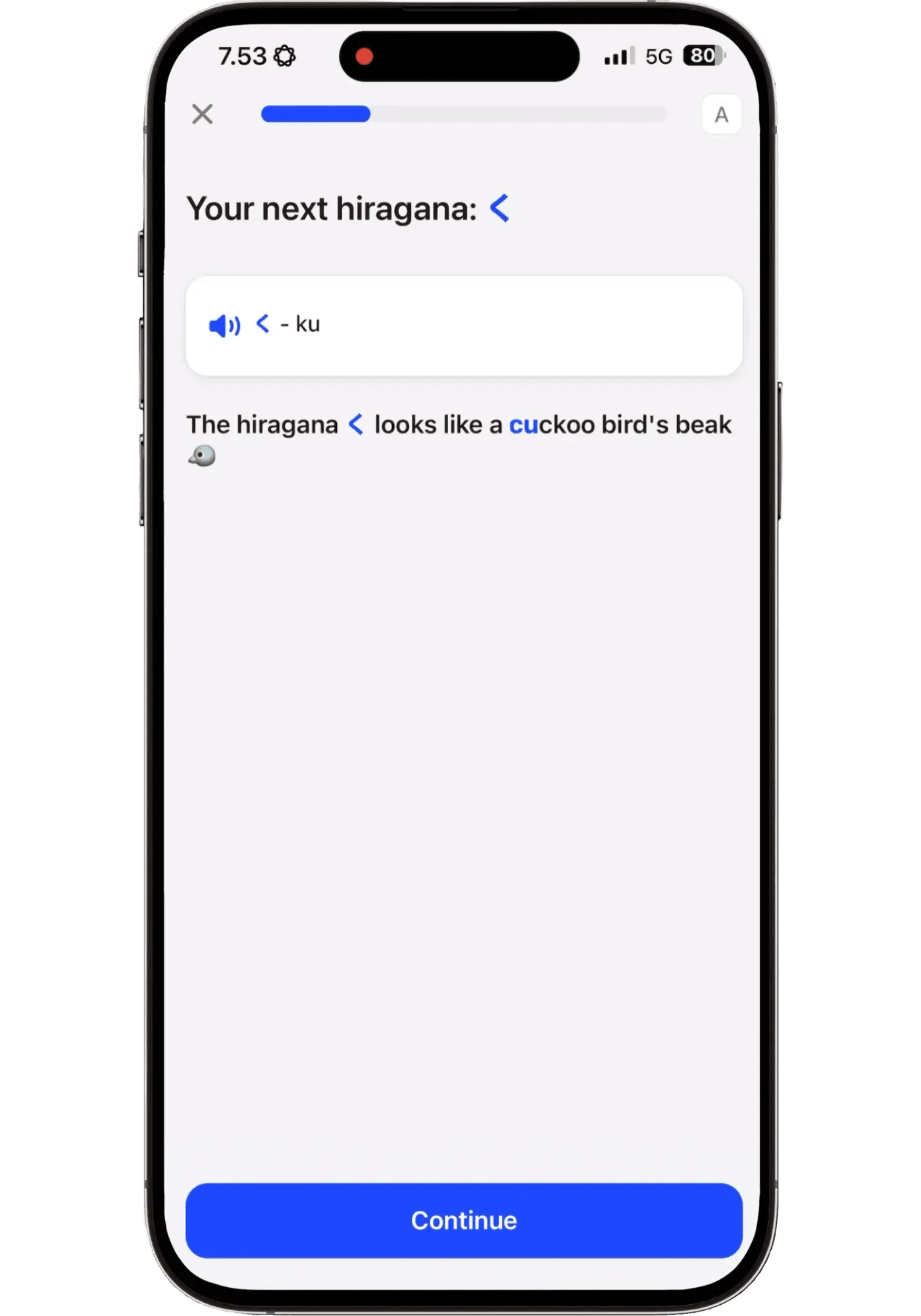
Learning a few Hiraganas at a time in slow drip-style, with simple mnemonics.
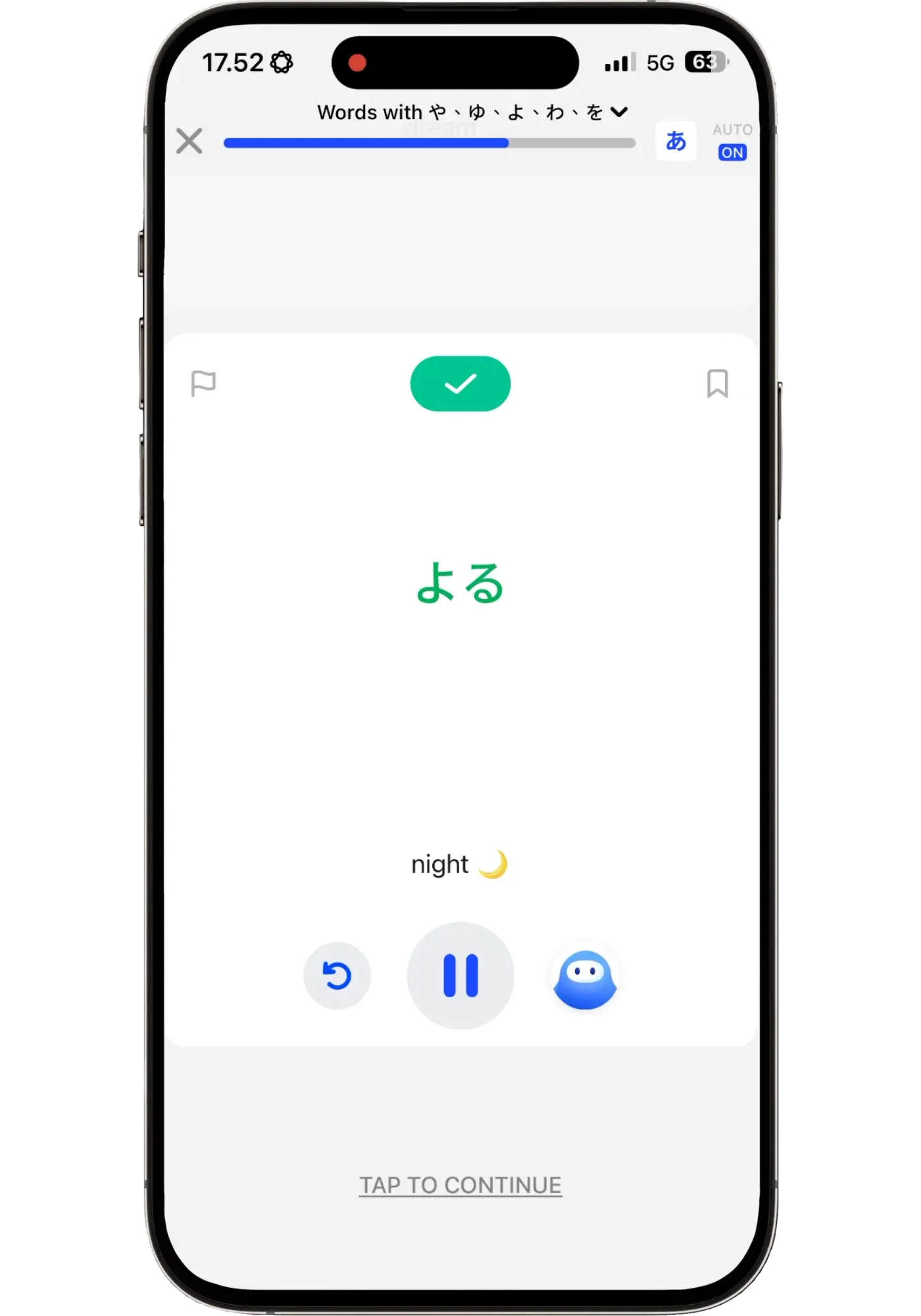
And then suddenly I was reading よる (night) off the screen and getting it right.
When the app talked back like an actual Japanese person
On day 18, I was in a Q&A chat where the AI was playing a friend asking how much the bill was. I had no idea of what things cost in yen, so I just made a number up: “five thousand yen.”
And it reacted. "E, gosen en? Takai desu ne." — huh, five thousand yen? That's expensive.
I burst out laughing. It was the delivery — it just sounded so Japanese, and reacting specifically to the number I randomly chose. The Japanese AI voice for these Q&A’s actually sounds like a real person and would drag out the “eeehh” and emphasize words just the way I’ve heard Japanese people do. (Korean does too. Spanish sounds okay, but you can tell it's AI.)

The moment I laughed out loud: “Huh, five thousand yen? That's expensive."
It's not just the reactions, either. It talks the way people actually talk. On day 17 I noticed it answering with "desu yo ne" when all I'd been taught was "desu ne", and throwing in little "eeh"s at the start of sentences. I wasn’t taught that — I just picked it up by paying attention to how it phrased things, and started adding the yo in my own answers as well, sounding a bit more natural.
It's also forgiving in a way I really appreciated. Around day 56 I was stumbling through a sentence — starting a word, stopping, restarting — the way you do when you're not fluent enough to get it all out in one go. But after tripping over my words and getting it right in the end, Speak just marked it as correct. A lot of apps would have marked it wrong, and I'd have sat there thinking: yes, I know, that's why I corrected myself. Speak lets you know when you got it right and ignores all those false starts. Which makes complete sense, because in real conversations even natives self-correct.
It’s not perfect though. On day 11, I tried to order gyoza, but it came out as "yozo" — which apparently means something completely different. Speak then generated a review lesson off the back of a mistake that was really just a transcription problem. But there’s the option to just ignore it since those generated lessons are optional anyway.
The week I almost quit
Not all of it was forward motion, though.
There was a day around day 26 when I was sick, but I still did my Japanese. Speak’s short lessons make it harder not to do it than to do it. Three minutes and I was done.
By day 35 I noticed I was struggling to answer in the Q&A chats. I kept tapping the lightbulb to see what I was supposed to say. That's just what happens when you're not putting the volume in and only doing one lesson a day. But even then it worked. I leaned on the lightbulb and said the sentences out loud anyway.
That's the trade-off with learning slowly. Five to ten minutes a day means you can always get it done, no matter what the day looks like. But you build far more momentum at 30, 60, 120 minutes a day — especially if you combine with other resources that target other areas. Because the thing Speak doesn't really do is build listening comprehension. If you want to understand real conversations or watch shows, you need to put in serious listening hours elsewhere and practice listening in a more connected manner — rather than Speak’s more piecemeal language.
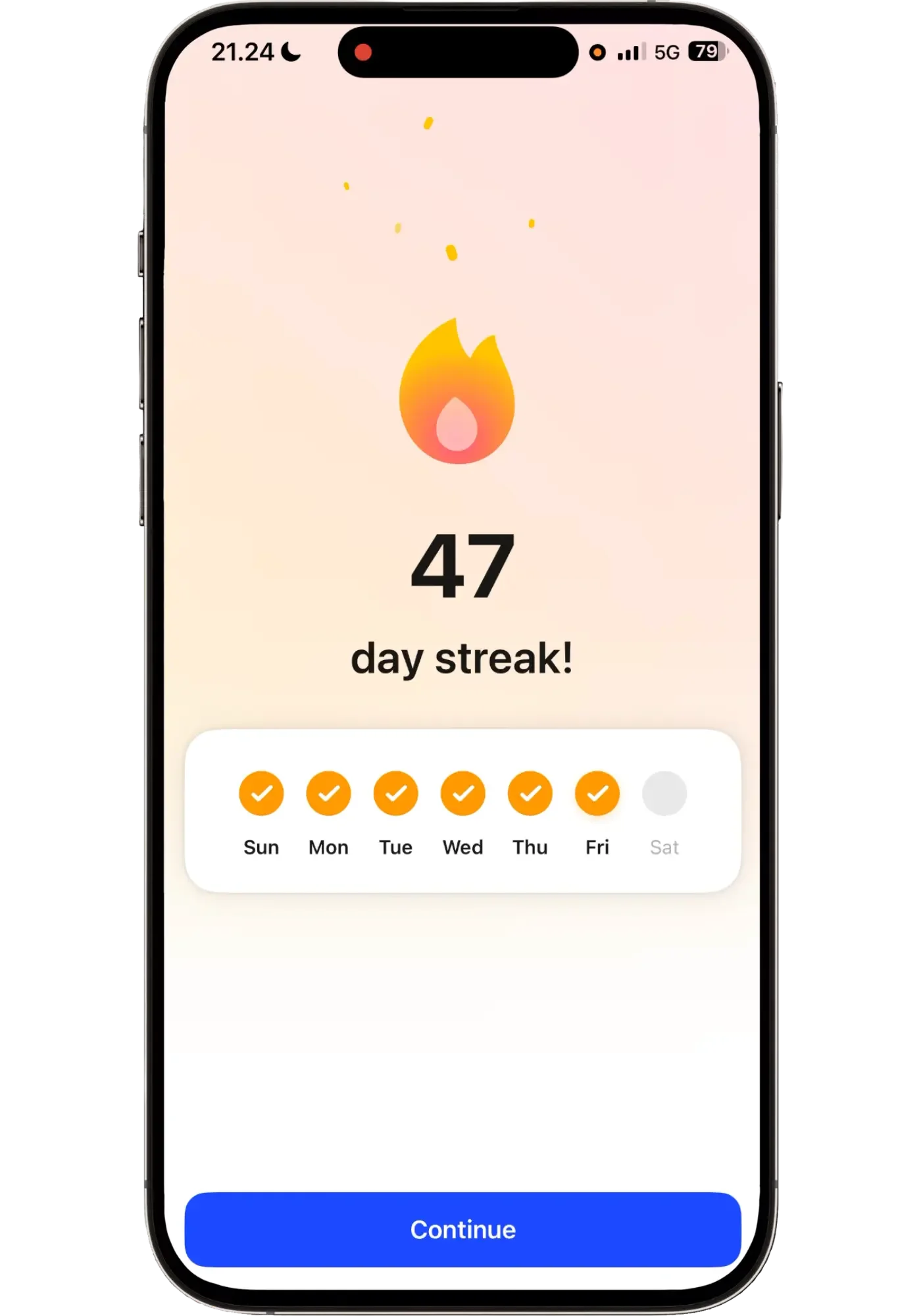
Only needing to finish one lesson each day meant I could keep that daily streak going no matter what.
But that wasn't my goal. I just wanted some Japanese. And some Japanese is a whole lot better than none.
About seven weeks in, I hit a totally crazy week. Barely any time for Japanese. I did one lesson a day purely to keep the streak alive. At the end of the day. Dead tired.
At that point, my motivation had already dried up.
Which is completely normal, and worth being honest about. The first few weeks of a new app are easy and fun. Then you reach the point where you have to actually decide whether you're continuing — because it doesn't feel exciting anymore, you can't see yourself improving, so you start wondering should I even be doing this? And I do have other languages that are more of a priority for me right now.
Which is exactly why goals and daily habits are more important than motivation. Motivation comes and goes. But it definitely never comes if you stop entirely. But I knew that if I kept going, even badly, it would come back at some point.
When motivation came flooding back
The very next thing that happened after that tough week — and it turned the whole thing around — was day 50.
The lesson was about asking for how to find specific things at a train station: the exit, the entrance, the ticket machines, the lift. The H&M mnemonic came straight back to me, which was satisfying on its own.
But then a listening drill did something I've never seen another app do.
It gave me a deliberately complicated answer — and told me not to worry about understanding all of it. Speak just said: “let's face it, you'll get a complicated answer from real people”. So the task wasn't full comprehension. It was catching whether they said left, right, or straight — or combinations of “straight then left” and so on.
That's survival Japanese right there (which the first Japanese courses in the app are aptly called): being able to pick out the one piece of information you need out of a sentence you don't fully follow.
I can't tell you how many times I've asked for the bathroom in a foreign language, only to have no idea what they just said back to me (a specific time in Greece when I was a teenager comes to mind). Now I was being specifically trained for this exact type of situation.
Later in the Q&A I was prompted to ask whether Osaka Station was the next stop — and the answer came back: no, it's the station after the next — and I'd never been taught ‘the one after the next’, but I could still figure it out since it just made sense based on what I had learned until this point.
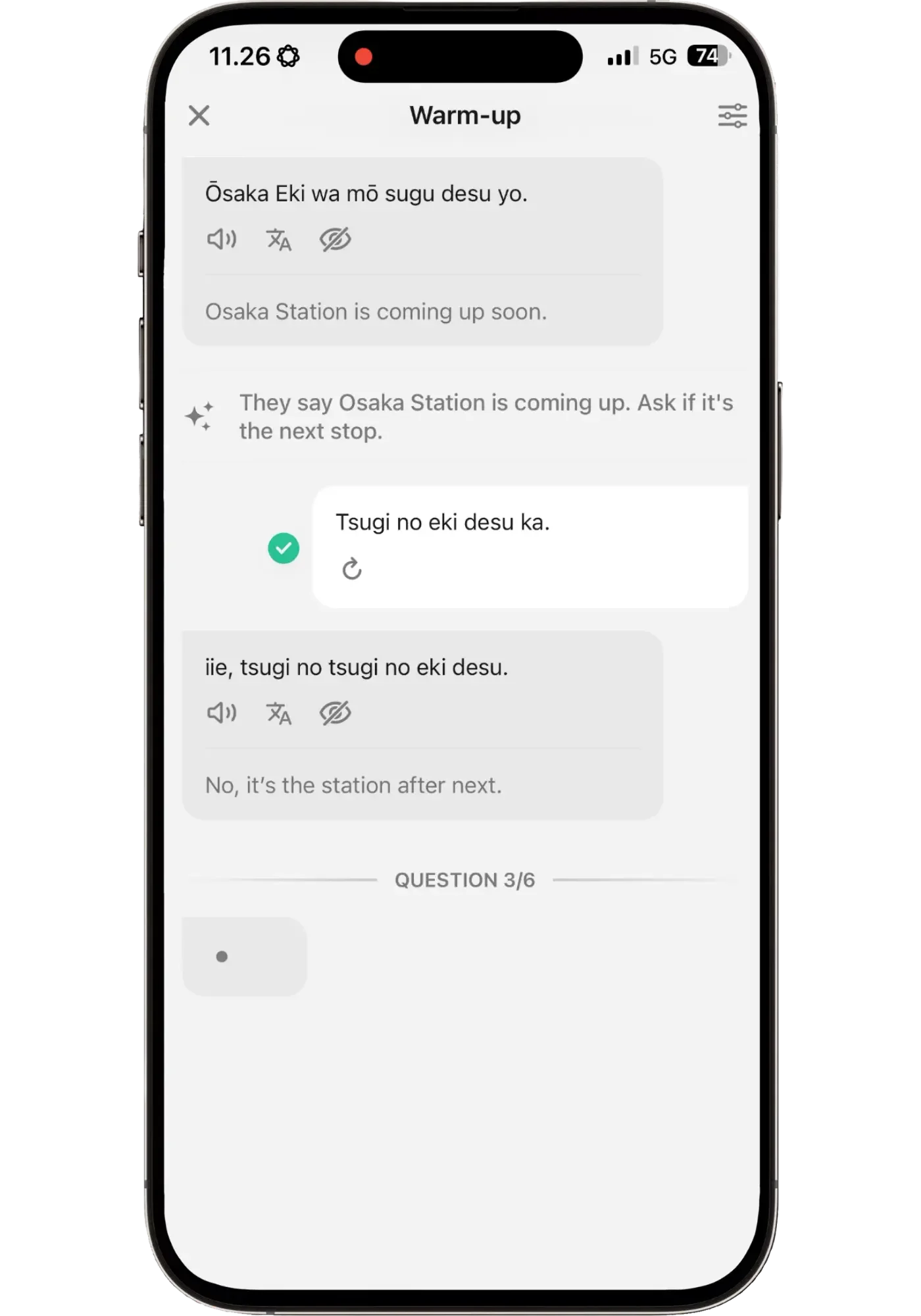
The answer I'd never been taught — and understood anyway.
That's where Speak is different for me. You can be nowhere near fluent, stumbling around as a beginner, but still understand enough to survive and get your point across.
So after a week or more of wondering if I should continue, I was suddenly stoked to keep going.
Proof it stuck: ordering in my head
Around day 70 something happened that had nothing to do with the app at all.
I was watching a YouTube video where someone was about to order food in Japan. And without thinking, I started ordering along in my head. I knew what to say. I knew the order to say it in. I even knew how to ask for two of something.
That might not sound like much but you have to put it in perspective: at that point I had less than 10 hours of Japanese in me with this app. That is nothing compared to what it takes to reach fluency in the language.
I don't think any other app could have given me that much usable Japanese in that little time AND made it as enjoyable to get there. (There's a reason I'm using Speak for five languages, even if three of them are purely for fun and nothing serious.)
Most apps make Japanese feel overwhelming. Speak fed it to me in pieces small enough to hold, with enough repetition that they stayed. And that only made me want to learn more of the language.
“Without even trying, I was ordering along in my head.”
The milestones
On day 72 a screen popped up telling me I'd learned all the Hiragana — all 46 of them.
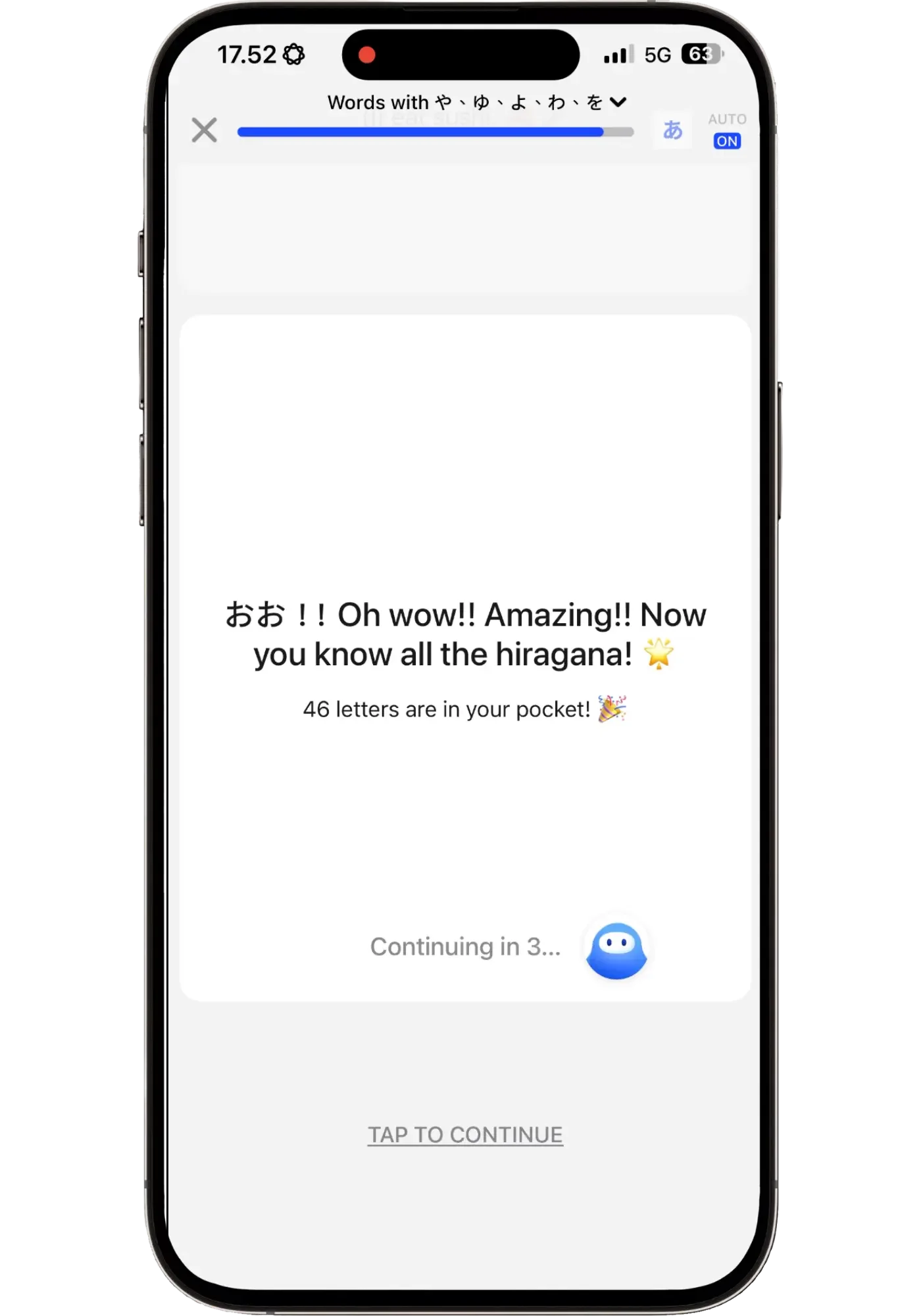
46 letters, collected almost by accident.
I hadn't been trying to — I'd just been walking the path, picking up a few characters at a time between other lessons, and at some point I'd collected the whole set.
Now — that doesn't mean I know them like the back of my hand. I need a lot more reading before recognition is instant. And I'll be honest, I'd gone through all the Hiragana once before with a different app a few years back, which probably gave me a small head start even though I had forgotten all of them at this point.
Apps I’ve used before have had more detailed and memorable mnemonics. Speak's are simpler. But simpler meant faster, and the truth is that mnemonics are training wheels either way — what actually locks a new writing system in is reading a lot until you don't need that trick anymore.
There were other smaller milestones along the way too. The daily streak. The XP you get which lets you climb the leader board. Finishing Beginner Survival Japanese Part 1 and moving into Part 2. And later, finishing Upper Beginner.
None of them are a big deal by themselves, but together they're what kept me opening the app.
Why I stopped doing it daily (and who this is really for)
After 90 days, I'm very happy with where I got to. I've barely scratched the surface of Japanese, but I know vastly more now than when I started, and I've got phrases I can actually recall and use. Not everything I’ve learned, but way more than I had with other apps. And all the phrases I’ve learned are right there in the Smart Review queue whenever I want to brush up on them.
Then I decided to stop doing it every day.
Not because it stopped working, but because I don't want to spread myself too thin. I'm pushing hard on Korean as a beginner, plus Cantonese, Finnish and Spanish — and being a husband, a dad, and running this blog on top of that.
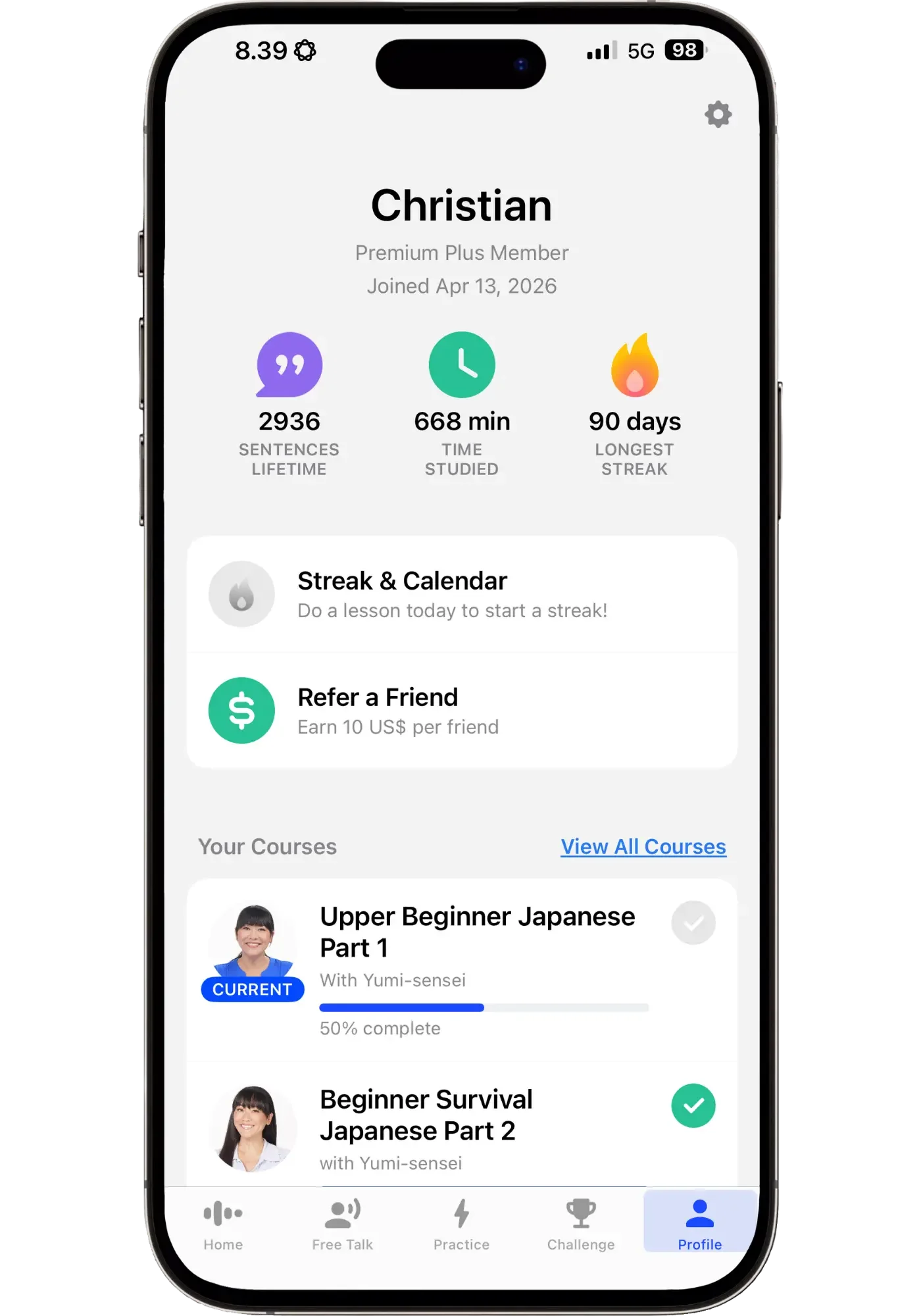
The 90-day streak, 11+ hours, and 2,900 sentences spoken.
I should also be honest about the filming. I'm glad I have the whole thing recorded — but some days it did take some of the fun out. It meant finding somewhere quiet and setting aside proper time, when the whole point had been doing it casually whenever.
So Japanese is now something I might do at the end of the day to relax, when I feel like it. Not every day. Weeks might even pass without me doing anything. Or I might hit a stride and do it every day. I don’t know. I’m just doing it for fun so we’ll see.
I want to be clear though: I don't recommend this approach, or even my 5-10 minutes a day if you're serious about Japanese. Daily learning is how you build momentum, and you're not getting to conversational — let alone fluent — in a language like Japanese without hundreds, thousands of hours of it.
But here's the flip side: that doesn't have to be your goal.
You do not have to be serious about a language for it to be worth doing. One lesson a day — five minutes or less — for a year would leave you able to order food, buy things and ask for directions with actual confidence. Push it to fifteen or twenty minutes and you'd get there sooner. And besides, that’s a great way to start learning a language. It’s even how I started learning Cantonese back in the day. I started small and the daily learning time just grew naturally with time. Just by staying consistent.
Across my 90 days I logged 668 minutes. That's a little over 11 hours of learning time — about seven and a half minutes a day.
If I ever book a trip to Japan, I’d just push it up to 15, 30 or 60 minutes a day the weeks leading up to it. And because all my progress is stored, I can hit Smart Review and refresh everything I've learned, even months or years from now.
If you’re curious about what I use each day to learn languages, here's the whole stack — all nine apps, across four languages:
So no, these 90 days weren't a waste. Learning a language never is.
Should you use Speak for Japanese?
So — is Speak actually good for learning Japanese?
Of everything I've tried, and I've tried quite a bit, I think Speak is the easiest way to get into learning Japanese (and other languages for that matter). You open it, you follow the path, and it handles the rest. It’s fun, engaging, and seriously effective.
That doesn't mean it's flawless. The speech recognition had trouble with single-syllable words, and it once took a good five seconds to register me saying "wi-fi" — things that don't happen in Spanish (the workaround was toggling on "can't speak now" so the AI fills it in, then switching it straight back off — though I wish that was available in the drills too, not just the lessons). It's a bit stricter on pronunciation than Spanish too — I got marked wrong for saying "dasu" instead of "desu," though it did motivate me to tighten up my pronunciation and overall it’s fairly lenient, which I appreciate as a beginner. Once it marked me wrong for missing a particle it hadn't taught me yet (though it was quickly redeemed when it introduced it only a few lessons later). And when I spoke English in an AI chat, it transcribed it into Japanese — but gave me no way to hear how that Japanese actually sounded, which felt like a missed opportunity to learn something I actually wanted to.
But the main thing for me was this: I was constantly learning new things, on a learning path that felt fun, without ever feeling out of my depth. I should say though that I'm only on Upper Beginner Part 1 — level three of twelve currently available in Japanese — so I can't tell you what happens deeper in. But in Spanish and Korean, where I've gone further, it stays at the right level. There's never a jump that feels too steep.
If you'd rather build comprehension first, look elsewhere — Speak works in short, practical chunks rather than the connected language you need for listening and reading comprehension. If I were learning Japanese seriously, I'd definitely add other things alongside it for comprehension (which is exactly what I’m doing in Korean).
Speak is a great fit if you're:
Wanting to actually speak from day one
Learning some tourist Japanese for an upcoming trip
Someone who's tried other apps and found Japanese too intimidating to stick with
If you want the full breakdown rather than the story, I wrote a full Japanese review after my first 30 days.
The regular Premium plan is currently $83.99/year — which works out to around $7 a month. Honestly cheaper than I expected, and it's the only plan you need as a beginner in my opinion (you can always upgrade later). There's a free week — try it and tell me you aren't hooked.
Related posts:
