Published

This post contains affiliate links. If you buy through one of them, I may earn a commission at no extra cost to you. See Full Affiliate Disclaimer.
Table of Contents
- How spaced repetition actually works
- My flashcard story: from 10,667 cards to burnout and back
- The languages I learned without flashcards (and what I did instead)
- Are flashcards necessary? And when are they worth it?
- How to use flashcards well (if you use them at all)
- Flashcards aren't the only kind of spaced repetition
- The bottom line: a tool, not a rule
I’ve created 10,667 flashcards completely by hand in Cantonese. And I learned Finnish to a high level without reviewing a single one, and only used them briefly and for a specific reason in Spanish.
Flashcards come up often in the questions I get — are they the "hack" that makes vocabulary stick? Or can you skip them without missing out?
You’ve got language learners who really are gung ho about their decks, and then you’ve got people like Luca Lampariello who have learned more than a dozen languages very successfully without any flashcards. I know experienced learners who wanted to get into flashcards, downloaded Anki, used it three times, and just couldn’t bring themselves to open it again.
So if you want a short answer from me: no, they're not a must. You can skip them entirely and still learn a language very well. And if you're here to find out whether you're missing out by not using them, let me be clear — you're not. The very fact that you’re asking the question “do I really need flashcards?” tells me you’re probably the kind of person who won’t enjoy them.
But then on the other hand, would I have personally created more than 10,000 flashcards by hand if I didn’t think they were valuable? I mean wouldn’t that be the definition of insanity?
I went from believing they were essential, to realizing they weren’t, to now using them in very specific ways. Flashcards are a tool, not a requirement — and whether they're worth it depends on the language, your goal, and whether you'll actually sustain them.
So let's break down when they're worth it, when to skip them, and how to use them well if you do.
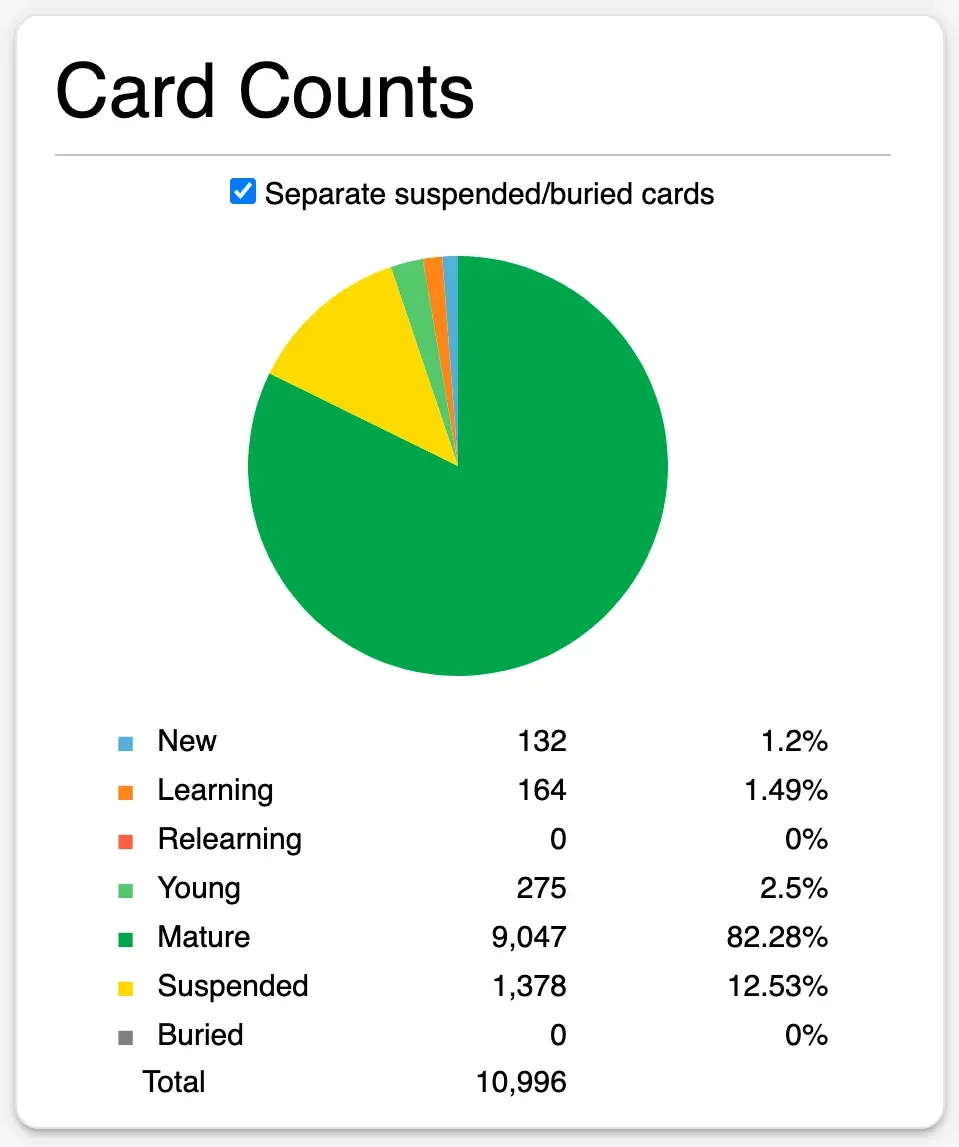
10,996 cards in Cantonese. 329 from a deck I imported — the other 10,667 I made by hand.
How spaced repetition actually works
Flashcards take advantage of SRS — Spaced Repetition System — to feed you learning content at increasing intervals. In other words: you’ll get automatic review of content right before your brain is about to forget them.
There are lots of apps that have some kind of flashcards feature integrated, whether it’s AI apps like Langua, input-based apps like LingQ, or TV content platforms like Lingopie — they all implement flashcards in some shape or form.
The most famous flashcard app is Anki, which is a free and open system that lets you customize your flashcards any way you want.
The principle is simple: a piece of information shows up on the front of a card. Know it? Press Good, and you won't see it again for a while. Don't know it? Press Again, and it comes back much sooner. Every time you get a card right, the gap before you see it next gets longer.
The most powerful part is that you can add lots of vocab without having to figure out when to review: the SRS does that for you, which makes it convenient. It also makes reviewing concrete: you know exactly how many cards you have that day, and when you're done, you're done.
That said, spaced repetition is a principle, and using a flashcard app is only one way to apply it.
My flashcard story: from 10,667 cards to burnout and back
When I started learning Cantonese back in November 2017, I had heard from other learners of the language how powerful flashcards were. And since I wanted the best and most effective way to learn the language, I used Anki right from the beginning (I actually used the wrong Anki app for a few weeks, but that’s another story…)
It took some time to figure out exactly how to use it. I had to fiddle around with the settings to set them up the way I wanted. Once I did, I started making flashcards out of everything I could find. Many seasoned language learners said to be selective about what ended up on a card. Nah, not me. I put everything I learned on there. Because I had this belief that if it didn’t become a flashcard, I wouldn’t remember it — turns out that wasn’t true at all.
I remember going through the beginner course Cantonese Class 101, which had a short dialogue at the beginning of each lesson. So as I went through them, I literally made a flashcard of each line of dialogue in each lesson. Not only that, I would record the audio from my laptop directly into Anki. I truly mastered the skill of tapping the mousepad so lightly that there wasn’t a “click” sound at the start of each card. I was also taking weekly Cantonese lessons on iTalki and I turned everything new I learned — audio and all — into flashcards.
In retrospect, this was totally overkill and a lot of work. But when you’re young, on fire, and believe something is super important — you tend to do crazy things like that. The good part was that I had authentic audio for all the flashcards I created those first two years or so. Which did good things for my pronunciation. Luckily, there are easier ways to do this nowadays.
What my flashcards used to look like
I kept them simple. I’d take a sentence, have the Cantonese transliteration (jyutping) show on the front side (since I couldn’t read Chinese characters back then), and the English translation on the backside — with the sentence audio. The key here was that I mostly used whole sentences, not individual words.
This meant I got the sentence structure for free — something you don’t get when you have cards with individual words (I had some flashcards that only had individual words too, but then I added a picture on the front side, for an added memory connection).
So I’d simply just listen to it, repeat the sentence, and press either “Hard/Good/Easy” or “Again” depending on if I knew it or not.
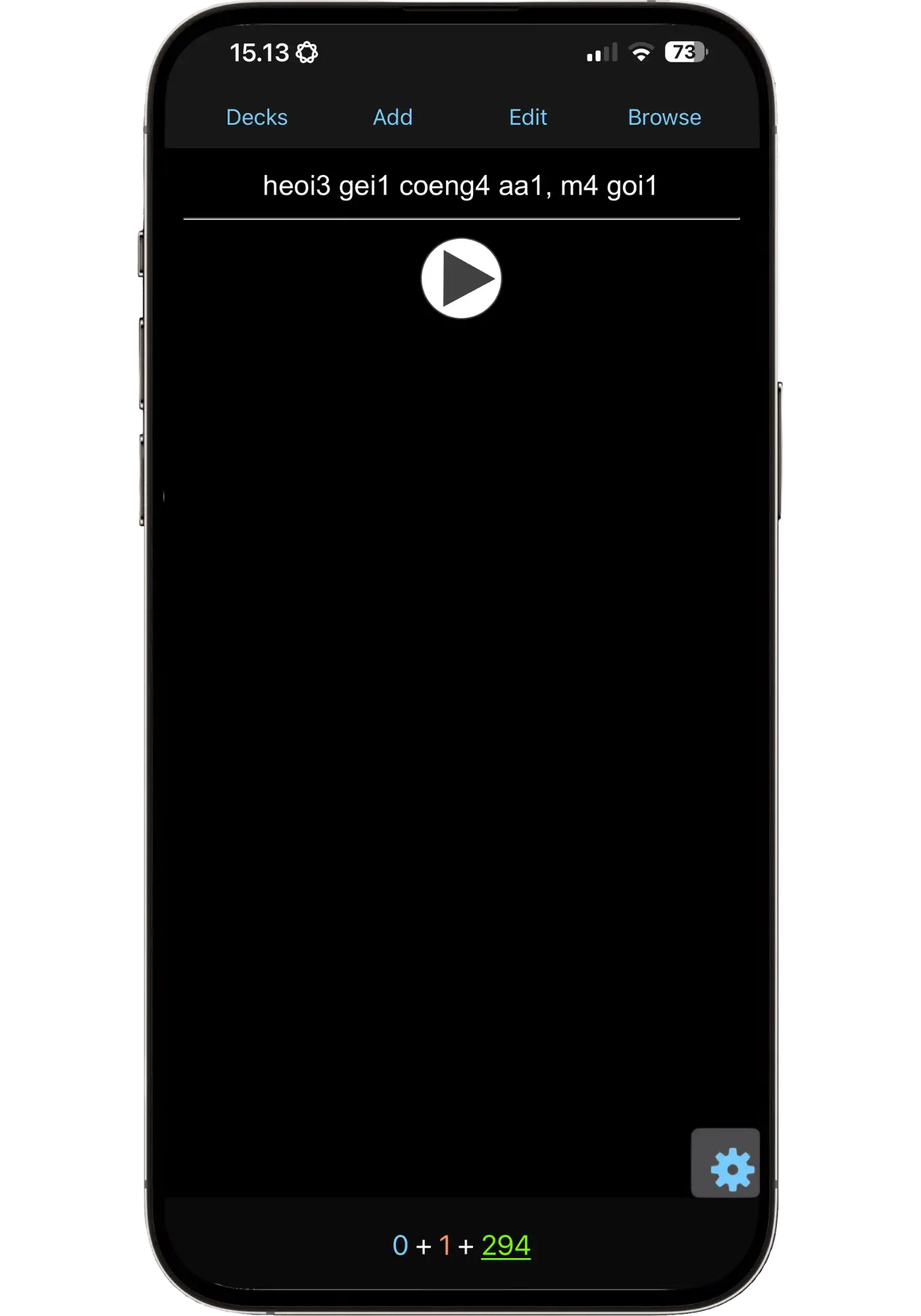
One of my early cards — a full sentence in jyutping, with audio I recorded myself.
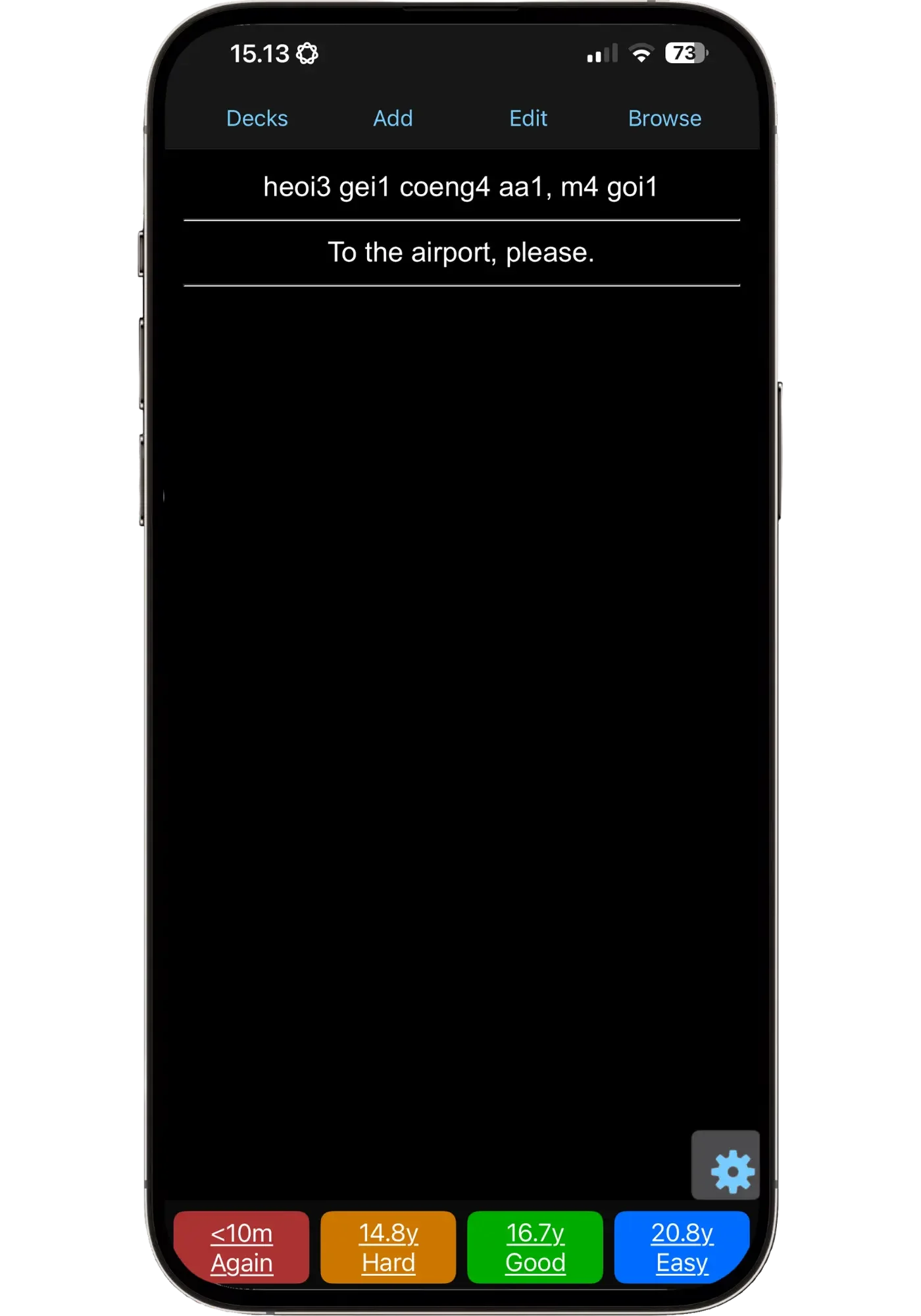
Just jyutping and a translation — no context, no image. Note the intervals: after eight years, Anki is offering to show me this one again in 2047 — lol.
While this let me cement useful vocabulary, one of the biggest benefits of my approach was actually for speaking. I never found the six tones of Cantonese to be a problem. And I attribute most of that to these flashcards. Because I would always read the whole sentence aloud and try to mimic the pronunciation.
This gave me practice of speaking all sorts of possible tone combinations (which is the actual challenge with the tones) and after 2-3 months of doing this daily I was comfortable navigating just about any tone combination. It served as a great pronunciation trainer for me, which I sort of just got by accident.
Flashcard burnout is real
After several years, and having made thousands of flashcards — 8,100 or so of them — and spending around 40 minutes a day reviewing them, I eventually got burnt out on the whole thing. I stopped making cards. I only remember doing two short stints for a TV show and a YouTube series when I wanted to review some of the vocab in those. And for those, I used Text to Speech rather than manually recording the audio, so it was a much easier process to create (you can bulk add TTS to multiple cards in Anki).
The count eventually went down to 10-15 minutes a day since I was only reviewing old cards and not creating any new. I just didn’t enjoy it anymore. And to be honest, I continued mostly out of habit and sort of a false sense of responsibility.
Because the thing with flashcards is, if you don’t do them every day, the backlog of reviews starts piling up. So you’re going to be reviewing every day, and I just felt I was spending all this time on flipping through cards when I could be doing something more impactful instead.
So I stopped. No more flashcards. Not for years. Until the fire got rekindled.
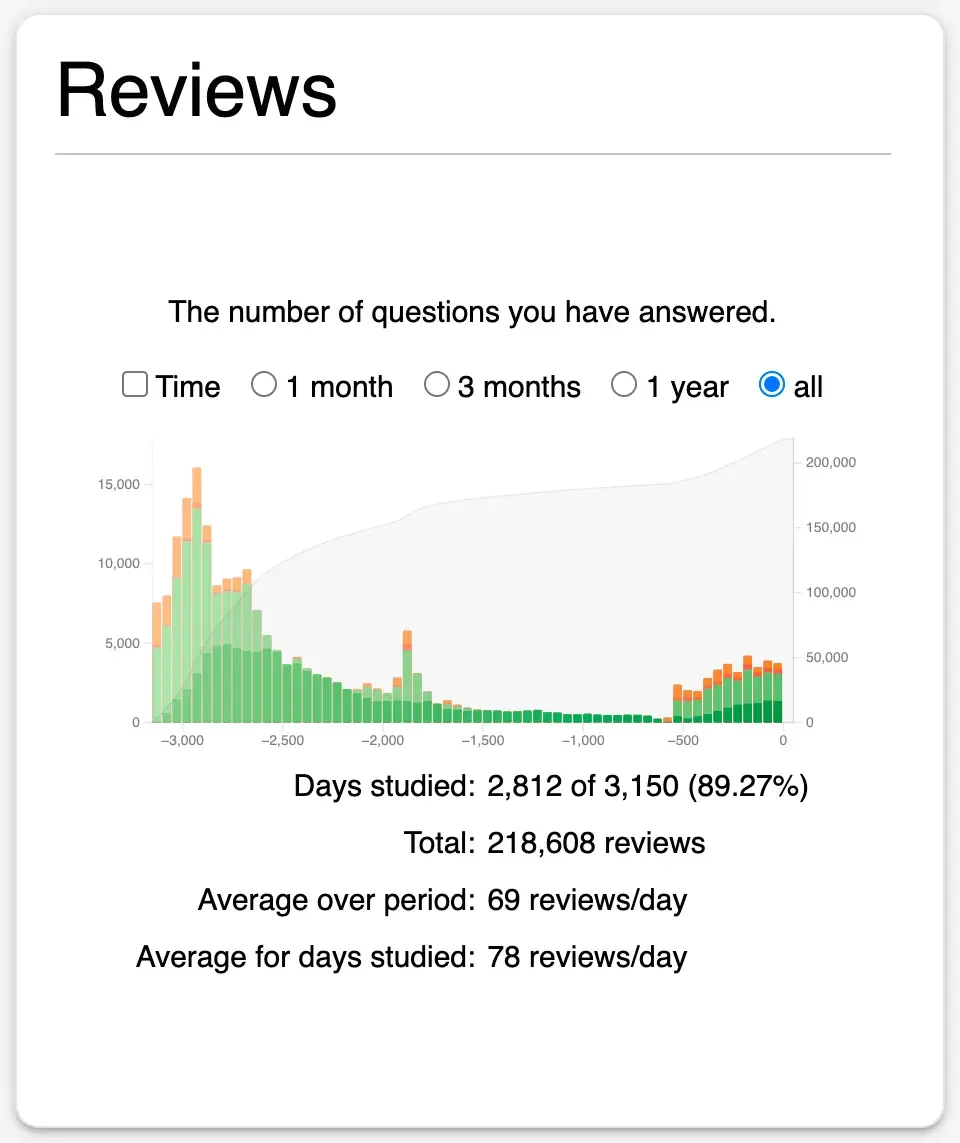
218,608 reviews across 2,812 days of studying. Sheesh. No wonder I burnt out.
My flashcards reinvention — Disney’s Gargoyles
Early in 2025 I took the excellent listening course Level Up Your Listening by immersion learner masters Refold. I felt comfortable with my Cantonese reading ability but felt like I had plateaued in my listening. I just wasn’t as comfortable as I wanted to be with TV shows, movies and other media. I needed something to break out of that and get to the next level. That course ended up being life-changing for my language learning and I got so many new perspectives and tools to improve my listening in any language — principles and techniques I still use daily to this day.
Two of the principles taught in the course were intensive listening and sentence mining. Intensive listening means going sentence by sentence — listening multiple times and using subtitles to clear up ambiguities. It trains your ears to hear tricky lines of dialogue. I started using this method with the Disney show Gargoyles on Disney+, working my way through the episodes.
For a full walkthrough of my method, see my post How I Improved My Cantonese Listening (60% → 90%) Using Disney+
As I was doing this, I figured I might as well capture the words I didn’t know and make flashcards of them. I know. Straight back to the thing that burned me out in the first place.
But this time it was different. For a few reasons:
I was already an advanced learner with a large vocabulary so I only captured the words and sayings I didn’t know — compared to every single word and phrase like I did when I was a beginner.
I used asbplayer (free Chrome extension) which created flashcards with the sentence, a screenshot of the scene, and original audio of the full sentence — in one click. I just needed to add the target word with the translation (a Cantonese-specific limitation, but still much more convenient than what I used to do).
I kept it only to this TV show. I didn’t make cards from anything else.
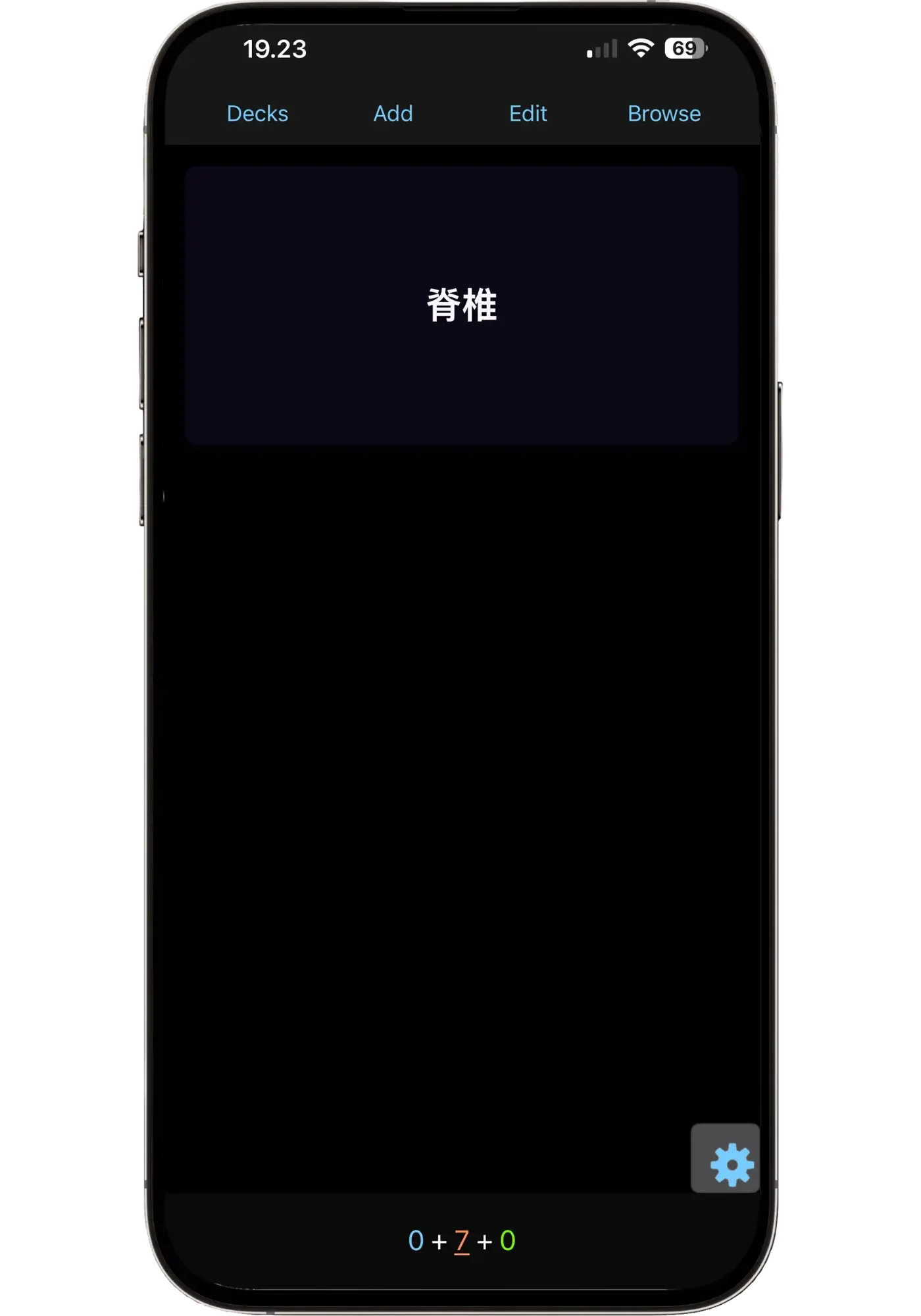
The front of a card from my Gargoyles deck — just the word. If I know the meaning and how it’s pronounced (with the tones), I pass it.

The back: pronunciation, tones, meaning, the original line with its audio, and the exact scene — all captured in one click with asbplayer. "Vertebra" is the kind of low-frequency word that can be hard to come across often enough to learn.
That way, I had a very convenient way to create high quality multimedia flashcards from a show I was working through. And since my flashcards were limited to this show only my reviewing stayed at 5-12 minutes/day on average (partly due to not making cards as often, partly using an updated algorithm). The workflow of making these cards became something I thoroughly enjoyed and looked forward to, instead of dreading.
And to be honest, the actual reviewing of flashcards isn’t my favorite thing in the world. But doing a few minutes of something I know has a big impact, vs. 40 minutes I no longer feel did, is the difference.
I’ve currently gone through 56 or so episodes (season 1 & 2) of Gargoyles, I’ve made 2,563 cards from the show, and I’m still going. And since I enjoy it, and have seen a significant improvement in my listening comprehension because of it, I’ll probably move on to a different TV show after I’m done with this one (my current plan is to use it for the classic Hong Kong drama ‘Triumph in the Skies’ next).
The languages I learned without flashcards (and what I did instead)
Cantonese is the one language where I've leaned on flashcards heavily. Finnish and Spanish I learned almost entirely without them — with two small exceptions I'll come back to further down.
I started Finnish a year after Cantonese (at the end of 2018), and decided early on not to use any flashcards whatsoever. For two reasons: first, I wasn't keen on building a whole new deck in another language. And second, I wanted to try and see if reading would be enough to build my vocab instead.
And after years of a very reading-heavy approach in Finnish, it worked. It gave me a large vocabulary without a single flashcard review. I am however, currently using flashcards in Finnish. But they are very different in nature than my Cantonese ones (more on that in the section on How to Use Flashcards Well (if you use them at all) down below).
Spanish, which I started learning early 2022, I never relied on flashcards. I used them for around five weeks as I was preparing for a Spanish YouTube interview. I’d have AI conversations in Langua and then save sentences from those chats to my Langua vocab deck. These were typically things I wanted to say but didn’t know how to. I would then drill them so that they would come out in my own speaking. It worked well. Other than those five weeks, my vocab in Spanish came completely from listening, reading, and speaking — not any deliberate reviewing.
Are flashcards necessary? And when are they worth it?
The short answer: no, they’re not necessary. If Cantonese had been the only language I’d learned, then I might have given you a different answer. But having also learned Finnish and Spanish with hardly any flashcards, my view is more nuanced than that.
And plenty of other people have learned language after language to fluency without ever touching one.
That doesn’t mean they can’t be useful. It just means they’re one tool among many in language learning — far from the most important, and nowhere near a requirement.
So here’s how I’d think about it, and whether they’d be worth doing for you specifically:
How far the vocabulary of the language is from what you already know. Languages further from your native one need more touch points before a word sticks — like Chinese, Korean, Japanese if you're coming from English. Cantonese was a special case for me on top of that: written Chinese is closer to Mandarin than to spoken Cantonese. Reading helped, but reading alone wasn't enough to close the gap — which is why I ended up mining TV shows.
When you have a specific goal with an end to it. If you've got an interview coming up in your target language and need to practice particular vocab, sentences and expressions — flashcards are a highly effective way to prepare. Same for how I use them in Finnish now: narrow, deliberate, aimed at one thing.
Whether you'll actually sustain it. A deck you dread is a deck you abandon — take it from someone with 218,608 reviews. It needs to be an amount of time per day that you can actually do, day after day. With cards from something interesting to you that you’ll actually be motivated to review.
To find out what my complete daily language learning setup looks like, here are the 9 apps (including Anki) I actually use:
How to use flashcards well (if you use them at all)
There are all sorts of card types. Production cards, for example, put English on the front and your target language on the back, so you have to produce the sentence yourself — it’s the most demanding type, and one I've honestly never really used. For me the point is getting lots of touch points with vocabulary, and I’ve found that to be enough — which isn't to say production cards don't work, I just never went that way.
These days I keep it simple: target word on the front, full sentence with audio and screenshot on the back.
That said, flashcards do different jobs depending on where you are:
As a beginner, they're mostly about foundations — training your ears to distinguish sounds your language doesn't have, and building a base of the most common words. This is where premade decks make the most sense. I should say though that I've never used premade decks as a beginner myself. Not because I'm against them — I've just always ended up making my own, partly because there aren’t a lot of them in Cantonese and also because I like the cards to be from what I’ve personally chosen. But if the actual making is what's stopping you, then I’d check out Refold's decks — they cover ‘minimal pairs’ for ear training and first-1K decks for foundational vocabulary in several languages (Japanese, Spanish, Czech, and more) and even some content-specific decks (Harry Potter, Avatar).
Tip: if you’re going to download more than two decks, signing up for their monthly subscription will be the cheapest option — it gives you access to download all their decks.As an advanced learner, the whole thing flips. Now you know most of the words you come across, so cards are for filling gaps — the words and expressions you don't run into often enough to pick up on their own, or that are hard to guess from context. That's the whole basis of my Gargoyles method.
I personally find them the least valuable at the intermediate stage — then it’s more about being exposed to a lot of volume, rather than the targeted practice flashcards provide.
A few things I'd tell anyone starting out:
Save phrases and sentences, not just single words — you then get the grammar for free.
Don't capture everything. Only what you actually want to be able to say, or the specific gaps you want to fill.
Keep each deck limited to one source. One show, one course, one teacher. It's the difference between a deck you finish and a deck that you run from.
Review daily. It’s more efficient and the backlog is what quickly makes things get out of hand.
Here are three different ways I recommend using flashcards:
Mining TV shows and other media
This is the Gargoyles method I laid out earlier. What I didn't mention is the actual listening benefit. Since each card had the original audio from the scene, every review doubled as targeted listening practice. I could listen to the same line over and over, spoken by a real actor at real speed.
Sometimes I'll even make a card not because there's a word I want to learn, but because the sentence was hard to hear. I'll pick any word in it as the target word, and when it comes up I replay the audio a few times and it trains my ears to pick up each syllable in real time.
Vocabulary from your lessons
When you take lessons on platforms like LanguaTalk or iTalki, especially conversational lessons, you’re going to learn vocabulary that’s unusually relevant to you — because it often comes out of things you tried to say but couldn’t. Your teacher gives you the natural way to phrase it, and that's high-value material: you already know it’s something you want to be able to say. Making cards out of those, and reviewing them, is how you get them from the lesson into your own speaking.
Grammar and pronunciation, not vocabulary
Here's the Finnish exception I promised. Seven-plus years without a single flashcard, and now I use them — just not for vocabulary. Here’s what I do instead.
I have AI conversations in Langua about everyday things, using a specific prompt that has the AI take the sentences I got wrong and give them back to me corrected and more natural-sounding. I save those to Langua's flashcard deck and review them out loud, repeating each sentence several times. This is mostly to ingrain the correct grammar based on things I actually want to be able to say, to increase my spoken confidence and not have to wonder “is this correct and natural-sounding?”. Sometimes I'll generate a short AI story built around those same sentences and listen to it while doing the evening dishes, but regular flashcard review is mostly what I do currently.
Langua's cards work a bit differently: the AI voices are high quality, and replaying a card gives you a slightly different reading or even a different voice. Because of this, I’ve also started using these to improve my pronunciation too — by mimicking the AI voices and experimenting with things like tongue placement and mouth shape (it’s something I’ve just started doing so I’ll have to report back on that one in the future).
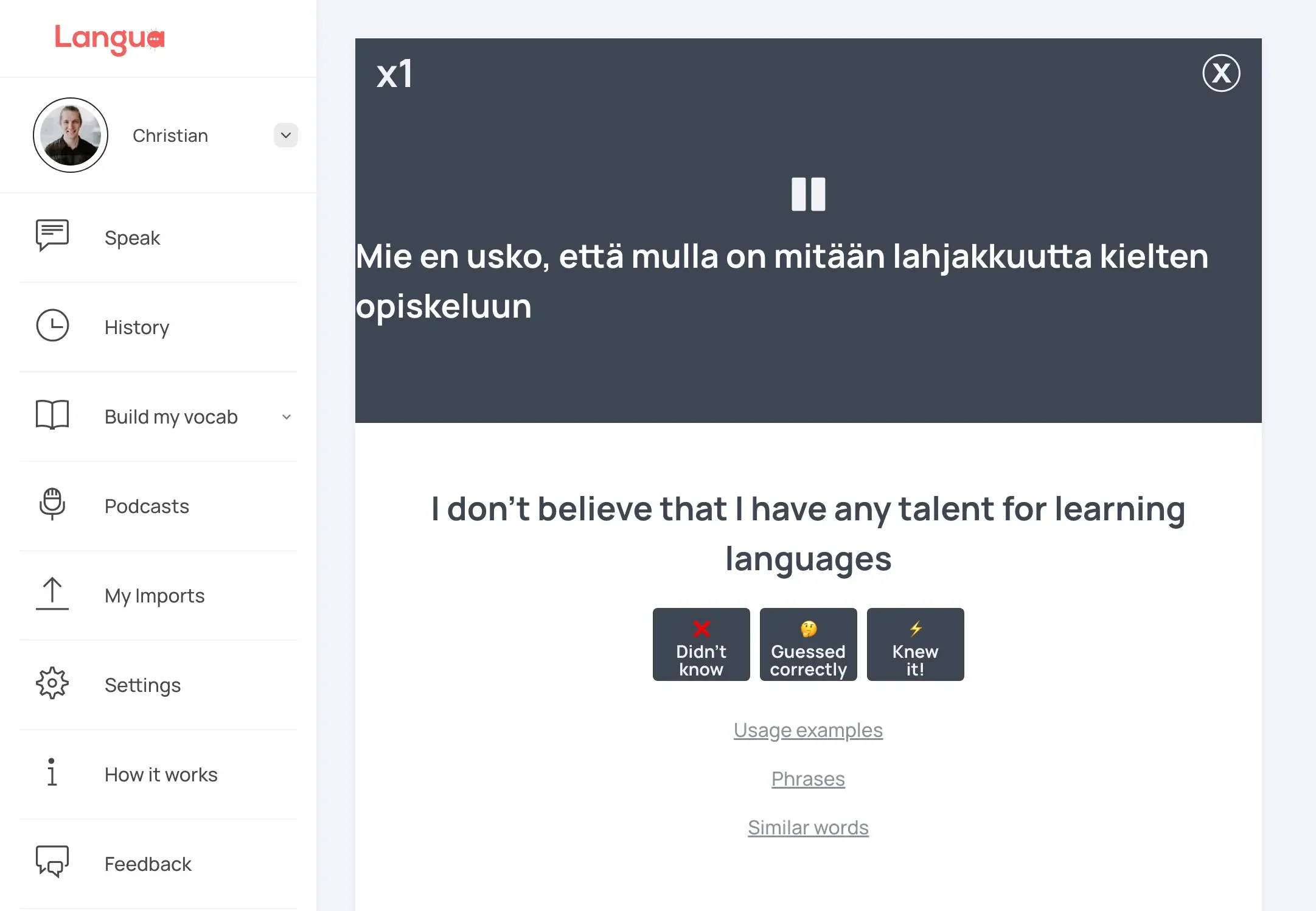
My Finnish cards aren't for vocabulary — I use them to drill pronunciation and grammar out loud. And the sentence that came up is about people telling me I must have a talent for languages. What's actually behind it is a five-figure pile of hand-made cards. (Note the "mie" instead of "minä" — that's the Lapland dialect spoken where I live which is what I’ve told the AI to use.)
One bonus: flashcards build you a searchable database of your own vocabulary. This can be quite useful and I have sometimes been reminded of something — could be a word or expression from a lesson I had years ago that I can’t fully remember — I can then search my deck for it and find it.
Outside of these uses, I don't see much need for flashcards. Enough listening, and especially reading, will grow your vocabulary mostly on its own, even without any deliberate review.
Flashcards aren't the only kind of spaced repetition
Repetition is the backbone of all learning. Do something enough times, and you’ll eventually be able to do it well. This is especially true for language learning — be exposed to a word enough times, and you’ll eventually remember it. But flashcard reviews aren’t the only way to get that repetition.
Here are two other ways:
Reading
Reading is a very effective one — you’ll encounter far more words, and a much richer range of them, than you’ll typically hear in everyday speech or on TV. The common words will come up often enough that they’ll stick quickly, and even rarer ones eventually become familiar once you’ve read enough. This is why I never felt I needed flashcards for Finnish. I've read over 1.7 million words in it — more than twenty books — which gave me all the repetition I needed.
Cantonese was the exception. I've actually read slightly more in Chinese, over 2 million words, and it still wasn't enough — because reading Chinese means mostly reading Standard Written Chinese. It grew my vocabulary of the overlapping words, but it didn't move the needle on my listening the way reading did in Finnish. I needed something else for that.
Priming
Another form of spaced repetition that doesn’t rely on clearing out your reviews every day is priming — something I’ve been using with Korean. I’ll watch shows on Lingopie, where you can tap any word in the subtitles to save it. But instead of reviewing my whole deck as flashcards (which you can do), I go to a specific episode and hit Pop Quiz: I hear the target word in TTS, then immediately the entire original line from the show that contains that word, and pick the meaning from four options (you can see me doing this in action in my post Lingopie Korean session where there’s also an accompanying walkthrough video).

The quiz plays the word in TTS, then the complete original line from the episode with the scene playing. I'm listening for where the word starts and ends in real speech — not just picking the right meaning.
The point isn't really picking the right definition. It's that when the original line plays, I'm deliberately trying to listen for that word and really hear it inside that line of dialogue. Korean is still mostly incomprehensible to me — I understand maybe 5-10% of a native drama. That's the exact opposite of my Cantonese, where I'm just filling those 5-10% gaps. This is more about learning to hear where a word starts and ends in the middle of fast spoken Korean.
The bottom line: a tool, not a rule
Flashcards are a powerful language learning tool — but they are optional, not a prerequisite. What they really are is a delivery system for repetition. Usually vocabulary, but also very effectively for listening, grammar and speaking. It makes some things more efficient, but it’s not the shortcut it’s sometimes made out to be.
Because what you need is enough repetition. And getting plenty of listening and reading to content is in itself a form of spaced repetition. And in many cases, that’s more than enough.
So if you can’t stand the idea of doing Anki reps, just skip them. You’ll be fine, and you’re not missing out. But if you like the idea of mining shows you're watching, building up your own database, and working on something in a targeted way — they can be an excellent way to fill in those gaps.
I might end up using Anki or other types of flashcards for Korean at some point. Or I might not. And for now, I don't feel the need. And that’s really the point. You decide for each language, each goal, each season, based on what will best serve you.
Whether you end up using them or not, you still need real exposure to the language. Flashcards are the vitamin supplements of language learning, not the meal. And if you've already learned a language without them — you've got all the proof you need.
