1,000 Hours of Spanish Listening: My 4.5-Year Progress Update
Published
This post contains affiliate links. If you buy through one of them, I may earn a commission at no extra cost to you. See Full Affiliate Disclaimer.
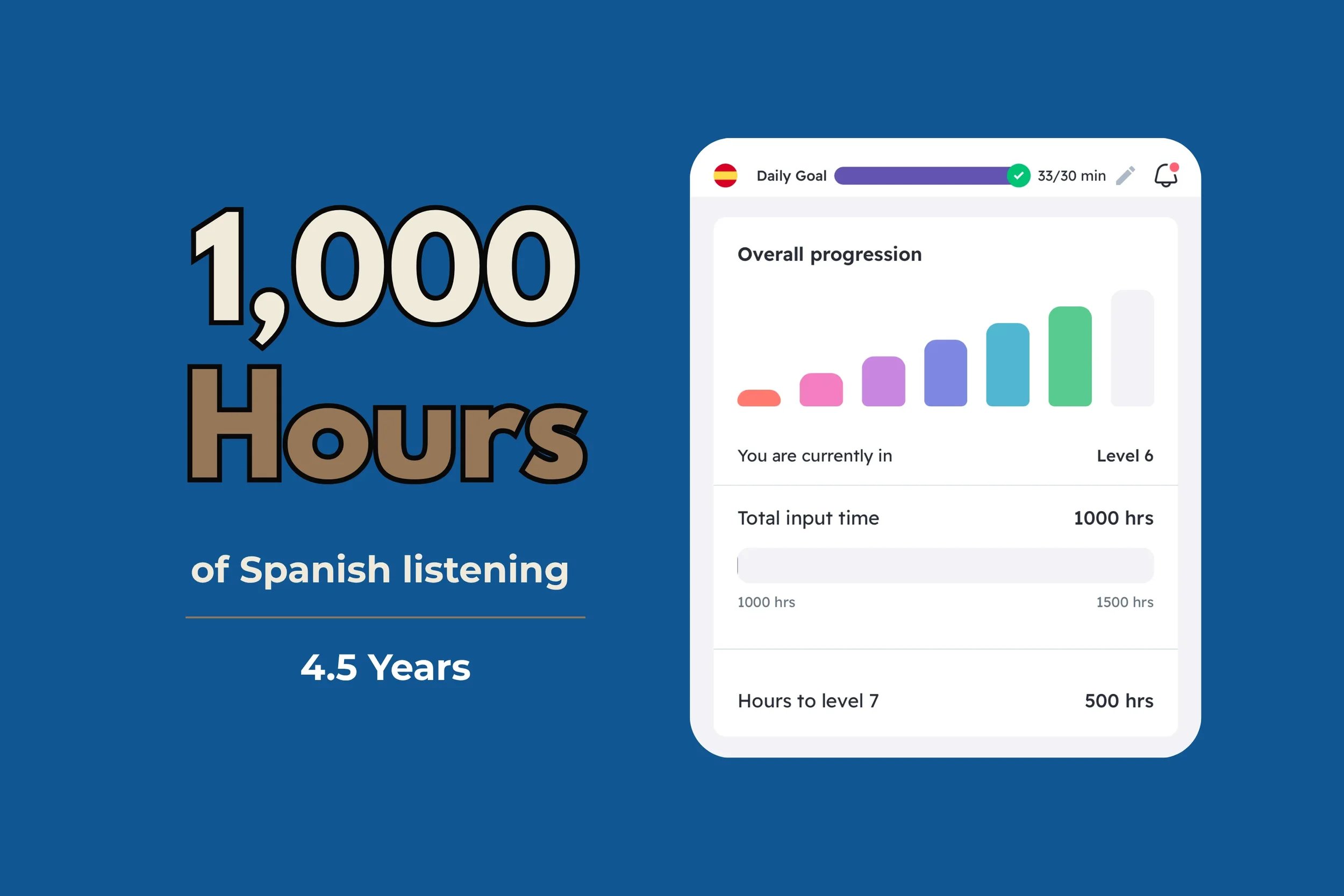
On July 11th 2026, I reached 1,000 hours of Spanish listening. It took me four and a half years.
You might be reading this thinking: “why did it take so long?” — but as I wrote at my two-year mark, going all in on Spanish was never practical for me, not with the other languages I was learning and everything else in life.
So it came down to learning slowly or not learning at all. I chose the first option and let consistency do the work over time.
At my three-year update I was at 658 listening hours, so this covers the 19 months since then, and what changed along the way.
1,000 hours is a real milestone. Dreaming Spanish says it's the point where you're comfortable with daily conversation — essentially some level of fluency. So did I get there?
Here’s what those hours actually looked like, the stats behind them, and every resource I used. I reached the 1,000 hours one and a half months ago. All other numbers are from where things stand currently.

July 11, 2026. The moment it ticked over to 1,000 hours, four and a half years after I started.
What 1,000 hours of listening actually looked like
Since very early on I’ve had one daily goal: 30 minutes of Spanish listening. Every single day.
It wasn’t so important what I listened to (as long as I enjoyed it), or how I felt that day. Some days I didn’t have great focus, some days I did. What mattered most was just that I got that listening in — for at least half an hour, without subtitles, only counting pure listening without any transcripts. And then let those minutes accumulate and do work over time.
I did most of the listening while doing something else — getting ready in the morning, walking, driving, vacuuming, doing the dishes. If I could listen while doing it, I did. I do the same in my other languages, which is why Spanish only got 30 minutes. If Spanish were the only language I was learning, I'd probably be doing at least one to two hours a day (as much as I love learning multiple languages, this is the part that I feel a bit envious of those of you only learning one — you can give it your full attention).
This means I wasn't always fully focused while listening, but it still worked. And I would also watch content when I wasn’t multitasking: dubbed shows like Friends, StarCraft tournaments with Spanish commentary, YouTube, that kind of thing. I also counted conversations — real ones with humans and AI ones — but only at about 50%, since you're only listening around half the time and speaking for the rest.
Listening hours per year
Four and a half years of Spanish, at almost exactly the same pace throughout.
That last stretch is 360 hours over 19 months, shown here as a yearly rate so it lines up with the others. Total: 1,018 hours of listening.
I logged all my listening hours on Dreaming Spanish, but only about 30% of my hours came from videos I actually watched on the platform. The other 70% came from elsewhere. Right now, Dreaming Spanish is where I track, more than where I watch. I used it heavily for the first couple of years but it eventually became too easy for me and I needed more challenging content to progress. Though I still put on the occasional video when I want something easy on a Saturday.
There's never been a single day where I didn't listen to something in Spanish. I missed the 30 minutes here and there, but the actual habit never broke (even one minute of listening counted). That's what slowly accumulated to 1,000 hours.

August 2025 — a normal month. Mostly a bit over 30 minutes, a few days under, and a few where I didn't want to stop.
Reading: the streak that keeps doing the work
Reading has been part of my learning from the start. I've read something in Spanish every single day since day two — some days a few minutes, some days quite a lot. I’ve done all my Spanish reading in LingQ, which is what I use for reading in all four languages I’m learning.
These past 19 months I've actually read less, more like five to ten minutes a day. During the nine months I spent on Spanish Uncovered, a lot of it came from reading the story chapters.
Right now I'm reading a book in Spanish that I've already read in Finnish: El arte perdido de educar by Michaeleen Doucleff (Hunt, Gather, Parent in English). An excellent book about raising kids.
Total reading time is harder for me to pin down than listening. LingQ only started tracking reading time after I'd been using it a while, and what it does track mixes reading and listening together. My best guess is somewhere between 350 and 400 hours.
Here are the rest of the stats: 1,681 days without missing one, 29,037 known words, and just over 1.18 million words read in total. This is across ten whole books, course transcripts, podcasts, and other content.
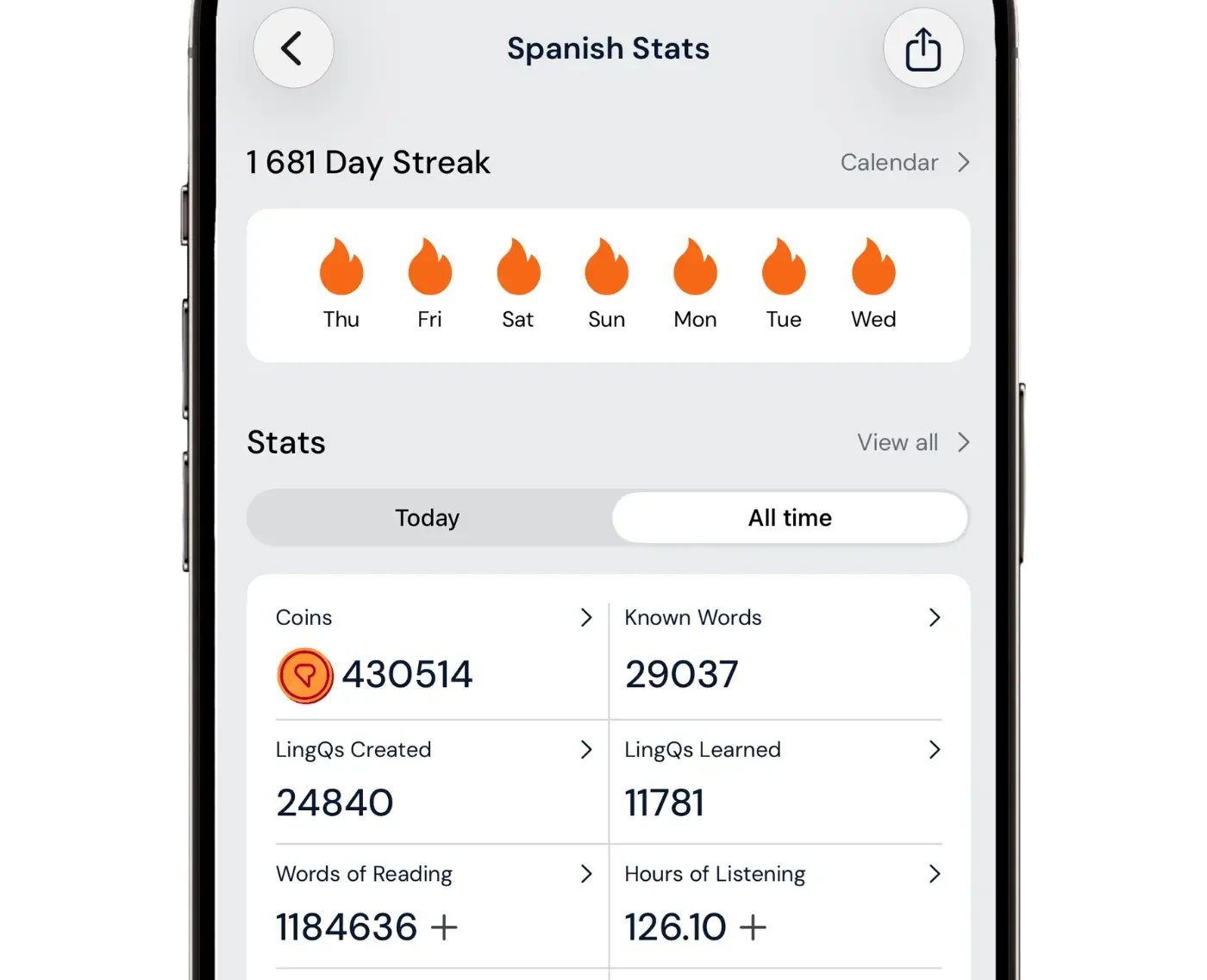
1,681 days of reading Spanish without missing one. The 126 listening hours here are only what I did inside LingQ.
Spanish Uncovered: 9 months, start to finish
I started Spanish Uncovered in October 2025, beginning with the intermediate courses out of curiosity — I had taken other StoryLearning courses before, and I wanted something structured for a change.
Even though I’d get into a particular TV show or a bunch of videos about a certain topic, most of what I'd done up to that point was self-directed and a bit scattered — I picked what I felt like watching or reading. A course has a start and an end, and I wanted to see what that would do.
I've never studied any Spanish grammar, so I was surprised at how useful the grammar sections turned out to be. Not because I tried to memorize the rules — I find that a poor use of my time. What it did was make me more aware. And that awareness increased what I noticed when listening to Spanish. I'd been quite comfortable understanding for a while, but understanding something doesn't mean you notice how the language is actually used — the grammar patterns behind it. And those grammar patterns are what make your speaking sound natural.
The StoryLearning method is built on listening to the same story, over and over. So something I did a lot during those nine months was repetitive listening. I'd done this with their Spanish Conversations courses before, and there's a real benefit to that which rarely gets talked about: once I could understand a story effortlessly, my attention moved on its own to how things were being said. I started picking up things like patterns, expressions, and word order.
That's how the material starts creeping into your own speech. I've caught myself using very Spanish expressions while speaking with natives without thinking about it, and I can trace them straight back to these courses.
By the time I had finished the last course, Mastery, no type of content felt out of reach anymore. Any TV show, YouTube video, and almost any topic felt comprehensible (besides maybe something like rocket science, but I’m not sure that’s even comprehensible to me in my native language). And I was catching more details in everything, which meant I got more out of everything I watched and listened to.
I've written full reviews of the intermediate courses and the advanced courses.
Langua
I used Langua every day for about six months from November. It's seriously good. I had conversations that were both useful for my speaking and actually interesting — one roleplay about traveling around South Korea went on for weeks. And it was a great way to practice outputting the things I was learning from the Uncovered courses (I made prompts in Langua from the speaking activities in the different chapters).
I then stopped using it daily in Spanish for a while. Not because it wasn’t working, but I decided to put more time into Korean around then because my progress wasn't fast enough, and started using Langua for Finnish more, plus working through Speak daily in Spanish and Korean.
That said, I recently started using it again, and it’s an app that has added tons of incredibly valuable features just in the last month or two. Read my full Langua review.
So how good is my Spanish after 1,000 hours?
Now that I’ve hit 1,000 hours, according to Dreaming Spanish I’m now at Level 6, which says “I’m comfortable with daily conversation”.
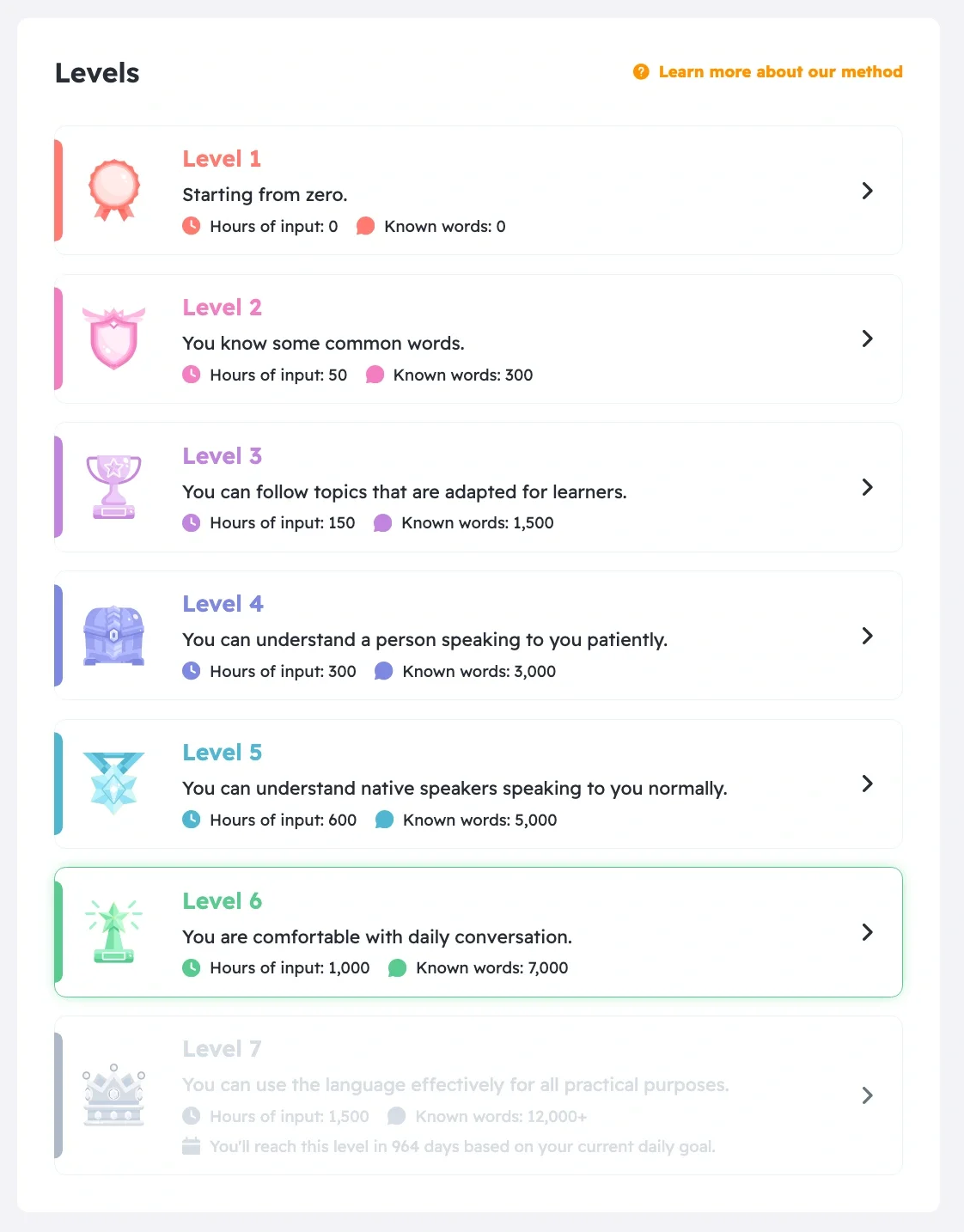
Level 6 unlocks at 1,000 hours. Level 7 needs 1,500 — the app says that’s 964 days away at my current pace.
That level is based on 1,000 hours of pure listening and nothing else. But I've also read a good amount and done a fair bit of speaking, so I'd say I've been comfortable with daily conversation for a while now.
But what does comfortable actually mean? I can sit and chat over coffee for two hours and have a conversation that flows the whole time. And the next week I can feel like I’m struggling in a five-minute conversation with a stranger in a coffee shop. A lot of it comes down to the topic but also other factors like certain settings force you to produce sentences much faster without blinking (a long sit down conversation vs. rapid fire exchanges at a coffeeshop).
What I've learned is that speaking is its own skill. Listening builds the foundation, and the more you listen the faster speaking develops — but you don’t get fluent in your speech purely through listening. You have to actually practice speaking. That's something I'm especially working on now, along with refining my pronunciation.
So am I fluent? Not quite. That's not based on anyone else's judgment, but purely on how it feels for me — I'd want conversation to feel a bit more effortless before I'd use the word. But it feels closer than it ever has.
What I'm doing now
Most of what I’ve described so far, except for Langua, is input. What has changed recently is that my focus has shifted more toward output — to get really comfortable speaking.
I've also gotten less strict about the daily 30 minutes. Korean is taking more of my time, and Spanish has become such a natural part of my life that I wanted to see what happened if I loosened the reins. I just enjoy listening to things in the language, and it’s a really satisfying reward when you reach the point where you can just put on anything and understand the vast majority of it. So listening pretty much happens without me trying to. I just make sure I’m in touch with the language every day. Some days it's a minute, some days it's an hour.

August 2026 — same month, one year later. 1 minute one day, 62 the next. 9.9 hours so far.
We'll see how this goes. If I slack off too much I might bring the 30 minutes back. But after this long, when just about any content is comfortable, the language stops being a thing you practice and starts being part of what you just enjoy in your spare time.
Speak
I began using Speak early this year while testing a bunch of AI speaking apps to find the best ones. I was so impressed that I haven’t stopped using it since.
What Speak is good at is drilling natural speech patterns and cleaning up grammar. Before this, if I'd needed to talk about the dates of a trip, I wouldn't have known to say del tres al siete de mayo — it’s a simple thing, but I just didn’t know it was del + al + de — so drilling that pattern is exactly the kind of thing that makes your speaking more confident. Same with me learning it’s tengo una reservación a nombre de Tapper when checking into a hotel.
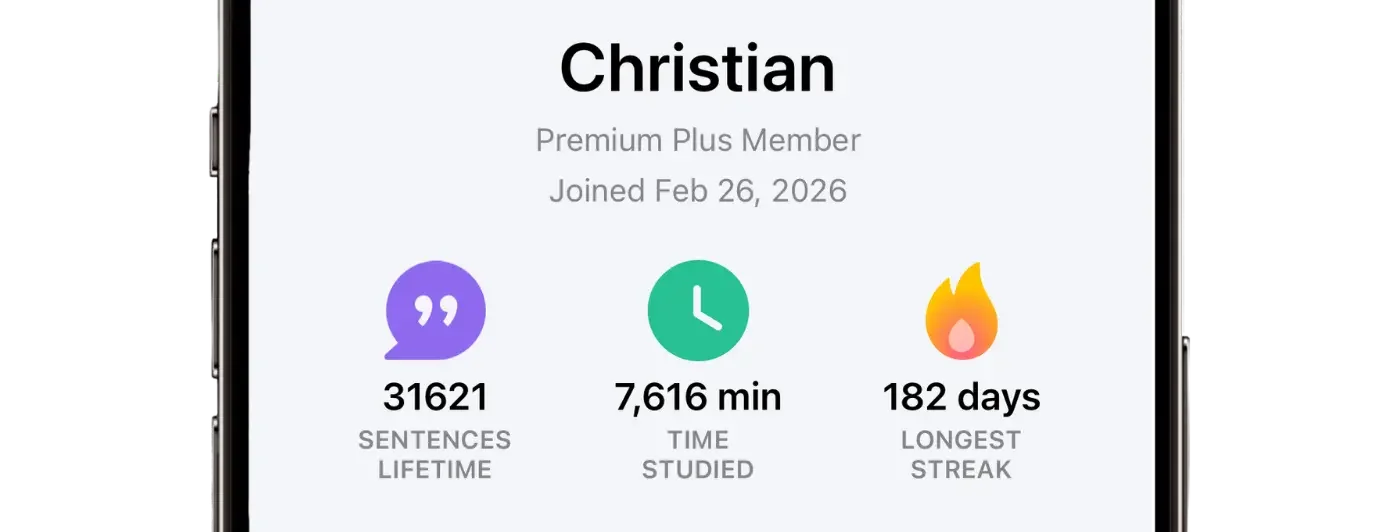
Six months of Speak, and I haven't missed a day since I started. None of these minutes count toward my 1,000 hours.
It's also been helpful for pronunciation, simply because you're mostly repeating sentences in different ways. You're not forming ideas or trying to think of the right words the way you are in a conversation, so your attention is free to focus on how things sound, and how they should feel in your mouth in order to sound natural.
It also helps clean up my mistakes as it generates targeted drills based on mistakes I’ve made in short AI exchanges.
What’s important to know is that Speak isn’t an AI conversations app, it’s a speaking trainer. So for someone looking to practice conversations I’d go with Langua (see my Langua vs Speak comparison if you want to dig deeper). What Speak does is train the foundations and building blocks for good speaking. It's the app I recommend to a beginner, and I wish I'd had it when I started Spanish. But I’ve also found it very helpful as an intermediate learner to clean up grammar and intuitively produce natural sounding sentences.
I joined on February 26th, and I’m on a 182-day streak. I've spent 7,616 minutes in the app across different languages. Roughly 60 to 70% of that is Spanish, so around 75 to 90 hours of hearing and repeating sentences.
Read my full Speak review.
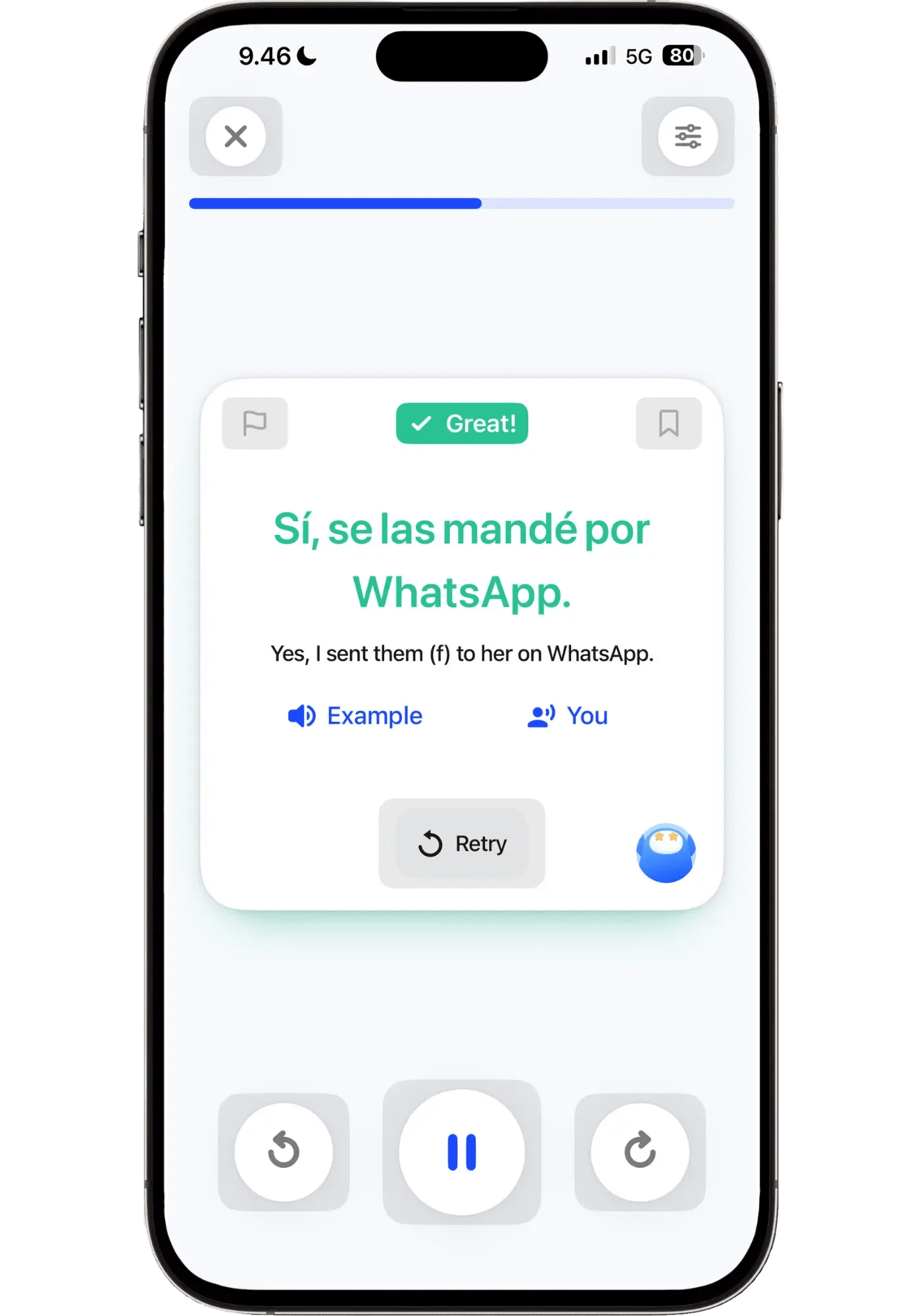
You don't learn a pattern like this by studying it. You learn it by hearing and saying it enough times that it sticks in your muscle memory.
Weekly lessons with a real teacher
A few weeks ago I finally started doing something I'd put off for years: regular lessons. Not to be taught Spanish, but to improve my speaking through conversational practice.
I've done this extensively in Finnish and Cantonese. In Spanish it was only the occasional lesson. My focus was on comprehension, and my speaking practice came mostly from AI. And to be honest, I just kind of got out of the habit of taking lessons, so it feels great to come back to them.
I got great results from Langua, but nothing replaces a native speaker. The feedback is different and more nuanced, it’s more encouraging, and there's the human connection you don't get from an app. So I started booking lessons on LanguaTalk — which is the same platform as Langua, so you can use both on the same account (sign up through either).
I've been taking weekly lessons with Agustina, an excellent teacher from Argentina I'd taken lessons with before. I record every lesson and review it afterward, which is something I’ve always done — it lets you catch your own tendencies, pronunciation habits, the mistakes you keep making without noticing. Also, I’ve often found that even when I feel that I don’t speak well, it actually sounds better on the recording. So that in and of itself is a source of encouragement.
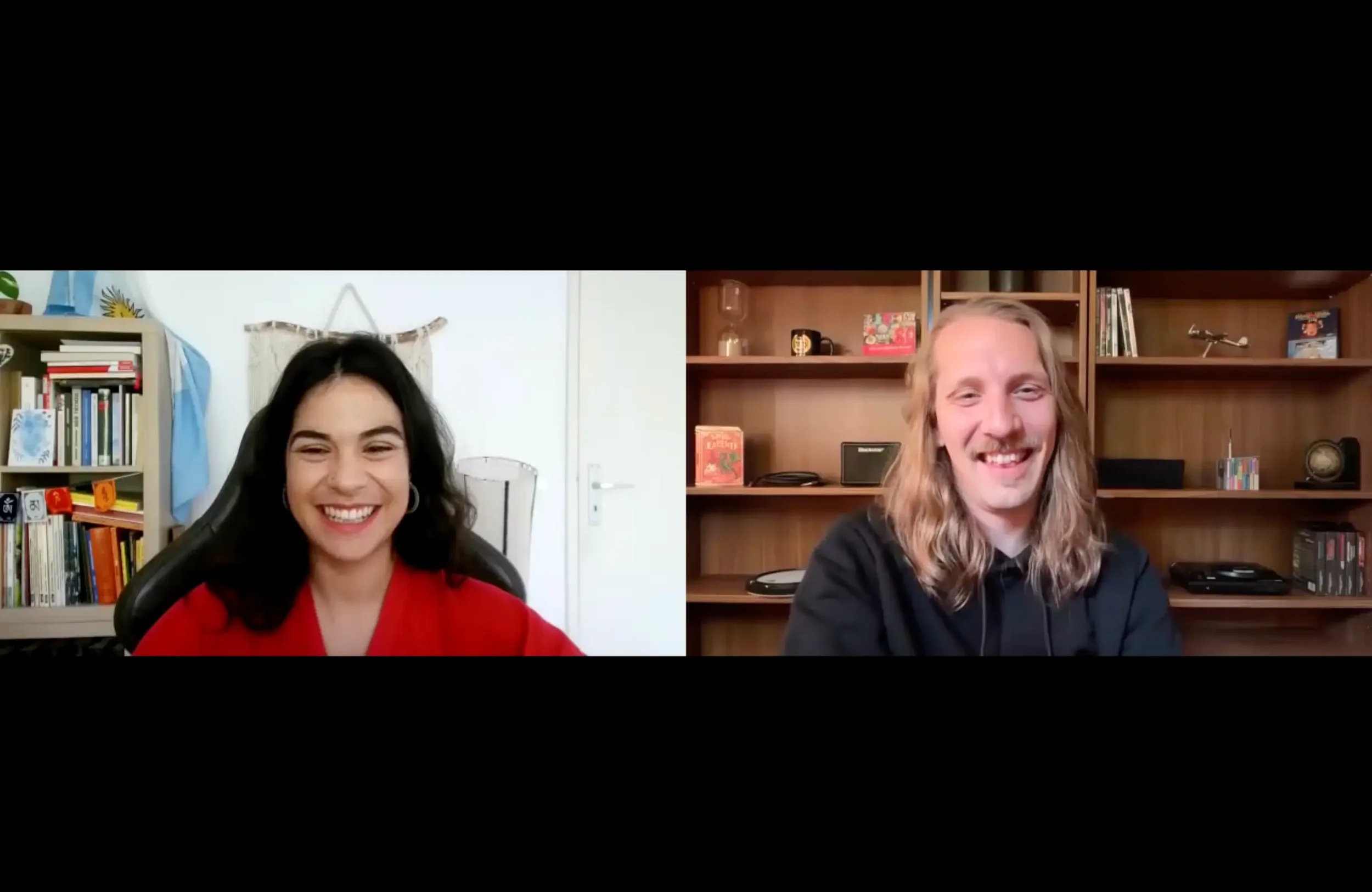
A Wednesday afternoon lesson. Most of them look like this with my excellent teacher. Book a lesson with Agustina — you can even try a free 30-minute lesson.
I've also started using Langua again. My teacher and I have started deciding the topic we’re going to discuss in advance, which lets me familiarize myself with it beforehand. So I practice that topic with Langua. To give you an example: the next one we’ll discuss is why I think effort is overrated. By practicing with Langua first I can get more out of it by having already learned some of the vocabulary, and having tried out sharing my opinions in Spanish. It means the lesson starts further along than it otherwise would.
The real test: a wedding in October
The main reason I’m doing a Spanish push right now is a wedding I’m going to in about six weeks. One of the friends getting married is Mexican, and our friendship is almost entirely in Spanish, so a good part of the guest list will be Spanish-speaking.
The rest of the guests probably won't speak a word of it. Which puts me in an unusual position — one of few people in the room who can have conversations with both sides. The better my Spanish is by then, the more of that I’ll be able to do.
Having a date on the calendar helps quite a bit. It turns "improve my speaking" into something with a deadline, and that's a completely different kind of motivation. And you typically do pushes like these for a shorter season, which turns this into a fun challenge for me.
It's obviously just one event, and I don't know how much Spanish I'll really end up using. But this is the whole reason I learn languages. I've loved meeting people since I was a kid, and languages open doors to people you otherwise couldn't talk to.
And regardless, it will only enhance my friendship with my Mexican friend the better my Spanish gets — and that’s actually my biggest motivation right now.
All the Spanish gear I've been using
Here's everything that got me to 1,000 hours, and what I'm using now.
Dreaming Spanish — where I track my listening hours, and where about 300 of them came from.
LingQ — daily reading, every day for over 1,600 days.
Kobo — where I buy Spanish e-books to import into LingQ.
Spanish Uncovered — the story-based courses (intermediate & advanced) I worked through over nine months. Finished now, but a big part of how I got here.
Speak — drilling natural speech patterns. Six months in. Still working through the Spanish course.
Langua — AI conversation practice. Daily for six months, and back in rotation now between lessons. Use code LINGTUITIVE20 to get 20% off the annual Unlimited plan.
LanguaTalk — where I book my weekly lessons with a real teacher.
Lingopie — Subtitled shows with clickable subtitles. Not currently in my daily rotation because my sit-down attention is going to Korean and Cantonese — but if Spanish were my only language, I'd use it a lot more than I currently do.
NordVPN — occasionally, to get at content from a specific region.
