Published
This post contains affiliate links. If you buy through one of them, I may earn a commission at no extra cost to you. See Full Affiliate Disclaimer.
Short on time? Many LanguaTalk tutors offer a free 30-minute trial for your first lesson. Browse the tutors here (you can switch to any language once you’re there).
Table of Contents
- My 9 Spanish lessons on LanguaTalk (with clips)
- How to book a lesson on LanguaTalk
- LanguaTalk prices and how paying works
- Pros and cons
- Who LanguaTalk is for
- LanguaTalk vs italki vs Preply
- How to get the most out of your lessons
- Langua: the AI app on your LanguaTalk account
- Verdict: is LanguaTalk worth it?
- FAQ
Four and a half years into learning Spanish, with more than 1,000 hours of listening behind me and a lot of help from AI apps, I was still stumbling over words more than I’d like to admit.
It was early August, and I had two months until a friend’s half-Mexican wedding. I wanted to actually talk with the Spanish-speaking guests in their language. So I gave myself a Spanish intensive: weekly lessons with the same tutor, focused on speaking.
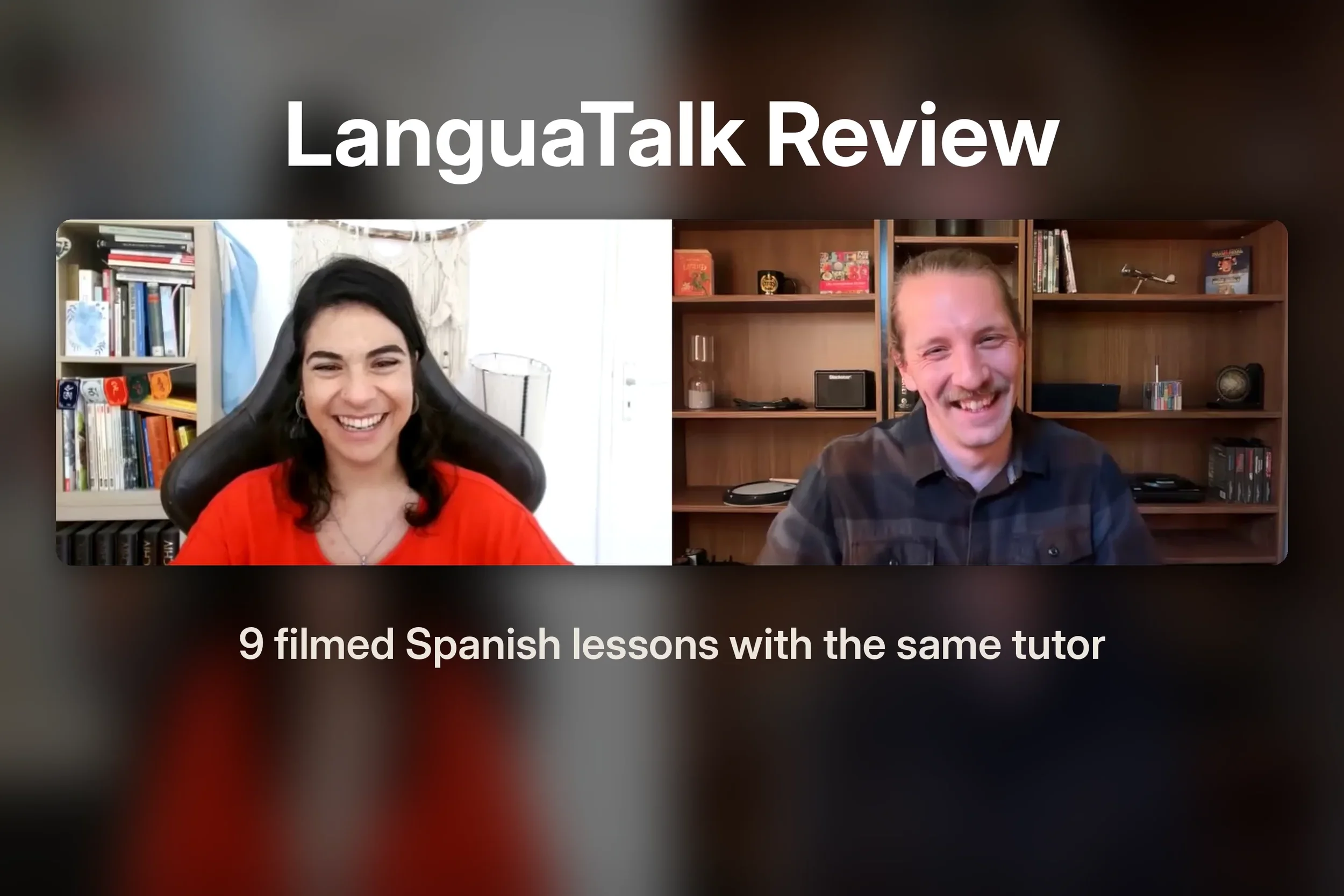
I filmed every single one of my lessons, and you’ll see clips from them throughout this post. You’ll see what an online lesson actually looks like, what we did to push my Spanish forward, and how to get the most out of your own lessons. You’ll also find out how it went at the wedding in the end.
All my lessons were on LanguaTalk, which I think is one of the easiest, most professional and flexible places to take online lessons right now. I’ll show you how it works, what I liked and didn’t, and how to book your first lesson, which can be free.
If you’ve been thinking about taking lessons but aren’t sure you’re ready, or where to start, this post will give you everything you need.
The short version
LanguaTalk, after 14 lessons since 2024
Worth it if your goal is to actually speak. Booking takes two minutes, you can find a tutor you click with and stick with them, and trying it costs you nothing.
What I liked
- Zero-risk free first lesson
- Lessons are booked instantly, no waiting for the tutor to accept
- No credits to buy first
- Carefully vetted, quality tutors
- Excellent customer service
- Clean, clutter-free website
What I didn’t
- You can’t message a tutor before booking
- No dedicated app
- Fewer languages than italki
My 9 Spanish lessons on LanguaTalk
Between August 7 and October 7, I took nine Spanish lessons on LanguaTalk with the same tutor, Agustina (plus one each with two other tutors, more on that below). That’s roughly one lesson a week, 55 minutes each, and I filmed every one.
This section follows the run from start to finish: why I wanted lessons in the first place, what a normal hour looks like, where I stumbled, the change I didn’t see coming, the topics that pushed me, and how it went at the wedding.
Along the way, you’ll see several short clips from the real lessons, about a minute each, stumbles included, so you know what it’s like before you book one yourself.
Just want to know how LanguaTalk works? Skip to how to book or prices.
Why take lessons when AI apps are this good?
For most of my language learning, lessons were my main speaking practice. I’d taken well over 100 of them before AI speaking apps even existed. Then AI came along and made it much easier, and cheaper, to practice speaking every day. I use AI apps daily, and they’ve helped my speaking a lot and been a game-changer for my language learning.
But they don’t replace a real person. One of the biggest differences for me is accountability. Knowing I had a lesson every week made me put in extra work: preparing the topic, doing my homework, practicing beforehand. With an app, those are much easier to skip.
Then there’s the feedback you can’t get from a screen. A nod from the teacher when I hesitate can tell me I’m on the right track before I’ve finished the sentence, which makes the feedback more instant. A tutor notices how you change over weeks, not just within one conversation. An app can tell you you’re doing great, but when a real person who’s heard you every week says it, it feels real, and it stays with you.
So it’s not either-or. AI practice between lessons, and a real person to use it and deepen it with, is the best setup I’ve found. You’ll see exactly what that looks like in the board game clip.
Why I stuck with one tutor
You can switch tutors as often as you like on LanguaTalk, and trying a few is a good idea. But once I find someone I click with, I stay.
A tutor who knows you can push you further. And that knowing only comes from consistent lessons. Over time, they learn what you do well, where you struggle, and what you’re working toward. And you get comfortable enough to actually talk freely. What’s also nice about it is seeing the same face every week, picking up where you left off, and a lesson to look forward to.
When I started Cantonese, I stuck with my first tutor every week for a whole year. A few months in, she told me, “You’ve improved faster than I expected.” I’d started out pretty terrible, so that meant a lot. When you’re learning on your own, it’s hard to tell whether you’re improving. A tutor who sees you every week can tell you, or help you get unstuck when you’re not.
Having been a language teacher and coach myself, I’ve seen it from the other side: the students who kept showing up week after week were the ones who really improved.
For this run, I went back to Agustina, a teacher from Argentina I first booked in January 2024 and have taken lessons with on and off since. Her lessons feel relaxed but productive, and she knows when to correct me and when to just let me talk. I also took a lesson each with two other tutors during the run. Trying someone new now and then is a good thing, and there are lots of great tutors on LanguaTalk. But with Agustina, we’ve built a rapport and a way of working together that just clicks, and when something works that well, I don’t see a reason to switch.
If you like her style in the clips below, Agustina offers a free trial lesson. You can book one on her profile.
What a lesson actually looks like
Every tutor is different, but after 130-plus lessons with about a dozen tutors, most of my lessons follow the same pattern: small talk first, then a topic, with corrections woven into the conversation. It’s built around you: your level, your life, and what you want to work on.
(As a beginner, a lesson looks different. More on that in who LanguaTalk is for.)
Here’s how the first lesson of the run started. Agustina and I hadn’t had a lesson in about half a year:
Notice what I do when I can’t find a word: instead of switching to English, I describe it in Spanish (“a small building for storing things”), and Agustina gives me the word. I throw in an English word now and then too, but I try to stay in Spanish as much as I can. As a beginner, it’s completely fine to rely a lot more on English and slowly weave in more of your target language.
As we talk, Agustina writes new words and expressions in a shared Google Doc, which many tutors do. Here’s what one relaxed hour gave me:
From one lesson
11 expressions I picked up in a single hour
Lesson 8, mostly while telling Agustina about three weeks in Gambia and explaining a board game. None of these were planned. They came up because I needed them.
- Se hicieron amigasThey became friends
- A veces no lo enganchaSometimes it doesn’t pick it up
- Una escala en camino a ÁfricaA layover on the way to Africa
- Una choza muy precaria, muy humildeA very basic, humble hut
- No te tomaban el no como respuestaThey wouldn’t take no for an answer
- Tapones de oídoEarplugs
- Se me revolvió el estómagoMy stomach got upset
- La zona horariaThe time zone
- La carne se pone feaThe meat goes bad
- Es algo todo medievalIt’s all medieval
- Me hace acordar a…It reminds me of…
It's not a performance
If you’re nervous about booking a lesson, you probably think of it as some kind of test: you have to speak well, or you’ll embarrass yourself. That’s not at all what it is. Making mistakes in your lessons is completely normal, whether you can already hold a conversation or can’t say a word yet. It’s an important part of learning.
Even after four and a half years of Spanish, I stumbled all the time. After my fifth lesson, I wrote in my notes that I stopped too often to search for words, and that my speech felt forced and, to be honest, “a bit unpleasant to listen to” (partly because of my pronunciation, more on that soon).
In another lesson, I realized I’d spent ten minutes answering a question she hadn’t actually asked, just because I’d misunderstood it. And at times my mind just froze and I couldn’t get out the words I needed.
None of that mattered. Agustina didn’t stop me every time I made a mistake. Often she just repeated what I’d said the right way and let the conversation continue (also known as a “recast”). Other times, she stopped to highlight and explain something, to help me become more aware. A good tutor knows that balance: correct everything and it gets frustrating fast, correct too little and you keep making the same mistakes without noticing.
Here’s what it looks like when I don’t get something at first. The grammar is fairly advanced, since that’s where my Spanish is right now. At your level, it would be something else, but it works the same way:
That’s what lessons are for: not showing what you already know, but figuring out what you don’t. You don’t need to be ready before you take one. Taking them is how you get ready.
Pronunciation: the change I didn't expect
My Spanish pronunciation wasn’t bad, but it wasn’t as effortless as I wanted it to be. I realized a lot of it came down to mouth shape, and a funny habit I’ve noticed in many Spanish learners, me included:
So I started paying attention to my pronunciation. No special exercises, just being aware of my mouth shape and how the sounds feel. A good way to practice was with Speak, where I repeat natural sentences out loud, one at a time. With only a single sentence at a time, there’s room to focus on how it sounds. In a real conversation, you’re busy working out what to say, so there’s not as much room left for pronunciation (unless conversations already flow so well that you have bandwidth left for it). That’s why I like short, targeted practice for improving pronunciation: one sound, one aspect at a time.
At the same time, I’d been working on my Finnish pronunciation in Langua. A custom prompt corrects my sentences, and then I repeat them as flashcards, copying the voice and trying to make the same sounds. Sentence by sentence. Some of it started carrying over to Spanish, especially those strong rolling R sounds.
The result: I could speak faster, with less effort. I didn’t notice how much until Agustina pointed it out:
The difference isn’t huge, but I do feel it every time I speak. I still trip over the R sometimes, and some sound combinations don’t feel natural yet. But when your mouth knows where to go, you stop slowing down for every word, and that’s what Agustina heard. And the easier it feels to speak a language, the more fun it is.
Topics I'd never pick myself
With AI apps, I can talk about anything, from StarCraft to smart light bulbs. But I’m always the one choosing. The AI follows wherever I steer. Sure, it can suggest topics, but a tutor brings topics to you, and because they know you, they can pick ones that push you a little further than you’d go on your own.
From lesson 3 on, Agustina sent me a list of topics to choose from, each with a short video to watch before the lesson. To prepare, I’d import the video’s transcript or audio into Langua and practice talking about the topic with the AI tutor. That way, I didn’t walk into the lesson starting from zero.
We talked about discipline, success, sacrifice and talent (which turned into homework: me arguing why I think effort is overrated, particularly in language learning), about why music moves us, and about how the language you speak shapes how you think. Sometimes we also talked about other topics, like when we ended up talking about cooking and I realized how much food vocabulary I still don’t have.
Abstract topics are challenging, but they’re some of the best. They force you to give opinions, explain and argue, not just describe, and that’s exactly where you notice the gaps in your Spanish.
Each topic went into the same shared Google Doc where Agustina writes down new words during our lessons, so everything from the run is in one place. Here’s what one of them looked like:
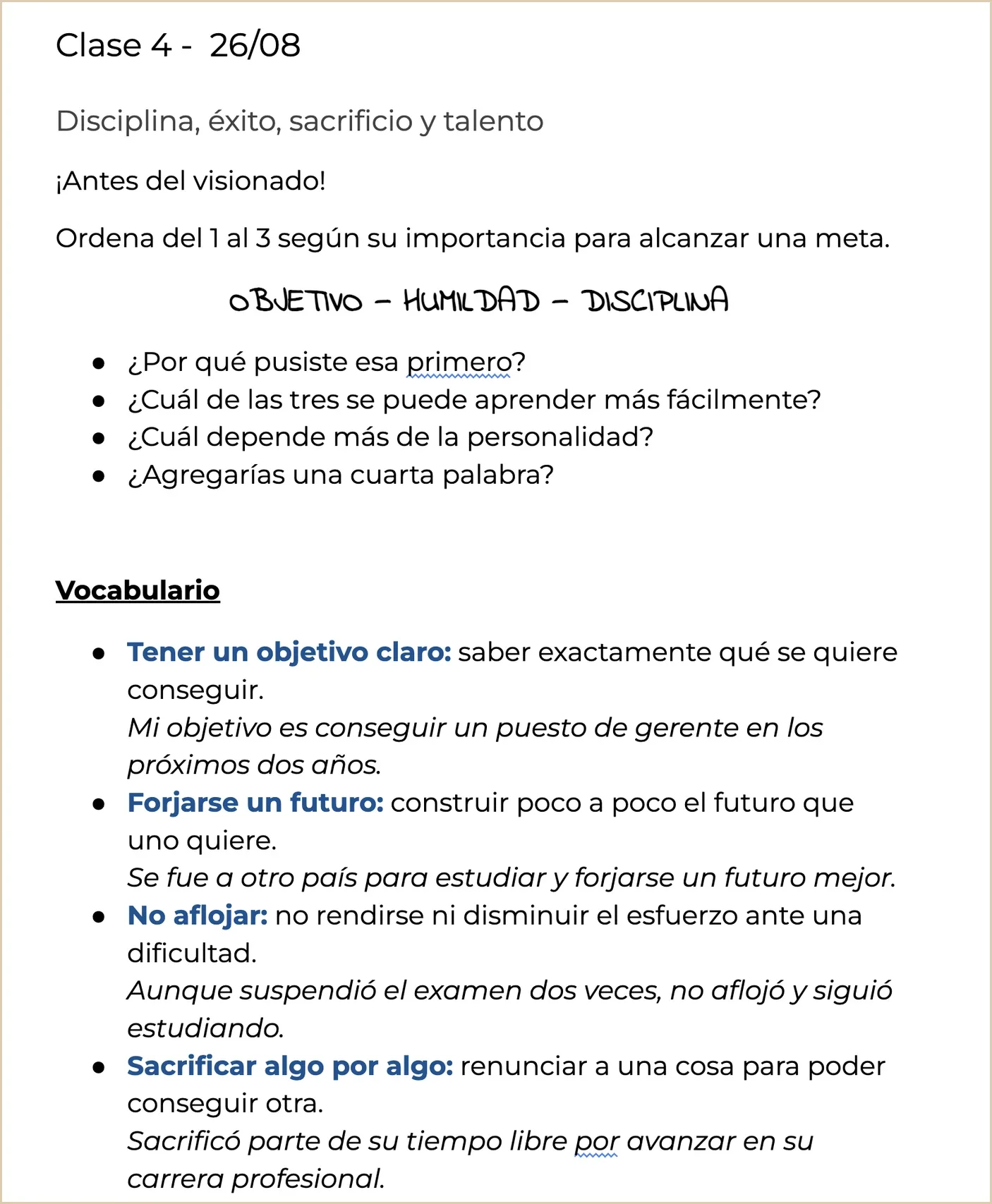
Lesson 4, Aug 26: a warm-up task, discussion questions and vocabulary, all prepared before the lesson. The video was Gabriel Batistuta’s TEDx talk on discipline.
Explaining a board game in Spanish
In lesson 7, we ended up talking about board games, something I’m a big fan of. At the end, Agustina gave me homework: pick a board game and explain the rules to her. It sounded both challenging and fun, and I chose Carcassonne, a game I’ve played a lot with my family.
It turned out to be one of the best speaking exercises I’ve ever done. Explaining rules is full of “when you do this, that happens,” which is exactly where the subjunctive comes in (just like in the coffee clip). And I ended up needing words I’d never used before, starting with what the pieces are even called.
It also reminded me how effective it is to go deep on one specific thing, instead of talking about everything and anything. When you go deep in one area, it spreads into others, so it strengthens your Spanish overall.
Here’s part of my explanation. Watch for the moment I reach for a word I’d practiced a day or so before:
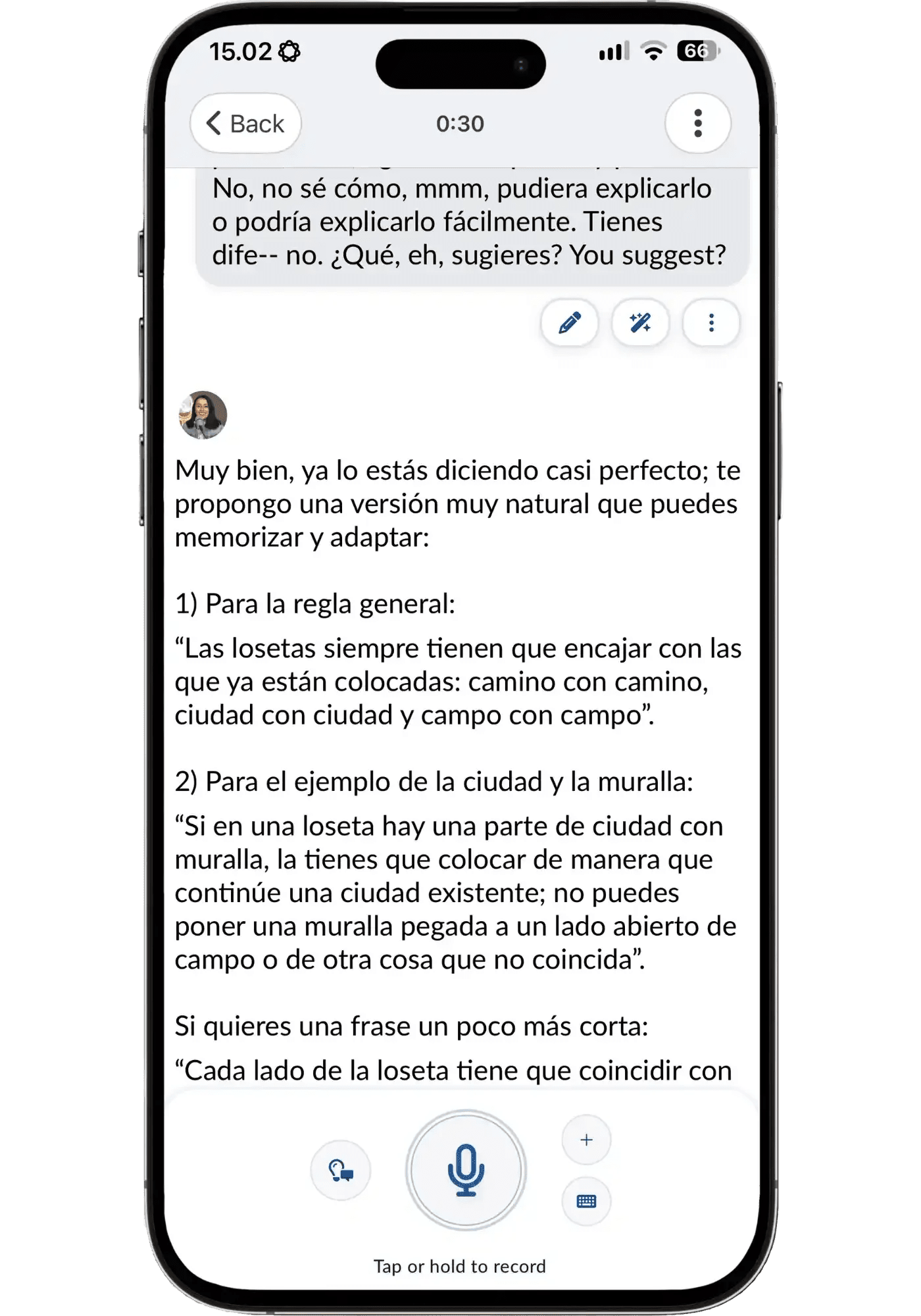
That “gracias, Langua” wasn’t planned. A day or two before the lesson, I spent about an hour in Langua practicing how to explain the rules: what the pieces are called, how the tiles connect, how you score points, and so on. Whenever I got stuck, the AI tutor gave me a natural way to say it, like las losetas siempre tienen que encajar (the tiles always have to fit), and I saved the useful phrases as flashcards in Langua. Encajar was one of them that came up a lot.
I still had to dig for it in the lesson, and twenty minutes later I’d forgotten it again, so Agustina had to remind me. That’s how new words work: you need to run into them a few times, sometimes many, before they stick. But that’s the combination I keep coming back to: AI to build and prepare, and a real person to actually use it with and get even more personalized and pointed feedback.
If you want to try the same kind of prep, Langua is free to start, and it’s the same account as LanguaTalk, so you’ll have both.
The result: the wedding
Our last lesson was the same week as the wedding. At the end of it, Agustina told me, “Estás avanzando muchísimo”: you’re making so much progress.
A few days later, I arrived at a dinner before the wedding, a little after everyone else. There were people from all over the world around the table, and a few of them were from Mexico. So after the introductions, I started talking with them in Spanish.
They were surprised, and the rest of the table even more so: “Wait, how come you speak Spanish!?” Then I overheard my friend tell one of his friends, very firmly: “Sí, hablamos en español” (yes, we speak Spanish). It wasn’t a party trick. Our friendship is in Spanish.
That set the tone for the rest of the wedding. The Mexican guests all spoke great English, but whenever it was just us, we ended up in Spanish anyway, even for practical things like sorting out details before the wedding. It just became the language we used with each other. And at the wedding itself, one of the Finnish guests heard me chatting in Spanish at the buffet and couldn’t believe it.
The lessons weren’t the only thing I did for my Spanish. One hour a week isn’t enough on its own. But they were what pushed me the most, and the rest of my practice during the week centered around them.
How to book a lesson on LanguaTalk
Booking a lesson takes about two minutes, and your first trial lesson can be free. Here’s the whole process, start to finish:
Booking a free trial lesson on LanguaTalk, from choosing a language to confirming by email.
Want to jump straight in? Browse the tutors on LanguaTalk. Many of them offer a free 30-minute trial for your first lesson (others, at a discount).
Or follow along step by step:
Step 1: Choose your language
This link takes you to the Spanish tutors. If you’re learning a different language, click “I’m learning” and pick your language from the list.
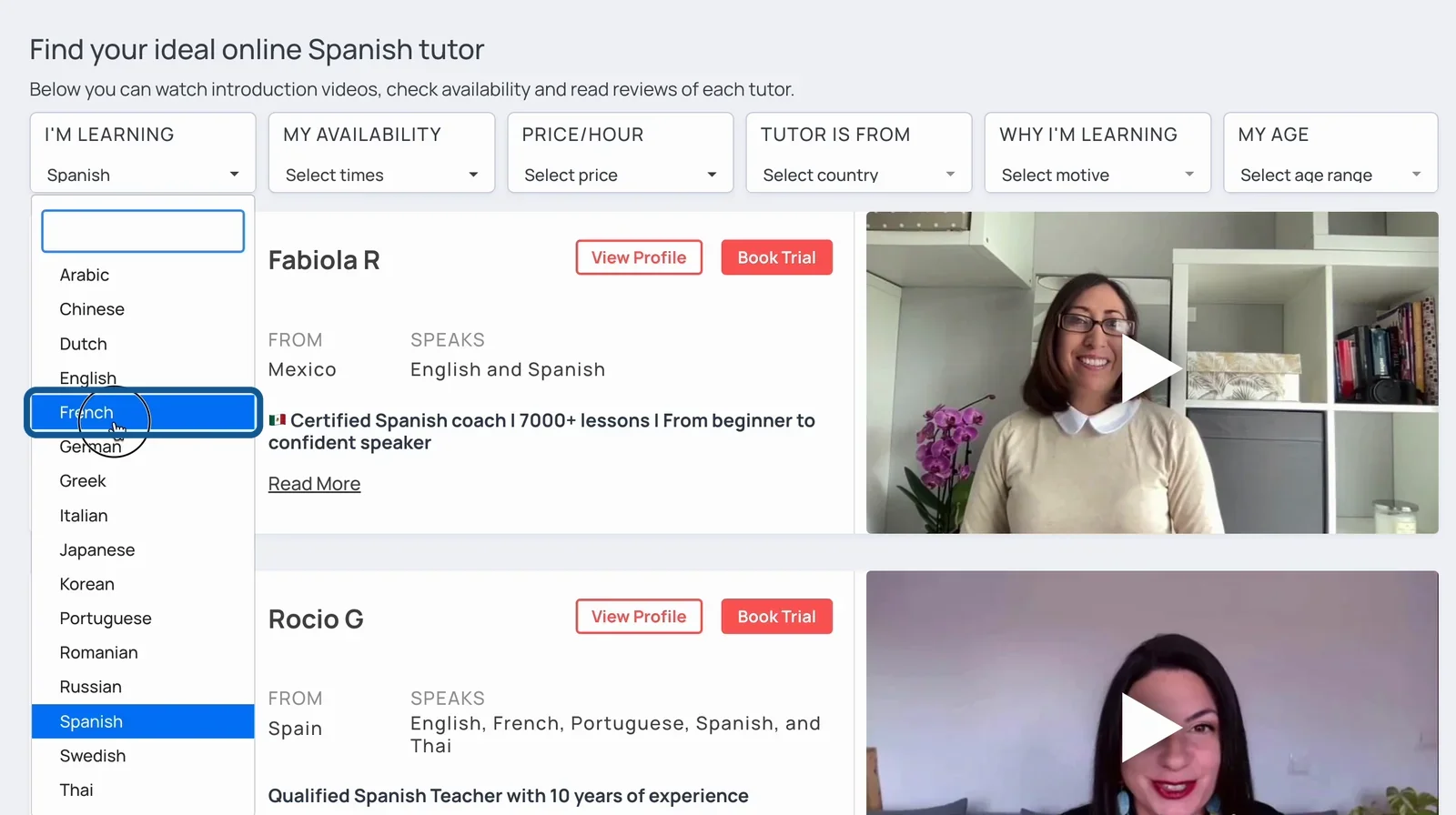
Switching from Spanish to French. Every language works the same way.
Step 2: Pick a tutor
Each tutor has a short intro video, their rating, the number of lessons they’ve taught and their price. Watch a few videos and pick someone you’d feel comfortable talking to — that’s what’s most important.
Then click “View Profile.”
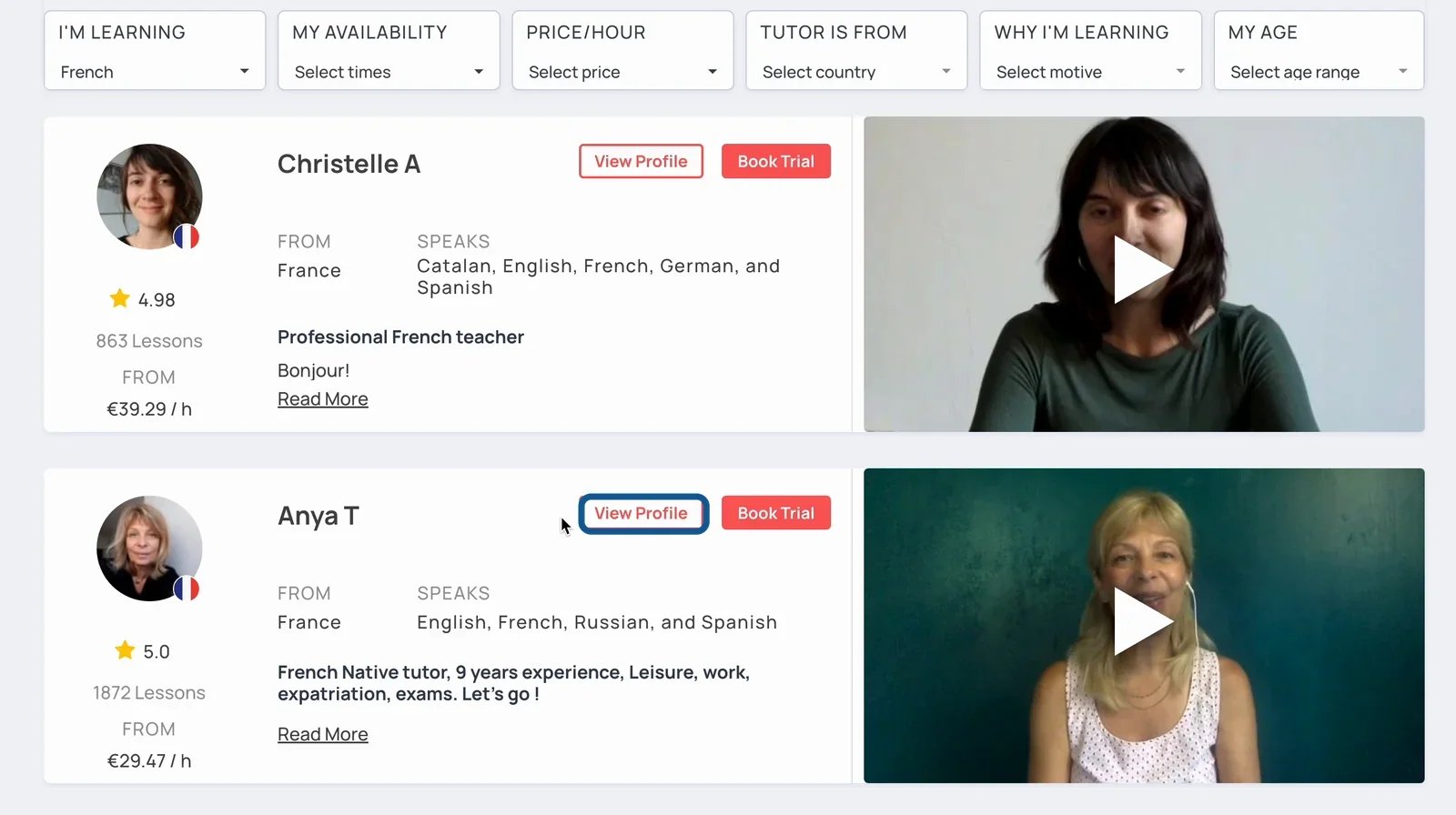
Every tutor has an intro video, so you can see what they’re like before you book.
Step 3: Book a free trial
On the profile you’ll see the tutor’s prices and reviews. Your very first trial lesson on LanguaTalk can be completely free (no credit card needed). Many tutors offer a free 30-minute trial, and it says “FREE” next to “Trial lesson.” Tutors who don’t offer a free trial offer a discounted one instead, at 30% of their normal lesson price.
After your first lesson, you can still book discounted trials with other tutors, so trying a few people to find the right one doesn’t cost much. Click “Book trial.”
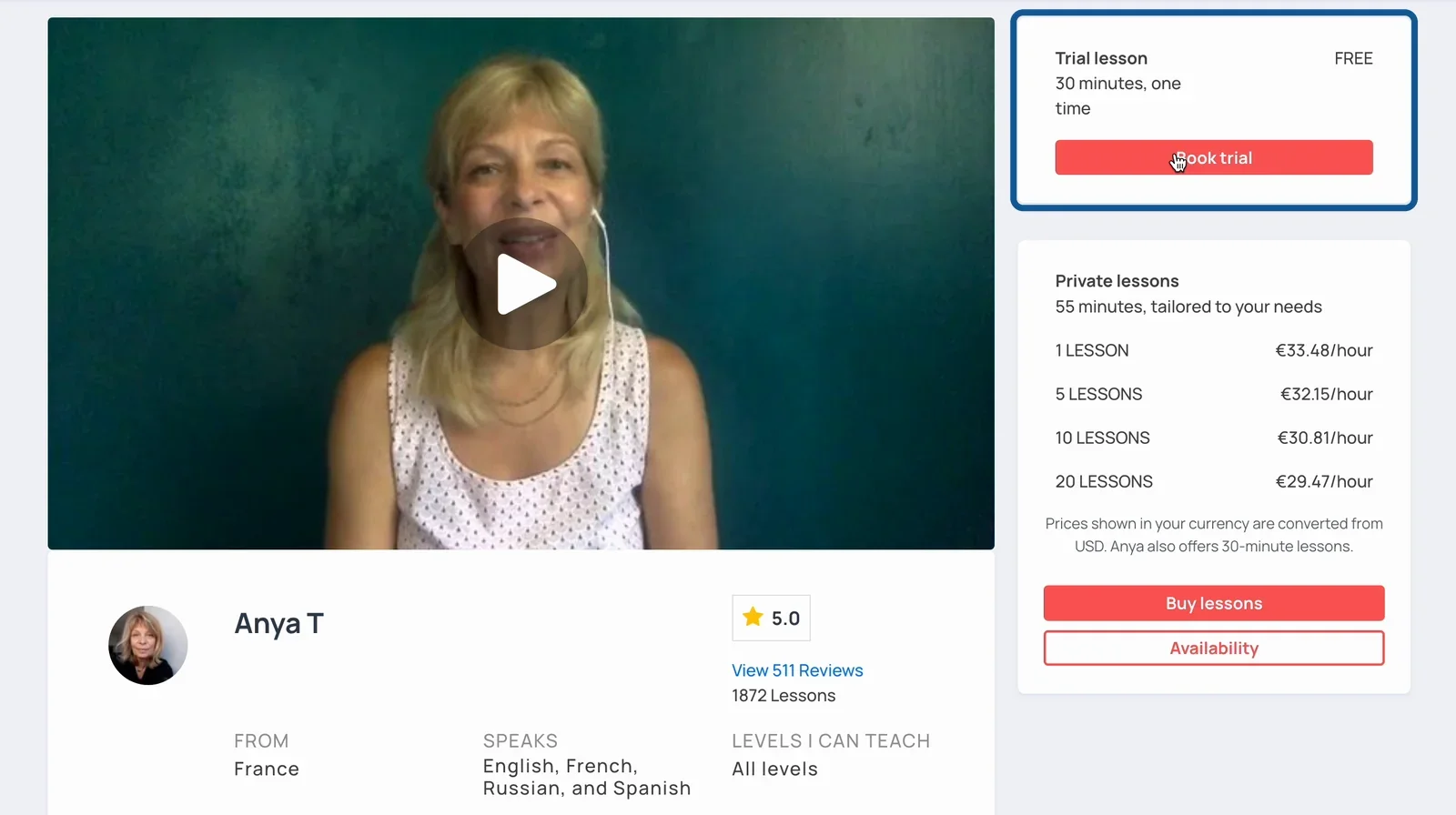
Some tutors offer free trials (others, at a discount). Look for “FREE” next to the trial lesson. After that, trials are discounted.
Step 4: Pick a time
Green slots are open. Times are shown in your own time zone, so there’s nothing to convert. Click the time that suits you.
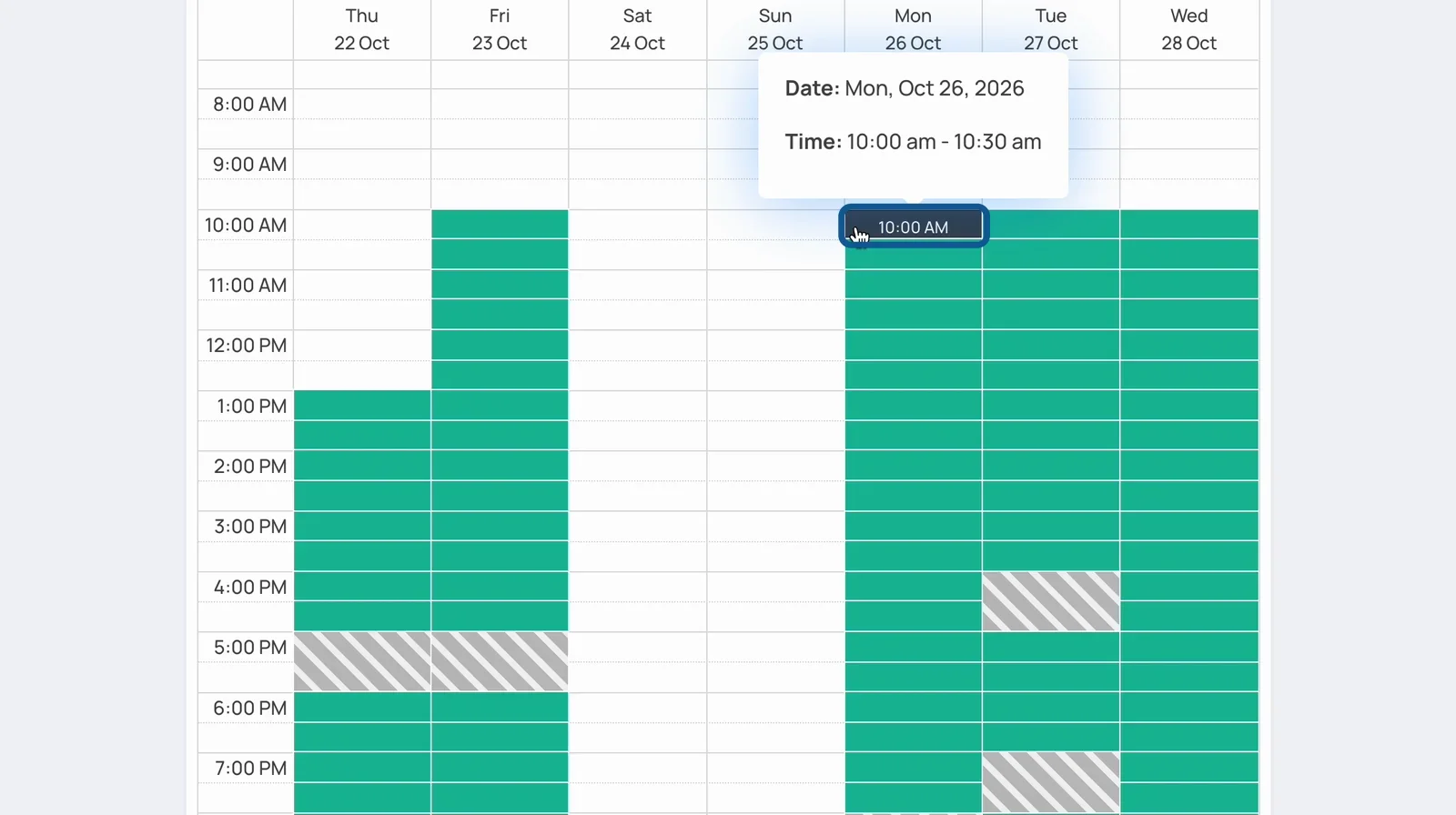
Times are shown in your local time zone.
Step 5: Tell your tutor about yourself
Fill in your age, where you live, your level, and a few lines about why you’re learning (at least 60 characters). This helps your tutor plan the first lesson. It doesn’t have to be fancy. For this walkthrough, I wrote that I studied French in school, forgot most of it, and want to learn to have simple conversations.
Then click “Continue.”
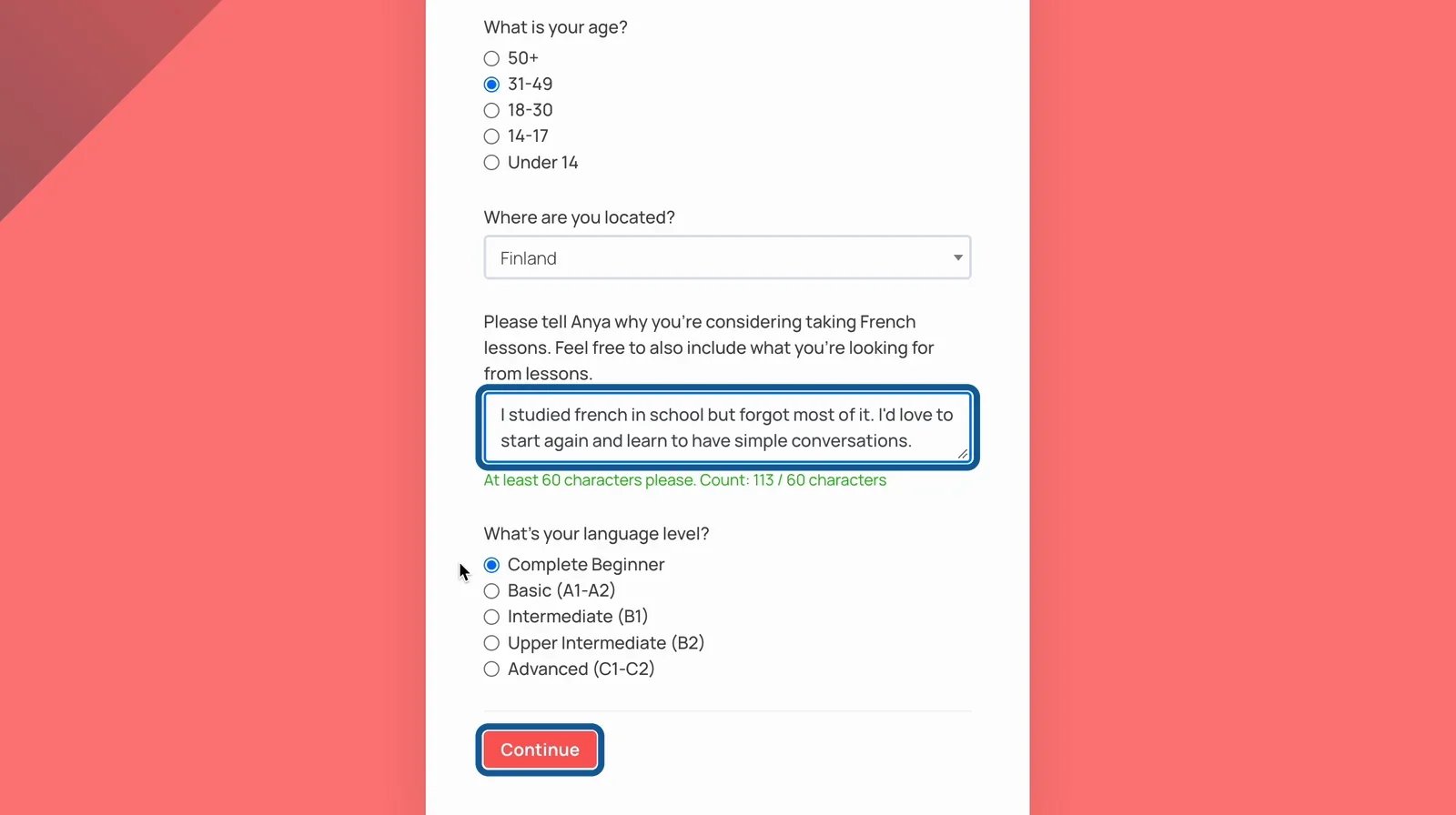
A few lines about your goals is enough.
Step 6: Confirm by email
This is the one step people miss. After you book a trial, LanguaTalk sends you an email titled “Confirm your booking with [tutor’s name].” Click the link in it within 10 minutes, or your reservation expires and you have to book the time again. If you can’t find the email, check your spam or promotions folder.
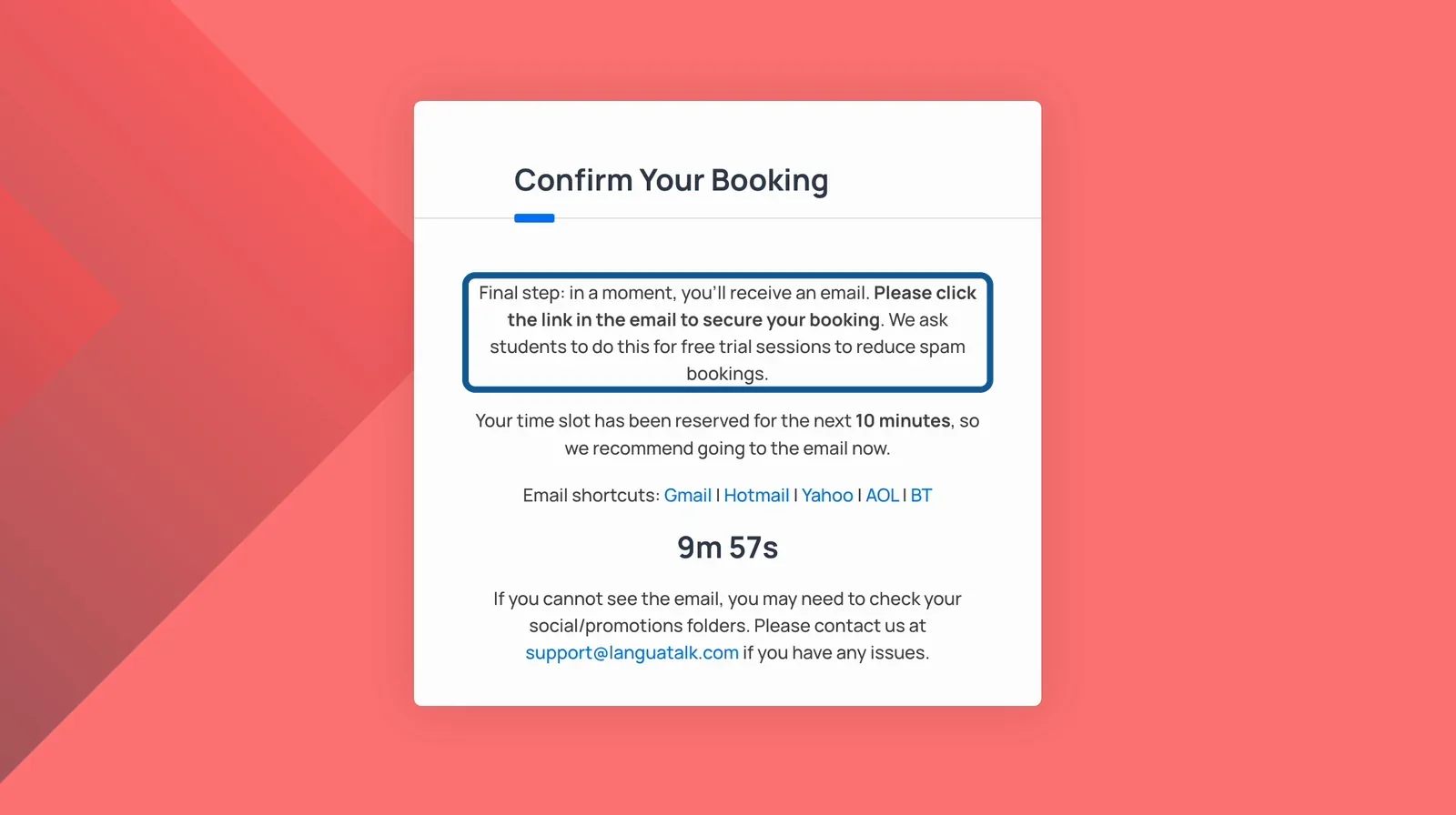
Click the link in the email within 10 minutes, or the slot is released.
You only have to confirm trial lessons. LanguaTalk asks for it because some students book a trial and never show up. Regular lessons are booked as soon as you book them. You still get a confirmation email, but there’s nothing to click or confirm.
That’s it. One thing I’d like LanguaTalk to add: you can’t message a tutor before you book. Once you’ve booked, though, you can reply to the confirmation email and your message goes to the tutor. That’s handy if you want to tell them what you’d like to work on.
LanguaTalk prices and how paying works
LanguaTalk doesn’t have one set price. Each tutor sets their own, and you can see it on their profile before you book.
For Spanish, prices start at around $10 an hour, and most tutors charge under $35. If you have a budget in mind, use the Price/Hour filter on the tutor page so you only see tutors in your range.
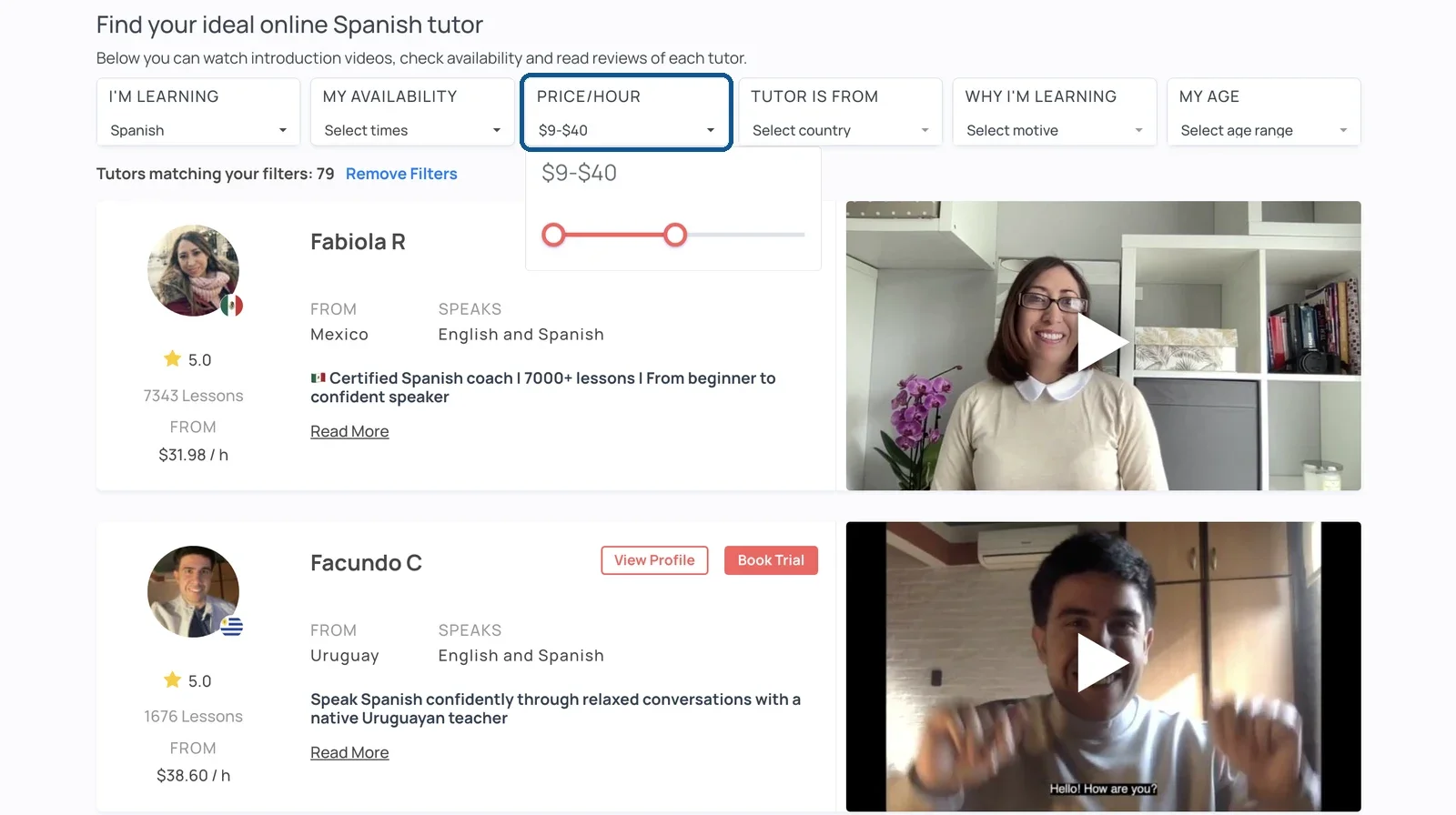
Set your budget with the Price/Hour filter.
How paying works:
One lesson or a package. Pay for one lesson at a time, or buy a package of 5, 10 or 20 lessons with the same tutor to bring the price per lesson down.
By card, in US dollars. Prices already include the payment processing fee.
No rush to use a package. You have nine months to book your lessons, or eleven if you ask for an extension.
Switching tutors? You can move your remaining balance to a new tutor. You can also get a refund on your remaining balance within 30 days of buying.
Cancel or reschedule up to 24 hours ahead. Cancel for a full refund, or move the lesson to another open time yourself. On italki, the tutor has to approve a new time first.
Like most tutors, Agustina offers both 55-minute and 30-minute lessons, with a lower price per lesson if you buy a package. You can see her current prices on her profile.
Pros and cons
What I liked
- Zero-risk first lesson. Many tutors offer a free 30-minute trial, the rest charge 30% of their normal price. No commitment, no card needed.
- Instant booking. A booked lesson is booked, and you can reschedule on your own too. No waiting for the tutor to accept (this is seriously so nice).
- No credits to buy first. Pay per lesson with a card, or buy a package of 5, 10 or 20 to bring the price down.
- Affordable tutors too. Prices vary by tutor, and some Spanish tutors charge as little as $10 an hour.
- Carefully selected tutors. LanguaTalk says it accepts only the top 10% of tutor applications.
- Fair cancellation. Cancel up to 24 hours before a lesson and get your money back.
- Helpful customer service. In my experience, they reply fast and sort out any issue, and others I know have said the same.
- Langua on the same account. LanguaTalk’s AI app is built in, with flashcards, AI stories and interactive transcripts for practice between lessons. No extra sign-up. The AI chat features need a paid plan.
- Clean, clutter-free website. Intro videos, ratings and reviews on every profile, and finding, booking and managing lessons is simple, with nothing getting in the way.
What could be better
- No messaging before booking. Once you’ve booked, you can reply to any LanguaTalk email to reach your tutor.
- No dedicated app. Reminder emails, Google Calendar sync and emailing your tutor cover the basics, but italki has an app, which is nice.
- Fewer languages. 16 languages, including all the big ones. italki has far more.
Who LanguaTalk is for
LanguaTalk is a good fit if:
You want to actually speak, with a real person.
You want flexibility in when and how often you take lessons.
You’re learning one of the big languages.
You want booking and paying to be simple: no credits, and no waiting for a tutor to accept a booking or a change of time.
Are you a beginner? You don’t need to speak Spanish (or any language) to book. Many tutors say in their profiles that they work with complete beginners, and they’ll use English when you need it. I took lessons in Cantonese after only one month of learning, and relied on English for a long time, gradually using more and more Cantonese until the lessons hardly used any English at all. So there’s no “too early” to start. Look for “beginners” in a tutor’s description and use your trial lesson to see if it feels right.
It’s probably not the best fit if:
You’re learning a less common language. LanguaTalk has 16 languages, so check that yours is one of them. Even then, some have only a few tutors. For Cantonese and Finnish, I went with italki.
You’d rather learn on your own schedule, without booking anything. Lessons need a set time with another person. If you want something you can open whenever you have ten minutes, an app or course is a better start. See my 5 best beginner Spanish apps and courses.
You want to practice every day on a small budget. A lesson every day adds up fast. For daily speaking practice, AI apps are much cheaper (I compare them in the best AI speaking apps). They work best alongside lessons, which is what I do, not instead of them. You still need to talk to real people at some point.
LanguaTalk vs italki vs Preply
italki and Preply are the other two big places to find a tutor online. I’ve used italki (for my Cantonese and Finnish lessons), but not Preply, so that column is based on how it works, not my personal experience.
| LanguaTalk | italki | Preply | |
|---|---|---|---|
| Languages | 16 | 150+ | 90 |
| Tutors | The most selective: accepts only the top 10% of applicants, says LanguaTalk | Tutors apply and can be turned down. Professional teachers and cheaper community tutors | 150,000+ independent tutors |
| First lesson | Free trial with many tutors, otherwise 30% of the price | Discounted trial with most tutors | Paid trial (25 or 50 min), with a free tutor switch or refund if it’s not a fit |
| How you pay | Per lesson by card | Add credits to your account first | Subscription, charged every 28 days |
| Unused lessons and refunds | Nine months to book package lessons. Refund on your remaining balance within 30 days of buying | No cash refunds on credits. They expire if you don’t log in for 12 months | Lessons you don’t schedule expire at each renewal |
| Booking | Instant, and so is rescheduling | You need to wait for the tutor to accept or decline your request, and the same goes for rescheduling | Tutors can accept or decline trial requests |
| Message before booking | No | Yes | Yes |
| App | No | Yes | Yes |
| I’ve used it | Yes, 14 lessons since 2024 | Yes, 79 lessons across Cantonese, Finnish, and Spanish | No |
My take:
For Spanish and the other big languages, I’d pick LanguaTalk. The tutors are more carefully selected, booking and rescheduling are instant, and you pay per lesson instead of buying credits first, which is nice not to have to deal with. I also find the website cleaner and nicer to use.
For less common languages, or ones where LanguaTalk only has a few tutors, italki is the better place to look. That’s where I took my Cantonese and Finnish lessons, and my Spanish lessons before I switched to LanguaTalk (new italki users who sign up through my link get $10 in extra credits after their first purchase).
I haven’t used Preply, so I can’t tell you what the lessons are like. The biggest difference is how you pay. Preply is a subscription, and lessons you don’t schedule before each 28-day renewal expire. That works if you know you’ll take lessons every week. If your schedule changes a lot, or you want more flexibility, paying per lesson is easier.
How to get the most out of your lessons
Try a few tutors, then stick with one. Not every tutor will suit you, and that’s what trial lessons are for. Once you find someone you click with, stay: a tutor who knows you can push you further than a new one every week.
Book a regular time. Same day, same time, every week. Lessons that happen beat lessons you keep meaning to book.
Prepare the topic before the lesson. Practice it with an AI app between lessons. You’ll walk in with words and ideas ready, and the lesson goes further. That’s how I prepped for the board game.
Tell your tutor what you want. Reply to the booking email with your goals, topics you care about, or what you want to fix. I told Agustina I had a wedding coming up and wanted to speak more naturally.
Say when you don’t get it. Remember the coffee clip? I didn’t understand esté until I admitted it. Saying “I don’t get it” is how a lesson turns into learning.
Describe instead of switching to English. Once you know enough words, explain the word you’re missing in your target language. Your tutor gives you the word, and you’ll remember it better.
Record your lessons. I record every lesson (with Zoom or Whereby, for example), and every clip in this post exists because of it. Rewatching shows you what you miss in the moment, like words you keep searching for or habits in your pronunciation. Ask your tutor first, so they’re comfortable with it.
Review the new words between lessons. Ask your tutor to write down new words and corrections, then add them to Langua’s flashcards, which are free with your LanguaTalk account (more in my Langua review).
Langua: the AI app on your LanguaTalk account
Langua is LanguaTalk’s AI language app, and the two live on the same platform. Whether you sign up for LanguaTalk or for Langua first, it’s one account, and you get access to both. (That’s also why you’ll sometimes see people online call Langua “LanguaTalk.”)
That makes it the most natural pairing for your lessons, and it also happens to be my favorite AI app overall: the most versatile and useful one I’ve tried. I go through it in depth in my Langua review.
Prepare for the topic. You can import audio or text into Langua. I imported the transcript or audio of the videos Agustina gave me as homework and practiced talking about each topic with the AI tutor before the lesson. For the board game, I didn’t even need a video: the AI already knows the rules of popular games like Carcassonne, so it could help me work out how to explain them. That’s where encajar came from.
Review your lesson words. Import the vocab list from your lesson in one go (Langua gives you a Google Sheets template you can copy with one click), then review the words as flashcards or in AI-generated mini stories, or have the AI tutor weave them into conversations. You can save whole sentences too, like the tile rule with encajar from my board game prep, and practice them with different exercises. In this one, you see the sentence in English and say it out loud in Spanish. Langua can even generate a picture for each card to make it more memorable. I wasn’t as consistent with this as I used to be (I’m juggling too many languages), but it’s the easiest way to make the words stick.
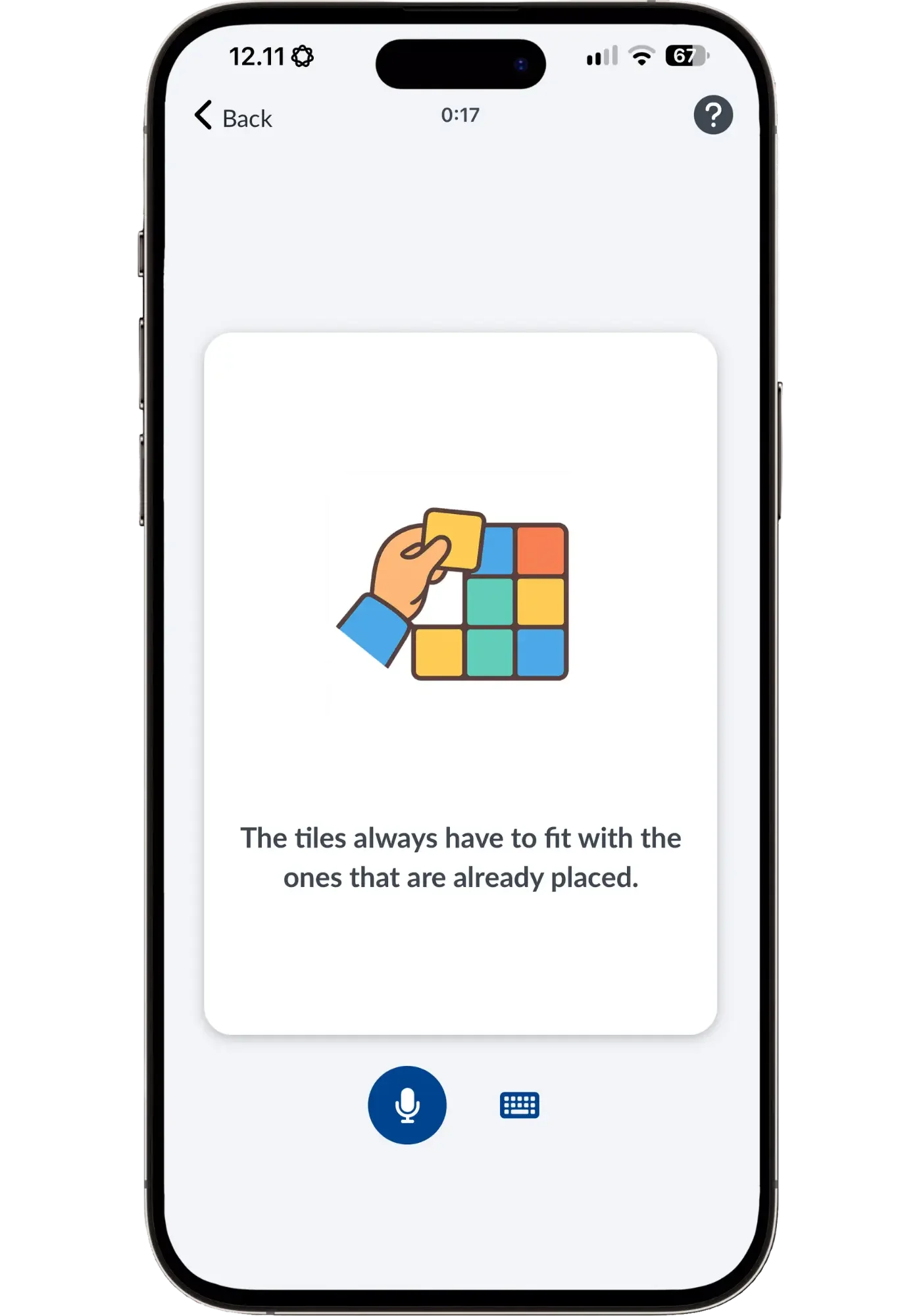
Front: say it in Spanish.
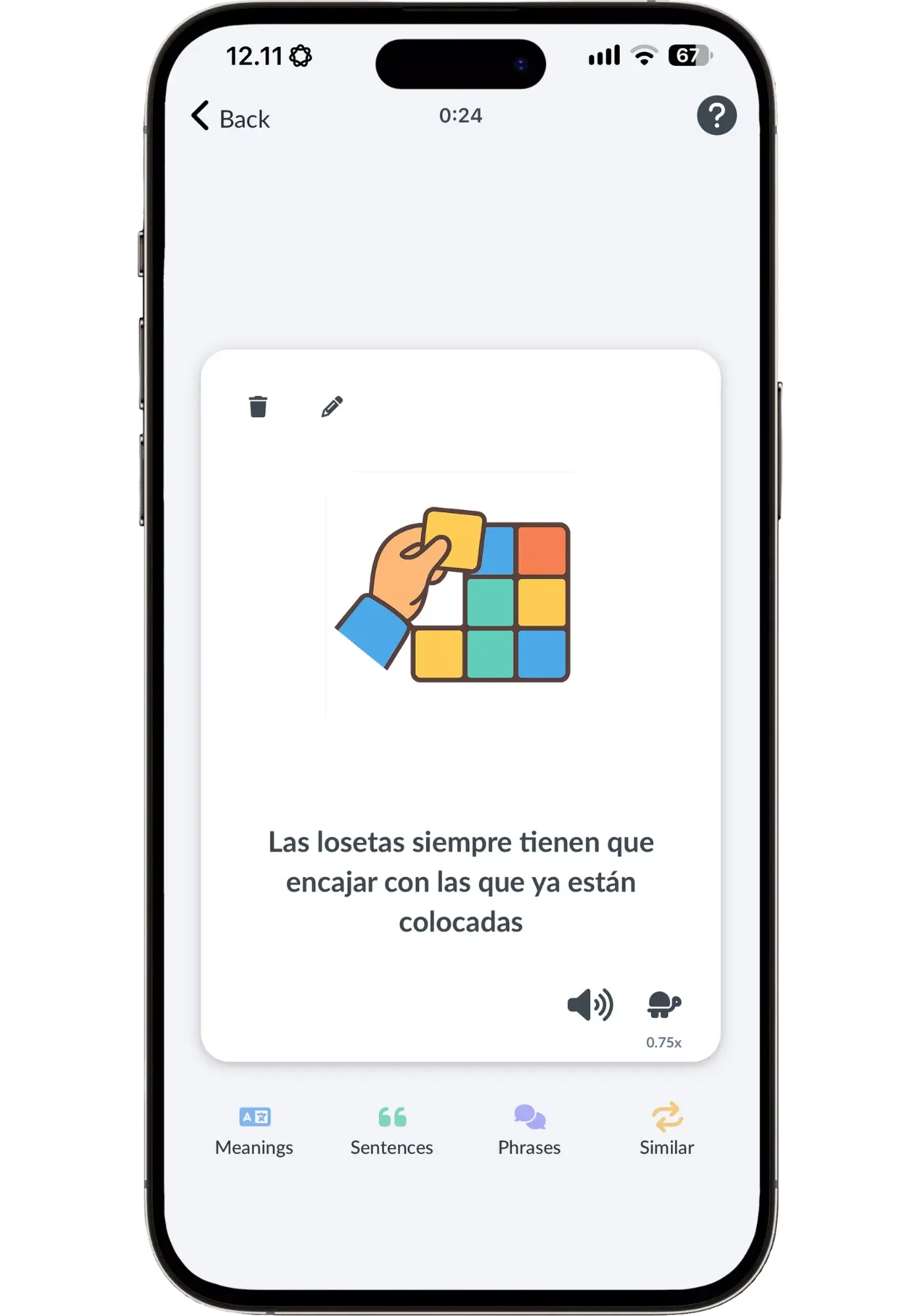
Back: check your answer and hear it.
Flashcards, AI stories, and podcasts and videos with interactive transcripts are free. For the AI speaking features, like conversations with the AI tutor, you need a paid plan. My code LING20 gets you 20% off the annual Unlimited plan ($199.99 → $159.99 a year), and the discount stays for as long as you’re subscribed. Enter it on Langua’s website, not in the app.
If you want to see the apps I use every day alongside my lessons, and how I fit them together, I put it all in a free guide:
Verdict: is LanguaTalk worth it?
After 14 lessons on LanguaTalk since 2024, including nine with Agustina for this two-month intensive, my answer is yes, if your goal is to speak.
The platform mostly stays out of your way, which is what you want from a tutoring site. What I’d change is small: I’d like to be able to message a tutor before booking, and an app would be nice. But to me, the pros far outweigh them.
The real value isn’t the website. It’s finding one tutor you click with and showing up every week. That’s what made Agustina notice I was speaking faster, and what made it natural for me to speak with the Mexican wedding guests in Spanish.
If you’ve been putting off lessons because you don’t feel ready, book the trial. It’s 30 minutes, at a discount or even completely free (no credit card needed), and you’ll know after one lesson. That’s the only way to find out, and I can guarantee that it’s not as scary as it might seem.
FAQ
Is LanguaTalk legit?
Yes. I’ve taken 14 lessons on LanguaTalk since 2024, and booking, payments and cancellations have all worked as described. LanguaTalk says it accepts only the top 10% of tutors who apply, and overall, the tutors I’ve had have been really good.
Is the first lesson on LanguaTalk free?
It can be. Many tutors offer a free 30-minute trial lesson. Tutors who don’t offer it for free charge 30% of their normal price instead. You don’t need a card to book a free trial. After your first lesson, trials with other tutors are discounted, not free.
How much does LanguaTalk cost?
Each tutor sets their own price. Spanish tutors start at around $10 an hour, and most charge under $35. Buying a package of 5, 10 or 20 lessons brings the price per lesson down. Lessons are paid by card, in US dollars.
Can I cancel or reschedule a lesson?
Yes, and you manage it yourself. Up to 24 hours before the lesson, you can cancel for a full refund or move it to any open slot in the tutor’s calendar. If a slot is open, it’s yours, with no waiting for the tutor to confirm. Within 24 hours of the lesson, you can no longer cancel, which protects tutors from losing income to last-minute no-shows.
Can complete beginners take lessons on LanguaTalk?
Yes. Many tutors say in their profiles that they teach complete beginners, and they’ll use English when you need it. Look for “beginners” in a tutor’s description and use your trial lesson to see if it feels right.
What’s the difference between LanguaTalk and Langua?
LanguaTalk is the tutoring site, and Langua is the AI app from the same company. They share one account, so signing up for either gives you both. Langua’s flashcards, AI stories and interactive transcripts are free. The AI speaking features need a paid plan. See more in my Langua review.
Is LanguaTalk better than italki?
For Spanish and other big languages, I prefer LanguaTalk: tutors are carefully selected, you pay per lesson by card, and booking and rescheduling are instant, with no waiting for the tutor to confirm. italki has far more languages and tutors, an app, and lets you message tutors before booking, so it’s the better choice for less common languages. But for the big languages, I often find the sheer number of tutors on italki overwhelming. LanguaTalk has plenty of range without that.
