Published
This post contains affiliate links. If you buy through one of them, I may earn a commission at no extra cost to you. StoryLearning gave me free access to Korean Uncovered at my request: I wanted to improve my Korean listening, and I knew from Spanish that these courses work. They didn’t ask for this review or see it before it went live. See Full Affiliate Disclaimer.
I started Korean Uncovered on a sunny day in July, with chapter 1 playing in my ears while I cut the grass. I'd been learning Korean every day for almost seven months, and I understood almost nothing of the story.
Which could only mean one thing: I was about to get an upgrade in my Korean comprehension.
Four months and up to 90 listens per chapter later, I can follow the story, even if I still miss a lot of the details. The earlier chapters I understand quite well, while the later ones still need more work.
Korean has been a tough language for me to learn, mostly because the sentences are built so differently from any other language I’ve learned. But this is the first time I feel like I’m seeing the light at the end of the tunnel, and my dream of watching StarCraft with the original Korean commentary, or a Korean drama, finally feels within reach.
In this review, you'll follow my four months with the course (I'm not done yet), the workaround I needed when I got stuck, what's inside, who it's for and who it isn't, and whether it's worth the price. There are a lot of visuals to give you as clear a picture as possible of what’s in the course before you buy.
The short version
Korean Uncovered Beginner, after 4 months of daily use
If your goal is to understand spoken Korean, this is the course I'd recommend. It moved my listening further than anything else I've used, though for Korean I needed one extra step: a way to look up words in the story.
What I liked
20 story chapters that build foundational vocabulary · lessons built on the story · excellent pronunciation lessons · Hangul in 30 minutes
What I didn't
No word lists · narration audio could be cleaner (fix coming) · quizzes and flashcards that add little
My 4 months with Korean Uncovered
I've worked with this course every single day for four months. I've finished all the teaching lessons, but I'm still working through the story chapters until I understand them close to 100%. Right now, I'd say I understand about half of the whole story: 80–90% of some of those earlier chapters, and more like 20–40% of the later chapters. I'll update this post as I go, and when I reach the finish.
Why I started: a lawnmower and chapter 1
Before that, I'd been using Lingopie to learn from Korean TV shows. It worked well, but it's something you sit down with. I was missing two things: content at the right level that I could listen to on repeat while doing other things, and a project with a clear beginning and end.
The first lets me learn during time that would otherwise be lost. The second is about motivation. With a fixed project, you can tell whether something is working or not, and there’s a sense of achievement at the end when you complete it. That's why I like to break language learning into these finite projects. The language itself has no clear finish line, but each project does, and each one you finish gets you further.
Korean Uncovered is my eighth StoryLearning course if I count the Conversations courses that I’ve done, and I love the feeling at the end of each one, when material I didn't understand at all becomes something I couldn't not understand even if I tried.
So I put chapter 1 on a playlist, turned on the lawnmower, and listened as the sun was shining on my face. The first chapter is about people meeting and introducing themselves, and since I'd learned some of that in other beginner courses, I could pick out a few things. I listened 10 times on repeat before moving on.
In chapter 2, my comprehension dropped significantly. Almost every word was new. Chapter 3 was easier: the three friends order coffee at a café, and I'd practiced exactly that in Speak, so I could follow along decently well, even if the words came faster than I could catch them. But I liked that, because I prefer natural content over something that’s been dumbed down. That’s what prepares you for native content and conversations.
30 listens before I checked the translation
For the next few days, I kept listening to those first few chapters, without looking up a single word. One phrase in chapter 1, "orenmanieyo," kept jumping out at me. I didn't know what it meant, but I felt like I had heard it before. I didn't worry about it though, I just kept recognizing it knowing that I would eventually learn what it meant.
I listened to chapter 1 thirty times before I even checked the translation. (I didn't read the Korean transcript at all for the first month and a half. More on why later.) When I finally listened while reading the English translation, I found out that 오랜만이에요 (orenmanieyo) means "long time no see." Of course! I knew I had heard it somewhere before. It felt like a real win.
This shows something important: you don't need to understand something to start learning it. Once you can actually hear a word, you've created a dictionary entry for it in your mind (an idea I got from the Japanese learner Matt Archer). All that's left is to fill in the meaning, and once you do, it sticks. I never had to look up 오랜만이에요 again, since that expression was now mine, and unless I take a multi-year break or something from Korean right now, I’ll never forget it.
When the lessons uncover what you've been hearing
The evening after those 30 listens, I watched my first lesson, which was a vocabulary lesson. The teacher went straight into it, and one of the very first things she explained was 오랜만이에요, the phrase I'd been hearing all week. Well, look at that.
And it kept happening. In chapter 4, I kept hearing 나왔습니다 (nawassumnida). I could tell it had something to do with the bathroom, but not what. Then a lesson explained that it means "came out," as in they came out of the bathroom. I didn't have to memorize it. I'd already heard it dozens of times, so it stuck the moment I got the meaning. Because a big part of understanding is just being able to catch the words when hearing them. You can know a word in reading without being able to catch it when purely listening, which is why listening is more challenging than reading.
And that’s why I listened over and over. Your brain starts parsing all the sounds and you start registering them when you listen.
My favorite one: in August, I got curious about a pattern in chapter 11 I kept hearing. I just looked it up in Google Translate. It was 에서…까지, "from [place] to [place]." The next day, the particle lesson opened with exactly that.
This is where the course gets its name. The lessons are where the language you've been hearing gets uncovered. They almost started to feel like the reward for all that listening, and they made me want to listen more so I'd be ready for them. If I'd gone straight to the lessons, they would have been just information, and a lot of it wouldn’t even have made sense and would have flown right past me. Because I'd heard everything first, every lesson cleared up something I'd been wondering about. Not everything, but some key things.
So I made it a habit: after watching a lesson, I'd go straight back to the chapter and listen for what she'd just taught. You won't catch everything, but you'll catch a few things each time, and the chapter gets a little clearer.
The "is this even working?" stretch
One week in, I already had doubts. I'd listened to each chapter dozens of times and done the lessons, but I got to a point where listening more didn’t help me understand more.
And that’s one of the challenges with the courses: progress didn’t come in a straight line. Words cleared up in random places, so it was hard to tell whether it was working, even when it was. But it’s an important skill to learn, to let go of the control to try to “learn this word right now” and just let it come to you when it does. If you keep encountering it, you will eventually learn it, without deliberately forcing it.
That said, even after learning several languages this way, I still get the same feelings everyone does: is this really working? Am I just spending time with this for no reason? The difference is that I know from experience not to let those feelings decide whether I keep going. That's why for quite some time I had a daily goal of listening to the story for 30 minutes. Some days I felt progress, and some days it felt like I was learning nothing. The goal doesn't care either way, you just hit it each day and keep going no matter what, and over time it really makes a difference.
What helped most was remembering why I was doing this. One evening in August, a new season of ASL (the Korean StarCraft league) started. I've watched it with Spanish commentary for years, but that night I switched to the original Korean commentary. I only understood a word here and there, "red" or "that direction," but it was still so much fun. If I enjoyed it while understanding almost nothing, how much more would I enjoy it once I understood it? I'd wanted that for years, decades even, and it made me want to go after this course even harder.
Any course gets boring at some point (usually in that middle stretch). Having that bigger goal in the back of your mind is what carries you through.
Why I added LingQ
After a few weeks of steady progress, I hit a wall. It felt like I could listen to each chapter 100 times and still not understand it. Listening while reading the English translation gave me the overall picture, but I couldn’t connect the sounds to their meaning. Korean sentences are built completely differently from English, so even with the translation in front of me, it was very hard to tell which word meant what.
In Spanish or Italian, lots of words look like English and the word order is similar, so you can guess a lot from context. Korean has almost none of that, apart from a few English loanwords (which aren’t always obvious). As a beginner, most of the words in a sentence are new, so there isn’t enough context to guess from.
Reading the Korean transcript along with the audio didn’t solve it either. Hangul isn’t a hard script, but reading it as fast as the audio is something you can expect at a solid intermediate level, not as a beginner. And since my main goal was listening, I needed a way to connect the meaning to the sounds, not just to the text.
Does that mean the StoryLearning method doesn’t work for Korean? No. It just needs one more step that isn’t part of the course. I think the no-lookup approach works much better at intermediate, when you know more words and have a feel for how sentences are built. Though I’ll find out when I get there.
So I did what I always do and turned to LingQ, an app I’ve used for seven years across three other languages. It’s basically my language-learning hub. I’d already put the Korean Uncovered audio and transcripts into LingQ to use its playlists. I just hadn’t touched the transcripts until now. Now I could tap any word to look it up, and use sentence mode to play one sentence at a time from the original course audio while I was looking the words up.
The key was to look up a word, play its text-to-speech if I needed to, and then replay the whole sentence in the original audio, listening for that word. That’s how I started connecting each word’s meaning to its sound, inside full sentences. Some sentences were easier, most were hard, but you just keep working through them.
I did that with every chapter, and it helped tremendously. Could I have done without it? Maybe. But I believe it sped things up, and if nothing else, it made the chapters much easier to work with.
Working through chapter 18 in LingQ: play the sentence, tap the words I don’t know, check the translation, play it again, and move on to the next sentence. Each sentence plays the original course audio.
The audio timing isn't always perfectly matched to each sentence, but it’s pretty good. And you can adjust the timing as you go. You only do it once, and replaying the sentences while you adjust them is extra listening practice anyway.
The tipping point
Going through the chapters sentence by sentence, I started noticing a shift. Little by little, the fuzzy, unknown words cleared up, like clouds breaking up into blue sky. I started catching words while listening to the chapters as I did the dishes in the evenings.
Somewhere around 50% comprehension (my guess), there's a tipping point where the story stops being mostly gibberish and becomes something you can follow, even if you still miss words and details. Going from understanding 5–10% to about half the story, and almost all of the first few chapters, is the clearest sign I could get that it's working.
It can be frustrating to look up a word in the morning and not recognize it that afternoon. That's part of the process, and you can't force it. Some words stick, some you forget and meet again later. It's like a jigsaw puzzle: with only a few pieces, you can't see the picture, but once enough are in place, even scattered ones, the picture appears. And the more pieces are in place, the easier it is to find where the rest go.
My first 18 weeks with Korean Uncovered
From my daily notes. Comprehension is my own estimate.
Week 1 Jul 10
Chapter 1 on repeat while cutting the grass. I pick out a few introductions, and not much else.
Week 1 Jul 13
30 listens, then the translation. 오랜만이에요 clicks, and that evening's lesson explains it.
Week 3 Jul 28
Korean stops sounding like a jumble. I can hear where words start and end.
Week 6 Aug 16–20
The wall. Toughest stretch 30–60 listens per chapter, and most sounds still have no meaning.
Week 6 Aug 20
I start going sentence by sentence, looking up words inside the story.
Week 8 Aug 31
One chapter jumps in a single session, from about half to most of it.
Week 12 Sep 26
The early chapters start to open up. Chapter 1 is close to 90%.
Week 16 Oct 28
The tipping point. The words I know give me enough context for the ones I don't.
Week 18 Nov 9
All lessons done. Still listening toward 100%.
What's inside Korean Uncovered
Korean Uncovered Beginner has 20 chapters, twice as many as Spanish Uncovered Beginner for comparison. According to StoryLearning, each course is as long as it needs to be to get you to the next level, and in Korean, that takes longer, so the length makes sense.
The story
The story is cleverly built, both the plot and the language. The sentences get gradually more complex, and vocabulary keeps coming back, so you pick up some words just by continuing to listen.
It follows a group of friends traveling around South Korea to figure out a mysterious note. It's engaging enough, and I like that it doubles as a crash course in Korean culture and the places worth seeing if you visit, as well as what food dishes to try.
Having a story also makes re-listening much more enjoyable than random material. Each chapter is its own scene: landing at the airport and getting picked up, a gift that gets forgotten somewhere, a coffee shop near the airport, arriving at the hotel. You can picture each one as you listen, which makes it easier to understand. One evening recently I listened through the first eight chapters in a row while doing the dishes, without repeating anything or looking anything up, and it was a real pleasure and I could feel how things are just slowly starting to come together.
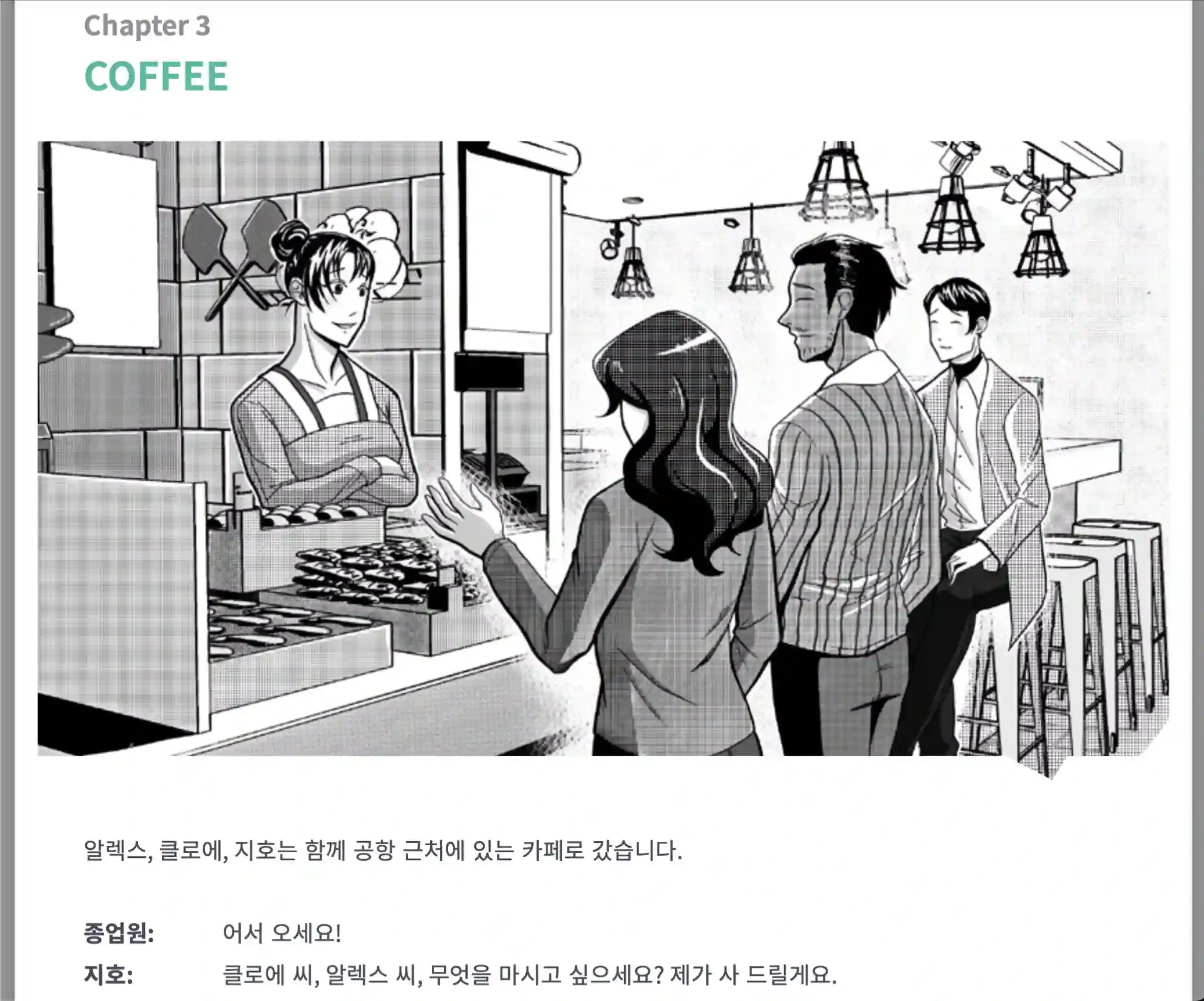
Chapter 3 of the story: Alex, Chloe and Jiho stop at a café near the airport.
The lessons
The course is taught by Minji Kim, who also runs a Korean-teaching YouTube channel with over 200,000 subscribers. Her teaching is one of the course's strongest points: clear, full of examples, drawing on screen as she goes, with summaries at the end. She moves much faster than the teacher in Spanish Uncovered Intermediate, which I found a bit slow for my taste (I watched those at 1.5–1.75x). I prefer it this way, though I’ll admit I’m not the most patient when it comes to lessons where you’re being taught. Nothing drags, and I can always pause or rewind, which I did many times.
Each chapter comes with four video lessons: vocabulary (about 16 minutes on average), grammar (about 19), particles (about 12) and pronunciation (about 3), plus a short written culture lesson in most chapters. That's close to 17 hours of lessons across the course. There are also some extra activities such as speaking activities and quizzes.
Vocabulary
The vocabulary lessons go through the words and phrases from the chapter, with examples taken straight from the story. Some of my favorite moments were small ones, like learning that 제 at the end of a word means some kind of festival: 영화제 is a film festival, 음악제 a music festival. Now when I hear a word ending in 제, I have something to go on, even if I don't know the rest of it.
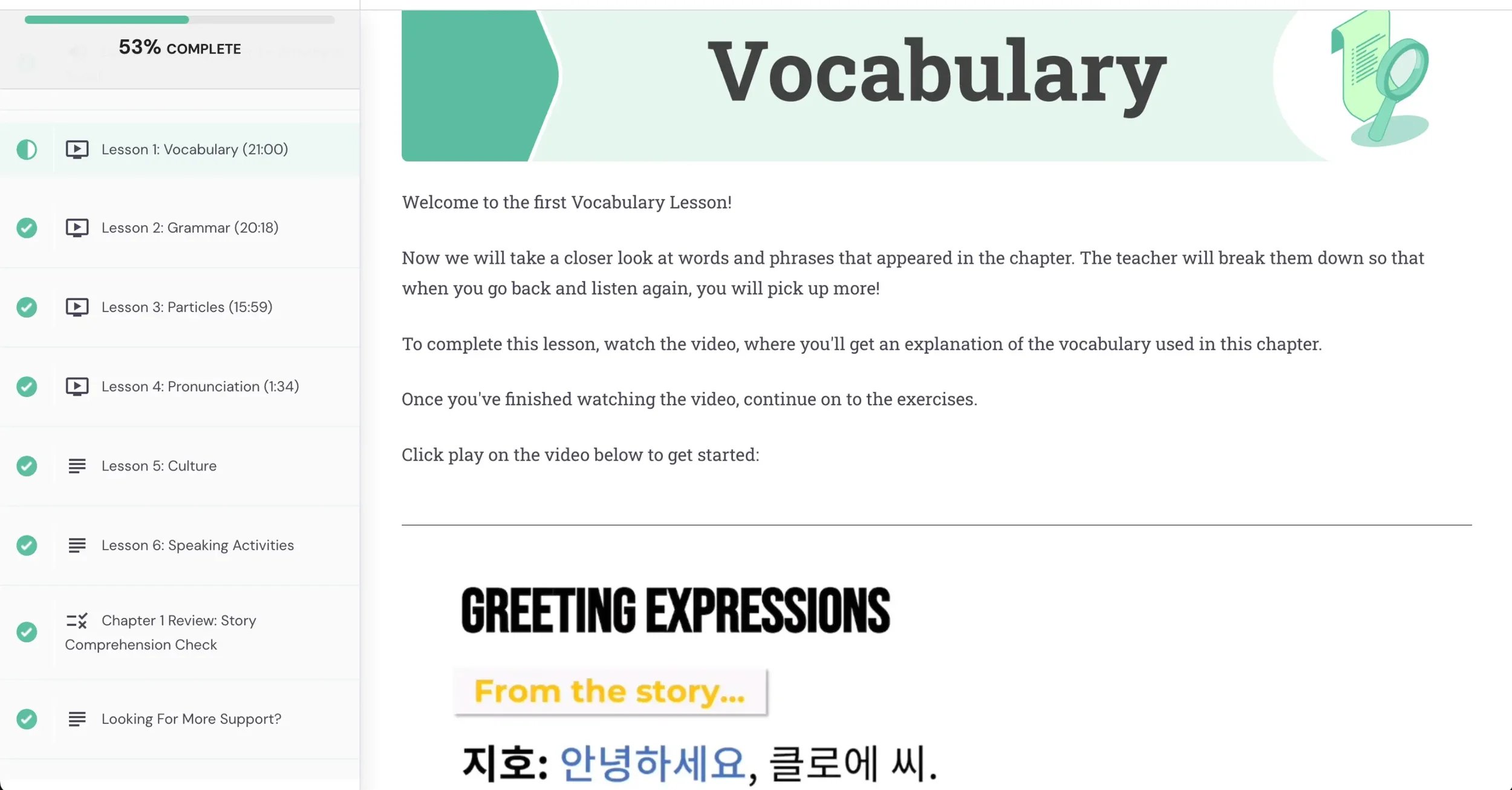
Each chapter comes with vocabulary, grammar, particle and pronunciation lessons, plus a culture lesson. The vocabulary lessons often start with a line from the story.
Grammar
The grammar lessons explain patterns you've already been hearing in the story. In chapter 13, the lesson on doing two things at the same time is where it really clicked for me. She took two separate sentences, then showed the combined sentence with both actions in it. It also cleared up something I hadn’t even noticed in the story: when you join two actions like this, only the last verb shows the tense. The first one stays in its basic form, even when you're talking about the past.
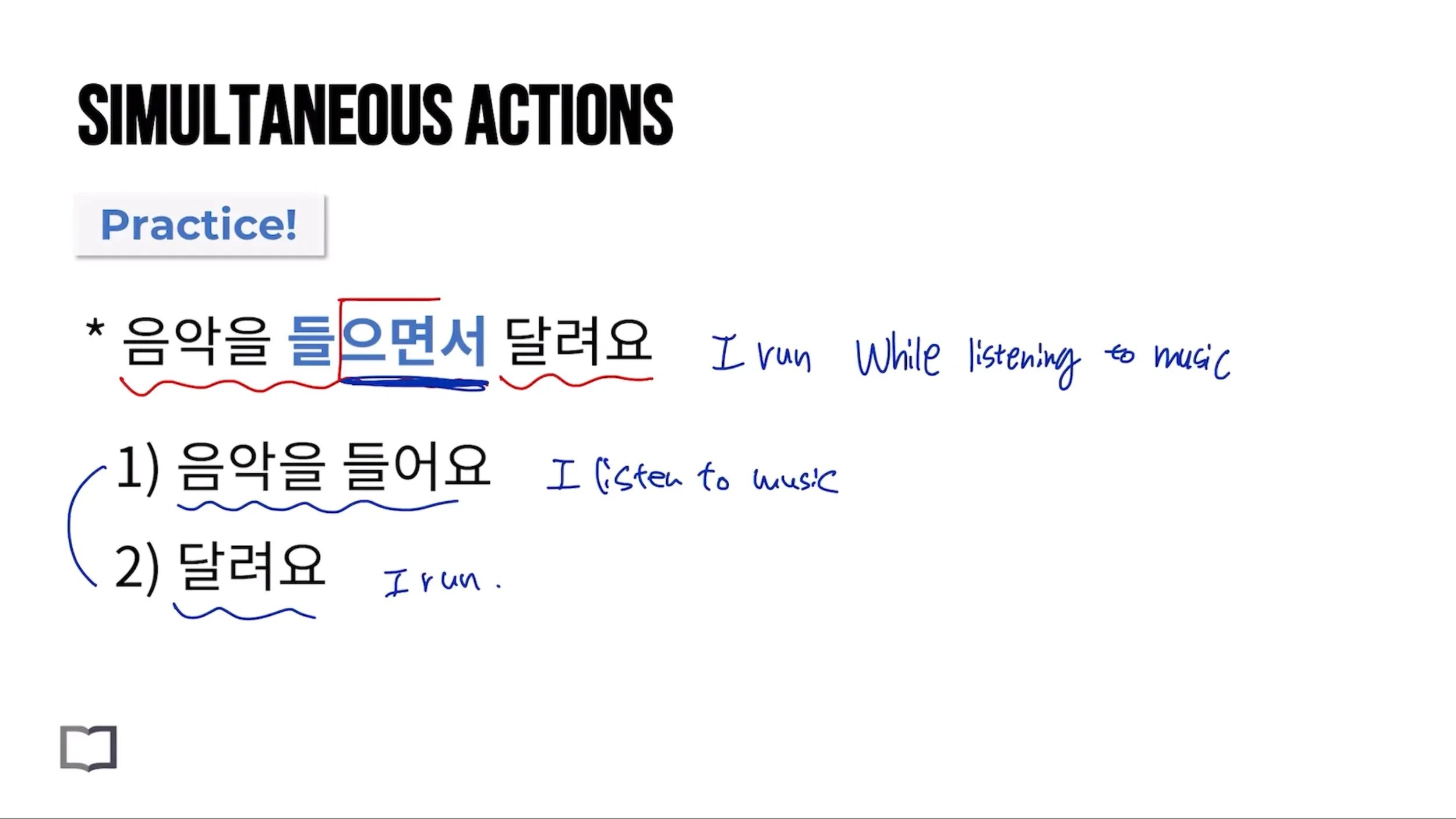
The chapter 13 grammar lesson: two separate sentences become one, "I run while listening to music."
Particles
Particles are a big part of Korean. They're small endings that show what role each word plays in a sentence, which works very differently from English (Japanese has them too). These lessons break down the particles in each chapter, using examples from the story, and show you how to use them in your own sentences.
In chapter 13, the particle lesson on 까지 used a sentence straight from the story, one I'd already worked through in LingQ that morning. Then it showed several other ways 까지 is used that I hadn't come across yet. I don't remember them all, but knowing they exist means I'm not confused when they show up.
After an example from the story, Minji shows other uses of 까지, like “even”: “Billy is even good at driving.” She writes it out as she explains.
Pronunciation
When I did Spanish Uncovered, the pronunciation lessons weren’t the ones that stood out the most. They were fine and all, but I think at that point I already had a quite firm grasp of it.
For Korean though, they are some of my favorites. They are typically 2–5 minutes but the teacher shows very clearly how to produce different sounds. Everything from tongue placement, to the shape of your mouth, and how much air pressure. This becomes very important for Korean since sounds like p, b, and bb or t, d, and tt have very fine differences, and it isn’t obvious how to pronounce them accurately.
One small thing from my own experience: I’d been wondering for a while why ㄹ sometimes sounds like an R and sometimes like an L, and the lesson that explains it comes in chapter 7. So you just have to be okay with these question marks and not getting the answer right away, because chances are they will be covered in a future lesson.
The challenge with Korean is that some of the sounds have much more subtle differences than many other languages. The difference for some of them comes down partly to airflow, and teacher Minji illustrates this very effectively using a napkin to show how much it moves on each sound:
Turn the sound on: Minji uses a napkin to show the difference between ㅂ, ㅍ and ㅃ.
This is just one example from a short segment of a pronunciation lesson. In other lessons, she shows how lip shape changes a sound, like rounding your lips for ㅗ and keeping them open for ㅓ, and those were some of the most useful lessons in the course for me.
Culture
These are short written pieces with pictures, each taking about a minute to read. They pick up a cultural detail from the story, like hanbok, Korean celebrities or the honorific system. One explains why Koreans say “our friend” or “our house” (우리 친구, 우리 집) instead of “my friend” or “my house,” something I’d been wondering about. A nice touch that gives you some background for what you’re hearing.
In general, the lessons get denser as the course goes on, and some grammar lessons in the later chapters run close to half an hour. They’re excellent, but they work best once you already know the chapter well. More on that in how to use it.
Learning Hangul in 30 minutes
The course opens with a Hangul crash course: three videos, 32 minutes in total, and by the end you've seen the whole alphabet and how it works. I've done Hangul lessons in Speak and Rocket Languages too, and this is by far the most compact. It also shows how each sound is made in the mouth more clearly than any other course I've used. The videos are dense, so you may want to watch them more than once.
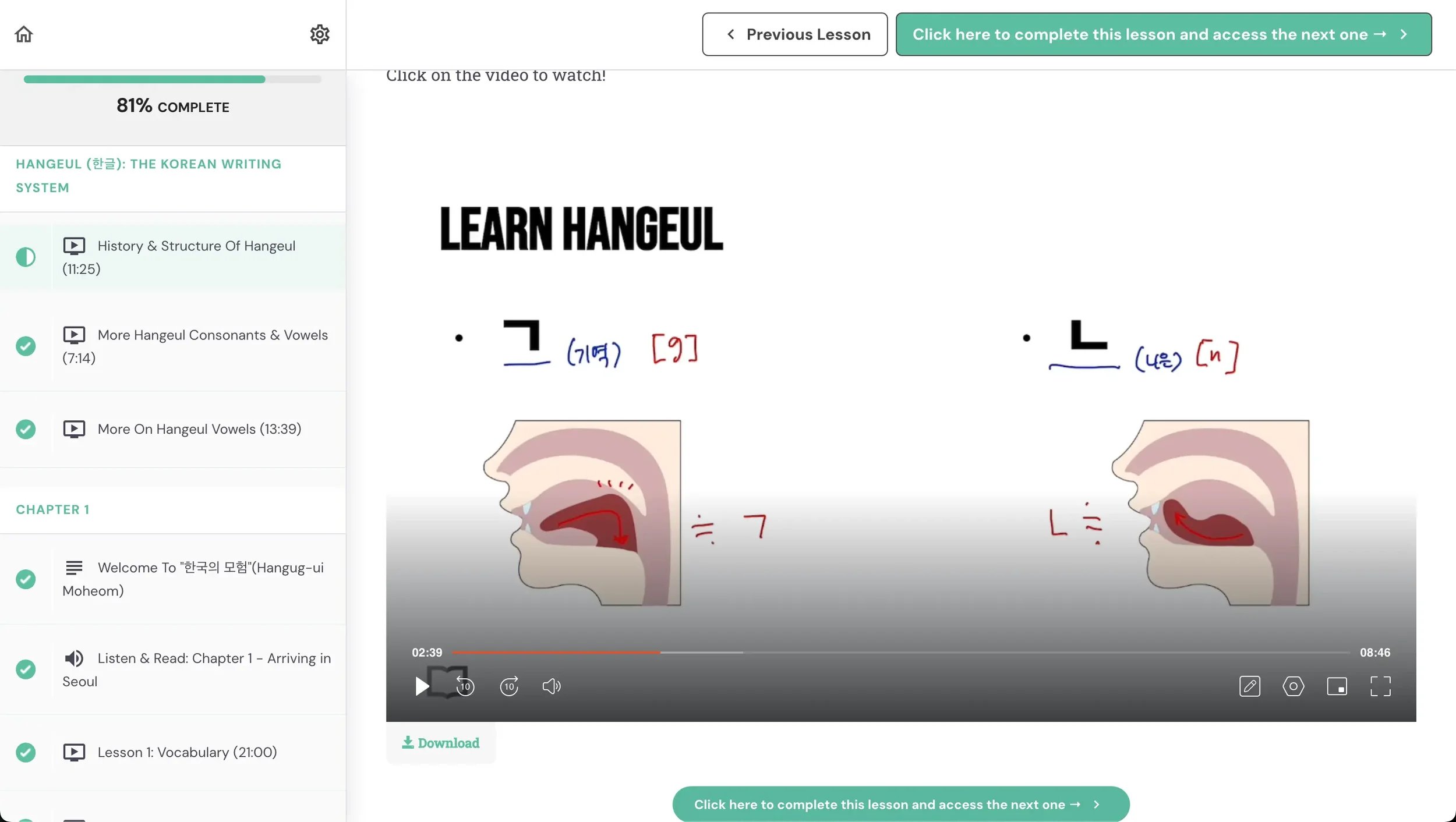
The Hangul lessons show where your tongue goes for each sound, like ㄱ and ㄴ.
What I skipped
The quizzes and flashcards. Everything is in Hangul with no romanization, and the flashcards have no audio. I tried them a few times and found them more demanding than helpful personally, so I stopped.
The practice activities after the grammar lessons. Same problem: Hangul only, and questions built on words from the transcript. I tried them again in chapter 13 to be fair, and they still weren't for me. I focused on listening, the lessons, and working with the transcript in LingQ instead.
The speaking activities. I didn't do these for Korean, since I wanted to focus on comprehension first and used other apps for speaking. But in Spanish Uncovered, I did a lot of them with Langua, and they worked really well (you can paste the activity straight into your own prompt). So I'd count this as something I haven't tried in Korean yet, not something that doesn't work.
None of these are why you buy the course. Skip them and you seriously lose nothing. If you like having different ways to practice, they're there.
How to use it: story first, lessons second
It's tempting to start with the lessons, because taking in new information feels like learning. But it's a trap, for two reasons. First, immersing in the story is how you actually learn Korean. Second, the lessons move fast, and without context and questions that pop up in your mind from listening and reading the story, a lot of them will go over your head.
A good example: for weeks, I'd wondered why the narrator seemed to pronounce 의 like "e" in words like 부산의. Was I hearing it wrong? Then the chapter 15 pronunciation lesson explained that 의 is often pronounced 에, so you'll hear both. Because I'd already noticed it, the explanation stuck right away.
My routine, step by step
My personal routine
- 1Put every chapter in one playlistI import each chapter's audio and story text into LingQ. That gives me a playlist for listening on repeat, and everything ready for working through the text later.
- 2Listen first, many timesPut the chapter on repeat while you do other things, before touching the lessons. I listened to chapter 1 thirty times before I even looked at the translation.
- 3Do one lesson, then go straight back to the storyListen right away for what the lesson just taught. That's when things you've heard twenty times suddenly make sense.
- 4Spread the lessons outOne lesson a day, with listening in between, works better than stacking three in a row. They're dense.
- 5When listening stops helping, go sentence by sentenceIn LingQ, sentence mode matches each sentence to the audio, so I can replay one line at a time and tap any word for its meaning and romanization. You can adjust the timing of the audio in each sentence by hand when needed.
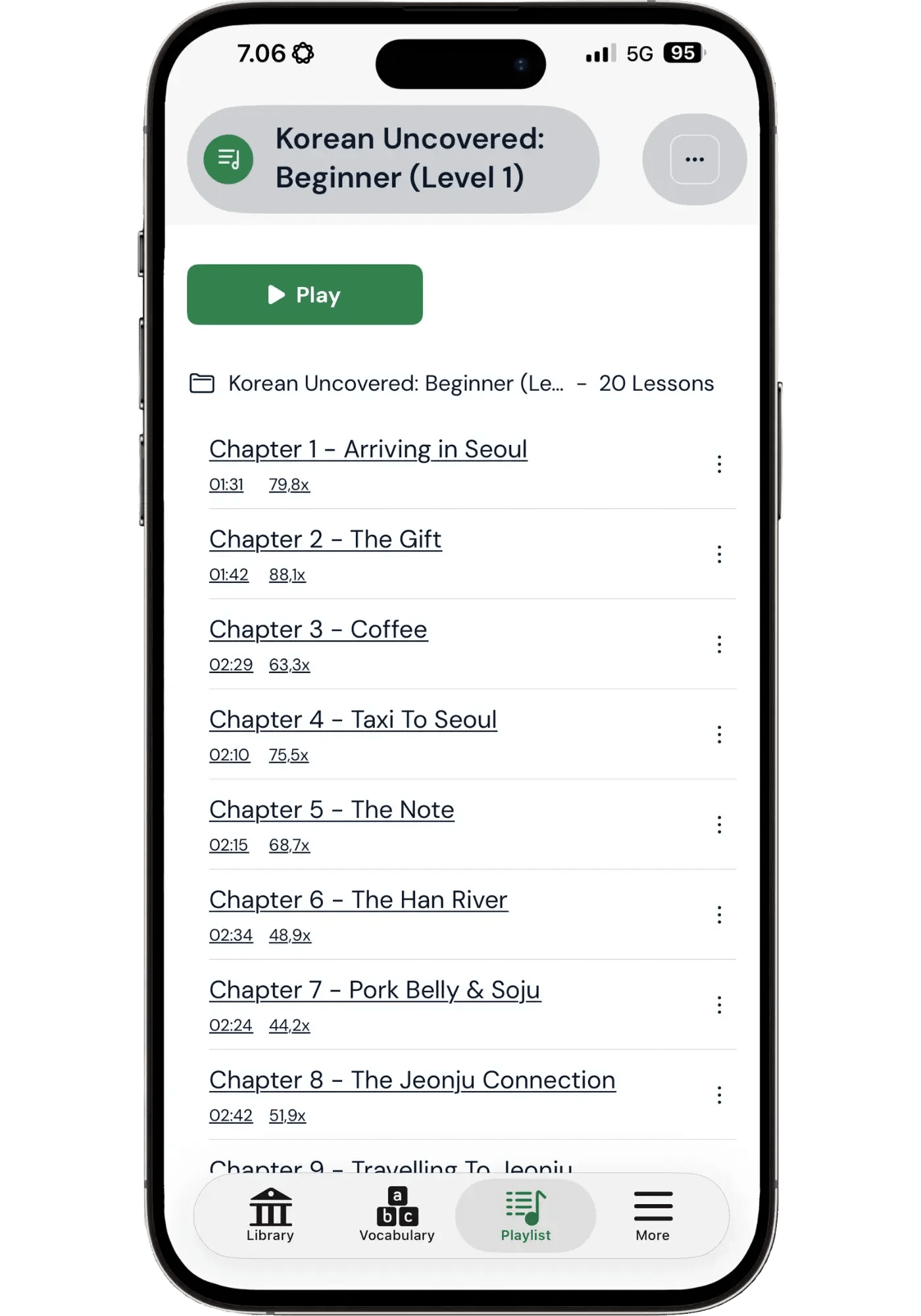
My Korean Uncovered chapters on repeat, which a playlist makes easy. Some I've played almost 90 times.
Do you need LingQ with it?
The course can work on its own. Words you don't catch keep coming back in later chapters and get clearer over time, which is how StoryLearning designed it. But if you want to really understand every chapter, like I did, you need a way to connect the meaning to the exact words you're hearing. A translation tells you what the whole sentence means, but in Korean it's hard to tell which word means what, and figuring that out from listening alone takes a long time. Here are the two options I'd recommend to speed that up:
LingQ (paid). This is what I use. Import each chapter's audio and transcript, tap any word for its meaning and romanization, and replay one sentence at a time with the original course audio. It's the smoothest way I've found to work through the stories. See my LingQ review.
One thing to know: the stories are copyrighted, so keep your imports private. In LingQ, private is the default, so just don't change it to shared.
Langua (free). With a free Langua account, you can paste in a chapter's transcript, click any word to see what it means, and click any sentence to see its translation and hear it read aloud by an AI voice. With a paid plan you can add full narration of each chapter, but you don’t really need it since you already have it from the course. The text comes in without line breaks, so it's not as smooth to read as LingQ, but it does the job.
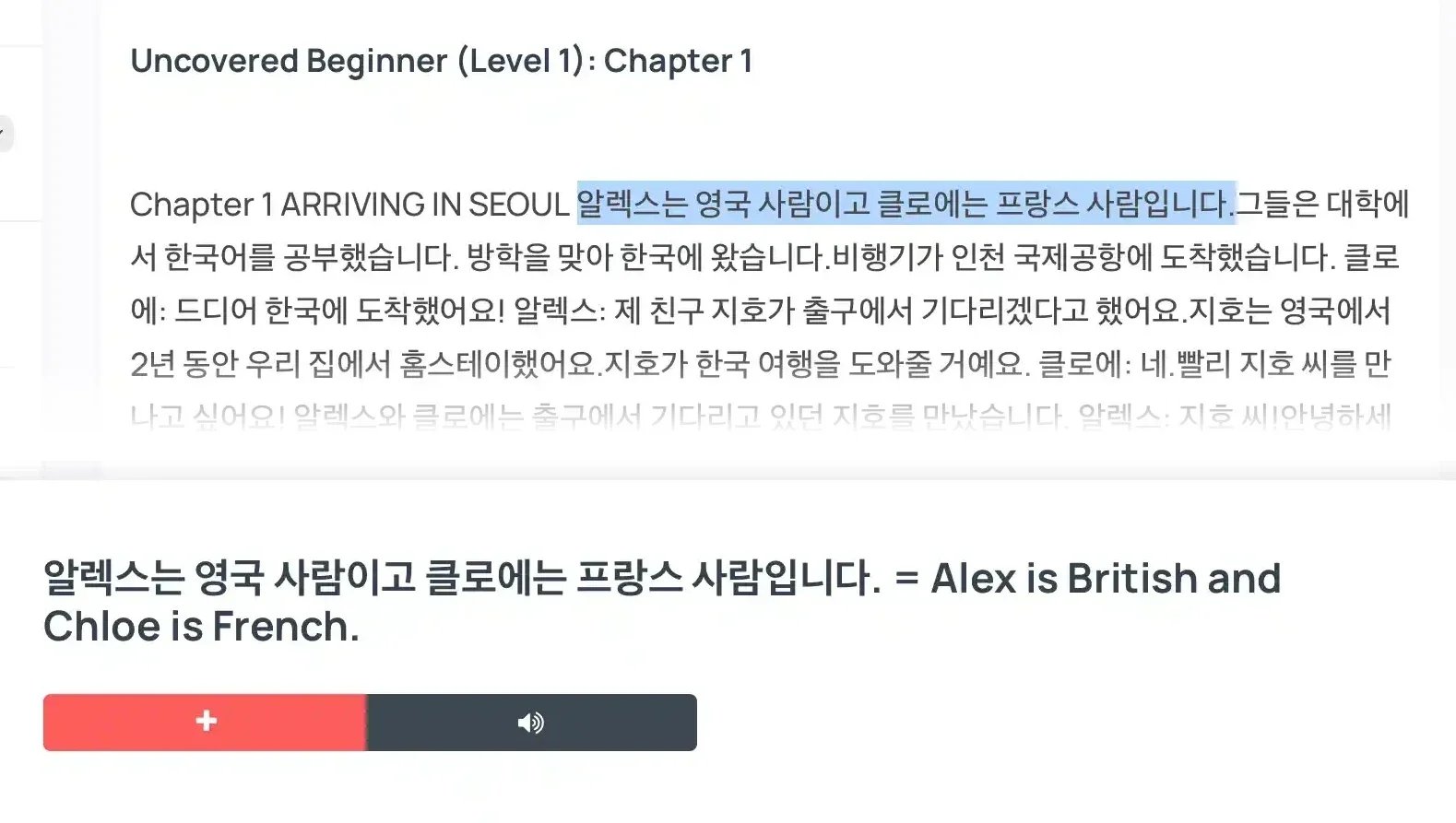
Chapter 1 in Langua’s free plan: click any word to see its meaning, or click a sentence to see the translation and hear it read aloud.
Whichever you use, the key is to look up the words and then go straight back to the story audio, so your brain links the meaning to the sound.
Is Korean Uncovered good for complete beginners?
Yes, but expect a steep start. It’s a beginner course, and the Hangul lessons mean you can start from zero, but you’ll get into it faster if you already know a little Korean. When I started, I’d done Rocket Languages, a few months of Lingopie and two months of Speak, and I still found it challenging.
However, a lot of that comes down to Korean simply being a challenging language, and at some point you just have to embrace that and dig in if you want to learn it.
If you’re starting from zero, you have two good options: build a small foundation first with a beginner app, or start with the course and give each chapter more time. Either way, if you’re serious about understanding spoken Korean, I think this course is close to a must-have. The sweet spot is around A1 to A2.
Pros and cons
What I liked
- So much material. 20 story chapters. Enough to keep you busy for months.
- Lessons built on the story. Examples come from chapters you've already listened to many times, so explanations click instead of going over your head.
- Excellent pronunciation lessons. Short (2–5 minutes), you see the teacher's mouth, and tricks like the napkin test make sounds like ㅂ, ㅃ and ㅍ clear.
- Hangul in 30 minutes. Three dense, clear lessons at the start teach you the whole alphabet.
- Culture tied to the story. Short culture lessons answer things you actually wonder about while listening, like why Koreans say "our friend."
- Normal and slow audio. Every chapter comes in both, so you can slow down to hear every syllable.
- A narrator who's easy to follow. He shifts his voice slightly for each character, without overdoing it, so it's easy to tell who's talking.
- Dense, no filler. Lessons move fast, silences are edited out, and many end with a summary. Easy to rewatch.
- A clear beginning and end. You can measure your progress on the same material, from understanding almost nothing to following the story.
What could be better
- No word lists. If you want to look up words, you need your own way to do it. For Korean, I found that essential (I used LingQ).
- The narration audio could be cleaner. You can hear breathing and small mouth sounds, which you notice more on repeat. StoryLearning is working on a fix.
- The lessons can be a lot to take in. They're dense, and denser in later chapters. They land best once you know the story well.
- The course platform (Teachable) is clunky for listening. Download the audio and make your own playlist on your phone.
- Weak quizzes and activities. Hangul only, flashcards without audio. I skipped them.
- Steep price when not on sale. $297 per level, though for Korean I think it's worth it.
The course is very high quality and well-made. What I'd most like to see added is a key vocabulary list for each chapter, and a way to go through the story sentence by sentence. With those, I wouldn’t have needed LingQ. In languages like Spanish, you can probably get by without them, but Korean is a different animal: you can't guess what words mean the way you can in Spanish.
Price: is Korean Uncovered worth it?
All Uncovered courses cost $297 per level, which is steep for a language course. For most languages, I'd wait for a sale if you can. StoryLearning doesn't run many (about two a year, with the biggest on Black Friday), so if one is on, it's worth grabbing.
Korean Uncovered is different. A typical Uncovered course takes 3–4 months at 30–45 minutes a day, which works out to roughly $75–100 a month. Korean Uncovered Beginner lasts much longer. I'm four months in at an hour or more a day and not done yet, and I'd expect 6–9 months for most people, even longer if you start from zero and want to reach close to 100% comprehension.
What you're paying for isn't the hours of audio. It's material at exactly the right level, in a story that keeps building on what you've already learned, with lessons that break it down. You'll also improve by putting together your own material, but without the same clear progression. Having the material ready to put on repeat is a big part of why I’ve stuck with it every day for four months, along with knowing I’m done once I can understand the story effortlessly.
So for Korean, I think Beginner is worth it even at full price. If you know you'll continue, the bundle is $831 for all four Korean Uncovered levels plus two Conversations courses. That's enough to keep you busy for a couple of years at a normal pace. It's a lot to pay at once, but it's cheaper than buying the courses one by one.
Every Uncovered course has a 7-day free trial, so you can try a few chapters and lessons before paying. Single courses also come with a 365-day money-back guarantee: "try the entire course risk-free for a full year. If it's not for you, get a full refund, no questions asked." In my experience, they handle refunds quickly and without any hassle.
StoryLearning usually runs its biggest sale of the year around Black Friday. If you'd like to know the moment it starts, sign up for my deal alerts below:
Black Friday 2026
Get an alert when the StoryLearning sale starts
StoryLearning's biggest sale of the year usually comes around Black Friday. Sign up and I'll email you the moment it opens. This is only for Black Friday 2026 deals, not my regular newsletter, and the emails stop in early December.
Verdict
Korean has been one of the hardest languages I’ve learned, and Korean Uncovered Beginner is what I credit most for how far my listening comprehension has come these past four months. Speak, Langua and Lingopie for sure all helped too, but this course gave me what I was missing: material at exactly my level, in a story I could put on repeat until it made sense.
The cons above are real. You’ll need a way to look up words, the lessons can be a lot to take in, and the start is steep. But none of them changes my recommendation. Out of the five Uncovered courses I’ve done, Korean has been my favorite, both for the teaching and for how much it upgraded my comprehension.
And I haven’t reached the best part yet. The real payoff comes when the story becomes effortless to understand, and expressions you’ve heard dozens of times start showing up when you speak. I’m only starting to feel that. Before, I could hardly make out a word in anything Korean I watched. Now I can actually see myself following a Korean drama, or a StarCraft match with Korean commentators. I'm not there yet, but if I keep working with material like this, I'm confident I’ll get there.
If your goal is to understand spoken Korean, this is the course I’d start with. Once I’ve finished Beginner, I’ll be moving on to Pre-Intermediate, and I’ll update this post along the way.
FAQ
Do I need to know Hangul before starting Korean Uncovered?
No. The course opens with three Hangul lessons, about 30 minutes in total, that teach you the whole alphabet. But everything after that is in Hangul, with no romanization, so it's worth learning it first. It's not a hard script, but like any new script, it takes a while to get used to, and reading it fluently comes with practice.
Does Korean Uncovered use romanization?
No. Story transcripts, lessons and activities are all in Hangul. If you want romanization while you're still slow at reading, a reading app like LingQ shows it when you tap a word.
Is Korean Uncovered good for complete beginners?
Yes. It's a beginner course, and it teaches you Hangul from scratch. Just expect the first chapters to be challenging, since Korean is a steep start whatever you use. It's easier if you already know a little Korean, but you can also start with the course and give each chapter more time. The jump from beginner apps to the kind of content that really moves you forward is never easy, but it's the most important step.
How long does Korean Uncovered take to finish?
Much longer than other Uncovered courses. I'm four months in at an hour or more a day and not finished yet. I'd expect 6–9 months at a normal pace, 5–6 if you go at it pretty intensely, and up to a year if you start from complete zero.
Why pay for a course when there's free Korean content online?
Free content is great, but it's rarely at the right level for a beginner (it's often either too easy or too hard), and it doesn't build on itself. With Korean Uncovered, every chapter is pitched at your level and reuses what came before, and the lessons explain what you've been hearing. It also has a clear beginning and end, so you can see your progress on the same material, and you know you're done when you understand the story. That's what kept me going every day for four months.
Should I listen to the normal or slow audio?
Both are included. I mostly used the normal speed, since I like throwing myself into the real thing as soon as I can. The slow version makes it easier to hear every word, but I found the meaning harder to follow, since it takes longer to get to the verb at the end of the sentence. Try both and see which works best for you. Either way, you'll want to work up to the normal speed eventually.
Is Korean Uncovered worth $297?
For Korean, I think it's worth it even at full price. It lasts for months, and the material is put together at exactly the right level, with lessons that break it down. If you can, wait for a sale. StoryLearning runs about two a year, and Black Friday is the biggest. Sign up for my Black Friday deal alerts, and I'll let you know the day it starts.
