A Typical Tuesday Learning Five Languages at Once
Published
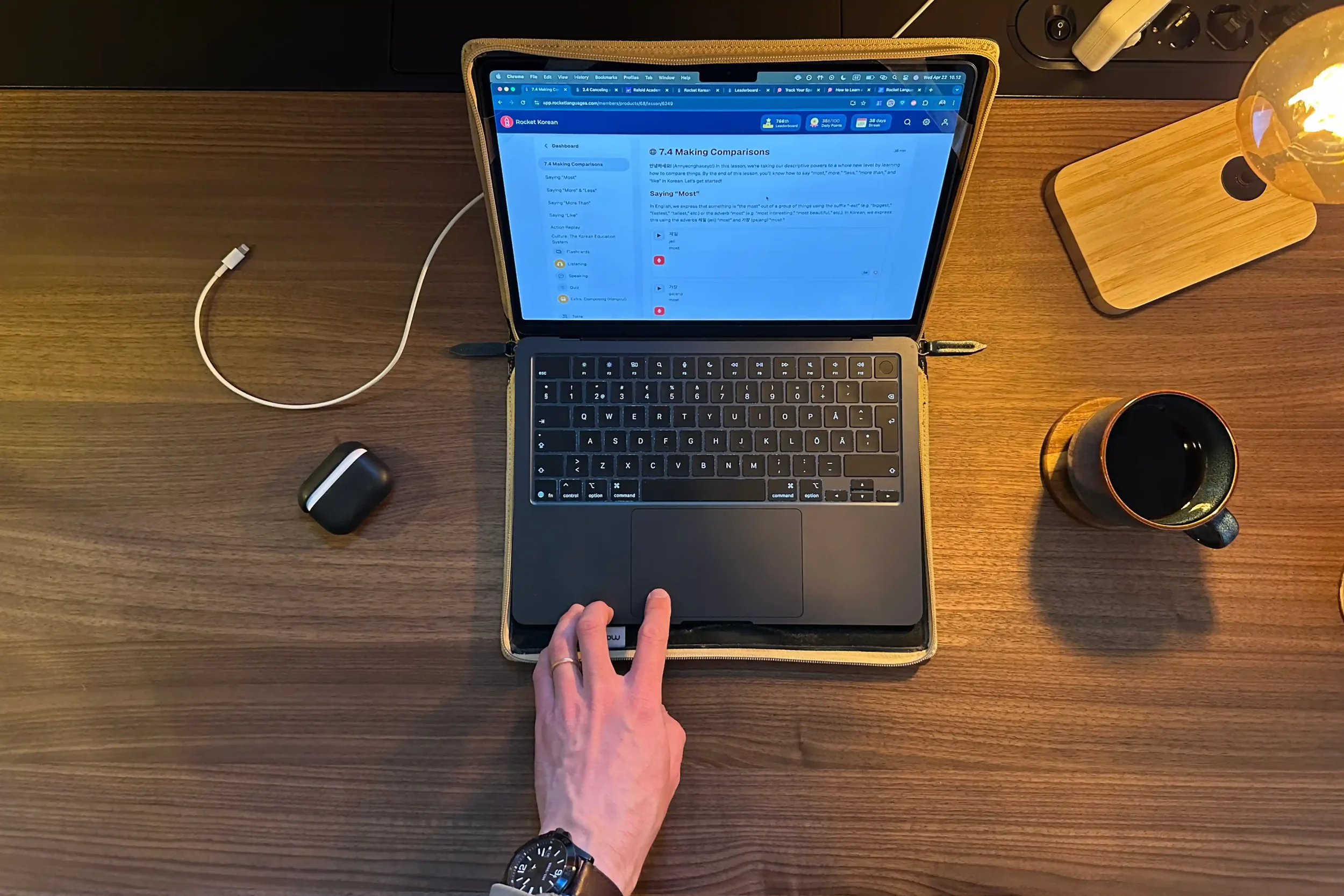
It’s a regular Tuesday in Finland. I’m learning five languages at once — Spanish, Cantonese, Korean, Finnish, and I just added Japanese into the mix last week.
I’m often referred to as a ‘polyglot', which isn't really a word I use for myself — it often feels like a badge of achievement, and that’s not why I'm learning languages. But it's a common term people use. When someone hears I’m learning multiple languages at the same time, the natural question is “how do you find the time to learn all these languages?”. And my answer is: you don’t. You weave them into your life.
When I started really getting into learning languages 8 years ago, I wanted to know what other experienced learners actually did. What does a typical day look like? What did they do? How much time did they spend?
So in that spirit, here's what my language learning routine looks like on a regular Tuesday.
Early morning: the one focused block
I like getting up early. That wasn't always the case, but for several years now I've come to appreciate the quietness of early mornings: the cool air, the sun just starting to warm up. And most of all, the undivided focus. It’s when my mind is the most fresh, so it’s the best time for me to focus on language learning.
Some days it’s 4:30, some it’s 6:00 or 7:00 — but my morning routine stays the same. I make a cup of coffee, and then head to my office to do some language learning first thing.
I used to squeeze Korean in whenever I could, mostly doing listening lessons while doing evening chores. But I wasn’t giving it my undivided attention that learning a challenging language from scratch requires. That’s why I started giving Korean a dedicated morning block (I mentioned the reason for finally taking Korean seriously in this post), and my progress has improved a lot since I started doing so.
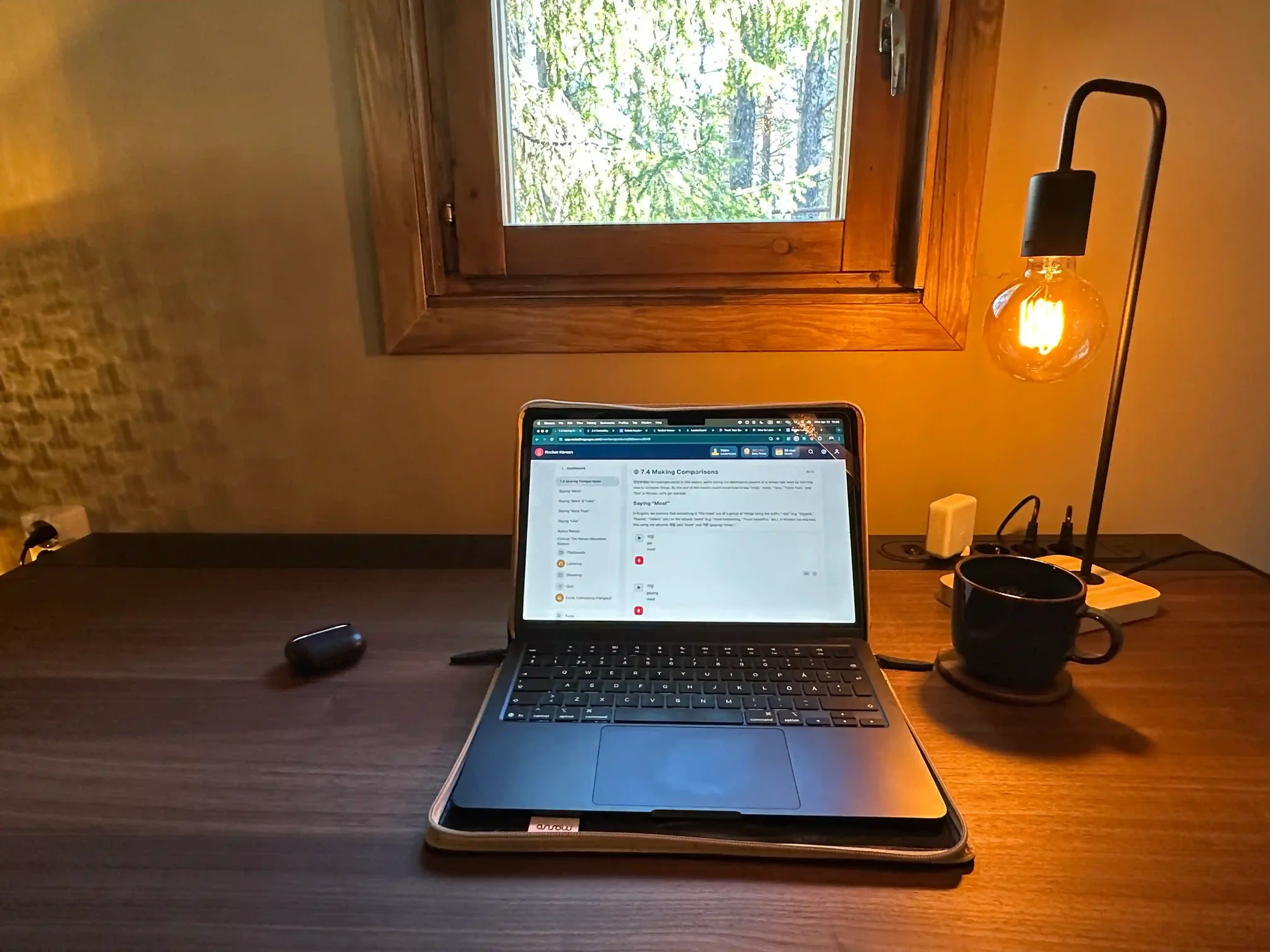
My principle is: whatever needs the most focus I do first. This is my main deliberate study block of the day. I put on some nice lo-fi music in the background, sip my coffee, and dive into some Rocket Languages lessons.
I track everything with Refold's Tracker App (which is free). It gives me a concrete sense of when I've hit my daily Korean goal — 30 minutes, with a 5-minute minimum goal for weekends. I can split that time across whatever I'm doing: listening, speaking, grammar, alphabet study — and it all counts toward the same goal. This morning I clocked in at 44 minutes.
Reading in the gaps
For over 6 years, I’ve read daily with LingQ. It’s my most used language app and I’ve read a lot in certain seasons. Right now though, I’m not putting a big emphasis on reading — though I still keep that daily reading habit alive in three languages: Cantonese, Finnish, and Spanish.
In Finnish, I'm currently reading the last Narnia book. In Spanish, I'm going through the Advanced Storylearning Uncovered course transcripts — reading to clear up unfamiliar vocabulary between listens to the chapters.
For Cantonese, I’ve read regular books for years, but I've recently switched to podcast transcripts. I import episodes I want to listen to, use LingQ's AI simplification tool to generate an easier-to-read version, and work through them. It doubles as vocab prep for when I listen to these episodes, and improves my Chinese reading skills at the same time.
I simply read enough to reach 50 points in LingQ, which maintains my daily streak. It typically takes 5-10 minutes per language. Once I reach that goal in one, I move on to the next one. By dinner I’ve read a little bit in all three.
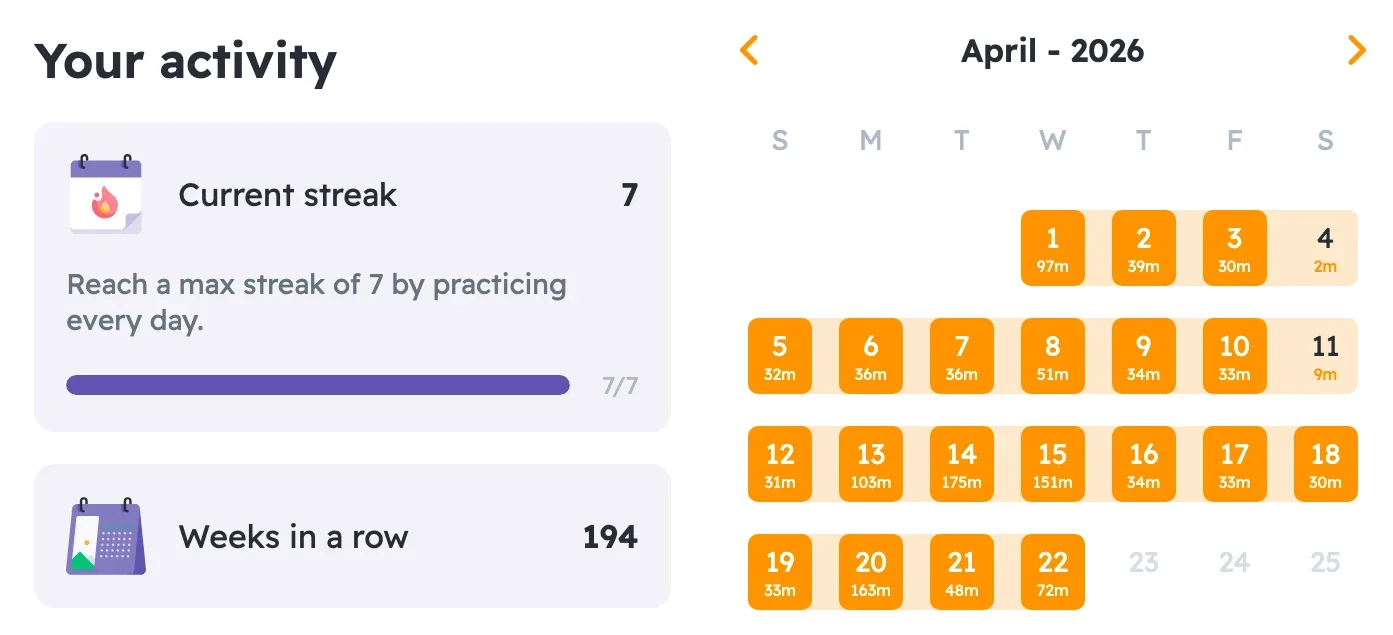
For example, in Finnish this particular Tuesday, I only read for 4 minutes to reach my streak. That's not a lot. Are those 4 minutes really worth it? Yes, for two reasons. First, psychologically — I feel I'm making some kind of progress, even if it's slow. Second, practically — keeping the habit alive means it's easy to read more whenever I have the time and desire to do so. If I took a break, I'd lose momentum and have to rebuild it. So instead of reading nothing, I'd rather have consistency that right now often looks something like this:

This particular day, I read 7 minutes in Cantonese and 3 minutes in Spanish — on the low end of what I usually do, but still in the ballpark. Other seasons I've read 20 minutes daily. I've even had stints when I read an hour or more. When I worked night shifts for a few months several years ago, I'd read 1-2 hours of Cantonese and 1-2 hours of Finnish every shift.
For now though, I'm happy with this slow-brewing approach. I'm already comfortable reading in all three, so it's more about expanding vocabulary and picking up new expressions than building the fundamental skill of reading.
I don't have dedicated reading time. I just fit it in throughout the day — mostly, if I'm honest, during bathroom breaks.
Listening while doing chores
Listening is the language skill that gets the most time during my day. For two reasons. One, it's the most important language skill — it's the foundation for understanding conversations and native media. Two, it's the easiest to do while doing other things (dishes, cleaning, getting ready, driving, etc.).
For Spanish, I have a daily listening goal of 30 minutes. Something I've kept going for 4 years now. It's just part of my day and I barely think about it anymore. Currently I'm listening to the Advanced Uncovered Spanish Courses (the same chapters I read in LingQ). I fit it in whenever I can. Getting ready in the morning — dressing, brushing my teeth, shaving — is usually about 15 minutes, so I'm already halfway to my goal right there. I have the stories downloaded to my LingQ app, which tracks listening time automatically, so it's easy to know when I've hit my goal. When I hit at least 30 minutes — check. Done. I log it in Dreaming Spanish and move on. Unless I want to listen more, of course.
This morning I listened to Cantonese podcasts instead, since I knew I'd have a Spanish immersion block in the evening.
For Cantonese I also have a 30-minute minimum, but I try to stretch it to 60 minutes or more whenever I can. It's a language that requires a lot of time to develop listening comprehension. It also happens to be my favorite language to listen to — so when I’m able to get into it, the time racks up without me even trying. I listen to a lot of podcasts on YouTube (which conveniently tracks listening time), and I also work with a Disney TV show in a specific way to mine the vocabulary and improve my listening. Some evenings, I might even put a lighthearted Cantonese TV show on during a kettlebell workout.
Most of the podcast listening happens while cleaning up in the evening after the kids are in bed (we have two wild small boys, so there's plenty of cleaning up — great for language learning!), or when I'm unloading the dishwasher, cooking, that kind of thing. Provided I'm alone in the kitchen, of course.
For Finnish, I don't have a steady listening routine or goal. I'd like to listen more, but there's always a trade-off when juggling several languages. Besides, I live in Finland. I’ve got Finnish family, Finnish friends, and my wife speaks Finnish with our kids — so I'm constantly surrounded by the language. Back when I was at a lower level, most of this immersion went over my head. Now, at an advanced level, I'm absorbing it constantly just by living my life.
The stroller-and-flashcards trick
Remember that Cantonese TV show I mentioned? When I sit down at my computer to work through new episodes, I create flashcards from lines of dialogue that contain new vocab. Then I review them daily — both because reviews pile up fast if I skip days, and because daily review is more effective for learning than doing it sporadically.
Lately, to get our youngest son to sleep, I've been rocking him in the stroller. Sometimes he needs my attention for a bit, but eventually the best thing is for me to just be quiet so he can fall asleep. Since I can rock the stroller with one hand, I use this moment to review my Anki flashcards. Headphones in, 5-10 minutes of going through my deck. It counts as listening practice too, since the cards have the original audio from the scenes — giving me targeted review of trickier sentences while cementing new vocab. Plus, it’s part of my 30-minute daily Cantonese listen goal.
A few minutes I'd otherwise spend doing nothing become a few minutes of Cantonese — attached to something I do every day, so it happens without me having to set aside extra time for it.
Evening TV inputs
Once the daily cleanup is done, evenings are usually for relaxing. Most of the time I'll just hang out with my wife. If we watch a TV show, it's usually in English — though sometimes we'll put on Friends in Spanish, which is great Spanish listening input.
This evening was different. She had things to do, and I had something I'd been looking forward to all day: there's a Korean StarCraft tournament on right now (a hugely popular e-sport in South Korea) that only runs twice a year. For the past few years I've watched it with Spanish commentary — a great way to pick up colloquial phrases while watching something I truly love. I'd love to watch it in Korean eventually, but my level is still too basic (part of why I'm learning it). Sports are good for this kind of input: it's easy to rack up hours of listening without making a conscious effort (other than the initial decision to watch it in Spanish instead of English).
I made a cup of Yorkshire tea, grabbed some Finnish vichy water, and sat down on the couch to watch. Relaxing, enjoyable, and I knocked out my 30-minute Spanish listening goal without thinking about it. Some nights this easily turns into 2 hours. This Tuesday was only about 45 minutes — my wife finished her things, and I wanted to hang out with her, so I cut my StarCraft session a bit shorter than usual.
Speaking practice, and the tired-brain reality
Right now, I'm doing speaking practice with different apps. For Spanish I use Langua and Speak (see my comparison of these two and why I use both daily). Speak is for drill-based practice and cleaning up my grammar. Langua is for natural conversation and learning colloquial expressions.
I typically get my Speak session in sometime before lunch. This Tuesday, I actually did it while working on this very blog post that you’re reading. Not while actually writing — that requires my full brain capacity so I can't multitask while doing it. But while doing the lighter work: uploading pictures, organizing subheadings, adding links. I had the phone leaning against a big book next to me, listening and repeating the prompts as I went.
My phone was a bit far away, so sometimes Speak needed me to repeat a word two or three times before it registered. Headphones would solve this, but I was lazy and just did it without — it works great most of the time anyway. Yes, this would be more effective to do with full focus, but 50% effectiveness and actually getting it done wins over perfect focus and not doing it. The Speak Smart Reviews (I go into detail on these in my Speak review) are especially good for this, since I'm then reviewing vocab I've already learned rather than learning brand new material.
I've recently started adding daily Cantonese speaking sessions. And to be honest, most of the time they happen in the evenings, which isn't ideal — because my brain is pretty fried by then. Today was an exception. Around 10:30 I wandered to the kitchen to make another cup of coffee, and since no one else was home, I turned it into a 15-minute Cantonese debate about homeschooling vs. traditional schooling using Talkpal (one of the AI speaking apps I reviewed here). Practicing speaking while the coffee was brewing was a perfect, natural gap. However, this was best case scenario — most days aren't like that.
I've also been doing daily Japanese with Speak. It's not a language I'm seriously focused on, but Japanese is new enough that I can't multitask while doing them — it needs my full focus. I just fit in a short 10-15 minute session during a work break. On this day, I did it in the afternoon.
My Japanese began as a fun 30-day experiment and ended up going for 90 days — here's the full journey.
Langua I use daily in Spanish too. This particular day it happened at the end of the day, which isn't ideal — but done is better than perfect (I'm working on moving it earlier, when my brain is sharper). Langua is where I practice actual conversation, the closest thing to talking with a real person. I have an ongoing scenario that's been running for weeks now — a very engaging adventure set in South Korea (I wrote about it in this part of my Langua vs. Speak post) — so I just picked up where we left off and did some back-and-forths with the AI character. It's a great way to put the structures I've been drilling in Speak into real conversation, pick up colloquial vocab, and get feedback as I go.
Why weekends are actually the hardest
For me, weekdays are actually easier for language learning than weekends, as counterintuitive as that sounds.
That’s because weekdays actually have more natural gaps — work breaks, chores, transitions between tasks, time getting ready. It’s a more predictable schedule. Weekends are more unstructured: family outings, playtime with the kids, and longer stretches of being present with people. Which means I’m not going to sit down with my laptop for a focused 45-minute session (unless I wake up early and no one else is up — then I might sneak one in. But it’s the exception, not the norm).
On weekends, I just do some minimal learning to keep the habit going. I read to keep my LingQ streaks alive because I'm a sucker for streaks. Probably more than I should be. But it keeps me consistent and motivated, and that's what matters. I also do some Korean in Rocket Languages (even if it’s just 5 minutes), a 2-3-minute Speak session, and so on.
There’s usually dishes and cleaning in the evening, as well as getting ready, so I often get some listening in during those. I just do what I can to get some touch points in the different languages, without stressing about it.
How this adds up over time
Since I committed to daily language learning in late 2017, I haven't missed a day — except our honeymoon, and even that was in Hong Kong, so I used Cantonese every day anyway.
I’m not finding the time to learn, but threading it into the gaps throughout the day. Making it part of my life, more than anything.
Right now Korean gets priority first thing in the morning, while Cantonese and Spanish get a good amount of attention throughout the day. Finnish runs in the background, and Japanese is a short-term experiment. I'm not going full-blast on all of them — that's neither advisable or even possible.
The routine isn’t perfect, but imperfect practice beats skipped practice. And small daily touches compound over time, as you can see with my Cantonese learning time over the past year:

A year of Cantonese learning, tracked with Refold’s Tracker App
What makes me really happy is that I love learning languages now as much as when I started with Cantonese in 2017. That passion has never gone away. I'm a learner first, blogger second. My current Japanese experiment comes from genuine curiosity about the language and culture. The fact that I'll write about it is just a bonus. This blog grew out of my learning, not the other way around — I started it because I wanted more concrete detail about what learning a language actually looks like day-to-day. So I started writing the kinds of posts I'd been looking for myself.
Most people aren't trying to learn multiple languages at once, and you probably shouldn't (unless you're on the nutty side like me). And for the record, I didn't start here. I began with Cantonese and added a language every couple of years. I’ve never learned more than one language from scratch at a time.
But the underlying routine — the daily touch, imperfect but consistent, weaved into real life — works just as well for one language as it does for five. Actually, it works even better because you can focus all your attention on one.
